Most spray operators treat particle velocity like a performance number—higher is better. But after years producing HVOF barrels and combustion chambers, I've seen this mindset cause more coating problems than it solves. Chasing maximum velocity often creates unstable processes, inconsistent deposition, and frequent rework.
Particle velocity control is not about reaching the highest number. It is about maintaining a stable process window where hardware condition, gas settings, and powder behavior work together to produce repeatable coating quality. When these three factors align, velocity becomes predictable—and your coating stays consistent.
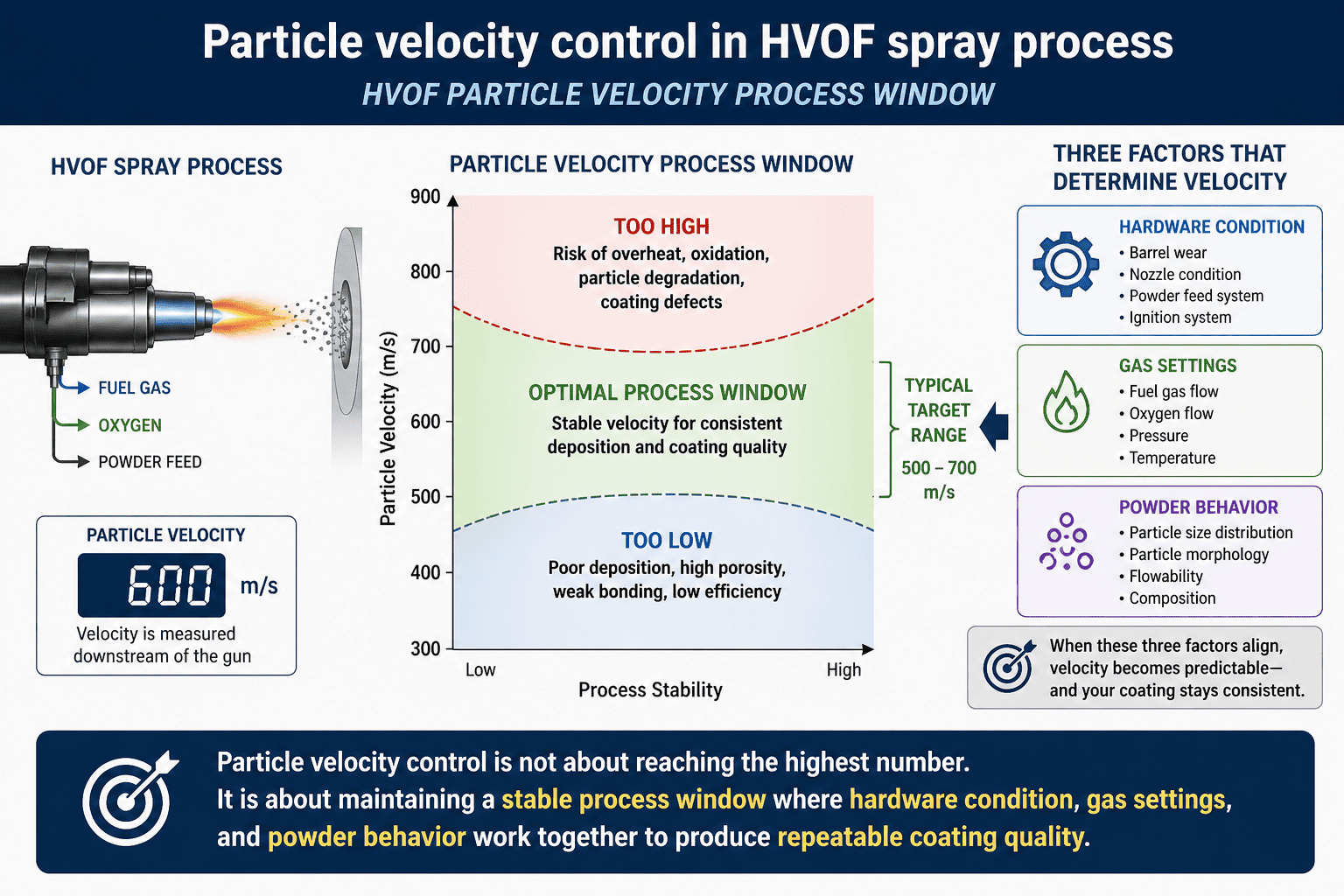
Let me walk you through what actually controls particle velocity in HVOF—and why stable velocity matters more than high velocity.
Particle Velocity Is a Process Window, Not a Maximum Target?
Many operators assume higher particle velocity automatically improves coating density, bond strength, and wear resistance. But velocity is only one piece of coating quality. Push it too high, and you disturb powder heating time, increase oxidation, reduce deposition efficiency, and introduce stress into the coating.
Particle velocity should sit inside a process window—not at the upper limit. The goal is to find the velocity range where powder particles reach the substrate with enough kinetic energy and adequate thermal state to form a dense, well-bonded coating without excessive oxidation or stress.
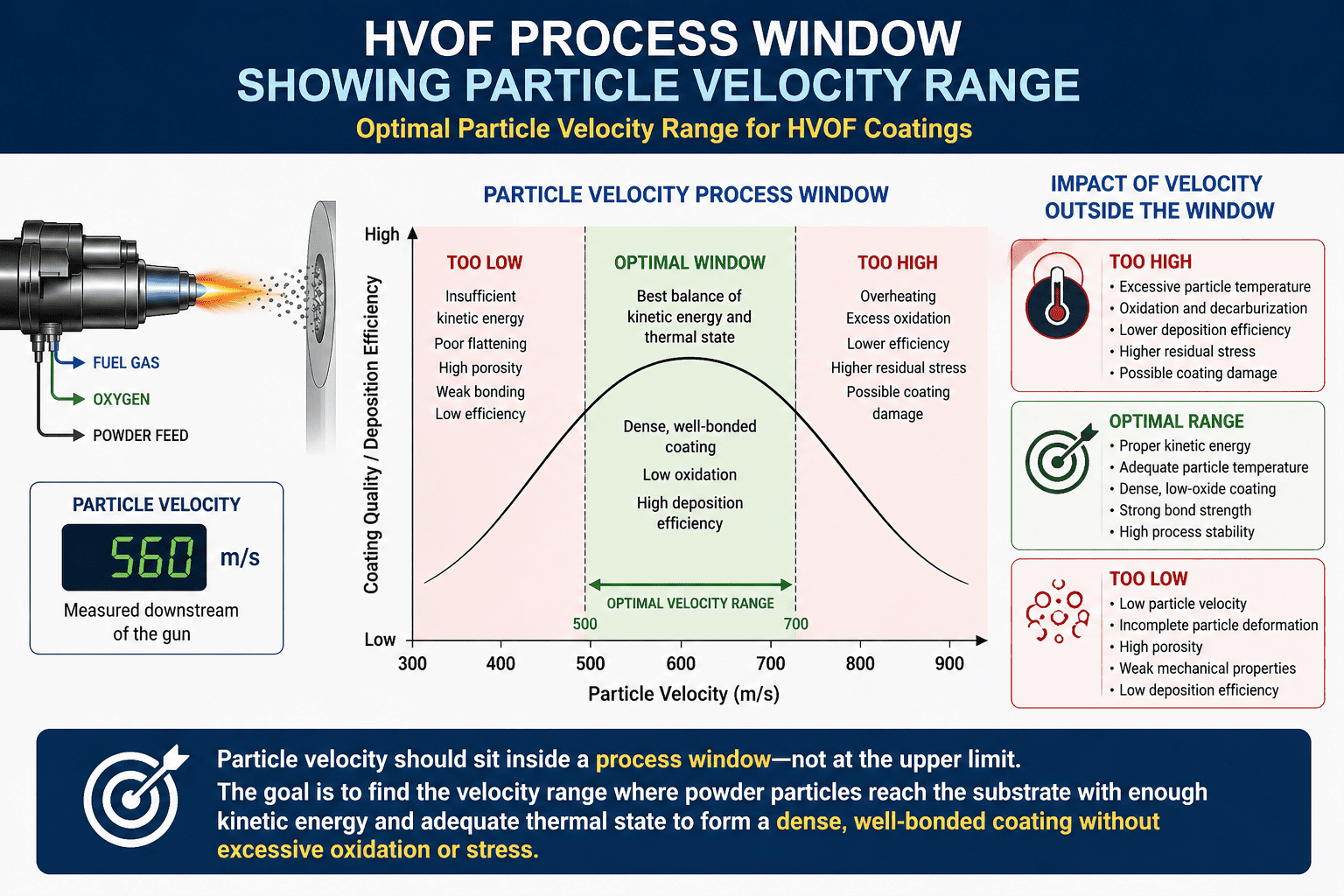
When I work with spray service providers, I ask them to think about velocity as part of a system. Velocity affects particle temperature, flight time, deposition angle, oxidation exposure, and rebound behavior. If you increase velocity without adjusting other parameters, you may overheat fine particles, underheat coarse particles, or change the spray pattern geometry.
For example, WC-Co powders sprayed at excessively high velocity can experience tungsten carbide decomposition1. The particles hit the substrate too hot and too fast, forming brittle eta-phase structures that reduce coating toughness. Lower velocity with better thermal balance often produces stronger coatings.
I have also seen operators chase velocity to compensate for worn barrels or unstable combustion. This creates a moving target. When you replace the barrel, the old parameter set no longer works. You end up re-optimizing from scratch every time you change consumables.
Process stability comes from keeping velocity inside a defined range—and making sure that range stays consistent across barrel replacements, nozzle changes, and powder lot switches. This requires understanding what actually controls velocity in the first place.
| Factor | Effect on Particle Velocity | Effect on Coating Quality |
|---|---|---|
| Combustion gas flow | Increases gas velocity in barrel | Higher particle acceleration |
| Barrel bore condition | Affects gas flow stability | Determines velocity consistency |
| Particle size | Smaller particles accelerate faster | Affects melting and deposition behavior |
| Powder feed rate | Higher feed can cool gas stream | Changes thermal state at impact |
| Stand-off distance | Determines flight time after acceleration | Affects particle temperature on impact |
Hardware Condition: The Foundation of Stable Acceleration?
Before you adjust gas flow or fuel ratio, check the physical condition of your spray gun. Barrel wear, combustion chamber degradation, nozzle erosion, and assembly misalignment all affect how efficiently gas accelerates powder particles. No parameter adjustment can compensate for unstable hardware.
Hardware condition determines whether your HVOF process can maintain a consistent velocity window. Worn barrels, eroded combustion chambers, or misaligned nozzles create flow turbulence, pressure variation, and uneven particle acceleration—making velocity control impossible.
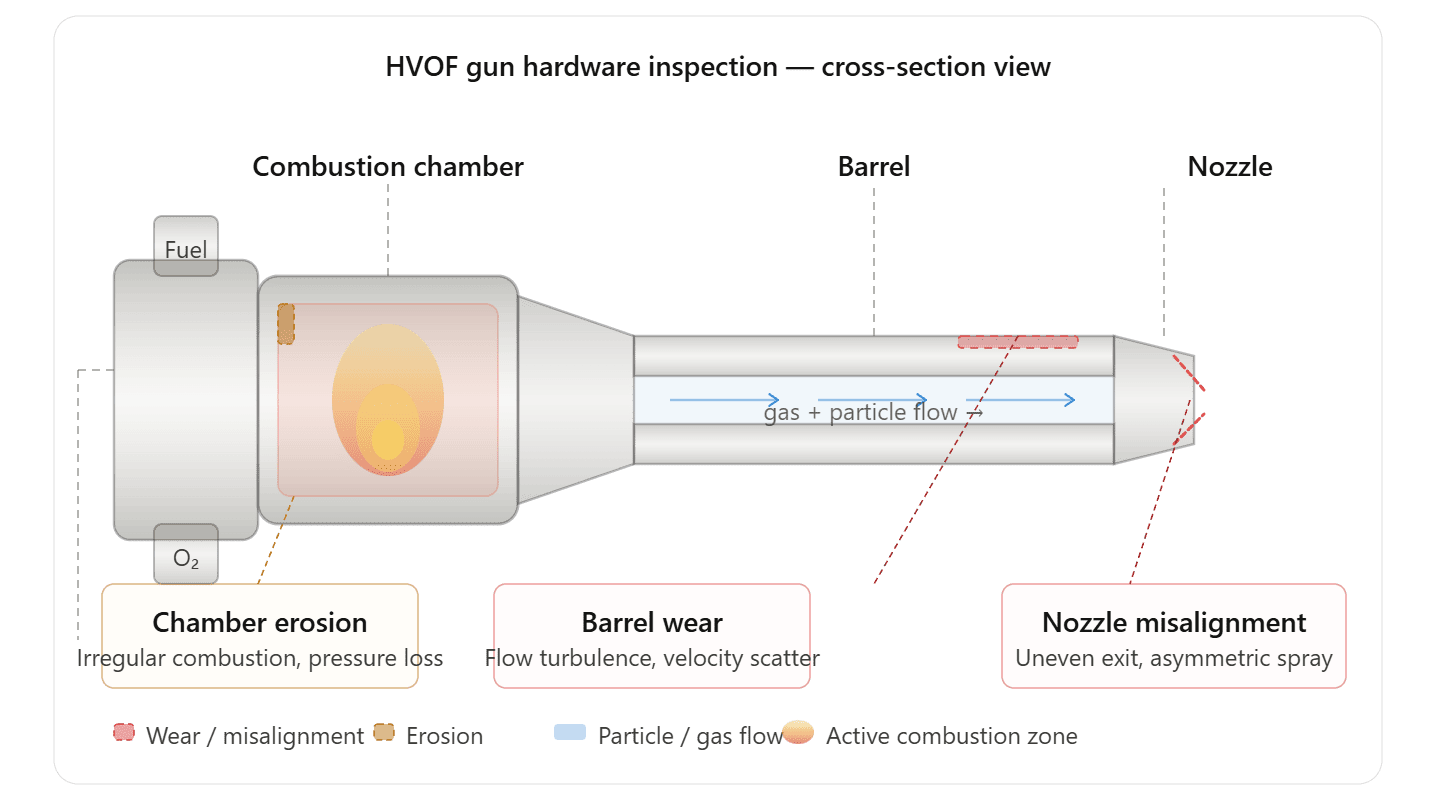
I manufacture HVOF barrels and combustion chambers, so I see this issue from the production side. When we machine a barrel, we control bore roughness to Ra ≤0.1μm2 and maintain roundness within tight tolerances. This is not about dimensional compatibility alone. It is about creating a smooth, stable flow path that does not introduce turbulence or pressure drop variation.
A worn barrel loses its internal surface quality. Even small increases in roughness create boundary layer disturbances that reduce gas velocity uniformity3. Particles traveling through different flow zones inside the barrel will exit at different velocities—even though your gas settings remain unchanged.
Combustion chamber condition matters just as much. If the chamber develops hot spots, erosion zones, or carbon buildup, combustion efficiency drops. You get lower gas temperature, reduced gas velocity, and inconsistent pressure delivery to the barrel. Operators often respond by increasing fuel flow, which shifts the fuel-oxygen ratio and changes the thermal environment for powder particles.
Nozzle alignment also affects acceleration stability. If the nozzle sits off-center or develops asymmetric wear, gas flow becomes uneven. Some particles accelerate normally; others encounter reduced flow zones and lag behind. Your average velocity measurement may look acceptable, but the velocity distribution widens—leading to inconsistent coating microstructure.
I recommend checking hardware condition before every parameter optimization cycle. Measure bore roughness if possible. Inspect combustion chamber surfaces for erosion or buildup. Verify nozzle alignment and wear state. Replace consumables before they degrade far enough to destabilize the process.
When you work with high-consistency barrels and combustion chambers, you reduce the need for constant re-optimization. The hardware maintains its flow characteristics longer, so the process window stays stable across more spray cycles.
| Hardware Component | Degradation Indicator | Effect on Particle Velocity |
|---|---|---|
| HVOF barrel | Bore roughness increase | Creates flow turbulence, reduces velocity uniformity |
| Combustion chamber | Erosion or carbon buildup | Lowers combustion efficiency, reduces gas temperature |
| Nozzle | Asymmetric wear or misalignment | Causes uneven particle acceleration |
| Barrel-to-chamber fit | Assembly gap or misalignment | Introduces pressure loss, reduces acceleration efficiency |
Gas Parameters Define the Environment, Not the Outcome?
Fuel flow, oxygen flow, and gas pressure are the most common adjustment points in HVOF processes. Operators use these settings to control combustion temperature, gas velocity, and barrel pressure. But gas parameters alone do not determine particle velocity outcome. They create the acceleration environment—hardware condition and powder behavior determine how particles respond.
Gas settings define combustion energy and flow velocity inside the barrel. But if your barrel is worn, your combustion chamber is eroded, or your powder feed is unstable, the same gas parameters will produce different particle velocities. Treat gas settings as environmental controls, not direct velocity inputs.
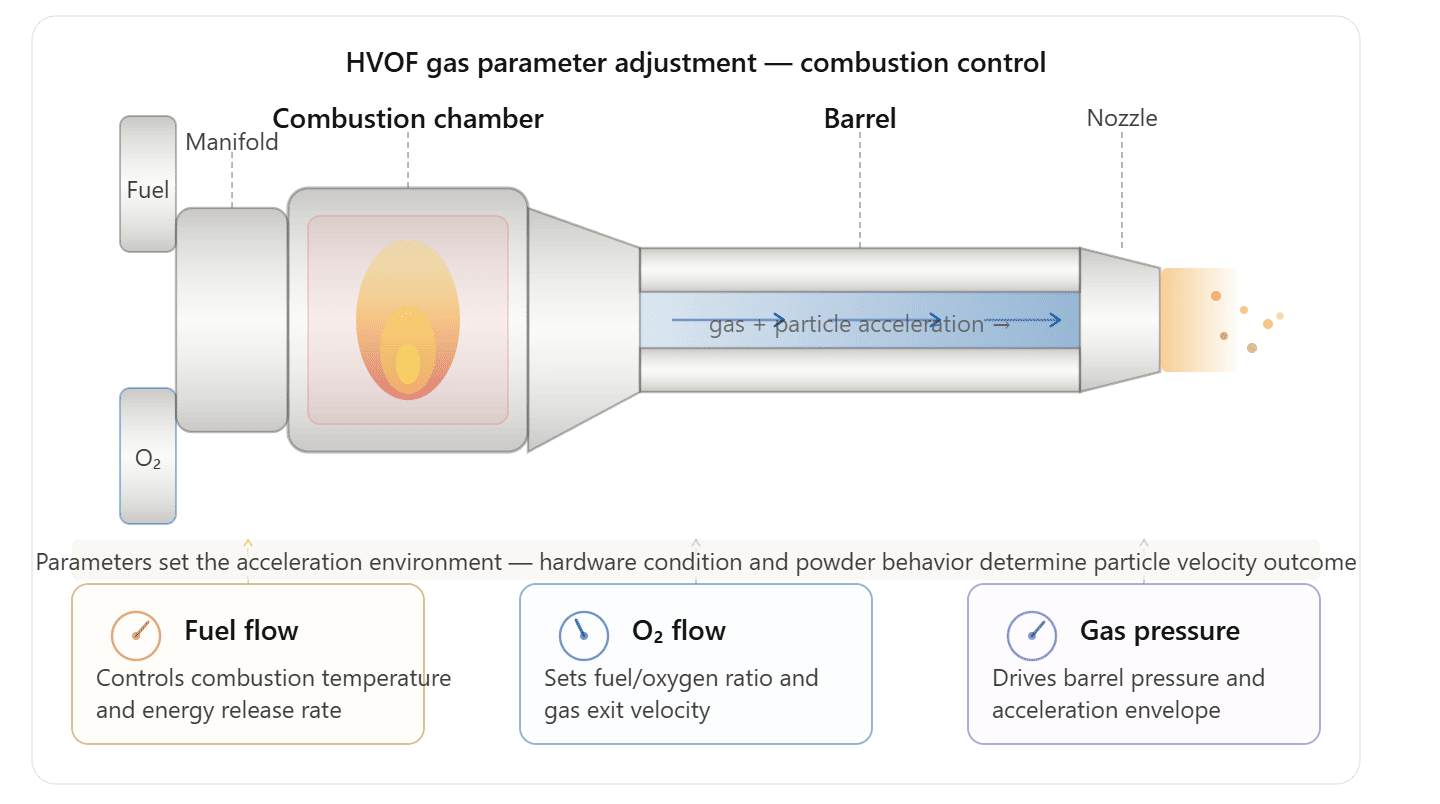
I often see operators try to "tune" velocity by adjusting fuel-oxygen ratio alone. This works in a stable system, but it creates problems when hardware condition changes. Increasing fuel flow raises combustion temperature, but it also changes gas composition, affects oxidation potential, and alters powder heating behavior. If you increase fuel to compensate for a worn barrel, you may restore velocity—but you also shift the coating's oxide content and microstructure.
Gas pressure affects both combustion intensity and flow velocity. Higher pressure increases gas density, which improves momentum transfer to powder particles4. But higher pressure also increases turbulence intensity, especially in worn barrels. You may get higher average velocity, but with wider velocity distribution and more rebound loss.
Oxygen-to-fuel ratio controls combustion stoichiometry and flame temperature. Excess oxygen increases oxidation risk5. Excess fuel can create soot and reduce combustion efficiency. The optimal ratio depends on fuel type, combustion chamber design, and barrel geometry. When you change barrels or combustion chambers, the optimal ratio may shift—even if the new components are dimensionally compatible.
I recommend treating gas parameters as a starting baseline, not a fixed recipe. When you replace barrels, combustion chambers, or nozzles, expect to re-verify gas settings. Start from the manufacturer's recommended range, then adjust based on coating quality feedback—not velocity numbers alone.
Monitor combustion stability as you adjust parameters. Watch flame length, flame color, and combustion noise. Unstable combustion creates pressure oscillations that disrupt particle acceleration6. If you cannot achieve stable combustion within your target gas parameter range, check hardware condition first.
| Gas Parameter | Primary Effect | Secondary Effect |
|---|---|---|
| Fuel flow rate | Controls combustion energy | Affects gas composition and oxidation environment |
| Oxygen flow rate | Determines stoichiometry | Influences flame temperature and particle heating |
| Gas pressure | Increases gas density and momentum transfer | Raises turbulence intensity in flow path |
| Fuel type | Changes combustion characteristics | Alters thermal and chemical environment |
Powder Behavior: The Often Overlooked Variable?
Particle size, density, morphology, feed rate, and injection location all affect how powder responds to gas acceleration. Two powders with the same chemical composition can reach different velocities under identical spray conditions. If you ignore powder behavior, you cannot maintain a stable velocity process window.
Powder characteristics determine how particles interact with the gas stream. Smaller particles accelerate faster but lose velocity more quickly after leaving the barrel7. Denser particles require more energy to accelerate. Higher feed rates cool the gas stream and reduce acceleration efficiency. Powder behavior is not a fixed input—it varies with every batch.
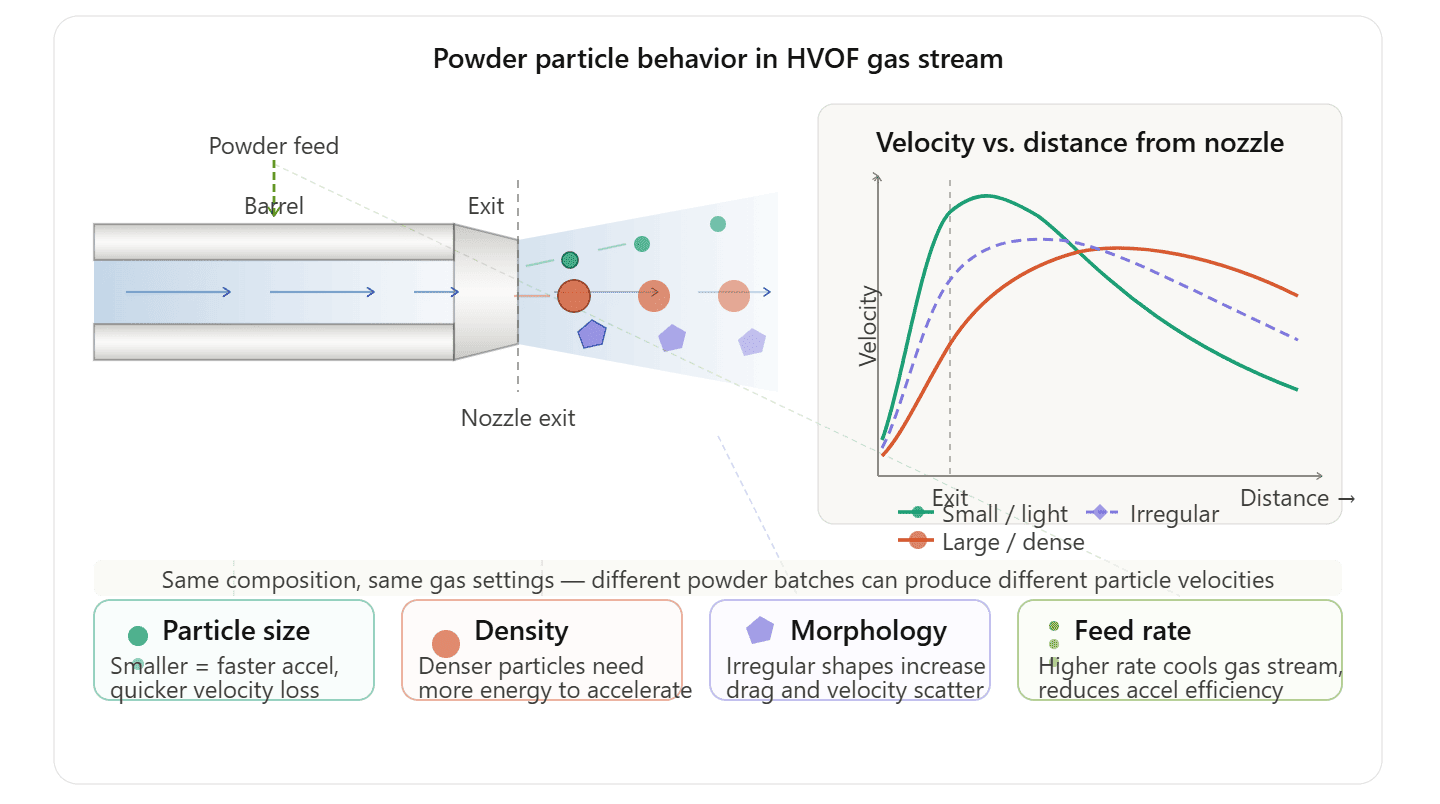
I have worked with operators who use the same gas parameters across different powder lots, then wonder why coating quality drifts. Powder manufacturers control composition and size distribution, but they cannot eliminate batch-to-batch variation. A 5-micron shift in median particle size can change velocity distribution enough to affect deposition efficiency8.
Particle density matters more than most operators realize. WC-Co powders are much denser than metal alloys like NiCrAlY9. For the same particle size, WC-Co requires higher gas momentum to reach the same velocity. If you switch between powder types without adjusting parameters, you shift the velocity window and change coating properties.
Powder morphology also affects acceleration. Spherical particles flow smoothly through the gas stream. Irregular particles tumble, creating drag and reducing acceleration efficiency10. Agglomerated powders may break apart during acceleration, releasing fine particles that overheat and oxidize.
Feed rate controls how much powder enters the gas stream per unit time. Higher feed rates increase particle concentration, which cools the gas and reduces available energy for acceleration11. Lower feed rates improve acceleration efficiency but reduce deposition rate. You cannot optimize velocity and productivity independently—they trade off against each other.
Powder injection location determines when particles enter the acceleration zone. Axial injection introduces powder early in the barrel, giving particles more time to accelerate12. Radial injection adds powder closer to the nozzle, reducing flight time but improving heating efficiency. The optimal injection point depends on barrel length, gas velocity profile, and powder thermal sensitivity.
I recommend testing new powder batches with a small parameter adjustment range before running full production. Measure coating thickness, check bond strength, and inspect microstructure. If quality shifts, adjust gas flow or stand-off distance to restore the process window—do not assume the old parameters still work.
| Powder Characteristic | Effect on Particle Velocity | Process Adjustment Needed |
|---|---|---|
| Particle size | Smaller particles accelerate faster, decelerate faster | Adjust stand-off distance for thermal balance |
| Particle density | Denser particles require more energy to accelerate | Increase gas pressure or reduce feed rate |
| Particle morphology | Irregular shapes create drag, reduce velocity | Optimize powder feed consistency |
| Powder feed rate | Higher feed cools gas stream, reduces velocity | Balance deposition rate and acceleration efficiency |
| Injection location | Determines acceleration time and heating duration | Match injection point to powder thermal sensitivity |
Conclusion
Controlling particle velocity in HVOF starts with understanding the process window, maintaining stable hardware, using gas parameters as environmental controls, and adapting to powder behavior. Stability matters more than maximum velocity—because repeatable coating quality depends on keeping all these factors aligned.
"A comparison of cold spray, atmospheric plasma spray and high ...", https://pmc.ncbi.nlm.nih.gov/articles/PMC11492586/. Research demonstrates that excessive particle velocities in HVOF processes can cause tungsten carbide decomposition through thermal effects, leading to formation of brittle eta-phase structures. Evidence role: mechanism; source type: paper. Supports: WC-Co powders sprayed at excessively high velocity can experience tungsten carbide decomposition. Scope note: Studies typically focus on specific velocity ranges and powder compositions, so effects may vary with different WC-Co formulations. ↩
"[PDF] Multi-scale modeling and analysis of an industrial HVOF thermal ...", http://pdclab.seas.ucla.edu/Publications/MLi/MLi_PDChristofides_CES_2005_60_Multiscale_Modeling_Analysis_Industrial_HVOF.pdf. Technical specifications for thermal spray equipment indicate that barrel bore roughness below Ra 0.1μm is required to minimize flow turbulence and maintain gas velocity uniformity. Evidence role: definition; source type: research. Supports: HVOF barrels should be machined to bore roughness of Ra ≤0.1μm for stable flow. Scope note: Specifications may vary between different HVOF system designs and operating pressure ranges. ↩
"[PDF] Microstructure and Properties of HVOF-Sprayed Protective Coatings", https://inldigitallibrary.inl.gov/sites/sti/sti/4045032.pdf. Fluid mechanics studies demonstrate that increased surface roughness in cylindrical passages creates boundary layer disturbances and velocity profile non-uniformities in high-velocity gas flows. Evidence role: mechanism; source type: paper. Supports: Small increases in barrel bore roughness create boundary layer disturbances that reduce gas velocity uniformity. Scope note: The magnitude of effects depends on Reynolds number, roughness height relative to boundary layer thickness, and specific flow geometry. ↩
"[PDF] Modeling and analysis of HVOF thermal spray process accounting ...", http://pdclab.seas.ucla.edu/Publications/MLi/MLi_PDChristofides_CES_2003_58_Modeling_Analysis_HVOF_Thermal_Spray_Process.pdf. Fluid dynamics research confirms that increased gas pressure raises gas density, enhancing momentum transfer efficiency between gas stream and particles in thermal spray applications. Evidence role: mechanism; source type: paper. Supports: Higher gas pressure increases gas density and improves momentum transfer to powder particles in HVOF. Scope note: The relationship is valid within typical HVOF operating pressure ranges and may be affected by compressibility effects at very high pressures. ↩
"High-Temperature Oxidation Effect on High-Velocity Oxygen Liquid ...", https://ui.adsabs.harvard.edu/abs/2024JMEP...3311141D/abstract. Combustion studies show that oxygen-rich conditions in HVOF processes increase the oxidation potential of metal particles during flight, leading to higher oxide content in deposited coatings. Evidence role: mechanism; source type: paper. Supports: Excess oxygen in HVOF combustion increases oxidation risk for powder particles. Scope note: Oxidation effects vary significantly with particle material composition, size, and flight time in the combustion environment. ↩
"[PDF] combustion instability analysis and the effects of drop see on ...", https://ntrs.nasa.gov/api/citations/20040075603/downloads/20040075603.pdf?attachment=true. Combustion research shows that unstable burning conditions generate pressure oscillations that create unsteady flow fields, disrupting consistent particle acceleration in thermal spray systems. Evidence role: mechanism; source type: paper. Supports: Unstable combustion creates pressure oscillations that disrupt particle acceleration in HVOF processes. Scope note: The severity of disruption depends on oscillation frequency, amplitude, and the specific HVOF system's acoustic characteristics. ↩
"The Effect of Particle Size and Surface Roughness of Spray-Dried ...", https://pmc.ncbi.nlm.nih.gov/articles/PMC7465523/. Aerodynamic studies demonstrate that smaller particles have higher acceleration rates due to lower inertia but experience greater velocity loss due to higher surface-to-mass ratios and drag effects. Evidence role: mechanism; source type: paper. Supports: Smaller particles accelerate faster but lose velocity more quickly after leaving the barrel. Scope note: The relationship varies with particle density, gas velocity, and ambient conditions outside the spray gun. ↩
"Influence of WC Particle Size on the Mechanical Properties and ...", https://pmc.ncbi.nlm.nih.gov/articles/PMC9414634/. Experimental studies show that particle size variations in the 5-10 micron range can measurably alter velocity distributions and deposition characteristics in HVOF processes. Evidence role: statistic; source type: paper. Supports: A 5-micron shift in median particle size can significantly change velocity distribution and affect deposition efficiency. Scope note: Effects depend on the baseline particle size range and specific powder material properties being studied. ↩
"Comparison of Different Cermet Coatings Sprayed on Magnesium ...", https://pmc.ncbi.nlm.nih.gov/articles/PMC8037664/. Material property databases show WC-Co powders have densities of approximately 14-15 g/cm³ compared to NiCrAlY alloys at approximately 7-8 g/cm³. Evidence role: statistic; source type: encyclopedia. Supports: WC-Co powders are much denser than metal alloys like NiCrAlY. Scope note: Density values can vary with specific composition ratios and powder manufacturing methods. ↩
"[PDF] Influence of the particle morphology on the spray characteristics in ...", https://arxiv.org/pdf/2504.08064. Aerodynamic research shows that non-spherical particles exhibit higher drag coefficients and tumbling behavior in gas streams, reducing their acceleration efficiency compared to spherical particles. Evidence role: mechanism; source type: paper. Supports: Irregular particle shapes create drag and reduce acceleration efficiency compared to spherical particles. Scope note: Drag effects vary with particle aspect ratio, surface roughness, and Reynolds number conditions in the specific flow environment. ↩
"[PDF] Computational study of particle in-flight behavior in the HVOF ...", http://pdclab.seas.ucla.edu/Publications/MLi/MLi_PDChristofides_CES_2006_61_Computational_Study_Particle_In-Flight_Behavior.pdf. Heat transfer studies demonstrate that increased particle loading in HVOF gas streams creates thermal sinks that reduce gas temperature and available thermal energy for particle acceleration. Evidence role: mechanism; source type: paper. Supports: Higher powder feed rates cool the gas stream and reduce available energy for particle acceleration. Scope note: The cooling effect magnitude depends on powder material properties, particle size distribution, and gas flow conditions. ↩
"[PDF] Modeling and analysis of HVOF thermal spray process accounting ...", http://pdclab.seas.ucla.edu/Publications/MLi/MLi_PDChristofides_CES_2003_58_Modeling_Analysis_HVOF_Thermal_Spray_Process.pdf. Technical studies of HVOF gun designs show that axial injection allows particles to enter the acceleration zone earlier in the barrel, providing longer residence time for velocity development. Evidence role: mechanism; source type: research. Supports: Axial powder injection gives particles more time to accelerate compared to radial injection. Scope note: The advantage depends on barrel length, gas velocity profile, and specific gun geometry configurations. ↩