Plasma Spray Gun vs HVOF Gun is a common question, but it can become expensive if you start with the gun instead of the coating task. A wrong choice can cause rework, unstable spraying, short consumable life, or poor compatibility. I usually solve this by first checking the material, application goal, and existing system.
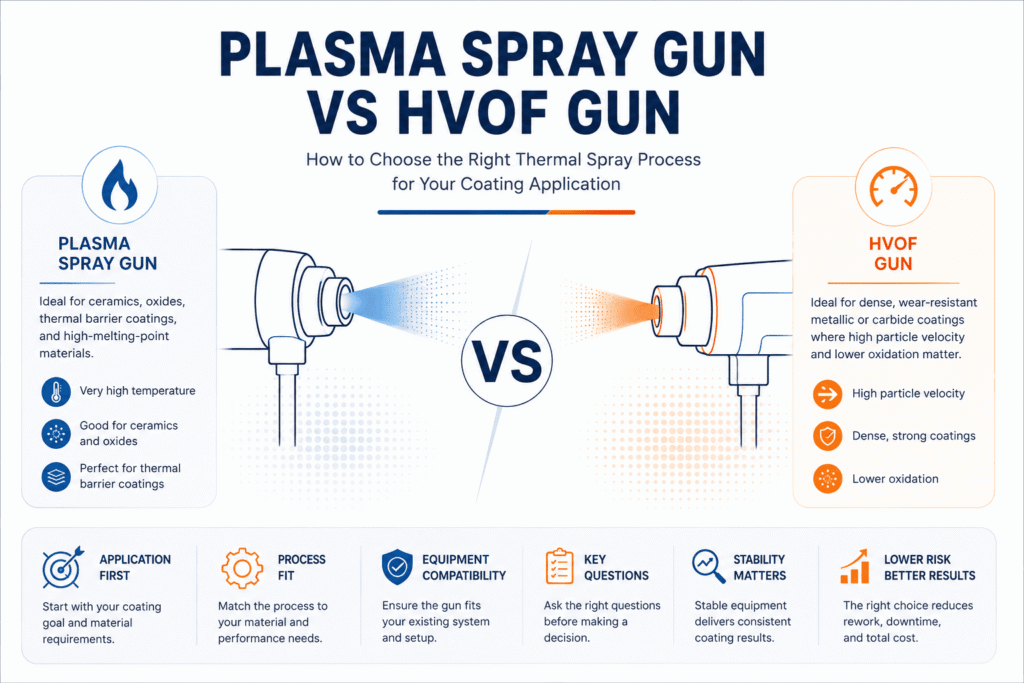
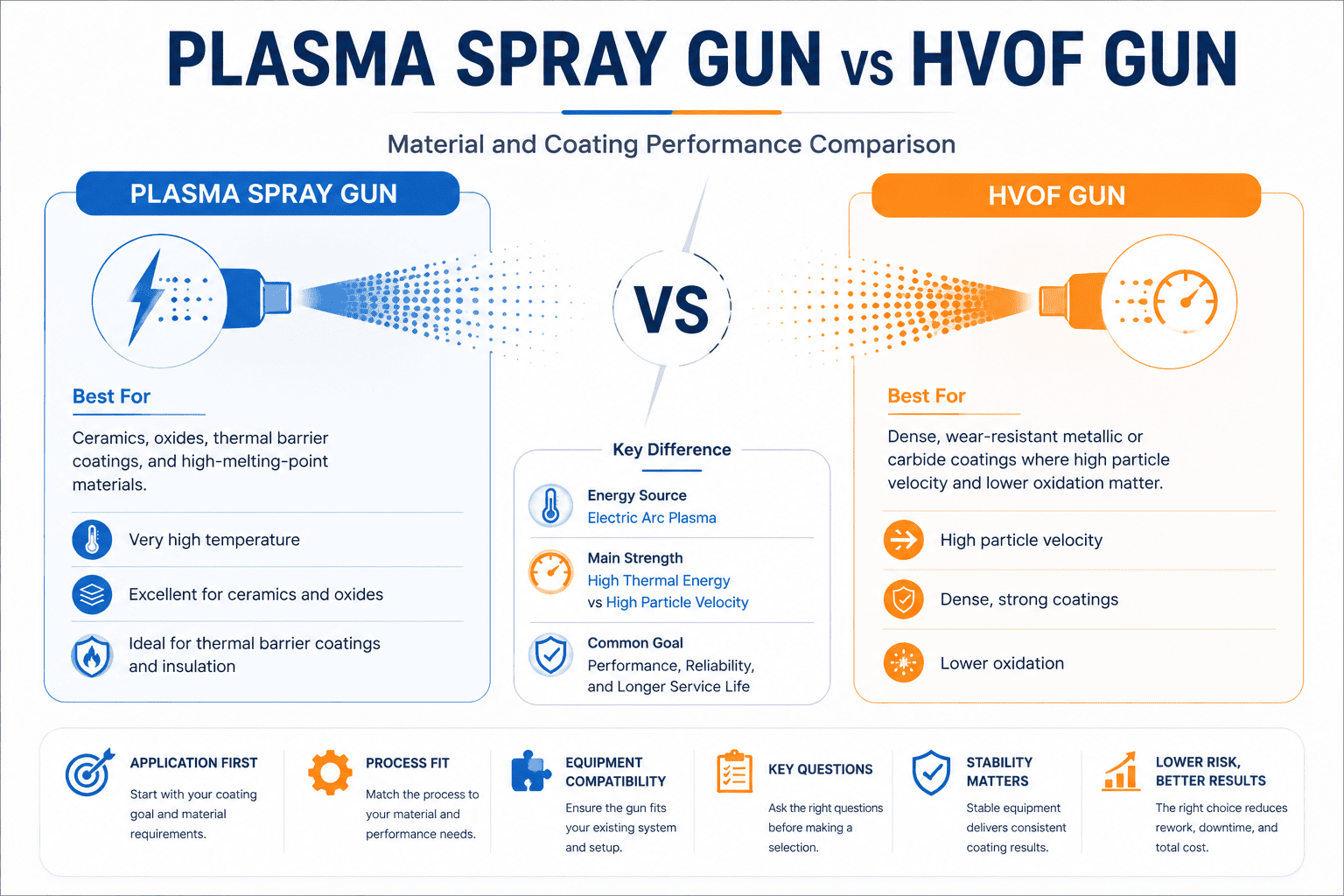
A plasma spray gun is usually the better fit for ceramics, oxides, thermal barrier coatings, and high-melting-point materials.1 An HVOF gun is usually better for dense, wear-resistant metallic or carbide coatings where high particle velocity and lower oxidation matter.2 The right choice depends on material, coating function, equipment compatibility, and process stability.
The simple answer helps, but it is not enough for a real workshop decision. In my experience supplying gun bodies, electrodes, nozzles, barrels, and combustion chambers, most problems appear after the purchase, when the gun does not match the process window or maintenance reality.
Start with Your Application, Not the Plasma Spray Gun vs HVOF Gun Debate?
Many buyers ask me, “Which gun is better?” That question sounds practical, but it often creates the wrong starting point. If the coating material, substrate, part geometry, and failure mode are unclear, the answer becomes guesswork. A spray gun is only useful when it matches the application.
The right first step is to define the coating job. You should confirm the material, coating purpose, part condition, existing equipment, gas supply, powder specification, and quality target before comparing a plasma spray gun vs HVOF gun. Process fit matters more than a general ranking.

Why the application decides the process
A thermal spray gun is not a universal repair tool. It is part of a process chain. The gun creates heat and velocity, but the coating result depends on many connected factors3:
- Coating material
- Particle size distribution
- Substrate preparation
- Carrier gas and fuel gas
- Spray distance
- Gun traverse speed
- Cooling method
- Consumable condition
- Operator control
- System stability
When I discuss selection with a workshop team, I first ask what the coating must do. This avoids the common mistake of comparing catalog specifications without understanding the failure risk.
Common coating goals and likely process direction
| Coating goal | Common material type | Process often considered | Reason |
|---|---|---|---|
| Thermal barrier | Ceramics, oxides | Plasma spray | High-temperature melting capability |
| Wear resistance | WC-Co, Cr₃C₂-NiCr | HVOF | Dense coating and high particle velocity |
| Corrosion resistance | Metal alloys, cermets | HVOF or plasma spray | Depends on material and environment |
| Dimensional repair | Metals, alloys | Plasma spray or HVOF | Depends on bond strength, heat input, and finish |
| Electrical insulation | Alumina and ceramics | Plasma spray | Ceramic melting is usually required |
| Surface strengthening | Carbides or alloys | HVOF | Lower oxidation and dense structure are often preferred |
This table is only a starting point. I do not treat it as a final rule because real parts are not always simple. A pump sleeve, turbine component, aircraft repair part, or heavy machinery shaft may have different coating thickness, masking, cooling, and finishing requirements.
Questions I ask before discussing a gun model
I usually ask buyers these basic questions before recommending any gun body or consumable:
-
What material will you spray?
Powder chemistry and melting behavior matter more than brand preference. -
What is the coating function?
Wear resistance, corrosion protection, thermal barrier, and dimensional repair are different tasks. -
What system do you already use?
A gun compatible with METCO, TAFA, SG-100, or another platform must match the actual system configuration. -
What problem are you trying to fix?
The problem may be coating porosity, unstable arc length, short electrode life, flame fluctuation, or part rejection. -
What consumables are currently used?
Cathodes, anodes, nozzles, barrels, and combustion chambers all influence stability.
In my own manufacturing work, I have seen that a small fit issue in a wear part can create a large process issue at the spray booth.
This is why I prefer an application-first discussion. Plasma Spray Gun vs HVOF Gun is not a beauty contest. It is a risk-control decision.
When Plasma Spray Gun vs HVOF Gun Makes More Sense—and When HVOF Is a Better Fit?
Choosing between processes becomes stressful when both seem technically possible. The risk grows when a buyer focuses only on temperature, velocity, or price. Plasma spray and HVOF solve different problems. Each process has strengths, limits, and maintenance requirements.
Plasma spray usually makes more sense for ceramics, oxides, and high-melting-point materials because the plasma jet provides very high thermal energy. HVOF is often a better fit for dense carbide and metallic wear coatings because it uses high particle velocity with relatively lower particle oxidation.
Where plasma spray is usually stronger
A plasma spray gun uses an electric arc to create a high-temperature plasma jet.4 The arc heats process gas to extremely high temperatures, and this helps melt materials that are difficult to process with combustion-based methods.
Plasma spray is often considered when the coating involves:
- Alumina
- Titania
- Zirconia
- Chromia
- Yttria-stabilized zirconia
- Other ceramic or oxide powders
- Certain high-melting-point materials
This is why atmospheric plasma spray, often called APS, remains important in aerospace, energy, and industrial repair.5 It is widely used for thermal barrier coatings, electrical insulation, wear protection with ceramics, and other functional coatings.
However, plasma spray is not automatically better. It can involve higher oxidation for some metallic materials. It can also require careful control of arc behavior, powder injection, cooling, and gun maintenance. If the cathode and anode condition is poor, the arc can become unstable. That instability can affect repeatability.
Where HVOF is usually stronger
An HVOF gun uses high-pressure combustion to accelerate particles at high velocity.6 HVOF stands for High Velocity Oxygen Fuel. The process is known for producing dense coatings, especially with carbide and metallic powders.7
HVOF is often considered when the coating involves:
- Tungsten carbide-cobalt
- Tungsten carbide-cobalt-chromium
- Chromium carbide-nickel chromium
- Nickel-based alloys
- Cobalt-based alloys
- Wear-resistant metallic coatings
The main advantage is not simply “hardness.” The bigger advantage is the combination of particle velocity, coating density, and controlled oxidation. This can be important for shafts, rolls, valves, hydraulic parts, and other components exposed to wear or corrosion.
But HVOF is also not a universal answer. It may not be the best process for many ceramics because the heat input is usually not enough to melt high-temperature ceramic powders in the same way plasma spray can.8 HVOF also depends heavily on fuel, oxygen, combustion chamber condition, barrel condition, and powder behavior.
Plasma spray vs HVOF in practical terms
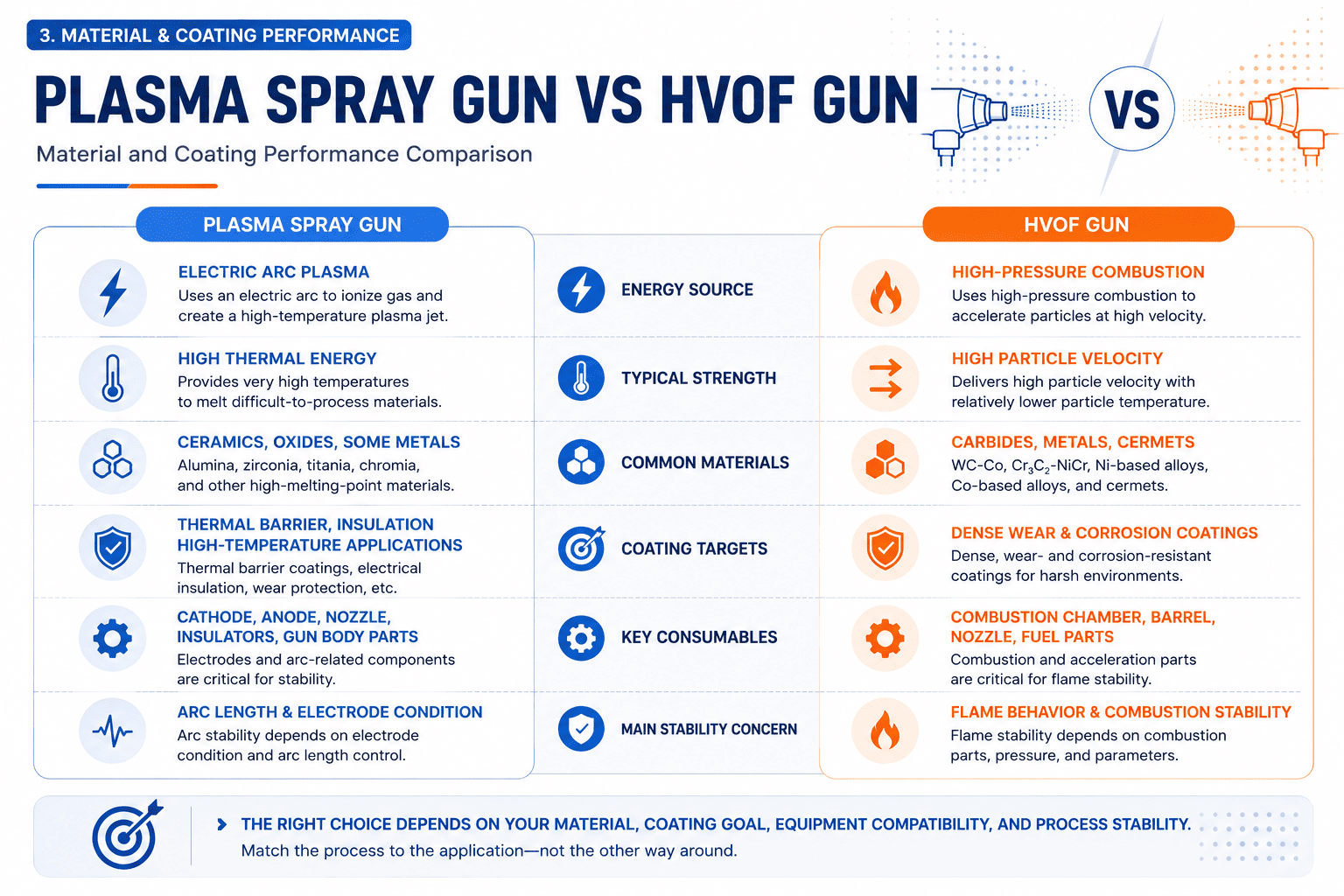
| Factor | Plasma spray gun | HVOF gun |
|---|---|---|
| Main energy source | Electric arc plasma | High-pressure combustion |
| Typical strength | High thermal energy | High particle velocity |
| Common materials | Ceramics, oxides, some metals | Carbides, metals, cermets |
| Common coating targets | Thermal barrier, insulation, high-temperature materials | Dense wear and corrosion-resistant coatings |
| Key consumables | Cathode, anode, nozzle, gun body parts | Combustion chamber, barrel, nozzle, fuel-related parts |
| Main stability concern | Arc length and electrode condition | Flame behavior and combustion stability |
| Selection risk | Poor material fit or unstable arc | Poor process fit or unstable flame |
When I compare a Plasma Spray Gun vs HVOF Gun with a buyer, I try to avoid one-word answers. The real answer depends on the coating requirement. If the material needs extreme heat, plasma may be the better route. If the part needs a dense carbide coating, HVOF may be the better route.
A practical way to think about it
I often use this simple logic:
- If the powder is ceramic or oxide, start by considering plasma spray.
- If the powder is carbide or metallic wear material, start by considering HVOF.
- If both are possible, compare coating function, system compatibility, and failure risk.
- If the existing system is fixed, check whether the process window is realistic before buying new gun parts.
This method avoids shallow decision-making. It also helps procurement teams avoid buying a gun that looks correct on paper but causes downtime in production.
Questions to Ask Before Choosing a Plasma Spray Gun vs HVOF Gun?
A wrong gun purchase is frustrating, but the bigger problem is usually process disruption. If the gun does not fit the powder, system, gas conditions, or maintenance capability, the workshop pays through rejected parts and downtime. Good questions reduce that risk.
Before choosing a plasma spray or HVOF gun, ask about material type, coating purpose, existing equipment, gas and powder conditions, part geometry, required coating quality, consumable life, and current failure symptoms. These answers show whether the gun is the real issue or only one part of a larger process problem.

Question 1: What material will you spray?
This is the most important question. A coating powder is not just a consumable. It defines the process direction.
You should confirm:
- Chemical composition
- Particle size range
- Powder morphology
- Melting point
- Recommended spray process
- Supplier process notes
- Storage condition
For example, alumina and zirconia usually push the discussion toward plasma spray. Tungsten carbide-cobalt or chromium carbide-nickel chromium often pushes the discussion toward HVOF. But I still avoid absolute statements because powder grade, desired coating thickness, and final finishing requirements can change the decision.
Question 2: What is the coating supposed to do?
The coating target should be written clearly. “Improve surface” is not enough. The coating may need to solve one specific problem.
Common goals include:
- Wear resistance
- Corrosion resistance
- Thermal barrier
- Electrical insulation
- Dimensional restoration
- Erosion resistance
- Surface hardness
- Fretting resistance
Each goal creates a different process priority. A thermal barrier coating needs high-temperature material capability. A dense carbide coating needs particle velocity and low oxidation. A dimensional repair coating may need predictable thickness build-up and machinability.
Question 3: What equipment do you already have?
This question matters a lot for buyers who want replacement guns or consumables. A gun body is not selected alone. It must match the existing system.
You should check:
| Existing item | Why it matters |
|---|---|
| Gun model | Determines compatibility with wear parts |
| Control console | Affects gas, current, and parameter limits |
| Powder feeder | Influences feed rate stability |
| Cooling system | Protects gun body and consumables |
| Gas supply | Affects arc or flame stability |
| Robot or manipulator | Controls spray path and repeatability |
| Existing parameters | Shows whether the process window is already proven |
In our own production, we manufacture ARCTHERM gun bodies and critical consumables for common thermal spray platforms, including models compatible with major systems such as METCO F1, F4, 9MB, 3MB, TAFA 5220, and SG-100. Compatibility is not just a drawing issue. It also involves fit, tolerances, internal surface quality, and stable operation.
Question 4: What is the current failure symptom?
A buyer may think they need a new gun, but sometimes they need better consumables, maintenance, or parameter review.
Common symptoms include:
- Unstable arc length
- Flame fluctuation
- Short cathode or anode life
- Nozzle erosion
- Barrel wear
- Combustion chamber damage
- Powder injection inconsistency
- Coating porosity changes
- Frequent gun shutdown
- Unexpected part rejection
When I hear these symptoms, I do not immediately blame the gun body. I check the wear parts first. In plasma spraying, cathode and anode condition can strongly influence arc stability.9 In HVOF, barrel and combustion chamber condition can influence flame shape and repeatability.
Question 5: What is the real cost of failure?
The lowest gun price is not always the lowest risk. A thermal spray shop may lose more money through downtime, rework, masking removal, substrate cleaning, inspection delay, and missed delivery.
A practical decision should include:
- Part value
- Coating rejection risk
- Setup time
- Operator time
- Consumable replacement frequency
- System compatibility risk
- Maintenance skill level
- Production schedule pressure
This is why the Plasma Spray Gun vs HVOF Gun decision should include both procurement and production teams. Procurement sees cost. The workshop sees stability. Maintenance sees failure patterns. A good choice should satisfy all three.
Why Equipment Stability Matters More Than Gun Selection Alone?
Many people expect the gun model to solve everything. I understand that expectation because a gun is visible and expensive. However, thermal spray performance depends on the whole process chain. If one critical component is unstable, the coating process becomes unstable too.
Equipment stability matters because coating repeatability depends on machining precision, consumable fit, arc or flame behavior, gas supply, powder feeding, cooling, parameters, and maintenance. A good gun helps, but it cannot compensate for worn electrodes, damaged barrels, poor alignment, or inconsistent operating conditions.

The gun body is only one part of the system
A thermal spray gun must hold geometry, cooling, gas flow, and electrical or combustion conditions within a stable window. If the gun body has poor machining accuracy or weak fit between parts, the process can drift.
In our manufacturing work, we focus heavily on precision machining because small dimensional changes can affect stability. For key components, tight control of form tolerance, internal bore quality, and fit is not a luxury. It is part of risk reduction.
Important manufacturing factors include:
- Dimensional accuracy
- Internal bore roughness
- Concentricity
- Thread quality
- Sealing surface finish
- Cooling channel consistency
- Material selection
- Electrode connection quality
For critical parts, our machining target can reach dimensional accuracy within 0.01 mm, and we pay close attention to internal bore roughness. In many gun and consumable applications, internal flow quality matters because it affects gas behavior, cooling, and repeatability.
Plasma spray stability depends heavily on electrodes
In plasma spray systems, the cathode and anode are not simple spare parts. They shape the electric arc. Their condition affects arc length, arc attachment, heat input, and process stability.
Key plasma spray consumables include:
- Cathode
- Anode
- Nozzle
- Insulators
- Gun body cooling parts
- Powder injection components
If the cathode-anode connection is poor or the electrode material is inconsistent, the arc can become unstable. This can create process drift. It can also shorten service life and increase maintenance frequency.
In our ARCTHERM consumables, we pay attention to tungsten-copper connection quality. For cathode and anode manufacturing, strong bonding and stable conductivity matter. We also work with non-thoriated tungsten material options where appropriate because they avoid radioactivity concerns10 and can support reliable electron emission in suitable designs.
I do not claim that one electrode design will automatically improve every coating. That would be too broad. But I can say from the component side that poor electrode quality often creates problems that operators feel immediately.
HVOF stability depends heavily on combustion parts
In HVOF systems, the flame must remain stable. The combustion chamber, barrel, nozzle, fuel supply, oxygen supply, and cooling condition all matter.
Key HVOF consumables include:
- Combustion chamber
- Barrel
- Nozzle
- Fuel injector parts
- Seals
- Cooling-related components
A worn barrel can change particle acceleration.11 A damaged combustion chamber can disturb flame stability. Poor fit can cause leakage, overheating, or inconsistent spraying. These issues may not appear as a simple “gun failure.” They often appear as coating inconsistency, abnormal noise, temperature issues, or shorter wear-part life.
Stability checks should be routine
For gun bodies and critical consumables, I believe inspection should not stop at dimensions. Thermal spray equipment should also be checked for working behavior.
Useful checks include:
- Flame stability observation for HVOF guns
- Arc length and arc stability checks for plasma spray guns
- Cooling flow verification
- Fit check for replacement consumables
- Visual inspection for erosion
- Internal bore inspection
- Seal surface inspection
- Parameter comparison after part replacement
In our production and inspection process, we focus on flame behavior, plasma arc length, and stability for gun-related products where these checks apply. This helps reduce the risk that a part looks correct but behaves poorly in use.
Why this matters for procurement
Procurement teams often compare unit price. That is normal. However, thermal spray parts should also be compared by risk.
A more useful comparison looks like this:
| Purchase factor | Low-risk question |
|---|---|
| Gun body | Does it match the existing model and system? |
| Consumables | Are critical dimensions and fit controlled? |
| Electrodes | Is the connection stable and material suitable? |
| Barrel or chamber | Is internal geometry consistent? |
| Supplier support | Can the supplier discuss process symptoms? |
| Inspection | Are stability-related checks performed? |
| Replacement plan | Can wear parts be supplied consistently? |
The best decision is not only “Which gun should I buy?” It is “Which process and component set gives my shop the most stable path to the coating I need?”
That is the practical core of the Plasma Spray Gun vs HVOF Gun decision.
Frequently Asked Questions
Is HVOF better than plasma spray?
HVOF is not universally better than plasma spray. HVOF is often better for dense carbide and metallic wear coatings. Plasma spray is often better for ceramics, oxides, and high-melting-point materials. The better choice depends on coating material, application goal, equipment compatibility, and process stability.
Can I use the same powder in both plasma spray and HVOF?
Some materials may be available in grades for both processes, but you should not assume one powder works well in both. Particle size, morphology, chemistry, and melting behavior matter.12 You should check the powder supplier’s recommendations and verify whether your system can run the required process window.
What causes short consumable life in a plasma spray gun?
Short consumable life can come from unstable arc behavior, poor cooling, incorrect parameters, material quality issues, poor cathode-anode fit, contamination, or worn related parts. The gun body may not be the only cause. I usually inspect electrodes, nozzle condition, cooling, and operating parameters together.
What causes unstable flame in an HVOF gun?
Unstable HVOF flame can come from fuel or oxygen supply issues, worn barrels, damaged combustion chambers, blocked passages, poor seals, cooling problems, or incorrect parameters. Replacement consumables must match the gun design closely because small geometry changes can affect combustion behavior.
What information should I provide before asking for gun or consumable matching?
You should provide the current gun model, system brand, coating material, application goal, powder specification, gas conditions, current parameters if available, and the problem you are seeing. Photos of worn consumables also help. This information makes matching more accurate and reduces compatibility risk.
Conclusion
The Plasma Spray Gun vs HVOF Gun decision should start with the coating task, not with a simple ranking. Plasma spray usually fits ceramics, oxides, and high-temperature materials. HVOF usually fits dense carbide and metallic wear coatings. Still, the gun alone does not determine success. Consumable precision, system compatibility, arc or flame stability, powder, gas supply, and maintenance all matter. If you are choosing a gun or replacement parts, send me your material, application goal, current gun/system model, and current problem. I can help you review the practical matching direction.
"Thermal barrier coating", https://en.wikipedia.org/wiki/Thermal_barrier_coating. A review of thermal spray processes supports the use of plasma spraying for ceramic and oxide coatings, including thermal barrier systems, because the plasma jet can melt or soften high-melting-point feedstock materials. Evidence role: expert_consensus; source type: paper. Supports: Plasma spraying is widely used for ceramic and oxide coatings, including thermal barrier coatings, because plasma jets can provide the thermal energy needed to process high-melting-point feedstocks.. ↩
"High Velocity Oxygen Fuel Coating - an overview", https://www.sciencedirect.com/topics/materials-science/high-velocity-oxygen-fuel-coating. Thermal-spray review literature describes HVOF as a high-particle-velocity process that is commonly used to produce dense carbide and metallic coatings with relatively low oxide content. Evidence role: general_support; source type: paper. Supports: HVOF commonly produces dense carbide and metallic coatings with high particle velocities and limited oxidation compared with more thermally intensive processes.. ↩
"Warm spraying—a novel coating process based on high-velocity ...", https://pmc.ncbi.nlm.nih.gov/articles/PMC5099653/. Thermal-spray process studies show that coating microstructure and performance are governed by combined effects of feedstock characteristics, substrate preparation, particle state, spray distance, cooling, and operating parameters, not by gun selection alone. Evidence role: mechanism; source type: research. Supports: Coating properties in thermal spraying depend on interactions among feedstock, substrate preparation, particle temperature and velocity, spray distance, cooling, and operating parameters.. ↩
"Plasma Spray Process", https://fab.cba.mit.edu/classes/961.04/projects/RegXuProj/MasProjII.htm. Technical descriptions of plasma spraying define the process as using an electric arc to ionize a process gas and produce a high-temperature plasma jet that heats injected feedstock particles. Evidence role: definition; source type: education. Supports: The plasma spray process uses an electric arc to ionize gas and form a high-temperature plasma jet that heats feedstock particles.. ↩
"Atmospheric Plasma Spray", https://engineering.virginia.edu/labs-groups/wadley-intelligent-processing-materials-group/user-facilities/atmospheric-plasma-spray. Published reviews of atmospheric plasma spraying identify its use in aerospace and energy components, particularly for functional coatings such as thermal barriers and wear- or corrosion-resistant surfaces. Evidence role: general_support; source type: paper. Supports: Atmospheric plasma spray is used in aerospace and energy applications, especially for functional coatings such as thermal barriers and wear or corrosion protection.. Scope note: The source would support the stated application areas generally, not the author's specific business experience. ↩
"HVOF: Particle, Flame Diagnostics and Coating Characteristics", https://www.osti.gov/servlets/purl/5677492. Standard descriptions of high-velocity oxygen fuel spraying state that combustion gases expand through the gun and accelerate powder particles to high velocities before impact on the substrate. Evidence role: definition; source type: encyclopedia. Supports: HVOF is a combustion-based thermal spray process in which expanding gases accelerate feedstock particles to high velocity.. ↩
"An Influence of Oxygen Flow Rate and Spray Distance on the Porosity of ...", https://pmc.ncbi.nlm.nih.gov/articles/PMC9505576/. Peer-reviewed reviews of HVOF coatings report that the process commonly yields dense, low-porosity coatings, particularly for carbide-cermet and metallic feedstocks. Evidence role: expert_consensus; source type: paper. Supports: HVOF coatings, especially carbide and metallic coatings, are often characterized by high density and low porosity.. ↩
"A comparison of cold spray, atmospheric plasma spray and high ...", https://pmc.ncbi.nlm.nih.gov/articles/PMC11492586/. Comparative thermal-spray literature indicates that HVOF generally produces lower particle temperatures than plasma spraying, which can limit its suitability for fully melting many high-melting-point ceramic powders. Evidence role: mechanism; source type: paper. Supports: HVOF typically provides lower particle temperatures than plasma spraying, making it less suitable for fully melting many high-melting-point ceramic feedstocks.. Scope note: The statement is process-general; some specialized HVOF variants and ceramic formulations may still be usable under selected conditions. ↩
"A Perspective on Plasma Spray Technology", http://www.columbia.edu/cu/seas/earth/wtert/newwtert/Research/sofos/Plasma_%20spraying_Nov2014.pdf. Research on plasma spray torches links cathode and anode condition, including electrode erosion and arc attachment behavior, with arc stability and repeatability during spraying. Evidence role: mechanism; source type: paper. Supports: Electrode condition and erosion in plasma torches affect arc attachment, arc stability, and operating repeatability.. ↩
"[PDF] Safety Data Sheet Tungsten Electrode WTh10, WTh20, WTh30, WTh40 ...", https://www.nrc.gov/docs/ML1505/ML15051A154.pdf. Occupational-safety guidance notes that thoriated tungsten electrodes contain radioactive thorium; therefore, non-thoriated tungsten alternatives avoid the radiological concern associated with thorium-containing electrodes. Evidence role: general_support; source type: government. Supports: Thoriated tungsten contains radioactive thorium, and non-thoriated tungsten alternatives avoid that specific radiological concern.. Scope note: The safety source supports the radioactivity issue, not the coating performance of any specific electrode design. ↩
"Modeling and analysis of HVOF thermal spray process accounting ...", http://pdclab.seas.ucla.edu/Publications/MLi/MLi_PDChristofides_CES_2003_58_Modeling_Analysis_HVOF_Thermal_Spray_Process.pdf. HVOF process studies show that gun nozzle and barrel geometry influence gas flow and particle acceleration, supporting the conclusion that barrel wear can change particle velocity and spraying behavior. Evidence role: mechanism; source type: paper. Supports: HVOF nozzle or barrel geometry affects gas dynamics and particle acceleration, so wear or geometry changes can alter particle velocity.. Scope note: The source would support the mechanism generally; the magnitude of the effect depends on the specific gun design, wear pattern, and operating parameters. ↩
"Comparison of the characteristics of HVOF and plasma thermal spray", https://www.osti.gov/biblio/160466. Studies of thermal-spray feedstocks show that particle size distribution, morphology, chemical composition, and melting behavior affect particle heating and deposition, thereby influencing process suitability and coating properties. Evidence role: mechanism; source type: paper. Supports: Feedstock particle size distribution, morphology, composition, and thermal behavior influence particle heating, acceleration, deposition, and final coating properties.. ↩