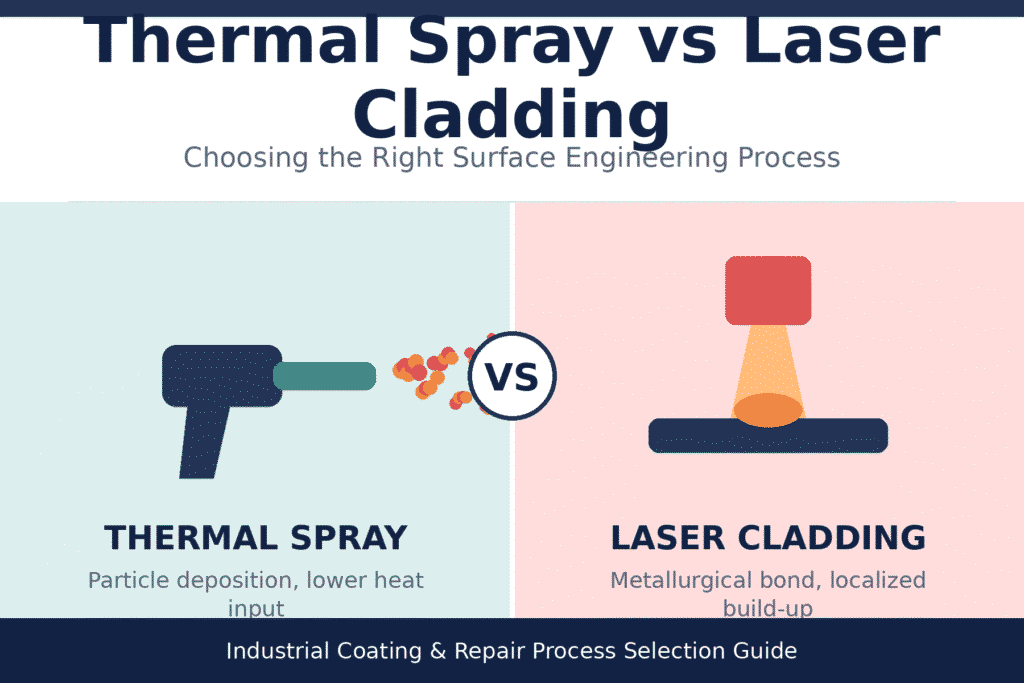
Thermal Spray vs Laser Cladding is a comparison I see many buyers frame the wrong way. They ask which technology is “better,” then they get stuck in coating thickness, hardness, or bond strength charts. That creates risk. I prefer to start with the part’s failure mode, heat sensitivity, repair goal, downtime window, and acceptance criteria.
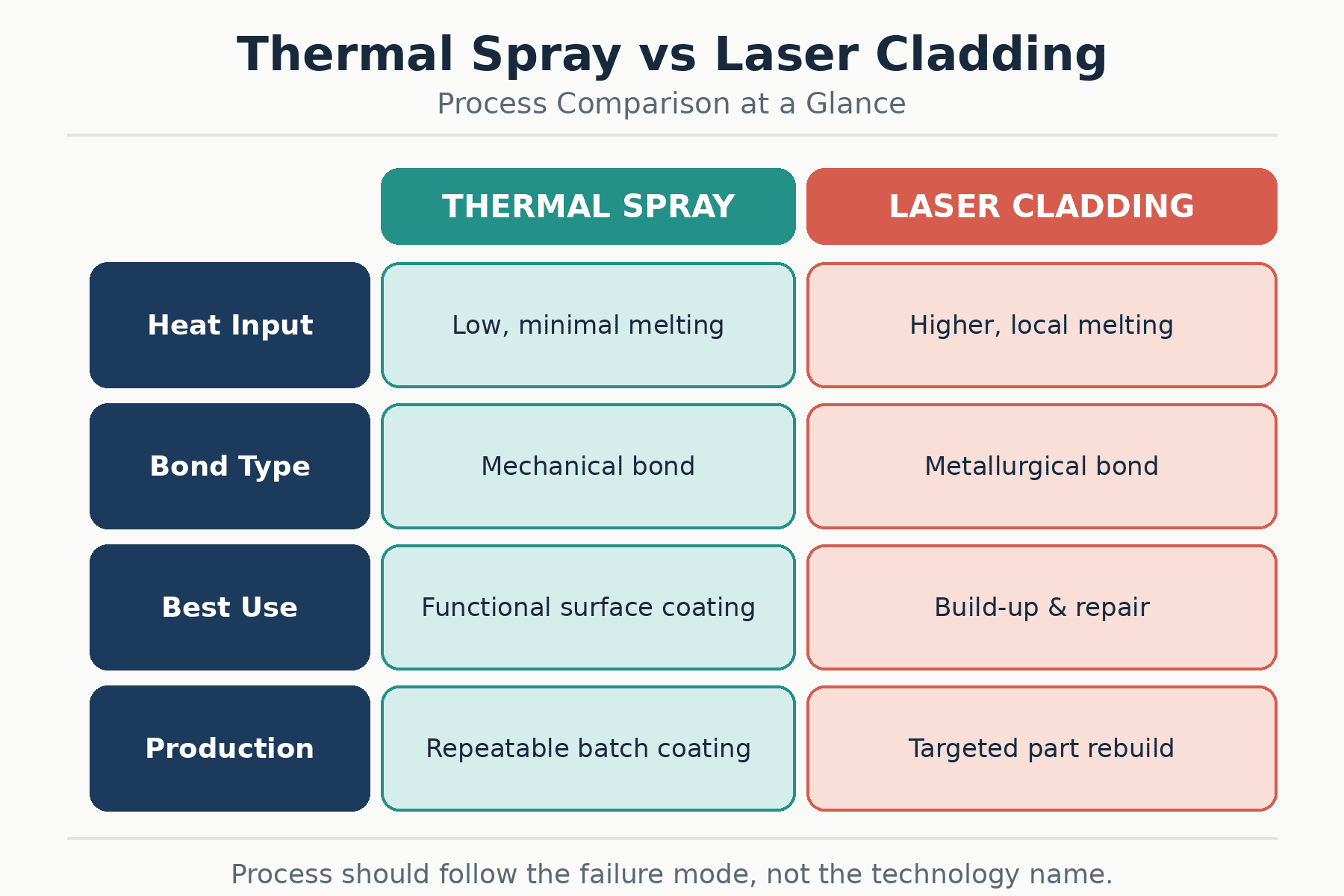
Thermal spray and laser cladding are both valuable surface engineering technologies, but they solve different repair and coating problems. Thermal spray is often a strong fit for functional surface coatings with lower heat input and repeatable production.1 Laser cladding is often better when a metallurgical bond, localized build-up, or thicker repair layer is required.2
I manufacture thermal spray gun bodies and consumables, so I naturally look closely at process stability. Still, I do not treat thermal spray as the automatic answer. The right decision depends on total project risk, not technology prestige. Let’s compare the two methods from an engineer’s buying and repair perspective.
Thermal Spray vs Laser Cladding: Start With the Repair Challenge, Not the Technology?
Many coating projects begin with a technology preference before the real problem is clear. That is dangerous. If a part is mainly suffering wear, corrosion, erosion, or dimensional loss, one process may fit. If heat distortion or substrate damage is the bigger risk, the decision changes quickly.
The best starting point in Thermal Spray vs Laser Cladding selection is the repair challenge. Engineers should first ask whether the part needs a surface functional coating, dimensional restoration, localized rebuild, corrosion protection, wear resistance, or low-heat processing. The technology should follow the failure mode, not the other way around.
Define the Real Failure Mode First
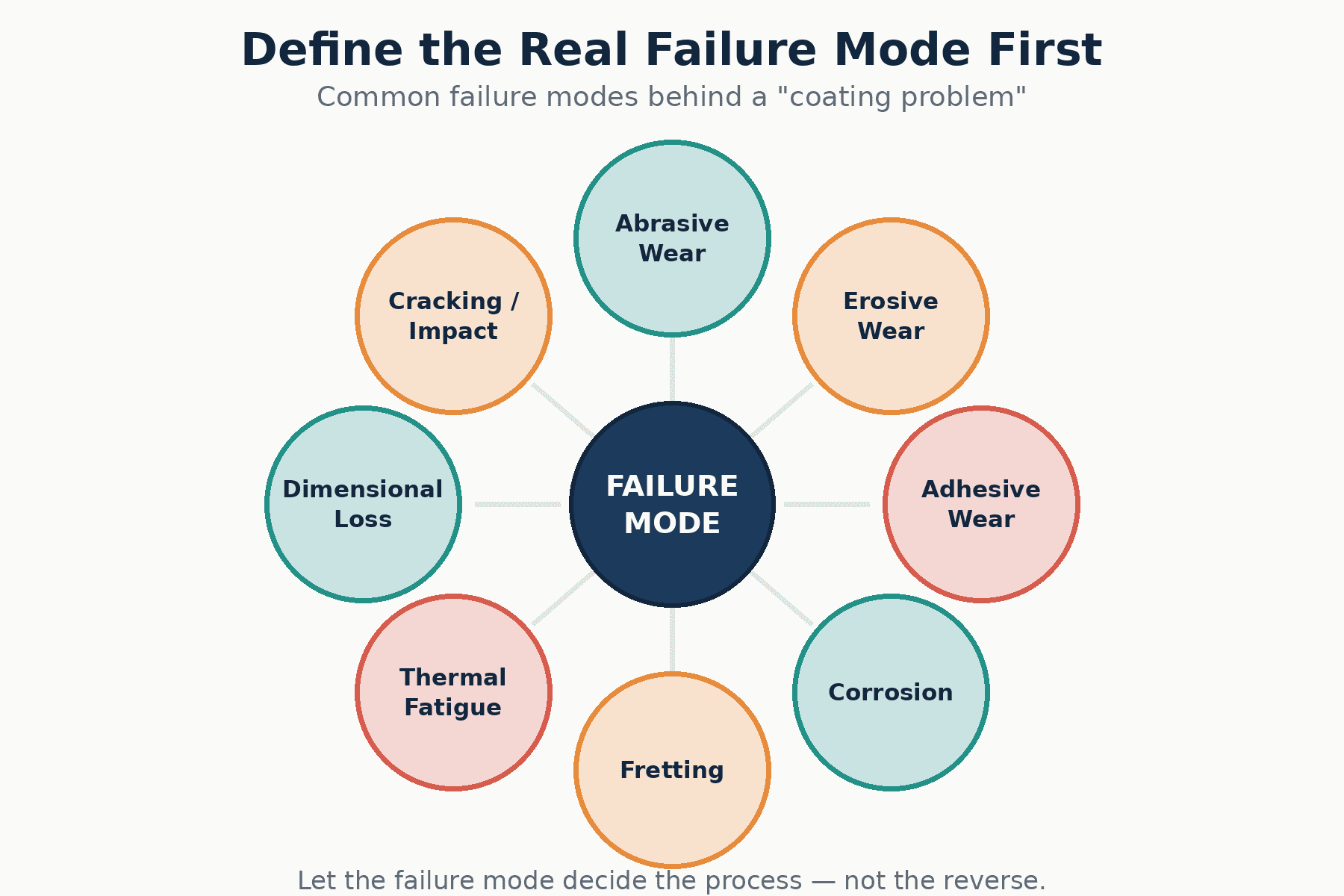
I have seen teams compare coating brochures before they inspect the part properly. That usually wastes time. A worn shaft, turbine-related component, pump sleeve, valve part, roller, or mold surface may look like a “coating problem,” but the real failure mode can differ.
Common failure modes include:3
- Abrasive wear from hard particles
- Erosive wear from high-speed flow
- Adhesive wear from metal-to-metal contact
- Corrosion from chemicals, humidity, or high-temperature media
- Fretting from small cyclic motion
- Thermal fatigue from repeated heating and cooling
- Dimensional loss from long-term service
- Cracking or local damage from overload or impact
Thermal spray is often relevant when the main goal is to create a functional surface with controlled heat input. Depending on the material and process, it can support wear-resistant, corrosion-resistant, thermal barrier, electrical, or dimensional restoration coatings.
Laser cladding is often relevant when the repair requires a metallurgically bonded layer or localized build-up. It can be useful when engineers need to add material to a damaged zone and then machine it back to specification.
Ask These Questions Before Comparing Processes
I usually advise customers to slow down and answer a few practical questions:
- What failed first: the surface, the geometry, or the substrate?
- Can the base material tolerate heat input without distortion or property loss?
- Does the part need a thin functional coating or a thicker build-up?
- How much post-machining is acceptable?
- What is the batch size and delivery window?
- What inspection standard will decide acceptance or rejection?
- What is the cost of rework if the first attempt fails?
These questions make the comparison more realistic.
| Decision Question | Thermal Spray May Fit When | Laser Cladding May Fit When |
|---|---|---|
| Main purpose | Surface function, wear/corrosion resistance, thermal protection | Local build-up, repair, metallurgical bonding |
| Heat sensitivity | Lower heat input is important | Substrate can tolerate controlled melting |
| Coating/build-up need | Thin to moderate coating is enough | Thicker localized layer is needed |
| Distortion risk | Distortion must be minimized | Some heat-affected zone is acceptable |
| Production style | Repeatable coating work or batches | Targeted repair or high-value component rebuild |
My practical rule is simple: I do not choose a process because it sounds advanced. I choose it because the part, failure mode, and acceptance criteria support it.
How Thermal Spray and Laser Cladding Differ in Process Characteristics and Applications?
The two technologies can both improve surfaces, but they do it in very different ways. If engineers only compare the final layer, they may miss the real process risk. Heat input, bonding mechanism, dilution, coating structure, deposition efficiency, and post-processing needs all matter.
Thermal spray generally deposits heated or molten particles onto a prepared surface, forming a coating with mechanical bonding and process-dependent cohesion.4 Laser cladding uses a laser heat source to melt feed material and part of the substrate, producing a metallurgical bond and localized build-up.5 This difference drives application fit.
Process Logic in Simple Terms
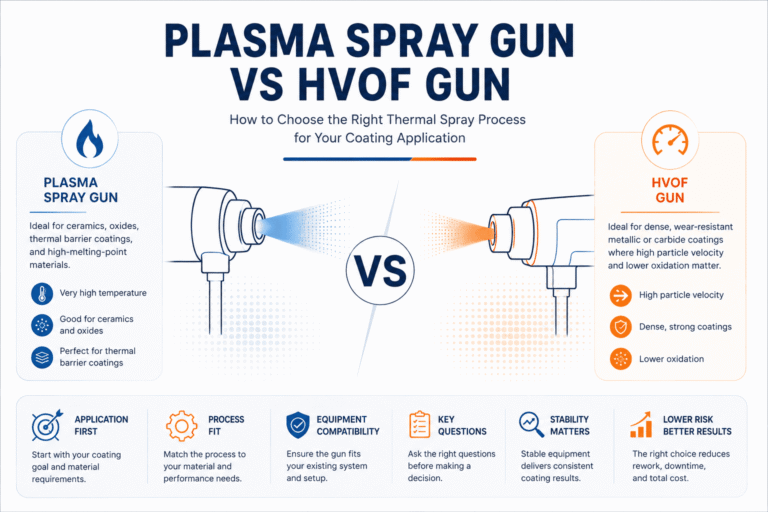
Thermal spray is a family of coating processes.6 It includes:
- HVOF — High Velocity Oxy-Fuel spraying
- APS — Atmospheric Plasma Spraying
- TWAS — Twin Wire Arc Spraying
- Flame Spraying
- Cold Spraying
Each process has a different heat source, particle velocity, material range, and coating structure. In my work, I focus heavily on the hardware side because a stable spray process depends on the gun body, cathode, anode, barrel, combustion chamber, and gas-flow stability.
Laser cladding is different. It uses a laser to create a controlled melt pool. Powder or wire feed material is added into that area. The deposited layer fuses with the substrate. That is why laser cladding is often selected for localized repair, dimensional build-up, and applications where metallurgical bonding is important.
Practical Application Differences
The choice often becomes clearer when I map the application.
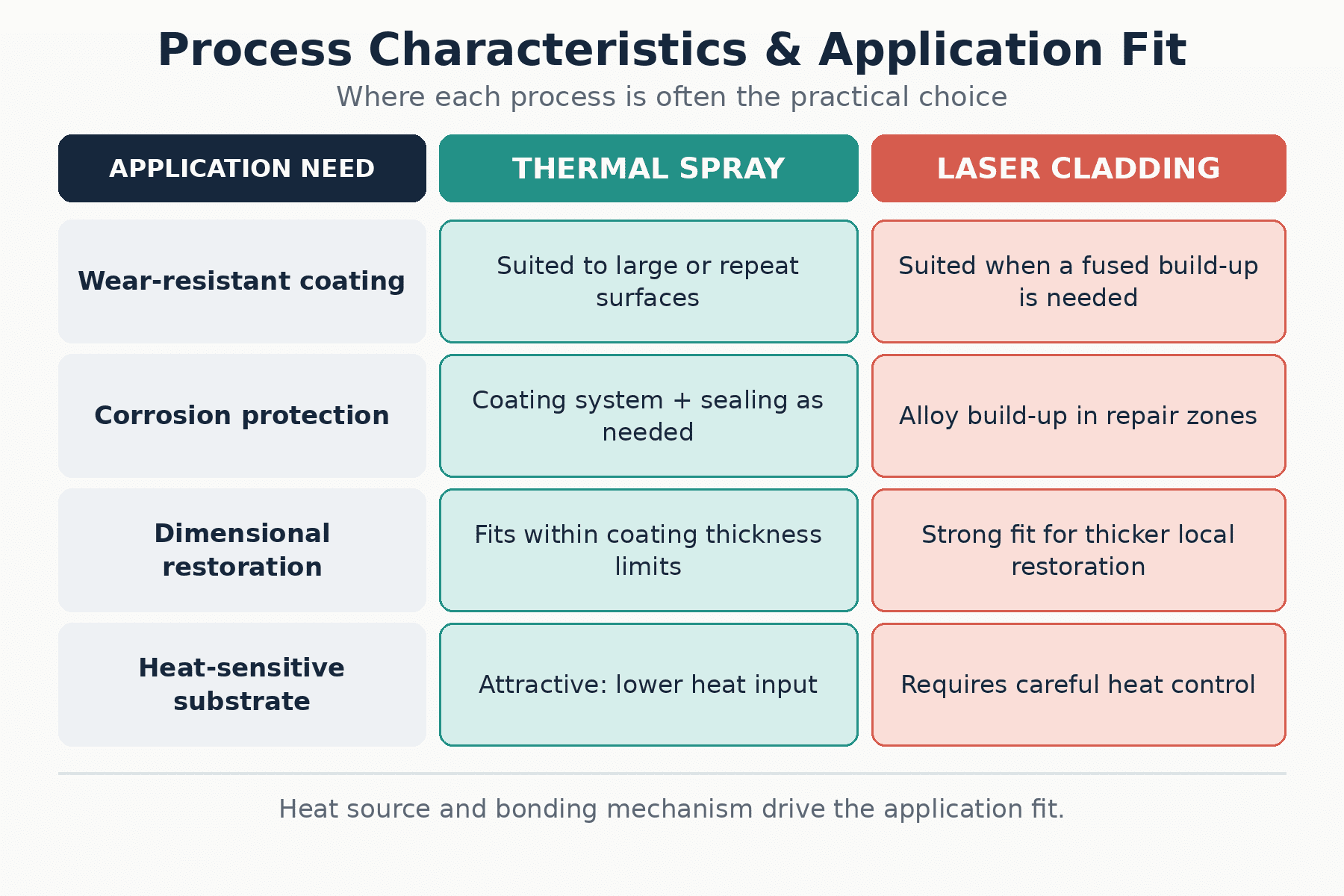
| Application Need | Thermal Spray Consideration | Laser Cladding Consideration |
|---|---|---|
| Wear-resistant coating | Often suitable, especially for large or repeat surfaces | Suitable when fused build-up is needed |
| Corrosion protection | Often suitable with correct coating system and sealing if needed | Suitable for alloy build-up and repair zones |
| Dimensional restoration | Suitable when coating thickness is within process limits | Strong fit for thicker localized restoration |
| Heat-sensitive substrate | Often attractive due to lower heat input | Requires careful control of heat input |
| High-value local repair | Possible, depending on geometry and coating need | Often attractive for targeted rebuild |
| Large batch coating | Often efficient with stable equipment and fixtures | Depends on part geometry and robot/laser setup |
Bonding Mechanism Is Important, But Not Everything
Many buyers focus on the phrase metallurgical bond and assume it automatically means “better.” I do not agree with that shortcut. A metallurgical bond can be a major advantage for certain repairs. However, it also comes with a heat input story. The substrate is partially melted, and that can affect distortion, dilution, microstructure, and post-machining.7
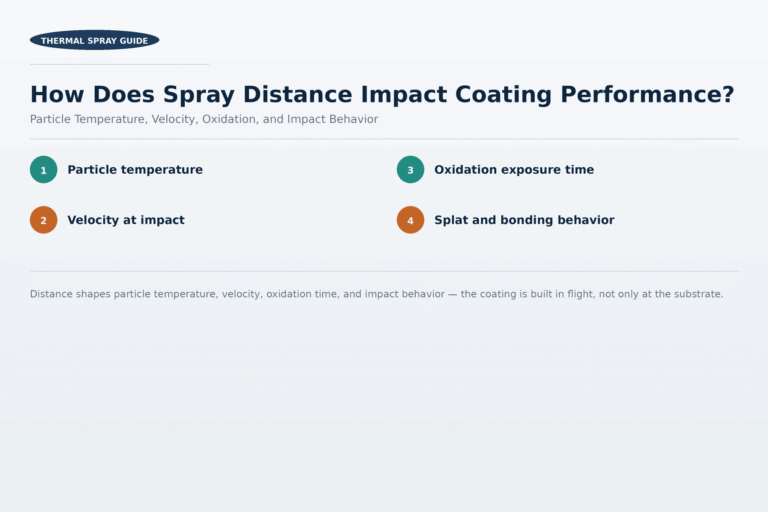
Thermal spray coatings usually rely on surface preparation, particle impact, coating cohesion, and process stability. That does not make them weak by default. It means the coating must be designed and applied correctly. Surface roughness, grit blasting, spray distance, temperature control, and gun stability all influence the result.8
Where Each Process Often Makes Sense
I would summarize it this way:
- Thermal spray is often practical for functional surfaces, repeatable coatings, lower heat input, and industrial production where coating consistency matters.
- Laser cladding is often practical for localized repair, thicker build-up, metallurgical bonding, and high-value parts that justify controlled laser processing.
Neither statement is absolute. Material, geometry, acceptance testing, operator skill, and equipment condition can reverse the easy answer.
Thermal Spray vs Laser Cladding: Key Factors Engineers Should Consider Beyond Coating Thickness and Bond Strength?
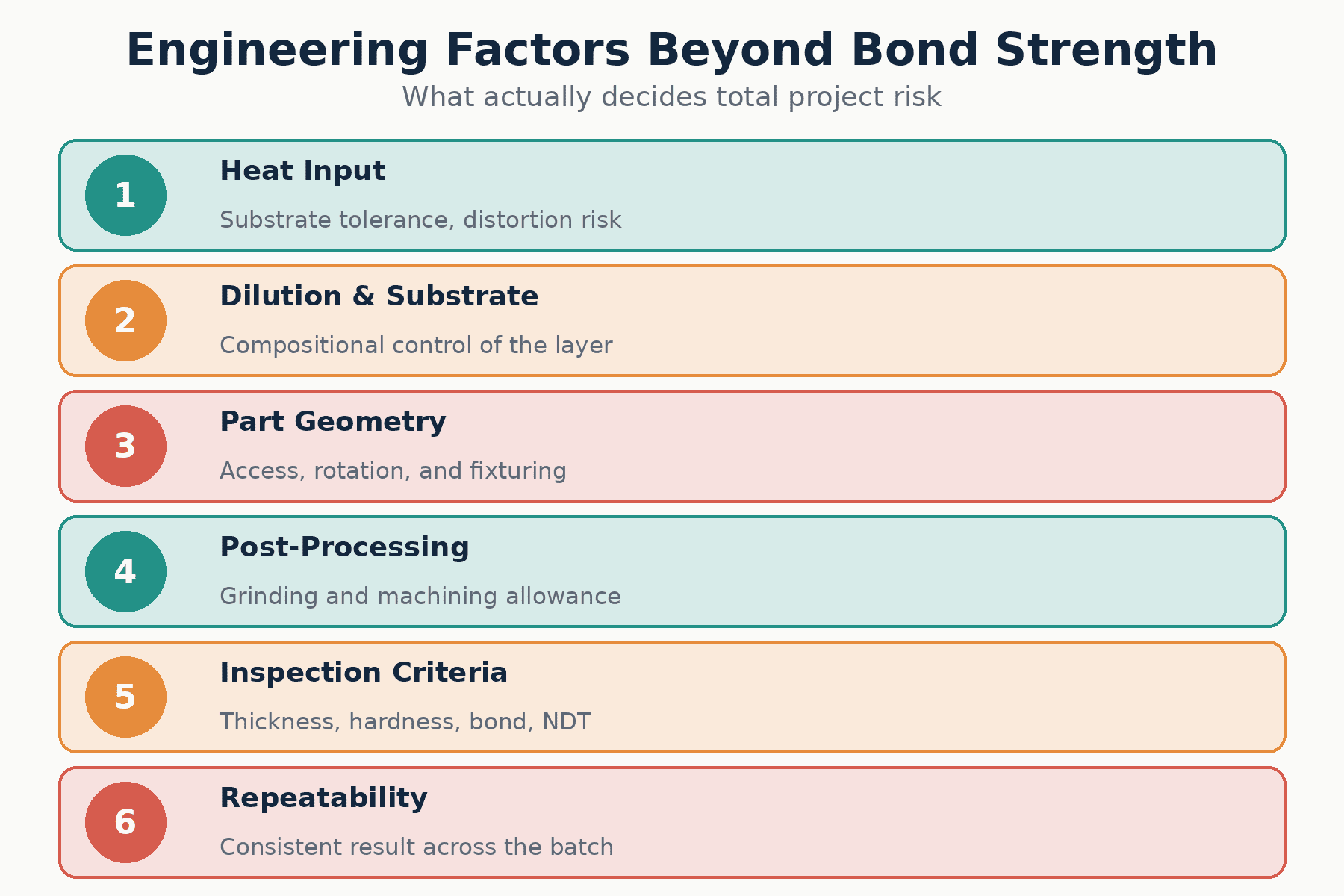
Thickness and bond strength are easy to compare, so they often dominate discussions. That can mislead decision-makers. A coating that looks stronger on paper may still fail if it distorts the part, requires excessive machining, misses the downtime window, or cannot be repeated across a batch.
Engineers should evaluate Thermal Spray vs Laser Cladding using heat input, substrate sensitivity, dilution, distortion risk, coating function, post-machining, inspection criteria, operator skill, equipment availability, and batch consistency.9 Coating thickness and bond strength matter, but they do not decide the process alone.
Why Isolated Parameters Can Mislead
I understand why buyers ask for bond strength, hardness, porosity, and coating thickness. These numbers are visible and easy to put into a purchase specification. However, real industrial repair has more variables.
For example, a part may accept a very hard layer but fail because the base component warped. Another part may have excellent adhesion but still be rejected because final machining removes too much material. A batch may pass one sample test, then struggle because consumable quality or torch stability changes during production.
That is why I always connect technical parameters to the final job risk.
Key Factors That Often Matter More
Here are the factors I would put in the decision matrix:
-
Heat input
- Can the substrate tolerate local melting?
- Will the part distort?
- Will heat affect previous heat treatment?
-
Dilution and substrate interaction
- Does the repair layer need to remain compositionally controlled?
- Is dilution acceptable for the application?
-
Part geometry
- Can the gun or laser head access the area?
- Is rotation, masking, or fixturing practical?
-
Post-processing
- How much grinding or machining is required?
- Can the final tolerance be reached after coating or cladding?
-
Inspection and acceptance
- Will acceptance be based on thickness, hardness, bond strength, visual inspection, NDT, metallography, or functional testing?
- Are these criteria realistic for the chosen method?
-
Repeatability
- Can the same result be achieved on the tenth part, not just the first one?
- Are consumables and spare parts stable?
A Simple Selection Matrix
| Factor | Why It Matters | Question I Ask |
|---|---|---|
| Heat input | Controls distortion and substrate risk | Can this part tolerate local melting? |
| Layer purpose | Defines coating or build-up need | Are we protecting a surface or rebuilding geometry? |
| Geometry | Affects access and uniformity | Can equipment reach the working zone correctly? |
| Post-machining | Adds cost and risk | How much stock must remain for finishing? |
| Batch size | Affects process economics | Is this one urgent repair or repeated production? |
| Quality control | Determines acceptance | What measurement proves success? |
| Supply stability | Affects downtime | Are consumables, spare parts, and operators available? |
My Manufacturing View
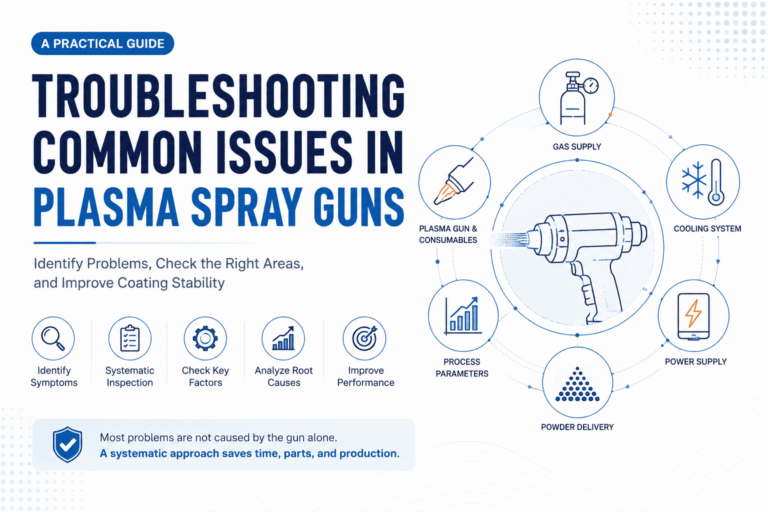
Because I manufacture spray guns, cathodes, anodes, barrels, and combustion-related parts, I pay close attention to variables that do not always appear in comparison charts. In thermal spray, a process is not just “HVOF” or “plasma.” It is also the condition of the hardware.
For example, I have seen how bore roughness, internal dimensions, electrode quality, and gun-body geometry influence stability. In our production, we control key dimensions tightly, with machining precision targeted within 0.01 mm where required and internal bore roughness controlled for critical components. These controls help support stable flame or arc behavior.
That experience makes me cautious when I read simple process comparisons. A process with a strong theoretical advantage can fail in production if equipment condition, consumable consistency, or inspection discipline is weak.
Why Thermal Spray Process Stability Matters in Real Industrial Production?
Thermal spray coating quality is often discussed as if it only depends on the coating material and process name. That view is incomplete. In real production, unstable arc or flame behavior can create inconsistent coatings, scrap, rework, and schedule pressure. Stability becomes a business issue, not just a technical detail.
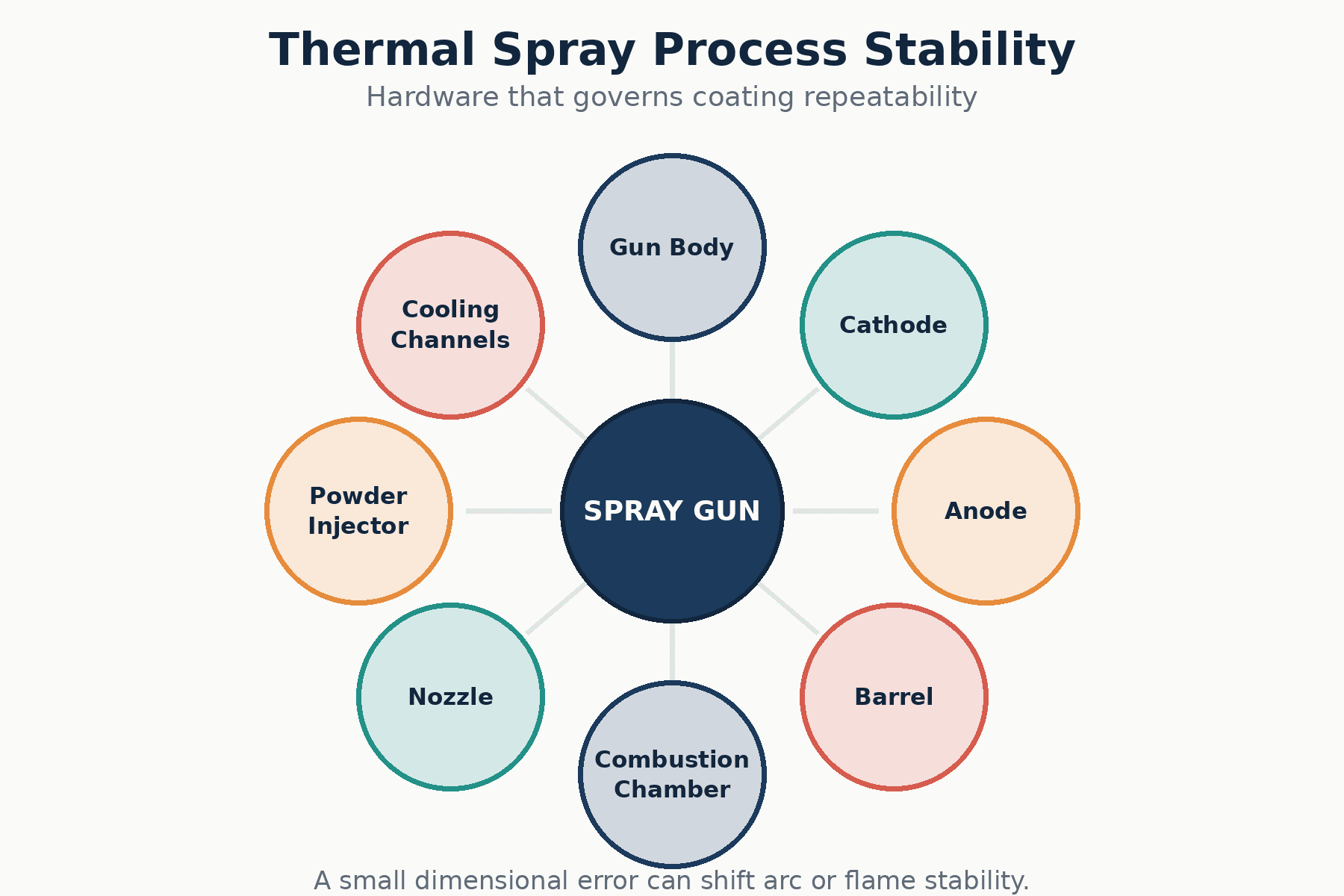
Thermal spray process stability matters because coating quality depends on repeatable particle heating, velocity, spray pattern, gas flow, gun condition, and consumable consistency.10 Stable gun bodies, cathodes, anodes, barrels, and combustion chambers help control arc or flame length, coating uniformity, and batch-to-batch reliability.
Stability Is Built Into the Hardware
I spend much of my time around the parts that many end users only see as spare consumables. In my experience, these parts can decide whether a coating process stays stable during a real production run.
Critical thermal spray hardware includes:
- Gun body
- Cathode
- Anode
- Barrel
- Combustion chamber
- Nozzle
- Powder injector
- Cooling and gas-flow channels
When these parts are manufactured poorly, the process may still start. But it may not stay stable. A small dimensional error can change gas flow, heat distribution, arc behavior, or spray pattern.11 A rough bore can affect flow and wear. A worn chamber can shift flame shape. An inconsistent electrode can influence arc stability.
What I Check in Practice
In our work, we manufacture ARCTHERM series gun bodies and consumables for mainstream thermal spray platforms, including systems compatible with common METCO and TAFA-style equipment. I am careful here because compatibility and performance always depend on actual model, material, and operating condition.
The checks I care about include:
- Key geometric tolerances
- Internal bore roughness
- Concentricity and alignment
- Cathode and anode material consistency
- Tungsten-copper connection quality
- Cooling-channel integrity
- Arc length or flame length stability
- Visual and operational stability checks
For cathodes and anodes, we use vacuum casting for tungsten-copper connection in relevant designs. The purpose is to improve connection quality and support service stability. We also use precision CNC machining, including dual-spindle, dual-turret equipment, to keep important dimensions controlled.
Why This Matters When Comparing Technologies
A buyer comparing Thermal Spray vs Laser Cladding may ask, “Which process gives better quality?” I would answer, “Which process can your supplier repeat under your production conditions?”
For thermal spray, repeatability depends on:
- Stable equipment
- Consistent consumables
- Controlled gas and powder feed
- Correct surface preparation
- Proper robot or operator movement
- Reliable cooling
- Inspection after coating
Laser cladding also has its own stability requirements, such as laser power control, powder or wire feed stability, shielding, path planning, and melt-pool control.12 I do not claim to be a laser cladding parameter expert. I only point out that every advanced process has stability variables.
Production Risk Is Often Hidden
The first sample may look excellent. The problem appears when the project moves into batch production or urgent maintenance. Then small instabilities become expensive.
Possible results include:
- Coating thickness variation
- Local overheating
- Unstable spray pattern
- Poor deposition efficiency
- Higher consumable wear
- More grinding time
- Missed delivery dates
- Inconsistent inspection results
That is why I treat process stability as a purchasing requirement. A supplier should not only show coating capability. They should show how they control the equipment, consumables, and inspection process behind the coating.
Choosing the Right Technology Based on Total Project Risk and Cost?
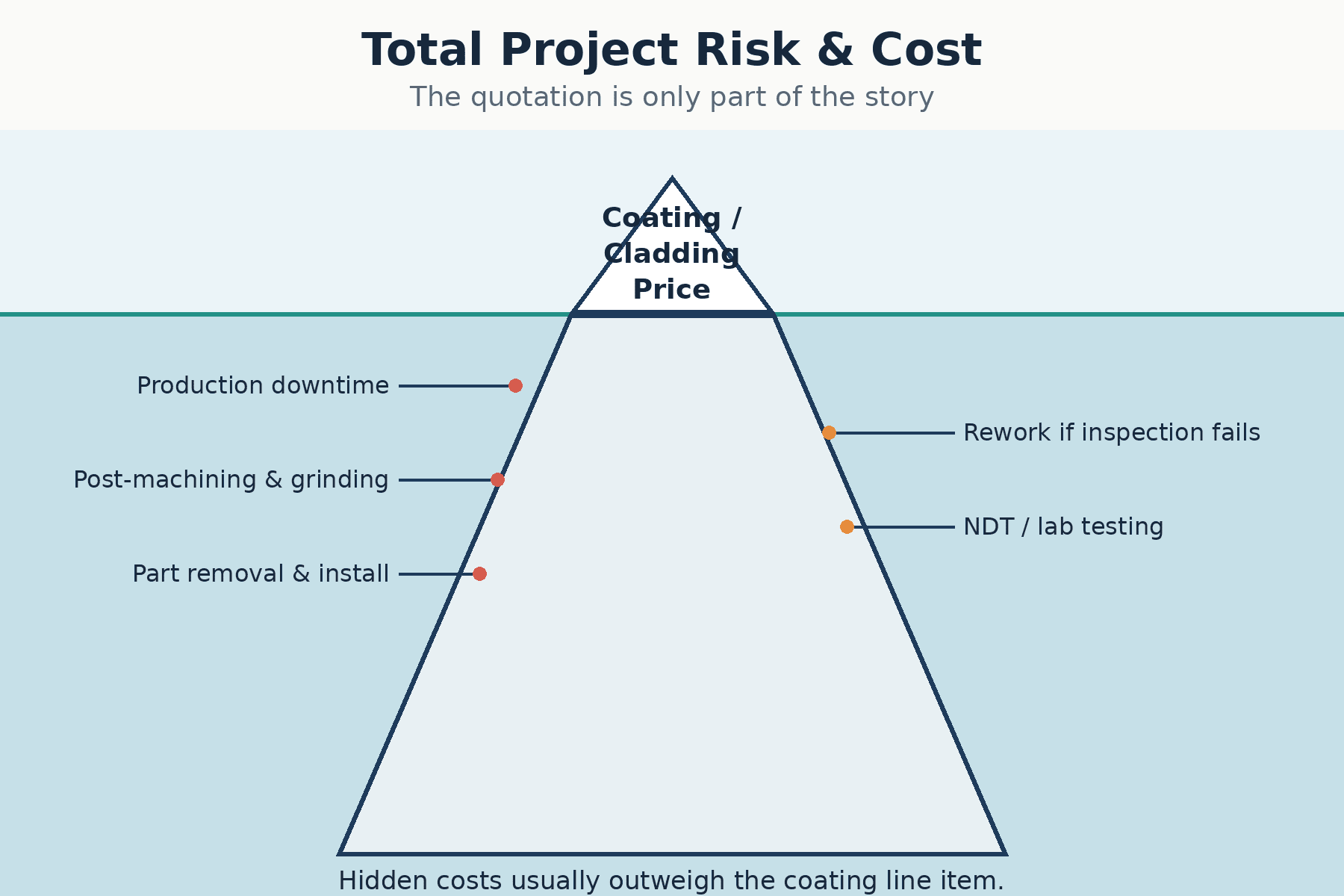
A low unit price can become expensive if the part fails inspection, misses the shutdown window, or needs repeated post-machining. A higher process price can be justified if it reduces downtime or saves a critical component. Cost should be measured as project risk, not just coating price.
The right choice between thermal spray and laser cladding should be based on total project cost and risk. Engineers should include downtime, part value, rework probability, post-processing, operator skill, equipment availability, delivery stability, inspection cost, and long-term repeatability in the decision.
Cost Is More Than the Quotation
I have learned that a quotation only tells one part of the story. In heavy industry, aerospace, energy, and machinery repair, the hidden cost can be much larger than the coating or cladding line item.
Total cost may include:
- Part removal and installation
- Cleaning and inspection
- Surface preparation
- Coating or cladding
- Heat management
- Post-machining
- Grinding and polishing
- NDT or laboratory testing
- Transport and handling
- Production downtime
- Rework if acceptance fails
- Spare-part availability risk
For high-value parts, the cheapest process may not be the safest. For large repeated batches, the most advanced process may not be the most economical. Context decides.
A Practical Cost-Risk Comparison
| Cost/Risk Item | Thermal Spray Consideration | Laser Cladding Consideration |
|---|---|---|
| Downtime window | Often efficient for repeat coating jobs | Can be efficient for targeted repair if setup is ready |
| Part heat sensitivity | Often lower heat input helps reduce risk | Heat input must be managed carefully |
| Build-up requirement | May need multiple passes or may not fit thick repair | Often strong fit for localized build-up |
| Post-machining | Common, but depends on coating type | Common for final geometry after build-up |
| Equipment availability | Many industrial coating suppliers exist, depending on region | Availability depends on laser system and expertise |
| Repeat production | Strong when process and consumables are stable | Strong when robot path and parameters are proven |
| Rework risk | Linked to preparation, gun stability, coating design | Linked to heat control, dilution, cracking, geometry |
How I Would Choose in Real Procurement
I would not start with “thermal spray is cheaper” or “laser cladding is stronger.” I would build a decision path.
Step 1: Define the failure mode.
If the main issue is surface wear or corrosion, I would evaluate thermal spray seriously. If the part needs structural build-up or localized material addition, I would evaluate laser cladding seriously.
Step 2: Check heat sensitivity.
If the substrate cannot tolerate local melting or distortion, lower heat input becomes very important. Thermal spray may become more attractive. If the substrate and geometry can handle laser processing, laser cladding remains in the discussion.
Step 3: Define final acceptance.
I would ask what inspection result proves success. The answer may include final dimension, hardness range, bond test, porosity limit, crack inspection, coating thickness, surface finish, or service trial.
Step 4: Include post-processing.
A process that deposits a good layer may still be expensive if it requires complex finishing. Final machining access matters.
Step 5: Evaluate supplier stability.
I would check whether the supplier controls consumables, critical spare parts, and process repeatability. For thermal spray, I pay special attention to gun and consumable quality because I know how much they influence production.
My Balanced Recommendation
If a customer asks me for a direct answer, I usually say this:
- Choose thermal spray when the project needs a functional surface coating, lower heat input, controlled deposition, and repeatable industrial coating output.
- Choose laser cladding when the project needs metallurgical bonding, thicker localized repair, or dimensional rebuild that justifies heat input and post-machining.
- Choose neither until the part’s failure mode, acceptance criteria, and downtime risk are clear.
That answer is less dramatic than a winner-takes-all comparison. However, it prevents expensive mistakes.
Frequently Asked Questions
Is thermal spray better than laser cladding?
Thermal spray is not universally better than laser cladding. It is often better for lower-heat functional coatings, wear protection, corrosion protection, and repeatable coating production. Laser cladding is often better for metallurgical bonding, localized build-up, and thicker repair layers. The part’s failure mode decides the answer.
Does laser cladding always create a stronger coating?
Laser cladding can create a metallurgical bond, which is valuable in many repair applications. However, “stronger” depends on the acceptance standard, substrate condition, heat input, dilution, cracking risk, and final machining. A strong bond does not automatically mean lower total project risk.
When should I choose thermal spray for industrial parts?
I would consider thermal spray when the part needs wear resistance, corrosion resistance, thermal protection, or dimensional restoration with relatively low heat input. It is also attractive when production repeatability, coating efficiency, and stable equipment are important to the project.
Why do thermal spray gun parts affect coating quality?
Thermal spray gun parts affect gas flow, arc or flame stability, particle heating, spray pattern, and coating consistency. Gun body precision, cathode and anode quality, barrel condition, combustion chamber geometry, bore roughness, and key tolerances can all influence repeatability in production.
What is the biggest mistake in comparing thermal spray and laser cladding?
The biggest mistake is comparing technology labels instead of project risks. Engineers should not decide only by coating thickness, hardness, or bond strength. They should also evaluate heat input, distortion risk, part value, downtime, post-machining, supplier capability, and batch consistency.
Conclusion
Thermal Spray vs Laser Cladding is not a contest where one technology wins every time. It is a process-selection decision based on failure mode, heat sensitivity, coating or build-up need, inspection criteria, downtime, and total project risk. From my manufacturing experience, I pay special attention to thermal spray stability because gun bodies, cathodes, anodes, barrels, and combustion chambers directly affect coating repeatability. If you are evaluating a repair or coating project, contact us to discuss the part, process fit, and stable thermal spray hardware options.
"Applications and Developments of Thermal Spray Coatings for the Iron ...", https://pmc.ncbi.nlm.nih.gov/articles/PMC9866076/. A peer-reviewed review of thermal spray technology supports that thermal spray is used for functional surface coatings and typically deposits material without bulk melting of the substrate, which is relevant to applications requiring controlled heat input. Evidence role: general_support; source type: paper. Supports: Thermal spray processes are widely used to deposit functional coatings and are generally associated with limited substrate melting compared with fusion-based deposition.. Scope note: The source should be used as contextual process support; suitability for any specific component still depends on material, geometry, and process parameters. ↩
"An Overview of Laser Metal Deposition for Cladding - PMC - NIH", https://pmc.ncbi.nlm.nih.gov/articles/PMC9412773/. A review of laser cladding reports that the process produces a metallurgically bonded layer by locally melting feedstock and substrate material, supporting its use for localized repair and build-up. Evidence role: general_support; source type: paper. Supports: Laser cladding forms a metallurgical bond through localized melting and is used for repair, refurbishment, and material build-up.. Scope note: This supports the general process capability, not that laser cladding is the best option for every thick repair. ↩
"Wear", https://en.wikipedia.org/wiki/Wear. Engineering failure-analysis references classify wear mechanisms such as abrasive, erosive, adhesive, and fretting wear, together with corrosion and fatigue, as common causes of industrial component degradation. Evidence role: definition; source type: education. Supports: Standard failure-analysis and tribology references classify abrasive wear, erosive wear, adhesive wear, corrosion, fretting, and fatigue as common degradation mechanisms.. Scope note: The source would support the classification of failure modes, not the diagnosis of any specific part mentioned in the article. ↩
"Thermal spraying", https://en.wikipedia.org/wiki/Thermal_spraying. Thermal spray coating literature describes coating formation as the impact and solidification of heated particles on a prepared substrate, with adhesion commonly associated with mechanical interlocking, surface preparation, and cohesive bonding between deposited particles. Evidence role: mechanism; source type: paper. Supports: Thermal spray coating formation involves particle impact and solidification on a prepared substrate, with adhesion influenced by mechanical interlocking and inter-splat cohesion.. Scope note: Some thermal spray variants and materials can involve additional bonding contributions; the source should be read as describing the general mechanism. ↩
"Analysis and Prediction of Melt Pool Geometry in Rectangular Spot ...", https://pmc.ncbi.nlm.nih.gov/articles/PMC11857141/. Laser cladding studies describe the process as laser-induced melting of added feed material together with a shallow region of substrate, producing a metallurgically bonded clad layer. Evidence role: mechanism; source type: paper. Supports: Laser cladding forms a melt pool involving feed material and a thin surface layer of the substrate, resulting in metallurgical bonding.. ↩
"Thermal spraying", https://en.wikipedia.org/wiki/Thermal_spraying. Reference descriptions of thermal spraying define it as a group of coating processes in which feedstock materials are heated or accelerated and deposited onto a surface, including plasma, flame, HVOF, and arc-spray variants. Evidence role: definition; source type: encyclopedia. Supports: Thermal spraying is a group of coating processes that includes plasma spraying, flame spraying, HVOF, wire arc spraying, and related methods.. ↩
"Study on the reduction of residual stress in laser cladding layers ...", https://pmc.ncbi.nlm.nih.gov/articles/PMC11237019/. Research on laser cladding reports that heat input and substrate melting govern dilution and clad microstructure and can contribute to residual stress or distortion, factors that may influence later finishing operations. Evidence role: mechanism; source type: paper. Supports: Laser cladding heat input and substrate melting affect dilution, microstructure, residual stress, and potential distortion.. Scope note: The link to post-machining is contextual; specific machining requirements depend on deposit geometry, allowance, and tolerance. ↩
"Surface Preparation via Grit-Blasting for Thermal Spraying", https://www.osti.gov/servlets/purl/123249. Thermal spray process studies show that substrate preparation, surface roughness, stand-off distance, and thermal conditions affect coating adhesion, microstructure, and performance. Evidence role: mechanism; source type: paper. Supports: Thermal spray coating adhesion and properties depend on surface preparation and process parameters such as stand-off distance, temperature, and spray stability.. Scope note: The source would support the importance of these variables generally, not quantify their effect for the specific equipment described in the article. ↩
"surface engineering measurement for standards for ...", https://www.govinfo.gov/content/pkg/GOVPUB-C13-091167cfb102aac5b678ecaba98fa052/pdf/GOVPUB-C13-091167cfb102aac5b678ecaba98fa052.pdf. Surface engineering selection literature emphasizes that coating and repair processes should be chosen by considering substrate response, heat input, functional requirements, finishing operations, inspection criteria, and production repeatability. Evidence role: expert_consensus; source type: research. Supports: Surface engineering process selection commonly considers substrate effects, heat input, coating function, post-processing, inspection requirements, and repeatability.. Scope note: Such sources usually provide a general selection framework rather than a direct one-to-one ranking of thermal spray and laser cladding. ↩
"Graded-Density Thermal Spray Coatings for Light Gas Gun ...", https://www.osti.gov/servlets/purl/1713026. Thermal spray diagnostics research demonstrates that particle temperature and velocity, together with gas-flow and plume stability, are key determinants of coating microstructure and property consistency. Evidence role: mechanism; source type: paper. Supports: Thermal spray coating properties are strongly influenced by particle temperature, particle velocity, gas flow, and spray plume stability.. Scope note: The source may not directly address every hardware item named in the article, but it supports the broader process-stability mechanism. ↩
"Design and Development of a High Velocity Oxy-Fuel Thermal Spray Gun", https://scholarworks.utep.edu/cgi/viewcontent.cgi?article=2209&context=open_etd. Studies of thermal spray torch and nozzle design indicate that geometric features influence gas dynamics, arc behavior, heat transfer, and spray plume formation, providing a technical basis for tight control of critical dimensions. Evidence role: mechanism; source type: paper. Supports: Thermal spray torch and nozzle geometry influence gas flow, arc stability, heat transfer, and spray plume characteristics.. Scope note: The source would support the engineering principle, not verify the tolerances or performance of any named product line. ↩
"Operando process monitoring for high-speed laser cladding", https://upcommons.upc.edu/bitstreams/968ef52a-9937-4b87-be00-5cef68ab336d/download. Laser cladding and directed energy deposition literature identifies laser power, feedstock delivery rate, shielding conditions, travel path, and melt-pool dynamics as important variables controlling deposit quality and process stability. Evidence role: mechanism; source type: paper. Supports: Laser cladding quality and stability are governed by laser power, feed rate, shielding, scanning path, and melt-pool behavior.. ↩