Spray distance affects coating performance because it controls what happens between the gun exit and the substrate. If that distance is wrong, particles may arrive too hot, too cold, too fast, or too oxidized. I have seen many coating problems improve only after teams treated distance as a process control variable, not a simple setup number.
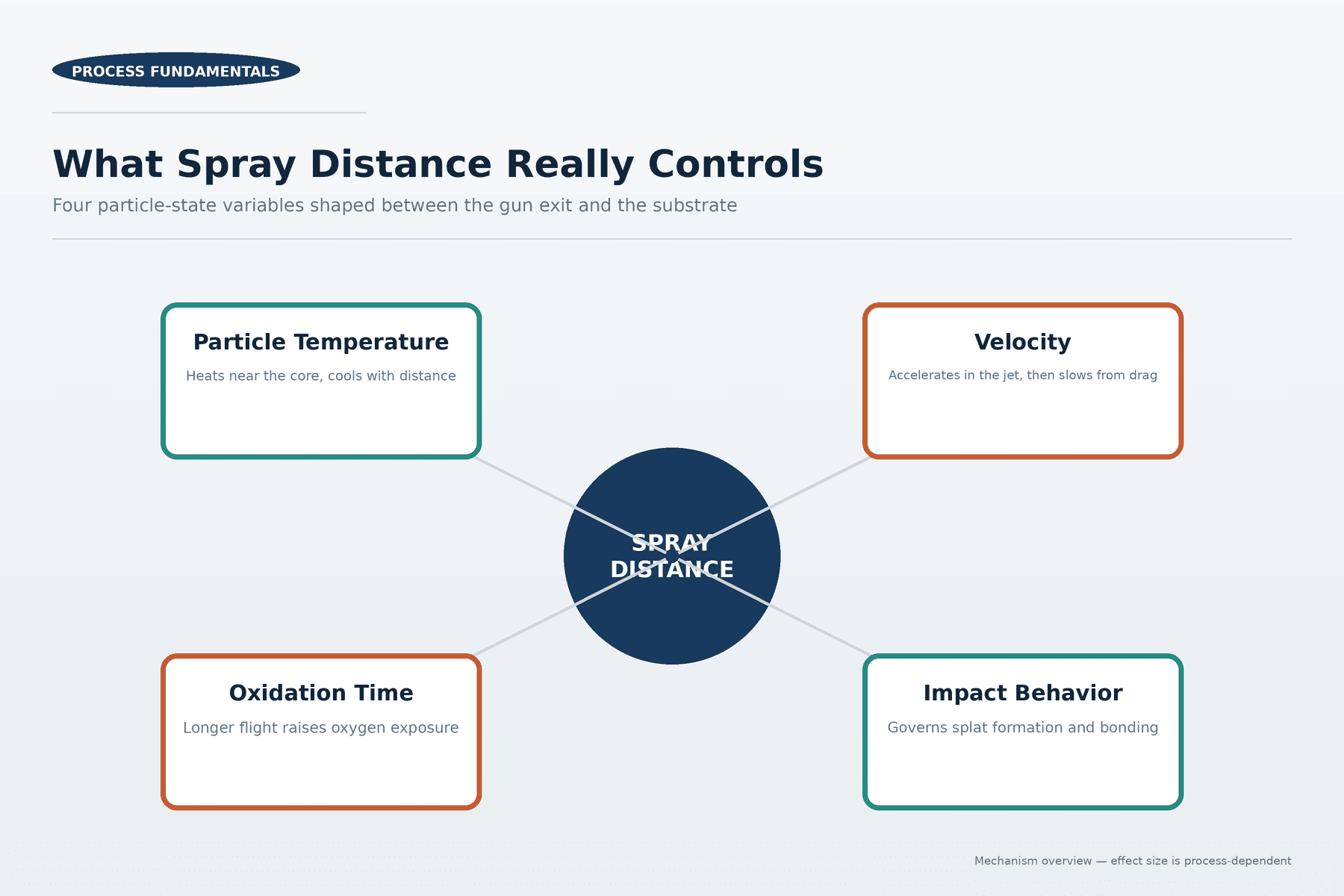
Spray distance impacts coating performance by changing particle temperature, velocity, oxidation time, and impact behavior before the material reaches the substrate.1 The right distance depends on the thermal spray process, powder or wire material, gun condition, wear-part stability, and required coating properties such as adhesion, porosity, hardness, and uniformity.
A fixed distance on a drawing can look simple. In real production, it interacts with flame shape, plasma arc length, barrel condition, cathode and anode wear, combustion chamber performance, and operator technique. So the better question is not only “What distance should I use?” It is “What particle state do I need at impact?”
Why Is Spray Distance More Than Just a Setup Parameter?
Spray distance often looks like a basic machine setting, so teams may adjust it quickly when coating results change. That can create confusion. If the real issue is particle state, gun stability, or consumable wear, changing only the distance may hide the cause instead of solving it.
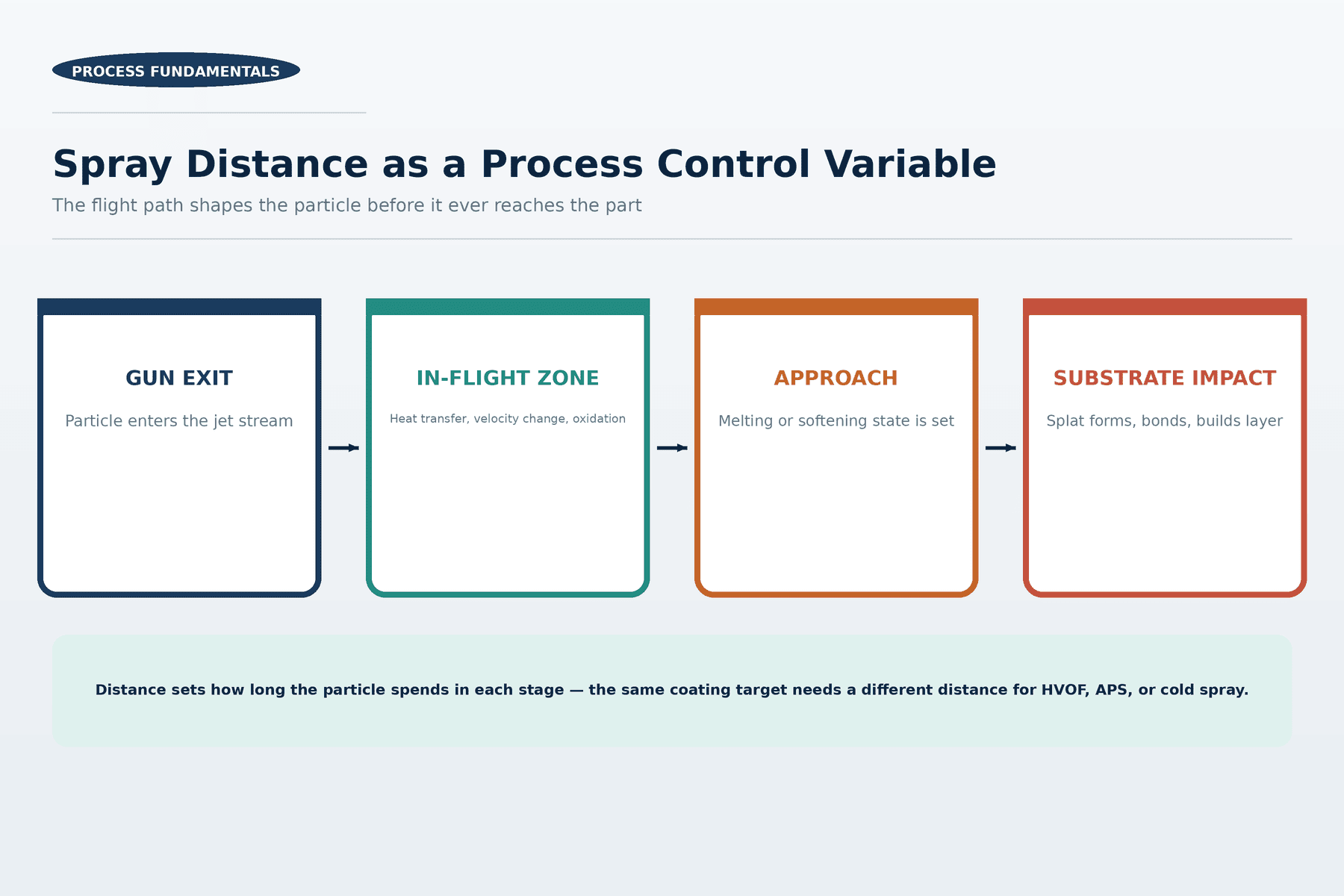
Spray distance is more than a setup parameter because it controls the particle’s flight history.2 During that short travel path, particles gain or lose heat, accelerate or decelerate, oxidize, and prepare to flatten on the substrate.3 This directly affects bonding, coating density, roughness, efficiency, and repeatability.
When I discuss unstable coating results with operators or maintenance teams, I try to reframe the question. The question should not be “What spray distance is correct for every job?” No universal answer exists across HVOF, APS, flame spray, twin wire arc spray, or cold spray.4 The better question is:
What particle temperature, velocity, and surface condition do I need when the material reaches the substrate?
That question is more useful because every thermal spray process has a different energy source and acceleration mechanism.
What spray distance changes during particle flight
During flight, each particle or droplet experiences several changes:
- Heat transfer: Particles can gain heat near the flame or plasma core, then lose heat as they move away.
- Velocity change: Particles can accelerate in the jet, then slow due to drag and turbulence.
- Oxidation exposure: Longer flight time can increase oxygen interaction, especially in open-air processes.5
- Melting or softening state: Particles may be fully molten, semi-molten, softened, or solid, depending on process and material.
- Impact behavior: Particles must deform properly to form splats, build layers, and bond to the surface.
A coating is not only built at the substrate. It is also shaped in the flight path. That is why a distance change can influence many coating properties at once.
| Particle condition at impact | Possible coating effect |
|---|---|
| Too hot or overheated | Higher oxidation risk, stress, rough buildup, possible coating damage |
| Too cold or under-softened | Poor flattening, weak bonding, higher porosity |
| Too fast for the condition | Excessive peening, stress, rebound, uncontrolled buildup |
| Too slow for the condition | Low deposition efficiency, porous or weak coating |
| Too oxidized | Brittle phases, lower cohesion, reduced performance |
| Stable and process-matched | Better repeatability, adhesion, density, and uniformity |
Why distance cannot be separated from process type
Different spray processes respond differently to distance. For example, HVOF often depends heavily on high particle velocity and controlled thermal input. APS, or atmospheric plasma spray, depends on plasma arc stability, powder injection, and particle heating. Twin wire arc spray involves molten droplets from wire tips and compressed gas atomization. Flame spray has its own combustion and heat transfer behavior. Cold spray relies mainly on particle velocity rather than melting.
Because of these differences, one distance rule cannot cover all applications. A ceramic coating, a carbide coating, a metal restoration layer, and a bond coat may each need different particle states. Even within the same process family, the correct range may change with:
- Material chemistry
- Powder size distribution
- Carrier gas and flow settings
- Gun design
- Nozzle or barrel geometry
- Substrate temperature limits
- Required coating thickness and surface finish
From the manufacturing side, I also pay close attention to gun body stability and consumable consistency. If a barrel, cathode, anode, or combustion chamber changes the flame or arc shape, the same measured distance may no longer produce the same particle state. This is a practical point, but it is often missed during troubleshooting.
What Happens When the Spray Distance Is Too Short or Too Long?
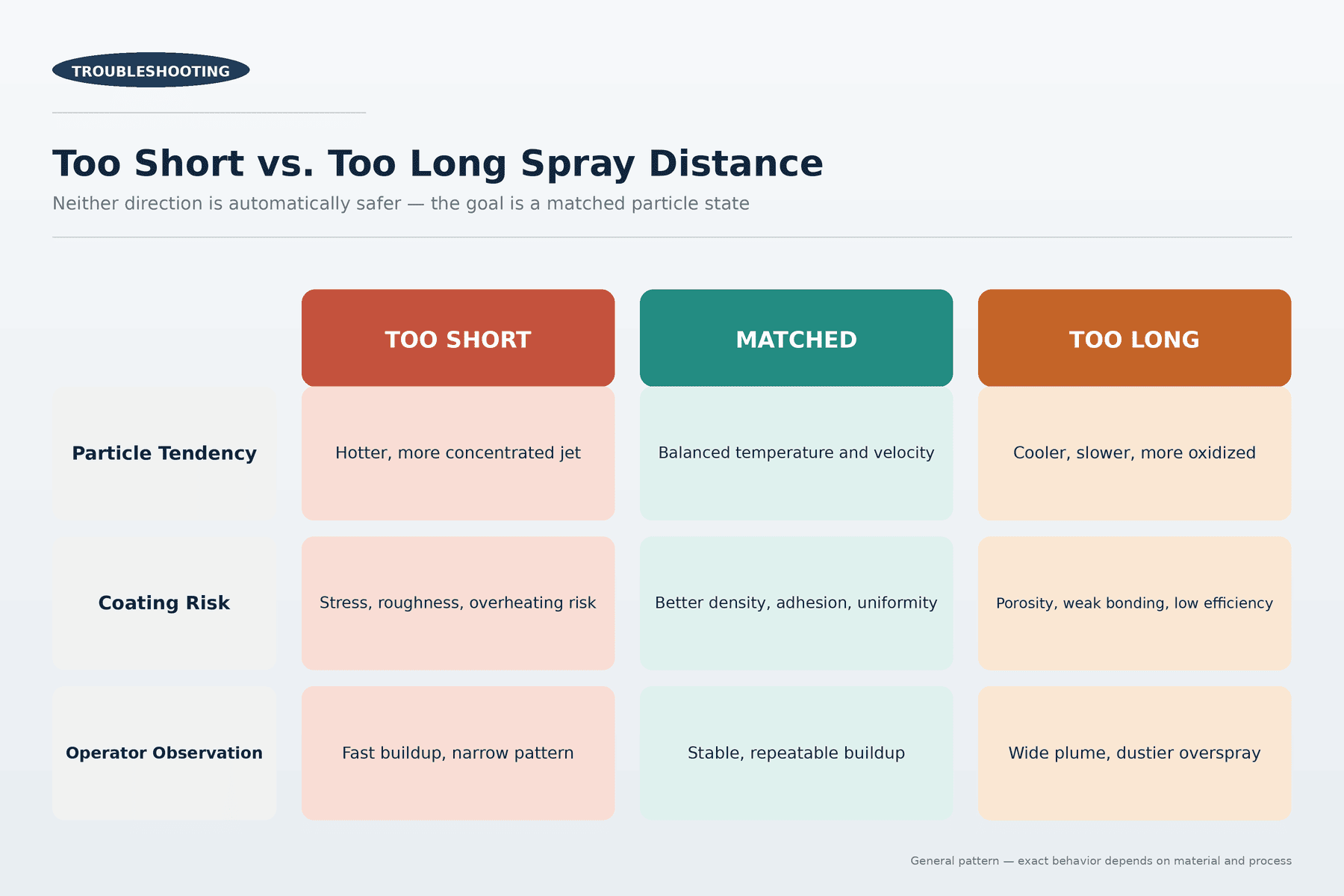
Spray distance problems can move in two directions. A short distance may look powerful and efficient, but it can overheat the surface or create uncontrolled buildup. A long distance may look safer, but particles can cool, slow down, oxidize, and form a weaker coating.
When the spray distance is too short, particles may arrive too hot or too aggressive, causing stress, oxidation, roughness, or local overheating.6 When it is too long, particles may lose heat and velocity, oxidize for longer, rebound, and create porous or weak coatings.7 Neither direction is always better.
I do not like simple statements such as “closer is stronger” or “farther is safer.” Both can be wrong. The correct distance is the one that gives the desired particle state at the substrate. In production, that target state must match the coating material, process, equipment condition, and part geometry.
If the distance is too short
A short distance can increase heat input and impact intensity. In some cases, deposition may look strong at first. However, the coating may become unstable if the particle and surface receive too much energy.
Common risks include:
- Substrate overheating
- High residual stress
- Rough or uneven buildup
- Excessive oxidation in some high-temperature zones
- Particle splash or poor splat control
- Thermal damage to sensitive parts
- Higher risk of local coating defects near edges or corners
A very short distance can also make the process less forgiving. Small gun movement errors may create visible coating differences because the jet is concentrated. On complex parts, this can cause non-uniform thickness.
If the distance is too long
A long distance gives particles more time in open atmosphere. That extra time can reduce temperature and velocity. It can also increase oxidation, especially for materials that react easily at high temperature.
Common risks include:
- Lower particle temperature at impact
- Reduced flattening and weaker splat bonding
- More rebound and lower deposition efficiency
- Higher porosity
- Weaker cohesion between layers
- Inconsistent coating density
- More sensitivity to air flow and spray booth conditions
A long distance can also widen the spray plume. That may help cover area, but it can reduce local particle concentration. The operator may see a broader pattern, while the coating becomes less dense or less efficient.
Comparing the two conditions
| Distance condition | Particle tendency | Coating risk | Operator observation |
|---|---|---|---|
| Too short | Hotter, more concentrated, more aggressive | Stress, roughness, overheating, uneven buildup | Fast buildup, hot surface, narrow pattern |
| Too long | Cooler, slower, more oxidized | Porosity, weak bonding, low efficiency | Wide plume, dustier overspray, slower buildup |
| Process-matched | Balanced temperature and velocity | Better density, adhesion, uniformity | Stable pattern, repeatable buildup |
Why “too short” and “too long” depend on the material
A carbide material, a metal alloy, and a ceramic powder do not respond the same way. Some materials need enough heat to soften or melt. Others must avoid decomposition, oxidation, or phase change. The same measured distance may be acceptable for one coating and unsuitable for another.
For example, many operators think first about particle temperature. That is important, but velocity matters too. A particle that is hot enough but too slow may not bond well.8 A particle that is fast but too cold may rebound. A particle that is too hot and too fast may create stress or rough splats. The process window is a balance.
This is why I always recommend reviewing distance together with:
- Material type
- Gun model
- Powder or wire feed condition
- Gas settings
- Substrate preheat
- Traverse speed
- Coating thickness target
- Wear-part condition
That last point is important. If the flame or plasma arc changes because the gun parts are worn, the operator may think the distance has changed in effect, even if the ruler still shows the same number.
Why May the Same Spray Distance Produce Different Results?
The same spray distance can produce different coating results, and that frustrates many teams. The operator may confirm the robot program, the fixture, and the standoff value. Yet the coating still changes. In my experience, this often means another process variable has shifted.
The same spray distance may produce different results because the jet itself may not be the same. Gun wear, barrel condition, cathode and anode erosion, combustion chamber changes, powder feeding, gas flow, and arc or flame stability can all change particle heating and acceleration before distance even matters.
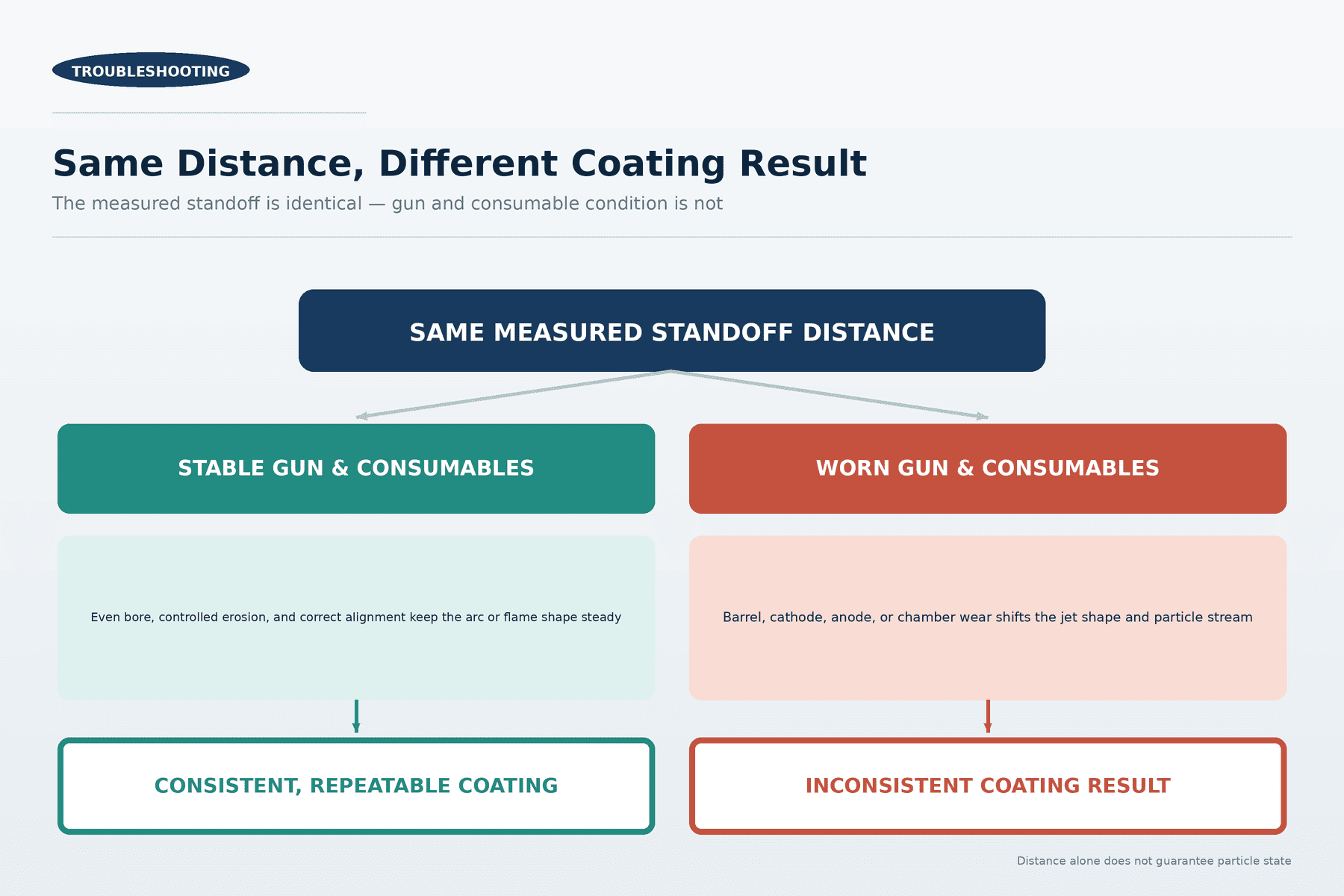
A measured distance is only the space between the gun and the substrate. It does not prove that the flame, plasma arc, or particle stream is identical. That is why I see distance as one part of a stability chain.
The role of gun and consumable condition
Thermal spray guns work under severe heat, gas flow, electrical energy, erosion, and particle wear. Over time, critical parts can change shape or performance. These changes may be small, but coating response can be sensitive.
Important components include:
- Gun barrel
- Nozzle
- Cathode
- Anode
- Combustion chamber
- Powder injector
- Wire guide or contact parts
- Seals and alignment surfaces
For plasma spray systems, cathode and anode condition can affect arc behavior.9 For HVOF systems, combustion chamber and barrel condition can affect flame shape, particle dwell time, and acceleration.10 For flame and wire arc processes, gas flow paths and feed stability matter.
At our manufacturing side, we pay close attention to critical dimensions, internal surface finish, and stability checks. For example, precision machining within tight tolerances and controlled inner bore roughness help support stable flow and repeatable gun behavior. I avoid claiming that one part alone guarantees coating quality, because the process is bigger than any single component. Still, unstable consumables can make a correct distance behave like the wrong distance.
Same distance, different jet
Here is a simple way to think about it:
| Measured item | What it tells you | What it does not tell you |
|---|---|---|
| Spray distance | Physical standoff from gun to part | Particle temperature, velocity, oxidation level |
| Robot path | Repeatable motion | Jet stability or powder stream quality |
| Gas setting | Target flow or pressure | Actual flow behavior inside worn parts |
| Current or fuel setting | Energy input setting | Real arc/flame shape under wear conditions |
| Powder feed rate | Material delivery rate | Particle heating quality and distribution |
This table explains why troubleshooting can become difficult. A team may verify every visible setting but still miss the internal condition of the gun. If the arc is unstable, if the flame length changes, or if the barrel geometry has shifted, the coating may change at the same distance.
Practical signs that distance is not the only issue
Operators and maintenance teams should look for patterns. Some signs suggest that distance may not be the root cause:
- The coating changes even when the robot path is unchanged.
- The spray plume looks different from previous runs.
- Arc or flame length appears unstable.
- The gun sound changes.
- Overspray pattern becomes irregular.
- Deposition efficiency drops without a clear material change.
- Coating thickness varies more than usual.
- Wear parts have exceeded normal service intervals.
- Recent maintenance changed parts but not process validation.
I have had conversations where a user first blamed powder quality or the equipment brand. Sometimes powder is involved. Sometimes settings are involved. But it is not fair or useful to blame one supplier immediately. A better approach is to check whether the selected distance still matches the real spray condition.
Why replacement parts must be consistent
Replacement consumables should not be treated as simple metal shapes. They are part of the spray system. A small change in bore, alignment, electrode geometry, or internal finish can influence flow and stability.
This is why I care about manufacturing details such as:
- Dimensional accuracy
- Concentricity
- Inner bore roughness
- Material connection quality
- Electrode stability
- No-gap or tight-fit assembly design where applicable
- Repeatable inspection before shipment
For cathode and anode components, material connection and thermal/electrical behavior matter. For barrels and combustion chambers, internal geometry matters. For gun bodies, alignment and sealing matter. These details help keep the process window stable, so the chosen distance remains meaningful over time.
How Should I Troubleshoot Coating Problems Before Changing the Spray Distance?
When coating performance becomes unstable, it is tempting to adjust spray distance first because it is visible and easy to change. That shortcut can work sometimes, but it can also create a moving target. A better method checks distance, gun stability, consumable condition, and process match in order.
Before changing spray distance, verify the current distance, part geometry, robot path, flame or plasma arc stability, wear-part condition, powder or wire feed, gas settings, and substrate preparation. If these items are stable, then adjust distance in controlled steps while watching coating response and process behavior.
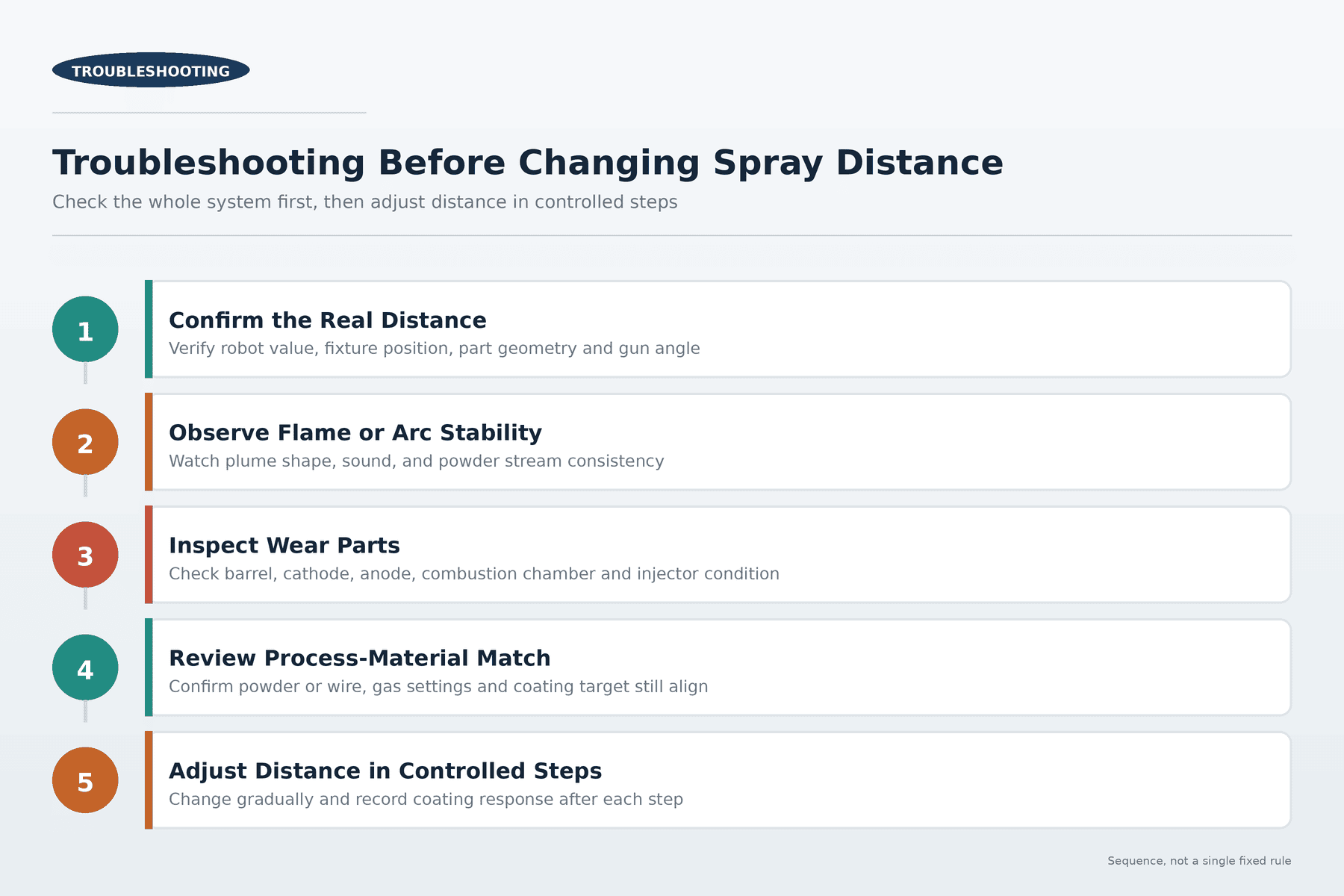
I like troubleshooting steps that operators can actually use on the shop floor. The goal is not to create a laboratory study every time a coating changes. The goal is to avoid random adjustments. A simple sequence can save time, parts, powder, and arguments between production, maintenance, purchasing, and suppliers.
Step 1: Confirm the real distance
First, confirm the actual standoff. This sounds basic, but it is easy to overlook.
Check:
- The programmed robot value
- The fixture position
- Part loading repeatability
- Gun angle
- Part distortion after preheat
- Surface features, edges, grooves, and corners
- Manual operator technique, if used
A nominal distance may not equal the real distance on the part surface. Curved parts and complex geometry can create local distance changes.11 Even if the average value is correct, edges may be too close and recesses may be too far.
Step 2: Observe the flame or arc stability
Next, check whether the energy source looks and sounds stable. For thermal spray, the jet is the carrier of particle history.
Look for:
- Flame length changes
- Plasma arc fluctuation
- Unusual sound
- Irregular spray plume
- Unstable powder stream
- Sudden overspray increase
- Arc starting difficulty
- Excessive spitting or pulsing
In our own work with spray guns and wear parts, flame and plasma arc length checks are important because they show whether the gun condition supports stable spraying. I do not use these checks as a replacement for coating testing. I use them as practical indicators before blaming distance or material.
Step 3: Inspect wear parts before making large changes
Wear parts can quietly move the process. A worn barrel, eroded electrode, damaged combustion chamber, or misaligned injector can change the particle stream. Then the same distance produces different coating behavior.
Use a simple inspection table:
| Component | What to inspect | Why it matters |
|---|---|---|
| Barrel or nozzle | Bore wear, erosion, deposits, alignment | Changes jet shape and particle acceleration |
| Cathode | Tip wear, erosion, connection condition | Affects plasma arc stability |
| Anode | Bore condition, erosion, arc track | Affects arc length and energy transfer |
| Combustion chamber | Heat damage, deposits, dimensional wear | Affects combustion stability |
| Powder injector | Blockage, wear, position | Affects particle entry into hot zone |
| Seals and fittings | Leakage, looseness, damage | Affects gas flow and consistency |
This check is especially useful after maintenance. A new part should improve stability, but any replacement still needs correct installation and process confirmation.
Step 4: Review process-material match
The selected distance must match the process and material. A distance that works for one coating may not work for another.
Ask these questions:
- Does the material need high velocity, high heat, or both?
- Is the powder size distribution the same as before?
- Has the wire type changed?
- Is the substrate temperature limit strict?
- Is the coating target dense, porous, rough, smooth, thick, or thin?
- Has the required coating thickness changed?
- Has the traverse speed changed?
- Has the spray angle changed?
These questions keep troubleshooting practical. They also prevent the common mistake of treating distance as an isolated value.
Step 5: Adjust distance in controlled steps
If the checks above look stable, then adjust distance carefully. I prefer controlled changes, not large jumps. Record the result after each change.
Track:
- Coating appearance
- Surface temperature trend
- Deposition rate
- Overspray
- Roughness trend
- Thickness uniformity
- Gun sound and plume shape
- Any visible cracking, dusting, or poor buildup
If your facility has testing capability, include adhesion, porosity, hardness, microstructure, or other required checks. If not, at least keep process records. A small production log can prevent repeated mistakes.
A practical troubleshooting mindset
The most useful mindset is this:
Do not ask only whether the spray distance is correct. Ask whether the whole spray system still creates the right particle state at that distance.
That mindset helps operators and managers avoid extreme conclusions. The problem may not be the powder. It may not be the gun brand. It may not be the operator. It may not be the distance alone. The root cause may be the relationship between distance, wear, stability, and material behavior.
For purchasing and maintenance teams, this also matters when choosing consumables. Lower-cost parts are not always a problem, and higher-cost parts are not automatically a solution. The key is repeatable geometry, stable materials, reliable machining, and proven compatibility with the gun system. In my view, consumables should support process consistency first.
Frequently Asked Questions
What is spray distance in thermal spraying?
Spray distance is the space between the spray gun exit and the substrate surface. It is also called standoff distance. It affects particle heating, cooling, velocity, oxidation, and impact behavior, so it has a direct influence on coating adhesion, porosity, density, roughness, and uniformity.
Is a shorter spray distance always better for adhesion?
A shorter distance is not always better. It may improve particle heat and impact in some cases, but it can also cause overheating, stress, oxidation, rough buildup, or coating damage. Adhesion depends on the right particle state, substrate preparation, process type, material, and gun stability.
Can worn consumables change coating performance at the same spray distance?
Yes. Worn consumables can change flame shape, plasma arc length, gas flow, powder heating, and particle acceleration. A worn barrel, cathode, anode, or combustion chamber may cause different coating results even when the measured distance has not changed.
Should I change powder supplier when coating results become unstable?
You should not change powder supplier before checking basic process stability. First verify distance, gun angle, feed rate, gas settings, flame or arc stability, wear parts, and substrate preparation. Powder quality can matter, but unstable coating performance often has multiple possible causes.
How do I choose the right spray distance?
You choose the right distance by matching the process, material, gun condition, and coating target. Start from qualified process guidance for your equipment and material. Then verify real coating performance through controlled trials, stable gun checks, and required inspection methods such as adhesion, porosity, hardness, or thickness tests.
Conclusion
Spray distance is not just a number on a setup sheet. It is a control variable that shapes particle temperature, velocity, oxidation time, flattening, bonding, porosity, and coating uniformity. The best distance depends on process type, material behavior, gun condition, and wear-part stability. Before changing it, I recommend checking flame or plasma arc stability, barrel condition, cathode and anode wear, combustion chamber condition, and feed consistency. If you need stable thermal spray gun bodies or precision consumables for METCO, TAFA, SG-100, HVOF, APS, flame, wire arc, or cold spray systems, contact us to discuss your application and stability requirements.
"An Influence of Oxygen Flow Rate and Spray Distance on the Porosity of ...", https://pmc.ncbi.nlm.nih.gov/articles/PMC9505576/. A peer-reviewed review of thermal spray processing supports that standoff distance affects in-flight particle temperature, velocity, oxidation exposure, and impact state, all of which are linked to coating adhesion, porosity, hardness, and uniformity. Evidence role: mechanism; source type: paper. Supports: Standoff distance influences in-flight particle thermal and kinetic state, oxidation exposure, and resulting coating characteristics.. ↩
"Thermal Spray Process - an overview", https://www.sciencedirect.com/topics/engineering/thermal-spray-process. Thermal spray research identifies standoff distance as a process parameter governing particle dwell time and in-flight history before deposition, supporting its treatment as more than a geometric setup value. Evidence role: general_support; source type: research. Supports: Thermal spray literature treats standoff distance as a process parameter that affects particle flight time and particle condition before impact.. Scope note: The source may support the general role of standoff distance rather than the article's specific production troubleshooting framing. ↩
"Warm spraying—a novel coating process based on high-velocity ...", https://pmc.ncbi.nlm.nih.gov/articles/PMC5099653/. A university or textbook-style source on thermal spray fundamentals supports that sprayed particles undergo heat transfer, changes in velocity, atmospheric reactions, and deformation into splats upon impact. Evidence role: mechanism; source type: education. Supports: Thermal spray particles experience heating or cooling, acceleration or deceleration, oxidation, and splat-forming deformation during deposition.. Scope note: The source would provide general physical context and may not quantify these effects for every thermal spray process. ↩
"(PDF) Overview of Thermal Spray", https://www.academia.edu/28667353/Overview_of_Thermal_Spray. An institutional thermal spray handbook or standards-based overview supports that HVOF, plasma spray, flame spray, wire arc spray, and cold spray differ in heat source, particle acceleration, and operating windows, so a single universal standoff distance is not technically meaningful. Evidence role: expert_consensus; source type: institution. Supports: Different thermal spray processes have distinct energy sources, particle heating mechanisms, acceleration mechanisms, and typical parameter ranges.. Scope note: The source may document process differences and typical ranges rather than explicitly state that no universal distance exists. ↩
"An Influence of Oxygen Flow Rate and Spray Distance on the Porosity of ...", https://pmc.ncbi.nlm.nih.gov/articles/PMC9505576/. Peer-reviewed studies of atmospheric thermal spraying support that longer in-flight residence time increases particle exposure to oxygen-containing atmospheres and can contribute to oxide formation. Evidence role: mechanism; source type: paper. Supports: In open-air thermal spray, increased particle residence time or standoff distance can increase exposure to oxygen and oxidation risk.. Scope note: The magnitude of oxidation depends on material chemistry, process type, gas composition, and particle temperature. ↩
"Residual Stress in Thermal Spray Coatings", https://ui.adsabs.harvard.edu/abs/1995nsf....9414537S/abstract. Experimental thermal spray literature supports that reducing standoff distance can increase particle and substrate heat input and may alter coating roughness, oxidation, and residual stress behavior. Evidence role: general_support; source type: paper. Supports: Shorter-than-optimal standoff distance can increase heat input and affect coating stress, oxidation, roughness, or substrate temperature.. Scope note: The specific defects depend on the spray process, material system, and parameter set, so the source would contextualize rather than prove every listed outcome. ↩
"Effects of Spray Angle, Traverse Speed, and Standoff Distance - PMC", https://pmc.ncbi.nlm.nih.gov/articles/PMC10419605/. Thermal spray studies support that excessive standoff distance can reduce particle temperature and velocity before impact and is associated with poorer splat flattening, higher porosity, or weaker coating cohesion. Evidence role: mechanism; source type: paper. Supports: Long standoff distance can allow particles to cool, decelerate, oxidize, and form coatings with increased porosity or reduced cohesion.. Scope note: The relationship is process- and material-dependent, and some optimized processes may intentionally use longer distances. ↩
"Cold Spray: Over 30 Years of Development Toward a Hot Future", https://pmc.ncbi.nlm.nih.gov/articles/PMC9059919/. Research on thermal spray splat formation supports that coating adhesion and splat bonding depend on the combined particle temperature and impact velocity, not on particle temperature alone. Evidence role: mechanism; source type: paper. Supports: Thermal spray bonding and splat formation depend on both particle thermal state and impact velocity.. ↩
"A Perspective on Plasma Spray Technology", http://www.columbia.edu/cu/seas/earth/wtert/newwtert/Research/sofos/Plasma_%20spraying_Nov2014.pdf. Studies of plasma spray torch operation support that cathode and anode wear influence arc attachment, voltage fluctuations, and plasma jet stability. Evidence role: mechanism; source type: paper. Supports: Electrode erosion or condition in plasma spray torches affects arc stability, attachment, voltage behavior, or plasma jet characteristics.. Scope note: The source would support the mechanism generally; the effect size varies with torch design and operating parameters. ↩
"Design and Development of a High Velocity Oxy-Fuel Thermal Spray Gun", https://scholarworks.utep.edu/cgi/viewcontent.cgi?article=2209&context=open_etd. HVOF process literature supports that combustion chamber and nozzle or barrel geometry govern gas jet structure, particle residence time, and particle acceleration before impact. Evidence role: mechanism; source type: paper. Supports: HVOF gun geometry, combustion chamber behavior, and barrel or nozzle condition affect jet characteristics and particle acceleration or residence time.. Scope note: The source may discuss design geometry and operating condition rather than wear of a specific commercial gun. ↩
"(PDF) The Effect of Spray Distance and Scanning Step on ...", https://www.academia.edu/17596842/The_Effect_of_Spray_Distance_and_Scanning_Step_on_the_Coating_Thickness_Uniformity_in_Cold_Spray_Process. Research on robotic thermal spray path planning supports that curved or complex surfaces can produce local changes in standoff distance and spray angle, influencing coating thickness and uniformity. Evidence role: general_support; source type: research. Supports: Part curvature and complex geometry affect local standoff distance, spray angle, and coating uniformity in thermal spray operations.. Scope note: The source would support the geometric principle and may not address every shop-floor fixture condition described in the article. ↩