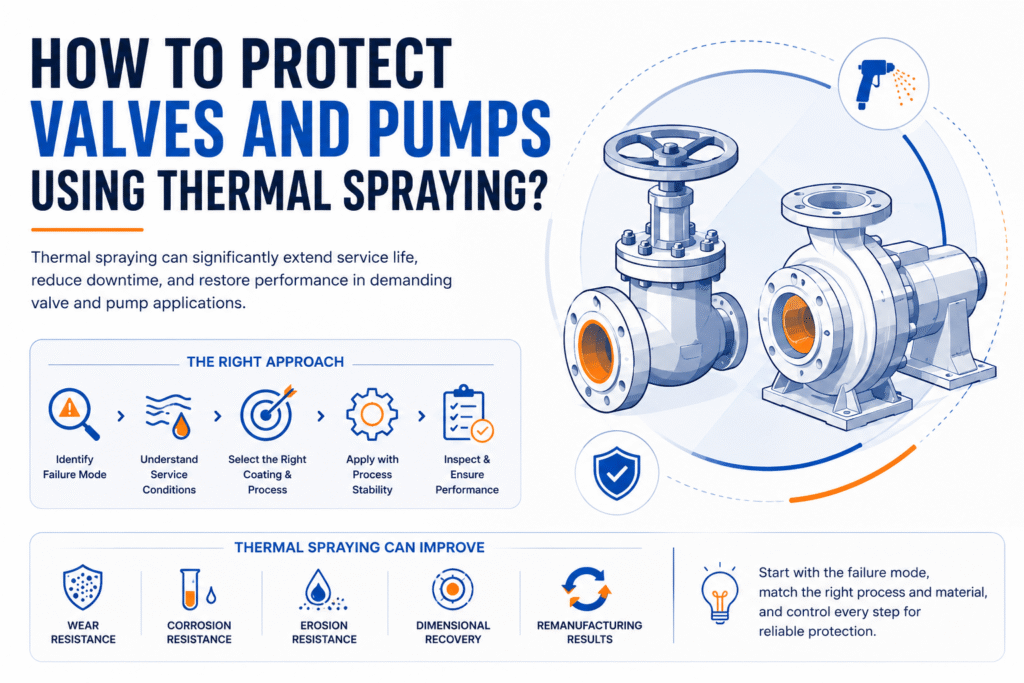
Thermal spraying can help protect valves and pumps, but many teams start in the wrong place. They ask for a coating name or the highest hardness number first. That creates risk, because leakage, sticking, cavitation, corrosion, and repeat wear often come from different failure modes. I prefer to start with the operating condition, then match the coating strategy.
To protect valves and pumps using thermal spraying, I first identify the failure mode, service medium, temperature, pressure, flow velocity, substrate, tolerance, and sealing requirement. Then I select a suitable coating process, material, surface preparation, and post-machining plan. Thermal spraying can improve wear resistance, corrosion resistance, erosion resistance, dimensional recovery, and remanufacturing results when the process is controlled correctly.1
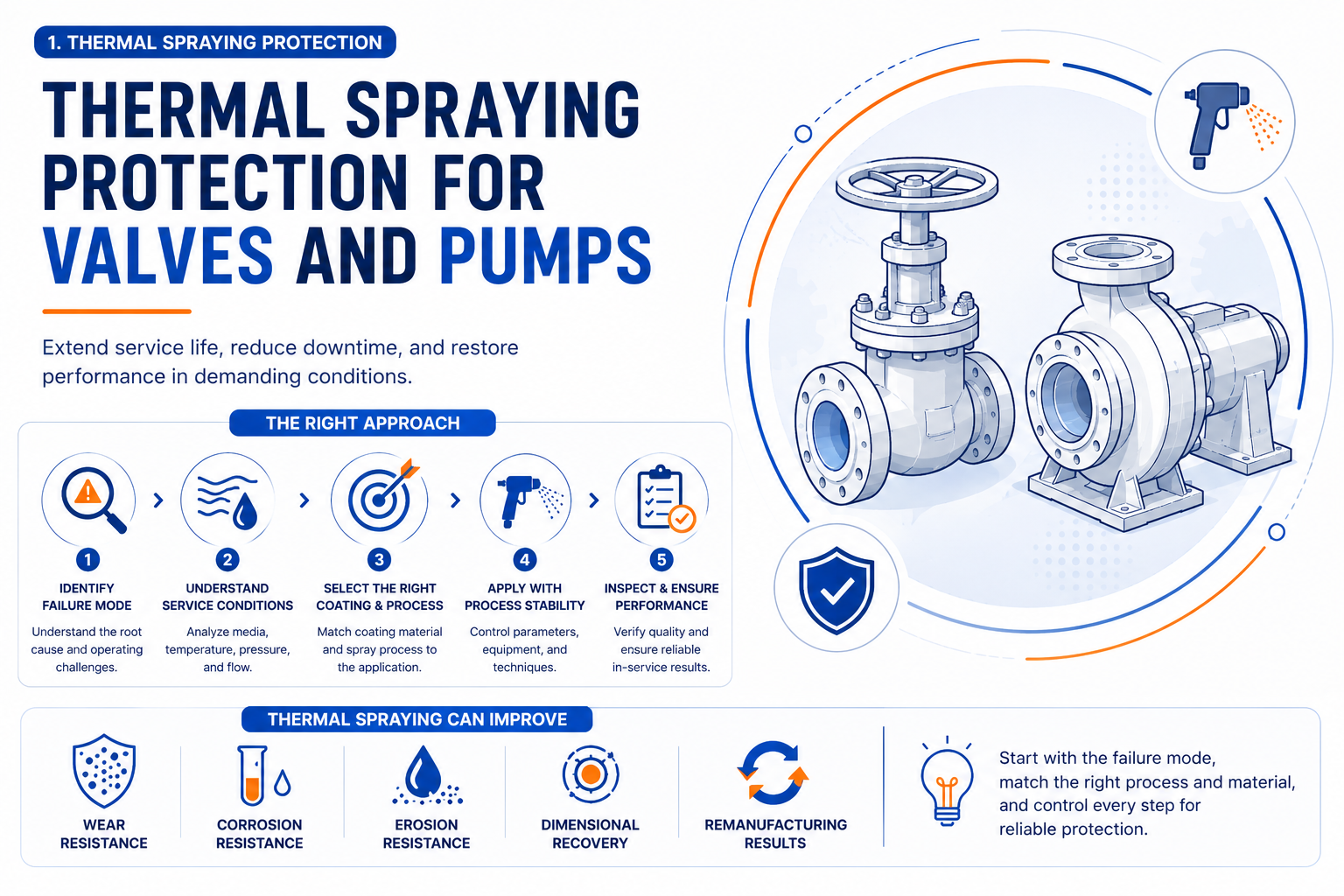
In my daily discussions around spray guns, consumables, and process stability, I often see the same pattern. The best results rarely come from choosing a famous coating name alone. They come from asking better questions before the first particle ever hits the part.
Start with the Failure Mode, Not the Thermal Spraying Coating Material?
Many valve and pump problems look similar after damage appears. A sealing face is scratched. A shaft sleeve loses size. A pump component becomes rough. The problem gets worse when someone says, “Just apply a harder coating.” I see this shortcut often, and it can lead to the wrong thermal spraying decision.
The right starting point is the failure mode, not the coating material. Abrasive wear, sliding wear, corrosion, erosion, and cavitation place different demands on a coating.2 A coating that performs well against dry abrasion may not be the best choice for wet corrosion, sealing surfaces, or high-velocity particle impact.

Why the Failure Mode Comes First
I usually begin with one simple question: what failed, and where did it fail? That question is more useful than asking for a material grade. Valves and pumps work in complex service environments. They may see liquid flow, solid particles, chemical media, pressure cycling, contact stress, and temperature changes at the same time.
Common failure modes include:
- Abrasive wear: Hard particles cut or plow the surface.
- Sliding or contact wear: Two surfaces rub under load.
- Corrosion: Chemical reaction attacks the surface.
- Erosion: High-speed fluid or particles remove material.
- Cavitation: Vapor bubbles collapse and create repeated impact.
- Oxidation: High temperature causes surface degradation.
- Dimensional loss: Wear changes clearance, fit, or sealing pressure.
Each condition requires a different coating expectation. For example, a hard carbide coating may help resist abrasive wear, but it may not solve a sealing problem if the surface finish is too rough after spraying. A corrosion-resistant alloy may help in a chemical medium, but it may not survive severe particle erosion if the coating structure and process are not suitable.
Questions I Ask Before Discussing Coating Names
When I support thermal spray process discussions, I like to ask practical questions first:
-
What medium is flowing through the valve or pump?
Water, slurry, oil, steam, seawater, acid, gas, or mixed media all matter. -
What is the working temperature?
Coating behavior can change at elevated temperature. -
What is the pressure and flow velocity?
High pressure and high velocity increase erosion and sealing challenges. -
Where is the damage located?
A sealing face, bore, stem, sleeve, impeller, plunger, or seat each has different functional needs. -
What tolerance must be restored?
A coating is not useful if the part cannot be machined back to the required dimension. -
What surface roughness is required?
A pump shaft sleeve and a valve sealing surface may need very different finishes.
Failure Mode and Coating Direction
| Main failure mode | Typical coating direction | Key caution |
|---|---|---|
| Abrasive wear | Carbide-based wear-resistant coatings | Hardness helps, but toughness and bonding also matter |
| Sliding/contact wear | Wear-resistant coating with good finish after grinding | Surface roughness and mating material are critical |
| Corrosion | Corrosion-resistant alloy or ceramic coating, depending on media | Porosity and sealing strategy may matter |
| Erosion | Dense, well-bonded coating with suitable toughness | Particle angle, velocity, and size change the answer |
| Cavitation risk | Tougher coating systems may reduce risk in some cases | Thermal spraying cannot guarantee cavitation elimination |
| Dimensional recovery | Build-up coating plus machining | Final tolerance decides whether repair is successful |
I do not treat thermal spraying as a universal fix. I treat it as a surface engineering tool. It can be very valuable when the failure mode is understood. It can also disappoint when the root problem is ignored. That is why I would rather spend more time on diagnosis than rush into a coating recommendation.
Choosing the Right Thermal Spray Solution for Different Valve and Pump Applications?
Valve and pump applications vary widely. A coating that works on a shaft sleeve may not suit a valve seat. A process that works for dimensional restoration may not be ideal for severe corrosion. The risk appears when teams compare coatings without connecting them to the actual duty.
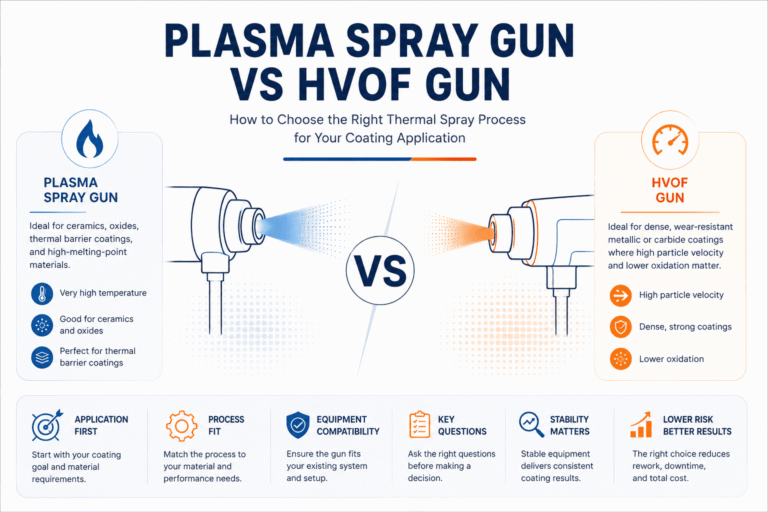
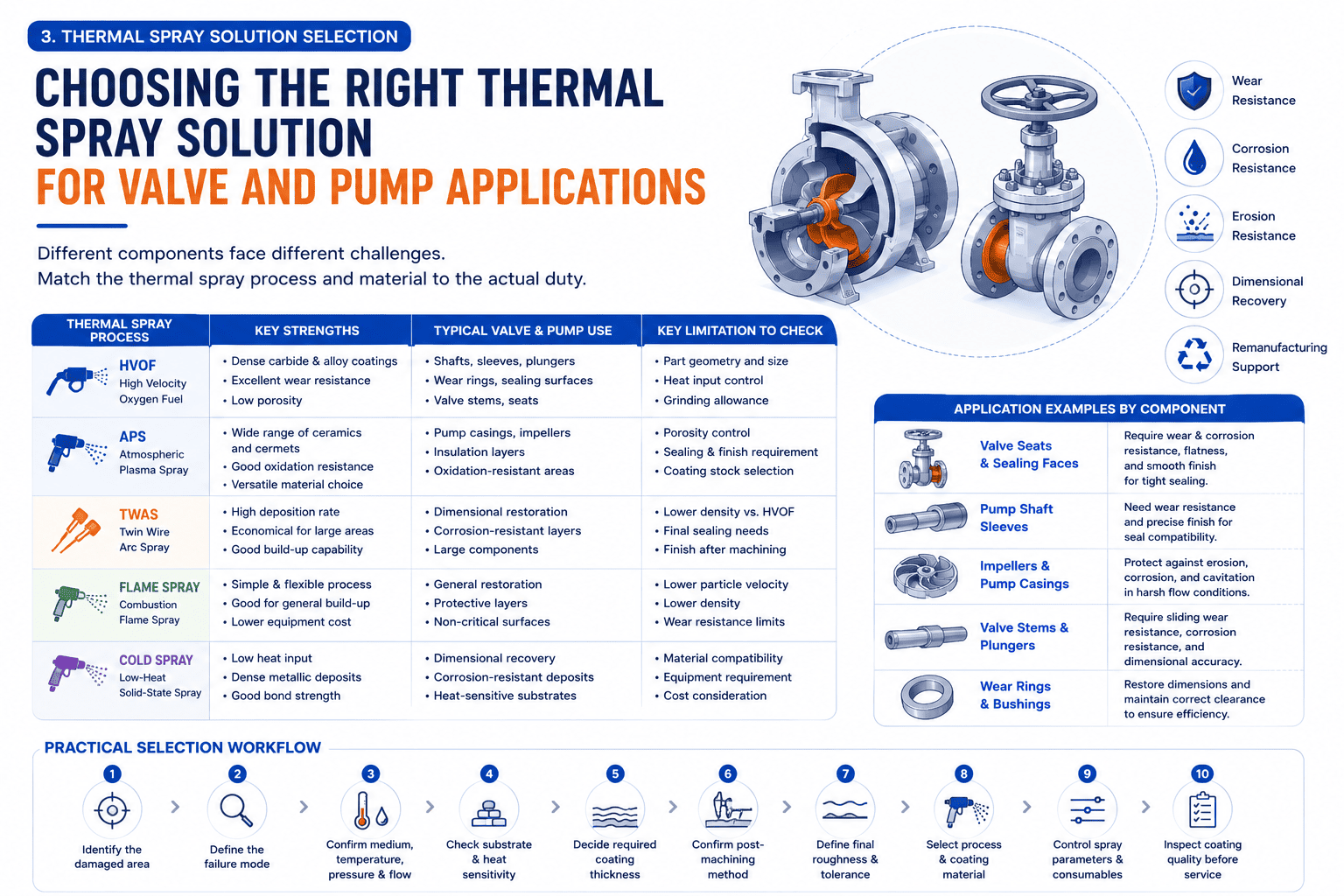
The right thermal spray solution depends on the component function, damage mechanism, substrate, and operating environment. HVOF, plasma spraying, arc spraying, flame spraying, and cold spray can all be useful, but each process has different strengths in wear resistance, oxidation resistance, corrosion behavior, coating density, and build-up capability.3
Match the Process to the Job
I try to avoid saying one process is always better. In reality, each thermal spray process has its own window. The best choice depends on what the coating must do after machining, assembly, and operation.
Here is a practical way to think about common options:
| Thermal spray process | Common strengths | Possible valve and pump use | Key limitation to check |
|---|---|---|---|
| HVOF High Velocity Oxygen Fuel | Dense carbide and alloy coatings, strong wear resistance4 | Shafts, sleeves, plungers, wear rings, sealing-related surfaces | Part geometry, heat input, grinding allowance |
| APS Atmospheric Plasma Spray | Ceramics, cermets, high-temperature materials | Insulation, oxidation resistance, selected wear areas | Porosity control, sealing, finish requirement5 |
| TWAS Twin Wire Arc Spray | Fast build-up, economical for larger surfaces | Dimensional restoration, corrosion-resistant layers | Coating density and final sealing needs |
| Flame spray | Flexible, accessible, useful for some build-up jobs | General restoration or protective layers | Lower particle velocity than HVOF in many cases |
| Cold spray | Low heat input, dense metallic deposits in suitable materials6 | Dimensional restoration, selected corrosion-resistant deposits | Material compatibility and equipment requirements |
Application Examples Without Oversimplifying
Different parts inside valves and pumps have different requirements.
Valve seats and sealing faces need more than wear resistance. They need the right flatness, roughness, and contact pattern. If the coating is too rough, too brittle, or incorrectly machined, leakage can occur even if the coating material is technically strong.
Pump shaft sleeves often need wear resistance and good finish. The coating must tolerate contact with seals or packing. The final ground surface matters because seal life can depend on roughness and surface texture.
Impellers and pump casings may face erosion, corrosion, or cavitation risk. In slurry or high-velocity liquid, particle impact angle and medium chemistry can change the best coating direction. In cavitation service, I would use careful language. A coating may reduce damage risk in some conditions, but it does not remove the hydraulic cause of cavitation.
Valve stems and plungers may need sliding wear resistance, corrosion resistance, and dimensional accuracy. A coating that is too thick, poorly finished, or uneven can cause sticking or abnormal contact.
A Practical Selection Workflow
When I discuss thermal spraying with customers, I like this sequence:
- Identify the damaged area.
- Define the failure mode.
- Confirm medium, temperature, pressure, and flow.
- Check substrate and heat sensitivity.
- Decide required coating thickness.
- Confirm post-machining method.
- Define final roughness and tolerance.
- Select process and coating material.
- Control spray parameters and consumables.
- Inspect coating quality before service.
This workflow keeps the decision practical. It also helps procurement teams avoid vague supplier claims such as “this coating is very hard” or “this alloy is used everywhere.” In my view, those claims are not enough. A good solution must fit the component’s actual job.
Why Hardness Alone Doesn't Determine Thermal Spraying Coating Performance?
Hardness numbers are easy to compare. That is why they often dominate coating discussions. The problem is that a valve or pump does not operate inside a hardness tester. It operates in pressure, flow, media, vibration, contact, temperature, and tolerance limits. Hardness alone cannot explain that full picture.
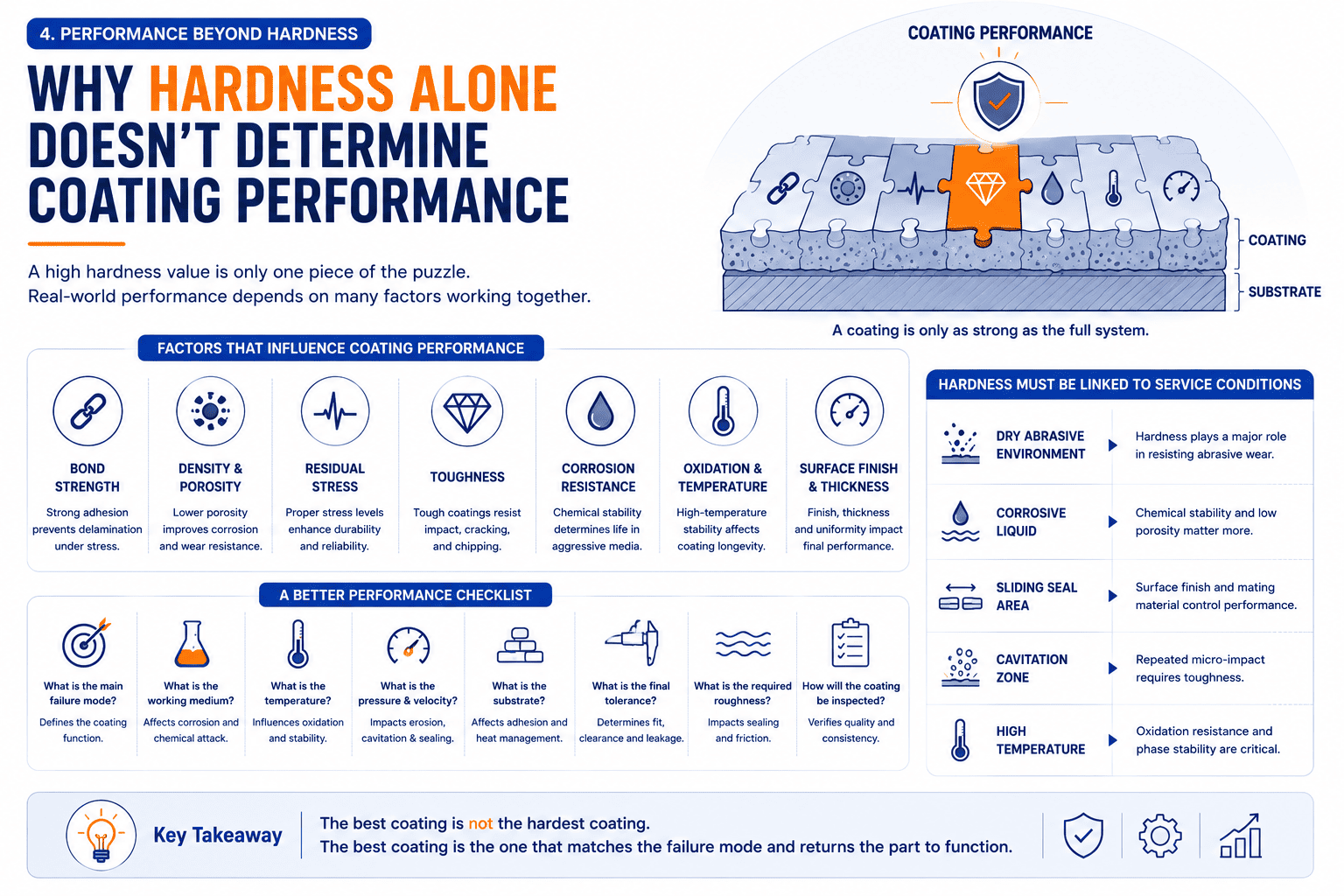
Higher hardness does not automatically mean better coating performance.7 Hardness matters only after the medium, temperature, pressure, velocity, substrate, coating structure, bond strength, thickness, finish, and mechanical fit are considered. A very hard coating can still fail if it is brittle, porous, poorly bonded, or wrong for the service environment.
The Hardness Misconception
I understand why hardness gets attention. A high HRC or HV value looks clear on a datasheet. It gives the buyer something simple to compare. However, I have learned that simple comparisons can hide important risks.
For valve and pump protection, coating performance may depend on:
- Bond strength
- Coating density
- Porosity
- Oxide content
- Residual stress
- Microcrack behavior
- Toughness
- Corrosion resistance
- Surface roughness after finishing
- Coating thickness and uniformity
- Compatibility with the mating part
A hard coating may resist abrasive particles. But if the application involves impact, thermal cycling, or edge loading, toughness becomes important. A hard coating may also polish well, but only if the coating is dense and the grinding process is suitable.
Hardness Must Be Linked to Service Conditions
The same hardness number can behave differently in different environments. For example:
- In a dry abrasive environment, hardness may strongly influence wear resistance.
- In a corrosive liquid, chemical stability and porosity may matter more.
- In a sliding seal area, surface finish and mating material may decide performance.
- In a cavitation zone, repeated micro-impact may challenge brittle coatings.
- In a high-temperature zone, oxidation and phase stability become more important.
This is why I do not recommend choosing thermal spraying coating systems by hardness alone. I prefer to ask what the coating must survive.
A Better Performance Checklist
Before accepting a coating recommendation, I suggest reviewing this checklist:
| Question | Why it matters |
|---|---|
| What is the main failure mode? | It defines the coating function |
| What is the working medium? | It affects corrosion and chemical attack |
| What is the temperature? | It affects oxidation and coating stability |
| What is the pressure and velocity? | It affects erosion, cavitation risk, and sealing |
| What is the substrate? | It affects adhesion, heat input, and preparation |
| What is the final tolerance? | It affects fit, clearance, and leakage |
| What is the required roughness? | It affects sealing and friction |
| How will the coating be inspected? | It verifies consistency before service |
Hardness is still useful. I do not dismiss it. I just put it in the correct order. It is one measurement among many. If a coating recommendation begins and ends with hardness, I would slow down and ask more questions.
In my view, the best coating is not the hardest coating. The best coating is the one that matches the failure mode and returns the part to function.
Beyond Thermal Spraying Coating Selection: Why Dimensional Accuracy and Surface Finish Matter?
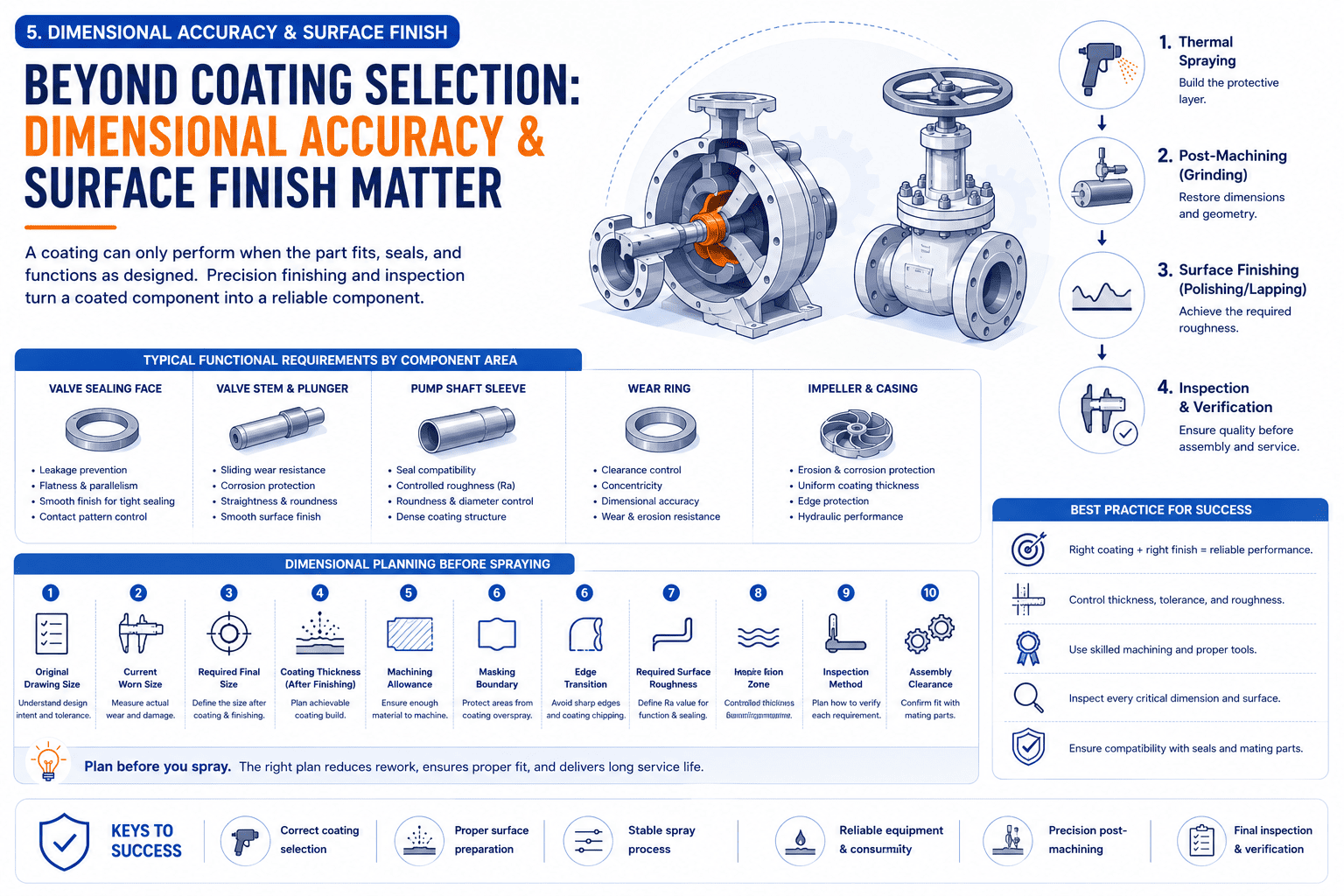
A coating can be well selected and still fail in service if the final geometry is wrong. Valves and pumps are functional parts, not display samples. A sealing surface must seal. A shaft sleeve must fit. A bore must hold clearance. If these details are missed, rework becomes likely.
For valves and pumps, post-coating function matters as much as coating selection. Dimensional accuracy, surface roughness, sealing face flatness, clearance, and post-machining quality decide whether the coated part can return to service without leakage, sticking, vibration, or premature wear.
Coating Is Only Half the Work
I often remind customers that thermal spraying creates a surface layer, but the part must still be finished to a working condition. This is especially important for valves and pumps because many coated areas interact with other components.
A few examples make this clear:
- Valve seats require controlled contact and sealing.
- Ball valve surfaces may require precise roundness and smoothness.
- Pump shaft sleeves need controlled diameter and roughness for seals.
- Wear rings need accurate clearance to maintain pump efficiency.
- Plungers need straightness and smooth finish to avoid seal damage.
- Bores and internal surfaces may require special tooling and inspection.
If the coating thickness is uneven, the machining allowance may be insufficient in some areas. If the coating is too porous or rough after finishing, it may hold media or accelerate seal wear. If the coating edge is not designed well, it may chip under contact.
Dimensional Planning Before Spraying
The best time to think about grinding or machining is before spraying starts. I like to confirm these items early:
- Original drawing size
- Current worn size
- Required final size
- Coating thickness after finishing
- Machining allowance
- Masking boundary
- Edge transition
- Required surface roughness
- Inspection method
- Assembly clearance
A coating supplier, repair shop, or OEM should not treat these as secondary details. They decide whether the coated part works.
Typical Functional Requirements
| Component area | Functional concern | Coating-related control point |
|---|---|---|
| Valve sealing face | Leakage prevention | Flatness, roughness, contact pattern |
| Valve stem | Sliding and corrosion | Diameter, straightness, finish |
| Pump shaft sleeve | Seal compatibility | Roughness, roundness, coating density |
| Wear ring | Clearance control | Final diameter and concentricity |
| Plunger | Seal wear and friction | Smooth finish and coating uniformity |
| Pump casing | Erosion/corrosion reduction | Coverage, thickness, edge control |
Why Equipment Precision Also Matters
My business focuses on thermal spray guns, components, and consumables, so I naturally pay close attention to hardware stability. However, I do not claim that equipment alone decides coating success. It is one part of a larger system.
Still, stable equipment supports repeatable coating results. For example, controlled gun geometry, stable arc or flame behavior, consistent powder or wire delivery, and accurate consumable dimensions all help reduce variation. In our ARCTHERM-related work, we focus on precision machining for spray gun bodies, cathodes, anodes, barrels, and combustion chambers because these parts influence process repeatability.
For high-quality valve and pump coating work, I would combine:
- Correct coating selection
- Good surface preparation
- Stable spray parameters
- Reliable spray gun and consumables
- Controlled coating thickness
- Skilled post-machining
- Final inspection
That full chain matters. If one link is weak, the coating may not deliver the expected function.
Process Stability Is Key to Reliable Thermal Spray Results?
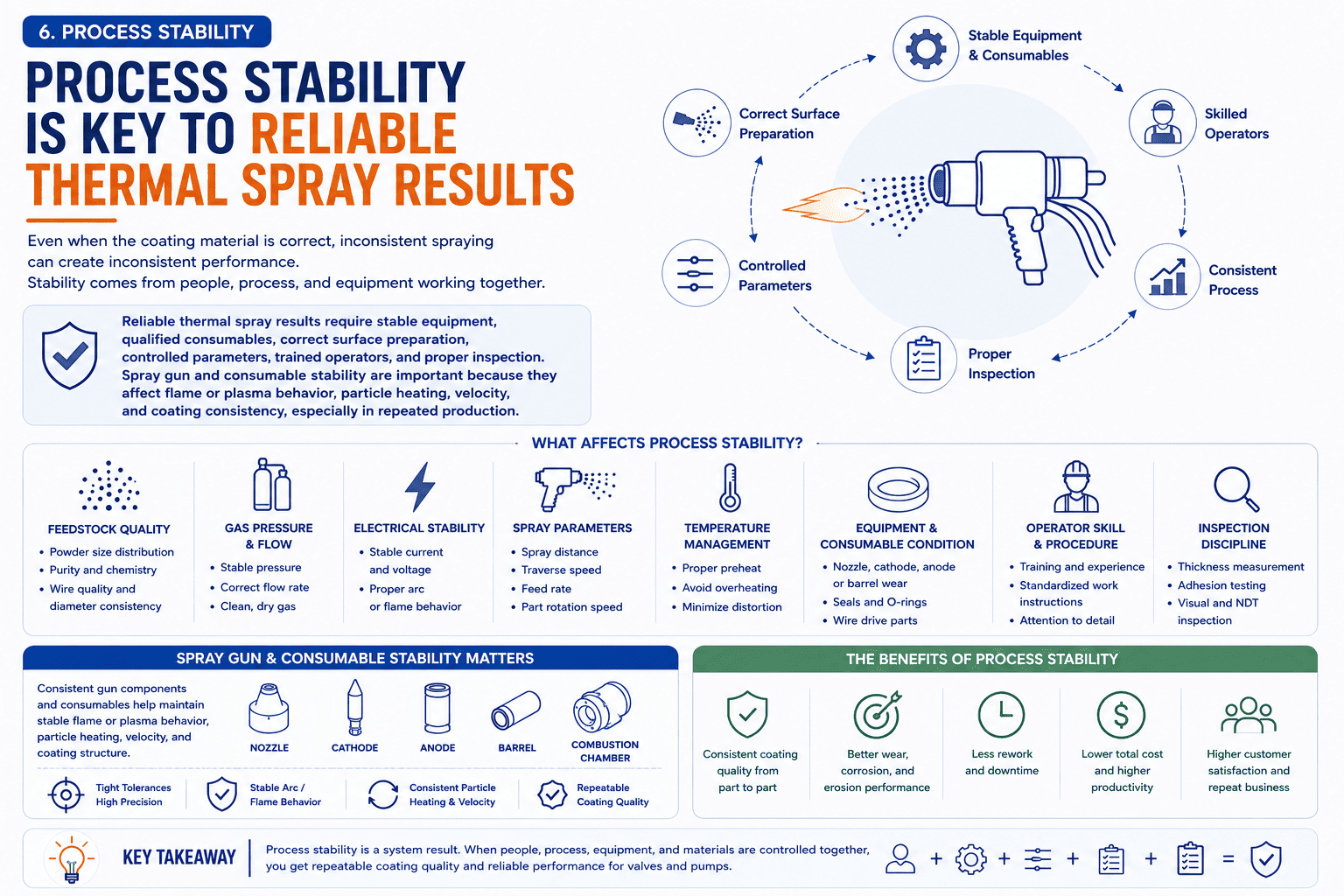
Even when the coating material is correct, inconsistent spraying can create inconsistent performance. A valve or pump manufacturer may need repeat production. A repair provider may need predictable restoration. A plant maintenance team may need fewer surprises. Process instability makes all of these goals harder.
Reliable thermal spray results require stable equipment, qualified consumables, correct surface preparation, controlled parameters, trained operators, and proper inspection. Spray gun and consumable stability are important because they affect flame or plasma behavior, particle heating, velocity, and coating consistency, especially in repeated production.8
What Process Stability Really Means
Process stability is not a marketing phrase. It is the practical ability to produce similar coating quality again and again. For valves and pumps, this matters because performance depends on coating structure, thickness, adhesion, and finish.
In thermal spraying, variation can come from many sources:
- Powder size distribution or wire quality
- Gas pressure and flow
- Current and voltage stability
- Spray distance
- Gun traverse speed
- Part rotation speed
- Surface preparation
- Substrate temperature
- Nozzle, cathode, anode, or barrel wear
- Operator technique
- Masking and fixturing
- Inspection discipline
I pay close attention to spray gun and consumable condition because worn or inconsistent components can change the spray plume. In plasma spraying, cathode and anode condition can affect arc stability. In HVOF, combustion chamber and barrel condition can influence flame stability and particle acceleration. In arc spraying, wire feeding and arc behavior affect deposit consistency.
Stability Does Not Replace Good Engineering
I want to be clear: stable equipment does not rescue a wrong coating selection. It also does not replace surface preparation or operator control. A well-made spray gun cannot make an unsuitable material correct for severe corrosion. A precise consumable cannot fix an incorrect final clearance.
However, process stability helps the selected solution perform closer to its intended design. This is especially important when production needs repeatability.
A controlled process should define:
-
Surface preparation method
Grit blasting profile, cleanliness, masking, and preheating must be controlled. -
Spray parameters
Gas flow, current, voltage, spray distance, feed rate, and traverse speed should be documented. -
Consumable condition
Nozzles, electrodes, barrels, wires, powders, and seals should be monitored. -
Temperature management
The part should not overheat or distort beyond acceptable limits. -
Coating thickness control
Thickness should allow final machining without excessive stress or waste. -
Inspection requirements
Visual checks, thickness measurement, adhesion testing, roughness measurement, or other relevant inspections should be specified according to the job.
Why I Connect Hardware to Coating Consistency
Because I work with thermal spraying equipment, spray guns, and consumables, I see how small hardware details can affect repeatability. Precision parts such as cathodes, anodes, gun barrels, and combustion chambers are not just spare parts. They support stable energy transfer and particle behavior.
For example, our manufacturing focus includes:
- Dimensional precision within tight tolerances
- Controlled inner bore surface finish
- Stable flame or plasma arc behavior
- Compatibility with mainstream thermal spray systems
- Non-thoriated tungsten material options for selected electrodes
- Vacuum casting approaches for tungsten-copper connections in relevant parts
I mention this lightly because it connects to the larger point. Process consistency is a system result. It comes from material choice, surface preparation, parameters, equipment, operator skill, and inspection working together.
For valve and pump protection, this mindset reduces guesswork. It helps teams compare suppliers by process control, not only by coating names.
Frequently Asked Questions
Is thermal spraying suitable for all valve and pump failures?
No. Thermal spraying is useful for many wear, corrosion, oxidation, erosion, dimensional recovery, and remanufacturing applications, but it is not universal. I would first confirm the failure mode, operating medium, temperature, pressure, flow velocity, substrate, and tolerance. Some failures require design changes, material changes, or hydraulic corrections.
Which thermal spray coating is best for pump shaft sleeves?
There is no single best coating for every pump shaft sleeve. The choice depends on seal type, medium, wear mode, corrosion risk, required hardness, final diameter, and surface roughness. HVOF carbide coatings are often considered for wear, but the final ground finish and seal compatibility are just as important.
Can thermal spraying prevent cavitation damage in pumps?
Thermal spraying may reduce cavitation damage risk in some conditions, but it should not be presented as a guaranteed cure. Cavitation is often caused by hydraulic conditions such as pressure drop, flow design, or operation outside the intended range. Coating selection should be combined with root-cause review.
Why does surface finish matter after thermal spraying?
Surface finish affects sealing, friction, leakage, and mating part wear.9 A coating may have good hardness and adhesion, but if the final roughness or geometry is wrong, the valve or pump may still fail. Grinding, polishing, lapping, and inspection should be planned before spraying starts.
How should I evaluate a thermal spray supplier for valve and pump parts?
I would ask how the supplier identifies failure mode, selects coating materials, controls surface preparation, documents spray parameters, manages consumables, and verifies final dimensions. A supplier should discuss tolerance, roughness, coating thickness, inspection, and process stability instead of relying only on coating names or hardness numbers.
Conclusion
Thermal spraying can be a strong way to protect valves and pumps when the decision starts with the failure mode and operating condition. I would not choose a coating by name or hardness alone. I would review wear, corrosion, erosion, cavitation risk, medium, temperature, pressure, clearance, sealing, surface finish, and process stability. If you are evaluating spray guns, consumables, or process support for repeatable valve and pump coating work, I can help you ask the right technical questions before production begins.
"Thermal Sprayed Coatings Used Against Corrosion and ...", http://www.columbia.edu/cu/seas/earth/wtert/newwtert/Research/sofos/Thermal_Sprayed_Coatings_Used_Against%20pdf.pdf. A technical review of thermal spray technology supports that thermal spraying is used for wear, corrosion, and erosion protection as well as repair or dimensional restoration, while noting that achieved performance depends on feedstock, substrate preparation, spray parameters, and post-processing rather than the process name alone. Evidence role: general_support; source type: research. Supports: Thermal spray coatings are used to modify surfaces for wear, corrosion, erosion protection and restoration, and coating performance depends on controlled process conditions.. Scope note: This would support the general capability of thermal spraying, not prove performance for any specific valve or pump part. ↩
"Surface Engineering & Coating Technologies for Corrosion and ...", https://pmc.ncbi.nlm.nih.gov/articles/PMC10343551/. Tribology and surface-engineering literature distinguishes abrasive, sliding/contact, erosive, corrosive, and cavitation damage mechanisms, supporting the article's point that coating selection should be matched to the operative failure mode; the source would provide mechanism-level support rather than a valve-specific selection rule. Evidence role: mechanism; source type: paper. Supports: Abrasive wear, sliding/contact wear, erosion, corrosion, and cavitation involve different mechanisms and therefore require different material or coating properties.. Scope note: Contextual support unless the source specifically discusses valves and pumps. ↩
"Review of the physicochemical properties and associated health ...", https://pmc.ncbi.nlm.nih.gov/articles/PMC7988297/. Comparative thermal-spray references report that HVOF, plasma spray, wire arc spray, flame spray, and cold spray differ in heat source, particle temperature and velocity, and resulting coating density and properties, supporting the article's process-selection distinction at a general level. Evidence role: general_support; source type: research. Supports: Different thermal spray processes produce different coating structures and properties because of differences in energy source, particle temperature, particle velocity, and deposition mechanism.. Scope note: The source would not determine the best process for a specific component without service conditions and acceptance criteria. ↩
"A comparison of cold spray, atmospheric plasma spray and high ...", https://pmc.ncbi.nlm.nih.gov/articles/PMC11492586/. Peer-reviewed HVOF coating studies and reviews commonly report that high particle velocities enable dense carbide and alloy coatings, with WC-based HVOF deposits often showing high wear resistance; this supports the table's general characterization but does not guarantee performance for every geometry or medium. Evidence role: general_support; source type: paper. Supports: HVOF can deposit relatively dense carbide or alloy coatings, including WC-based systems, with good wear resistance.. Scope note: General HVOF evidence, not a direct validation of all listed valve and pump uses. ↩
"Thermal Sprayed Coatings Used Against Corrosion and ...", http://www.columbia.edu/cu/seas/earth/wtert/newwtert/Research/sofos/Thermal_Sprayed_Coatings_Used_Against%20pdf.pdf. Research on plasma-sprayed coatings shows that lamellar microstructures may include pores and microcracks, and that porosity can influence permeability, corrosion behavior, and the need for sealing or finishing; this supports the stated APS control concerns without assessing a specific coating recipe. Evidence role: mechanism; source type: paper. Supports: Atmospheric plasma-sprayed coatings can contain porosity, and porosity may affect sealing, corrosion behavior, and post-finishing requirements.. Scope note: Contextual support because porosity levels vary widely with material and spray parameters. ↩
"Cold Spray: Over 30 Years of Development Toward a Hot Future", https://pmc.ncbi.nlm.nih.gov/articles/PMC9059919/. Cold-spray reviews describe the process as a solid-state deposition method in which particles bond by high-velocity impact rather than melting, enabling relatively low heat input and dense metallic deposits for compatible materials; this supports the article's general description but not suitability for every alloy or component. Evidence role: definition; source type: paper. Supports: Cold spray is a solid-state deposition process with comparatively low thermal input and can form dense metallic coatings when feedstock and parameters are suitable.. Scope note: Material compatibility and deposit quality depend strongly on powder, gas conditions, and substrate. ↩
"Thermally Sprayed Coatings for the Protection of Industrial Fan Blades", https://pmc.ncbi.nlm.nih.gov/articles/PMC11355385/. Coating and tribology reviews indicate that hardness is only one contributor to service performance, with adhesion, toughness, porosity, residual stress, microstructure, surface finish, and operating environment also affecting wear or failure; this supports the article's caution against hardness-only selection. Evidence role: expert_consensus; source type: paper. Supports: Coating performance depends on factors such as toughness, adhesion, porosity, microstructure, residual stress, corrosion behavior, and service environment in addition to hardness.. Scope note: The evidence is general and does not rank variables for a specific valve or pump service. ↩
"Design and Development of a High Velocity Oxy-Fuel Thermal Spray Gun", https://scholarworks.utep.edu/cgi/viewcontent.cgi?article=2209&context=open_etd. Thermal-spray process studies show that particle temperature, velocity, feed rate, spray distance, and torch or nozzle condition influence plume behavior and coating microstructure, adhesion, and repeatability, supporting the article's link between equipment stability and coating consistency. Evidence role: mechanism; source type: paper. Supports: Thermal spray coating properties are affected by process stability, including energy transfer, particle temperature and velocity, feedstock delivery, and torch or gun condition.. Scope note: This supports the general mechanism and does not substantiate any particular manufacturer's hardware performance. ↩
"Lubrication and Wear Characteristics of Mechanical Face Seals under ...", https://pmc.ncbi.nlm.nih.gov/articles/PMC7143530/. Tribology and seal-performance literature shows that surface roughness and texture influence real contact area, lubricant or fluid film behavior, leakage paths, friction, and mating-surface wear, supporting the article's emphasis on final surface finish. Evidence role: mechanism; source type: paper. Supports: Surface roughness and texture affect contact mechanics, fluid leakage pathways, friction, and wear in sealing or sliding interfaces.. Scope note: The cited evidence would be mechanism-level; acceptable roughness values remain application- and seal-design-specific. ↩