I see coating teams chase powder and parameters first. The problem grows when the flame still shifts. I look upstream at the nozzle and barrel.
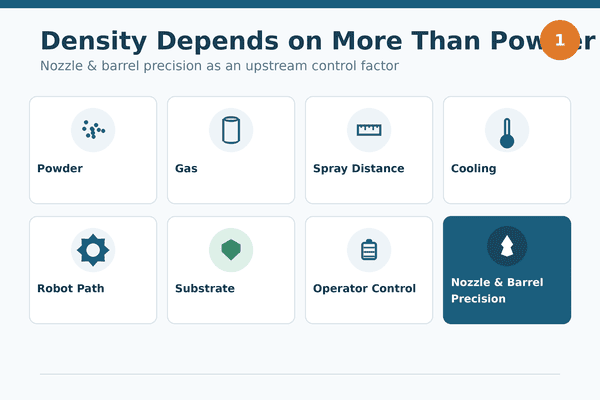
HVOF coating density depends on more than powder choice and spray settings.1 I treat nozzle and barrel precision as upstream control factors because their dimensions, alignment, and inner-bore quality can affect flame stability, particle heating, particle speed, spray focus, and density consistency.2
I have stood beside coating lines where the parameter sheet looked correct, the powder lot looked acceptable, and the operator still heard a small change in the flame. That small change matters. I do not see nozzles and barrels as simple metal parts that only need to fit the gun. I see them as parts that guide energy, gas flow, powder path, and spray shape.
I will not say that a precise nozzle or barrel alone guarantees a dense coating. That would be too simple. HVOF coating density also depends on powder, gas, distance, cooling, robot path, substrate, and operator control.3 I will say something more useful. I believe nozzle and barrel precision can reduce one important source of process variation, and that is often where stable production begins.
Why Are Nozzles and Barrels Not Just Wear Parts in HVOF Systems?
I often hear buyers call them consumables. That word can hide risk. A part can fit well and still spray poorly.
A nozzle or barrel in an HVOF system is a process-critical component, not only a replaceable wear part.4 I evaluate it by fit, key dimensions, coaxiality, inner-bore condition, machining stability, and inspection method because these details can influence spray stability and coating consistency.
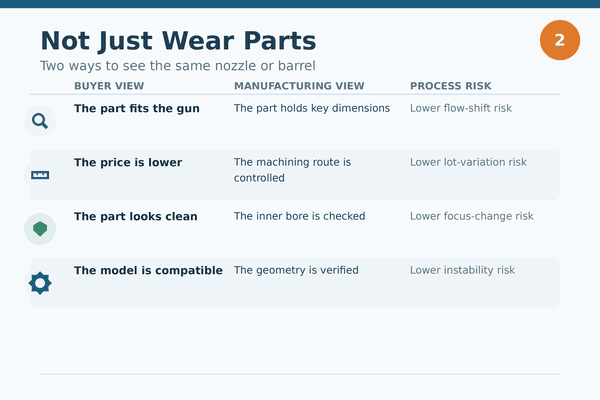
I manufacture thermal spray gun bodies and consumables, so I look at these parts from the machining side first. I have learned that a part that threads in smoothly is not always a part that supports a stable flame. A buyer may ask, “Is it compatible with my gun?” I think that question is only the first step. A better question is, “Can this part hold the geometry that my process needs?”
In HVOF, the nozzle and barrel shape the gas stream and the particle path.5 The part has a direct position in the energy flow. If the inner bore is not smooth enough, or if the centerline is not controlled well, the flow can become less stable.6 The operator may still complete the job. The coating may still pass a basic visual check. Yet the density may drift from batch to batch.
I often explain the difference in a simple table:
| Buyer View | Manufacturing View | Process Risk |
|---|---|---|
| The part fits the gun | The part holds key dimensions | Lower risk of flow shift |
| The price is lower | The machining route is controlled | Lower risk of lot variation |
| The part looks clean | The inner bore is checked | Lower risk of spray focus change |
| The model is compatible | The geometry is verified | Lower risk of unstable production |
I use precision machining because I do not want the coating shop to find my errors during spraying. In my work, I pay attention to dimensional control, shape and position tolerance, inner-bore quality, and stability-related inspection. In some parts, I control dimensions within 0.01 mm where the design needs it. I also focus on inner-bore surface quality because the inside surface is not a cosmetic area. It is part of the gas path.
How Do Precision Errors in Nozzle and Barrel Affect Flame Stability and Particle Behavior?
I have seen small geometry errors create large troubleshooting work. The flame may not fail. It may only become less repeatable.
Precision errors can affect gas flow, flame shape, and spray focus.7 When flame stability changes, particles may receive less consistent heating and acceleration.8 This can raise the risk of porosity, weak splat formation, and coating density variation, even when the powder and spray parameters remain the same.9
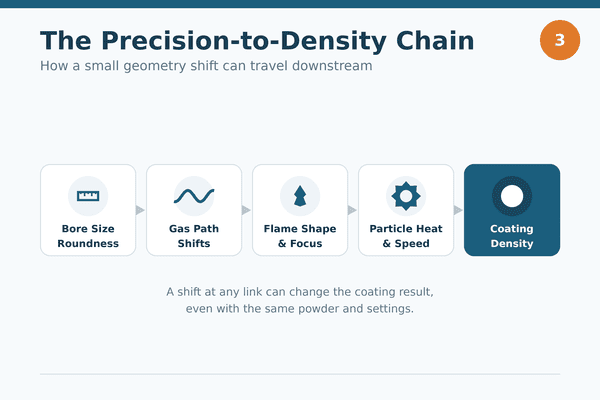
I like to explain the mechanism as a chain. The chain starts before the powder reaches the substrate. It starts with the geometry inside the nozzle or barrel. If the bore size, roundness, coaxiality, or surface finish shifts, the gas path can shift with it. If the gas path shifts, the flame shape and spray focus can also shift. If the flame shape changes, particle heating and particle speed may become less consistent. If the particle condition changes, the coating structure can become less stable.
I do not need to overstate this point. Nozzle and barrel precision is not the only factor. It is one upstream factor that can make the downstream process easier or harder to control.
| Manufacturing Variable | What I Watch | Possible Process Effect |
|---|---|---|
| Bore diameter | I check key internal dimensions | Gas velocity and flow balance may shift |
| Coaxiality | I watch centerline alignment | Flame and spray focus may move |
| Inner-bore roughness10 | I control the internal surface | Flow resistance may become less stable |
| Edge condition | I avoid burrs and damage | Local turbulence may increase |
| Lot consistency | I keep the machining route stable | Batch-to-batch spray behavior may vary less |
In my factory work, I use precision CNC machining for parts such as HVOF barrels, combustion-related parts, and thermal spray gun components. I also know that inspection cannot stop at outside size. The inner bore matters because the process happens through the part, not around the part. I also pay attention to flame, arc length, or stability checks for gun bodies or related components where the product type requires it. This kind of verification gives the buyer more useful confidence than a simple statement that the part is compatible.
A coating shop may see the effect as a wider spray pattern, a change in deposit efficiency, or a density result that moves without an obvious cause.11 The root cause may not be the nozzle every time. Yet I believe the nozzle and barrel should always be included in the troubleshooting path.
What Is the Hidden Production Risk Behind Low-Precision or Inconsistent Replacement Parts?
I understand why teams buy on price. The problem appears later. The low-cost part can pass installation and still cost more.
Low-precision replacement parts may not fail at once, but they can create hidden costs through coating variation, longer troubleshooting, rework, extra testing, schedule delay, and unstable customer acceptance.12 I treat part consistency as a production-risk control item, not only a purchasing cost item.
I speak with many buyers who face a real pressure. They must reduce consumable cost. I respect that. A coating shop has margins, lead times, and customer demands. Yet I often ask them to separate purchase price from total process cost. A part can be cheap on the invoice and expensive on the shop floor.
The most difficult risk is not always sudden failure. Sudden failure is visible. The operator stops the machine. The team replaces the part. The loss is clear. The hidden risk is slower. The coating density changes. The porosity level moves. The operator adjusts parameters. The quality team adds checks. The production manager loses time. The customer asks for an explanation. No one wants to blame a part that looks normal.
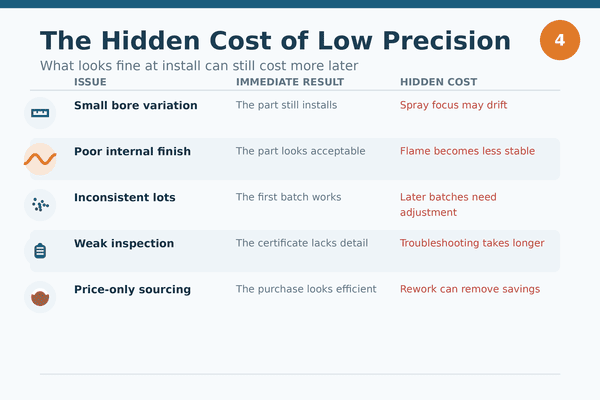
I often map the risk like this:
| Low-Precision Issue | Immediate Result | Hidden Cost |
|---|---|---|
| Small bore variation | The part still installs | Spray focus may drift |
| Poor internal finish | The part looks acceptable | Flame behavior may become less stable |
| Inconsistent lots | The first batch works | Later batches need new adjustment |
| Weak inspection | The certificate gives little detail | Troubleshooting takes longer |
| Price-only sourcing | The purchase looks efficient | Rework and delay can remove savings |
I do not say that every low-cost part is bad. I also do not say that every expensive part is good. I say the buyer needs proof of control. The supplier should know which dimensions matter. The supplier should know how the inner bore is machined and checked. The supplier should understand why stable flame behavior matters to the coating shop.
In my own work, I have learned that machining variation can become process variation. That lesson is practical. I use controlled machining and careful inspection because I do not want a customer to spend a full shift solving a problem that started in a small internal feature. A nozzle or barrel is small compared with the whole HVOF system. Yet its error can travel through the entire coating process.
What Should Buyers Evaluate Beyond Compatibility and Price?
I see many purchase requests with only model numbers. That is not enough. Compatibility tells me fit. It does not prove process control.
Buyers should ask about key dimensions, tolerance control, coaxiality, inner-bore roughness, machining method, material control, inspection method, and batch consistency. These questions help them judge whether a replacement nozzle or barrel can support stable HVOF spraying, not just fit the gun.
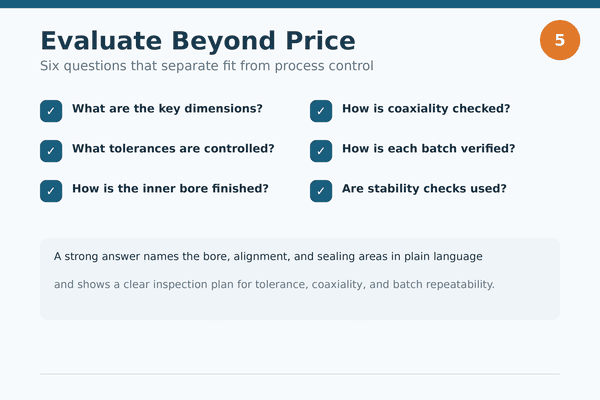
I suggest that buyers change the first question. Instead of asking only, “Is it compatible and what is the price?” I would ask, “Which features do you control, and how do you verify them?” This question moves the talk from sales language to manufacturing reality.
A good supplier should explain the part in terms of function. The supplier should know which areas guide gas flow, which areas affect sealing, and which areas influence alignment. The supplier should also be able to describe the machining process in plain language. For example, I use double-spindle and double-turret CNC equipment in precision machining work. This helps me control repeatability on complex parts. For critical parts, I also focus on dimensional accuracy, shape and position tolerance, and internal bore quality. Where the design requires it, I work toward tight control such as dimensions within 0.01 mm and low inner-bore roughness targets.
Here is the simple checklist I would use:
| Evaluation Question | Why I Ask It | What A Strong Answer Sounds Like |
|---|---|---|
| What are the key dimensions? | I need to know if the supplier understands function | The supplier identifies bore, length, alignment, and sealing areas |
| What tolerances are controlled? | I need more than a model name | The supplier gives practical tolerance targets |
| How is the inner bore finished? | I care about flow quality | The supplier explains machining and surface checks |
| How is coaxiality checked? | I care about spray focus | The supplier explains inspection tools and methods |
| How is each batch verified? | I care about repeatability | The supplier has a clear inspection plan |
| Are stability checks used where needed? | I care about real spray behavior | The supplier checks flame, arc, or gun stability for relevant products |
I also recommend that buyers keep records during testing. I would record the part batch, spray parameters, flame observation, coating density result, porosity result, and operator comments. This record helps the team separate powder issues from hardware issues. It also helps the supplier improve the part with real feedback.
I believe the best purchasing decision is not the cheapest part and not the most expensive part. It is the part with controlled geometry, clear inspection, stable batch quality, and a supplier who understands the HVOF process. That kind of buying method reduces risk before it reaches production.
Conclusion
I treat HVOF nozzles and barrels as process-control parts because their precision can reduce hidden variation before coating density problems appear.
"An Influence of Oxygen Flow Rate and Spray Distance on the ... - PMC", https://pmc.ncbi.nlm.nih.gov/articles/PMC9505576/. A review or experimental study of HVOF thermal spraying supports that coating density and porosity depend on interacting feedstock and process variables rather than on powder choice or nominal spray settings alone. Evidence role: general_support; source type: paper. Supports: HVOF coating density or porosity is affected by multiple interacting variables, including feedstock properties, gas conditions, spray distance, particle temperature, and particle velocity.. Scope note: The source would support the general multifactor nature of coating density, not prove the effect of any specific nozzle or barrel used in the article. ↩
"[PDF] Computational study of particle in-flight behavior in the HVOF ...", http://pdclab.seas.ucla.edu/Publications/MLi/MLi_PDChristofides_CES_2006_61_Computational_Study_Particle_In-Flight_Behavior.pdf. Thermal spray studies report that HVOF nozzle and gas-flow geometry affect particle temperature and velocity, which are linked to spray focus and coating microstructure. Evidence role: mechanism; source type: paper. Supports: Nozzle geometry and gas-flow conditions in HVOF spraying influence particle acceleration, heating, and resulting coating microstructure.. Scope note: Such evidence would establish the mechanism in HVOF systems generally, not certify the precision or performance of the specific parts described by the author. ↩
"An Influence of Oxygen Flow Rate and Spray Distance on the ...", https://pmc.ncbi.nlm.nih.gov/articles/PMC9505576/. Technical literature on HVOF process optimization identifies feedstock, gas parameters, standoff distance, substrate preparation, cooling, and motion control as variables affecting coating density and related properties. Evidence role: expert_consensus; source type: research. Supports: HVOF coating properties are affected by feedstock, gas parameters, spray distance, cooling, substrate preparation, and process control.. Scope note: The source would support the listed variables as recognized influences, but the relative importance of each variable depends on the material system and gun configuration. ↩
"Thermal spraying - Wikipedia", https://en.wikipedia.org/wiki/Thermal_spraying. General descriptions of HVOF thermal spraying describe the gun nozzle as part of the combustion and acceleration system that directs high-velocity gases and particles toward the substrate. Evidence role: definition; source type: encyclopedia. Supports: HVOF gun components, including nozzles, form part of the combustion and acceleration path that determines how particles are heated and propelled.. Scope note: An encyclopedia source would provide functional context, not a quantitative assessment of process criticality for a particular replacement part. ↩
"[PDF] Computational study of particle in-flight behavior in the HVOF ...", http://pdclab.seas.ucla.edu/Publications/MLi/MLi_PDChristofides_CES_2006_61_Computational_Study_Particle_In-Flight_Behavior.pdf. Computational and experimental studies of HVOF spraying show that nozzle passage geometry governs gas expansion and particle acceleration paths within the spray jet. Evidence role: mechanism; source type: paper. Supports: The geometry of HVOF gun passages and nozzles influences gas flow and particle trajectories during spraying.. Scope note: The evidence would support the general flow mechanism rather than the exact geometry of the components discussed in the article. ↩
"The Effect of Surface Roughness on Supersonic Nozzle Flow and ...", https://pmc.ncbi.nlm.nih.gov/articles/PMC12252482/. Fluid-mechanics references establish that internal roughness and geometric irregularity alter wall friction, turbulence, and velocity profiles in internal flows. Evidence role: mechanism; source type: education. Supports: Internal surface roughness and geometric misalignment can influence flow resistance, turbulence, and velocity distribution in confined passages.. Scope note: This would provide a general fluid-mechanics basis; it would not directly measure flow instability in a specific HVOF barrel. ↩
"[PDF] Design and Development of a High Velocity Oxy-Fuel Thermal ...", https://scholarworks.utep.edu/cgi/viewcontent.cgi?article=2209&context=open_etd. HVOF modeling and diagnostic studies indicate that nozzle geometry affects the gas-flow field and jet structure, with consequences for particle plume concentration and spray focus. Evidence role: mechanism; source type: paper. Supports: Changes in HVOF nozzle or gun geometry can alter gas-flow fields, jet structure, and particle plume characteristics.. Scope note: The source would support sensitivity to geometry in principle, not quantify the specific tolerance threshold implied by the article. ↩
"Analysis of a High Velocity Oxygen-Fuel (HVOF) Thermal ...", https://www.osti.gov/servlets/purl/10116459. Diagnostic studies of HVOF spraying show that particle temperature and velocity are governed by the combustion jet conditions through which the particles travel. Evidence role: mechanism; source type: paper. Supports: Particle temperature and velocity in HVOF depend on the combustion jet and gas-flow conditions, so instability in the flame or jet can affect particle heating and acceleration.. Scope note: The source would support the physical relationship between jet conditions and particle state, while direct proof of instability from a given nozzle would require system-specific measurement. ↩
"Warm spraying—a novel coating process based on high-velocity ...", https://pmc.ncbi.nlm.nih.gov/articles/PMC5099653/. Thermal spray research links particle temperature and velocity at impact to splat formation and to coating microstructural features such as porosity and density. Evidence role: mechanism; source type: paper. Supports: Particle temperature and velocity affect splat formation, porosity, and coating density in thermal spray and HVOF coatings.. Scope note: The source would support the mechanism broadly; specific porosity changes depend on coating material, particle size distribution, and spray parameters. ↩
"[PDF] State-of-the-art Review on Measurement of Pressure Losses of Fluid ...", https://nvlpubs.nist.gov/nistpubs/TechnicalNotes/NIST.TN.2206.pdf. Fluid-flow references show that internal surface roughness contributes to frictional losses and can alter turbulent flow behavior in enclosed passages. Evidence role: mechanism; source type: education. Supports: Surface roughness in internal passages affects frictional resistance and turbulence characteristics of fluid flow.. Scope note: This is contextual support from general fluid mechanics, not direct experimental evidence on HVOF nozzle bores. ↩
"Cold Spray: Over 30 Years of Development Toward a Hot Future", https://pmc.ncbi.nlm.nih.gov/articles/PMC9059919/. Studies of HVOF spray diagnostics relate particle plume characteristics and in-flight particle conditions to deposition efficiency and coating density. Evidence role: general_support; source type: paper. Supports: Spray plume characteristics and particle temperature/velocity are associated with deposition efficiency and coating density in HVOF spraying.. Scope note: The source would support plausible production symptoms, but it would not identify nozzle precision as the root cause in every troubleshooting case. ↩
"Why Small Manufacturers Should Consider a ...", https://www.nist.gov/blogs/manufacturing-innovation-blog/why-small-manufacturers-should-consider-manufacturing-execution. Quality-management literature on the cost of poor quality documents that process variation and nonconformance can produce indirect costs such as rework, additional inspection, delay, and customer acceptance problems. Evidence role: general_support; source type: institution. Supports: Manufacturing variation and nonconformance can generate indirect costs through rework, inspection, troubleshooting, delays, and customer quality issues.. Scope note: This would support the cost mechanism generally, not provide HVOF-specific cost figures for replacement nozzles or barrels. ↩