I see many beginners feel lost. They ask for coating material first. Then the project becomes unstable, costly, and hard to control.
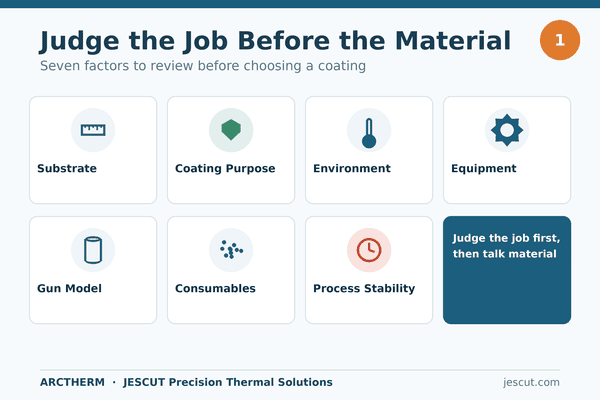
I believe beginners should learn thermal spray by judging the job first. I look at the substrate, coating purpose, working environment, equipment, gun model, consumables, and process stability before I talk about parameters or part numbers.
I have worked on spray gun bodies and key wear parts for years. I have also heard many questions from buyers, engineers, and maintenance teams. Some questions sound simple, but they often hide real process risk. I do not think a beginner needs to memorize every setting on day one. I think a beginner needs a clear way to ask better questions. If you want fewer wrong purchases and fewer unstable spray results, keep reading.
What Thermal Spray Really Is: A Family of Processes, Not a Single Technology?
I often hear people say “thermal spray” like it means one machine. That can cause wrong choices, weak coatings, and wasted time.
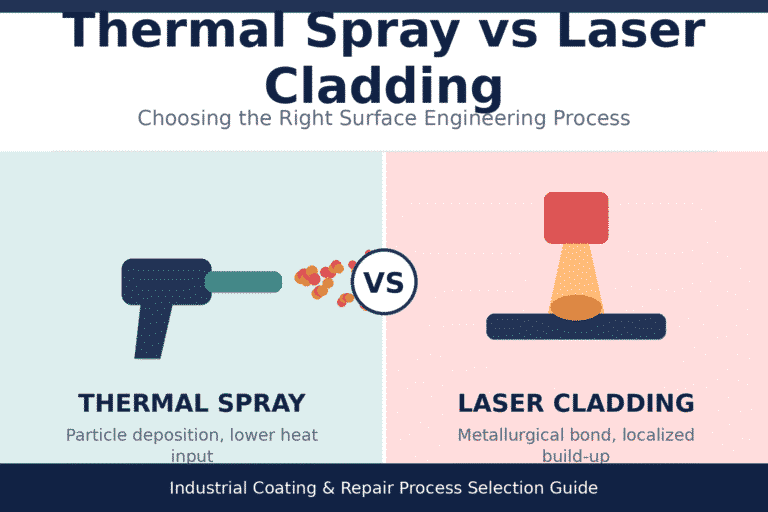
Thermal spray is a group of coating processes.1 I usually explain HVOF, plasma spray, twin-wire arc spray, flame spray, and cold spray as different routes for different coating goals, not as direct substitutes.
How I explain the process family to beginners
I usually start with one simple point. Thermal spray is not one process. It is a family of methods that heat or speed up coating material and send it to a surface.2 The coating forms layer by layer.3 The details change a lot by process. That is why I do not like one-size-fits-all answers.
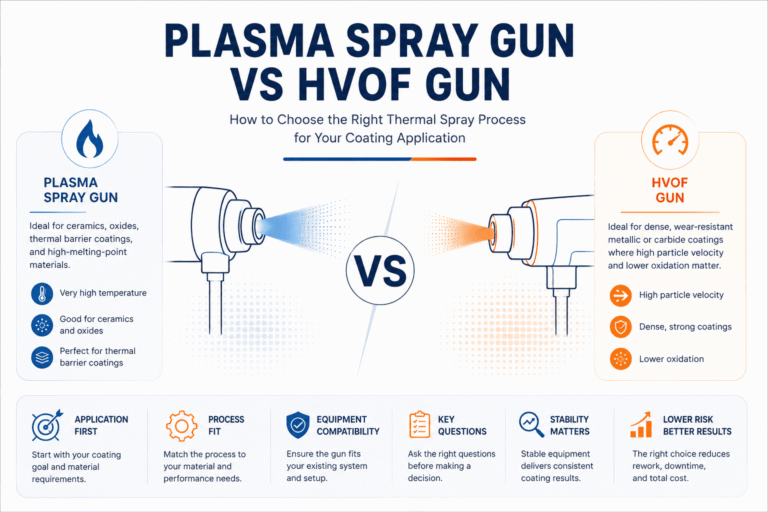
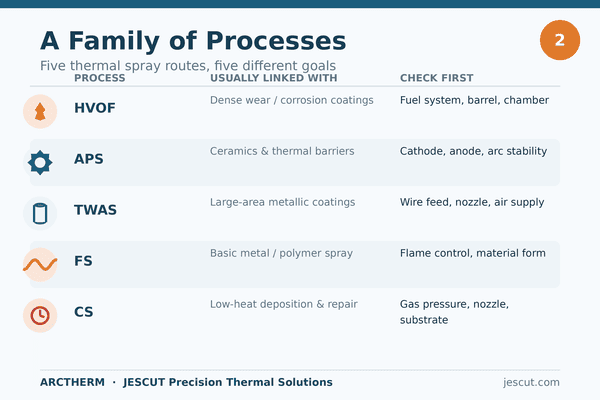
In customer talks, I often see a buyer ask, “Can this powder be sprayed?” I usually ask back, “Which process will spray it, and what do you want the coating to do?” That question matters. High Velocity Oxy-Fuel, or HVOF, is often linked with dense wear-resistant coatings.4 Atmospheric Plasma Spray, or APS, is often used when high temperature is needed for ceramic or special materials.5 Twin Wire Arc Spray, or TWAS, uses two wires and an arc.6 Flame Spray, or FS, is a more basic combustion route. Cold Spray, or CS, relies more on particle speed and less on melting.7
A simple process view I use
| Process route | What I usually connect it with | What I tell beginners to check first |
|---|---|---|
| HVOF | Dense wear or corrosion-resistant coatings | I check fuel system, barrel, combustion chamber, and part heat limit |
| APS | Ceramics, thermal barriers, and special powders | I check cathode, anode, arc stability, gas control, and cooling |
| TWAS | Large-area metallic coatings and repair | I check wire feed, arc stability, nozzle condition, and air supply |
| FS | Basic metal or polymer-type spray work | I check flame control, material form, and operator consistency |
| CS | Low-heat deposition and repair | I check gas pressure, nozzle design, and substrate preparation |
I keep this table simple on purpose. I do not use it to replace a process engineer. I use it to stop a beginner from treating every coating problem as the same problem.
How to Choose a Thermal Spray Process Based on Application Goals?
I see many new users choose a process because a supplier has a machine. That shortcut can lead to poor fit and repeat work.
I choose the spray route by application goal first. I look at wear, corrosion, heat, repair size, electrical needs, substrate heat sensitivity, coating thickness, and the actual equipment condition.8
How I move from the part problem to the process route
I like to begin with the part, not the catalog. The part tells me what matters. A pump part may need corrosion resistance. A shaft may need wear resistance. A turbine-related part may need a thermal barrier.9 A repair part may need build-up with low distortion. An electrical part may need conductivity or insulation. These are different tasks.
I also ask what the substrate can tolerate. Some substrates do not like high heat.10 Some parts have thin walls. Some parts have tight tolerance. Some parts will be machined after coating. This changes the choice. It also changes how much risk I accept.
I do not claim that one process always wins. I have seen stable coatings come from different routes when the goal, equipment, material, and operator practice fit each other. I have also seen problems when a good material was used with the wrong route.
The first decision table I use
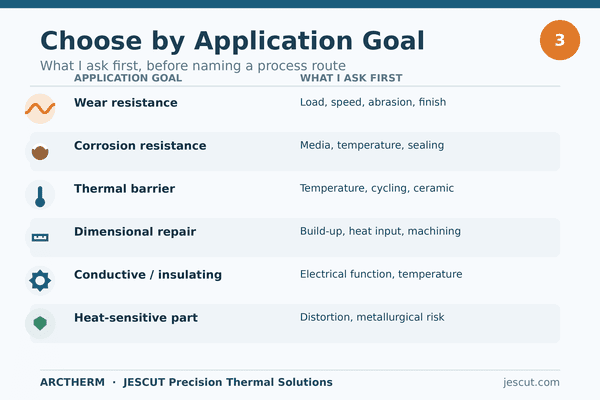
| Application goal | What I ask first | Process route I may discuss |
|---|---|---|
| Wear resistance | I ask about load, speed, abrasion, and surface finish | HVOF, APS, or other routes based on material |
| Corrosion resistance | I ask about media, temperature, sealing needs, and porosity risk | HVOF, TWAS, FS, or APS depending on coating |
| Thermal barrier | I ask about temperature, cycling, and ceramic system needs | APS is often discussed |
| Dimensional repair | I ask about build-up thickness, heat input, and final machining | TWAS, FS, CS, or HVOF may be considered |
| Conductive or insulating layer | I ask about electrical function and service temperature | APS or other routes depending on material |
| Heat-sensitive part | I ask about part distortion and metallurgical risk | CS or lower heat routes may be discussed |
I use “may” in this table because coating choice needs real project data. I also believe beginners should be careful with simple answers. A process recommendation without substrate, coating function, environment, and equipment details is not enough.
Why Spray Gun and Consumables Matter as Much as the Coating Material?
I see beginners focus on powder or wire. Then they ignore the gun, cathode, anode, barrel, or chamber until instability appears.
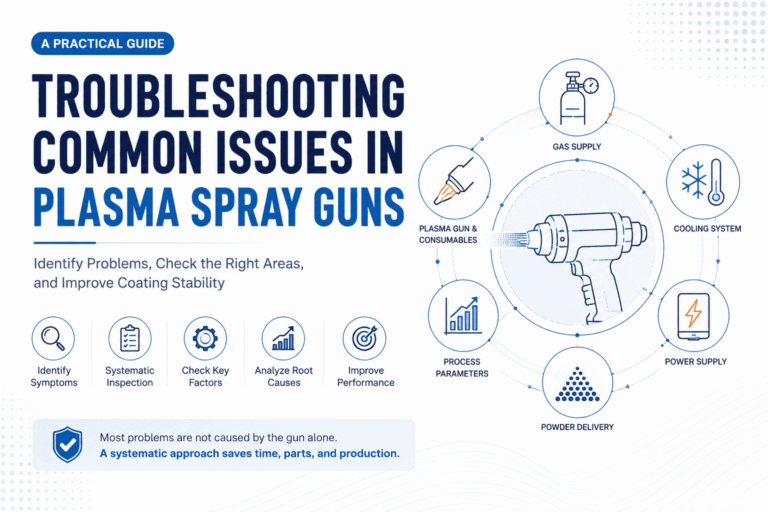
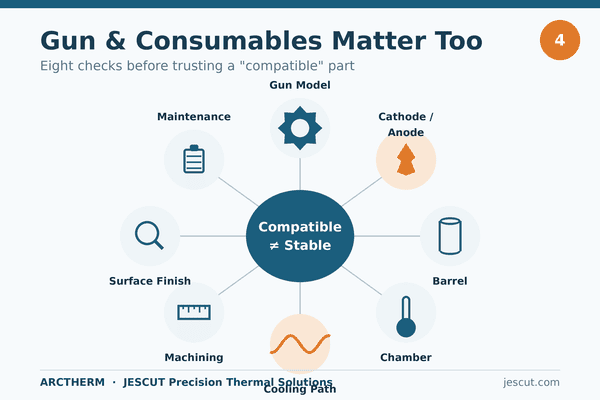
A coating material cannot perform well by itself. I check the spray gun, consumables, cooling, arc or flame stability, part fit, and wear condition because these items affect coating consistency.
What I have learned from manufacturing and service feedback
My work is close to spray gun bodies and wear parts. That gives me a practical view. I am not a coating lab authority. I do not claim that consumables alone decide coating quality. I do say that unstable hardware can make a good material behave badly.
For plasma spray, the cathode and anode condition can affect arc behavior.11 For HVOF, the barrel and combustion chamber condition can affect flame shape and stability.12 For wire arc systems, nozzle and contact parts affect arc and wire feeding. These details are easy to ignore when a part “fits.” But fit is only the starting point. A consumable can fit the gun body and still create risk if geometry, material, surface finish, cooling path, or machining precision is not controlled well.
In my own factory-side work, I care about inner hole finish, shape tolerance, connection quality, and stable testing. For example, ARCTHERM parts are made for several common global gun platforms. I mention this only as background. The main lesson is broader. Beginners should treat the gun and consumables as part of the process, not as simple accessories.
What I check before I trust a “compatible” part
| Item I check | Why I care | Risk if I ignore it |
|---|---|---|
| Gun model match | I need the correct physical and functional match | The part may fit poorly or run unstable |
| Cathode and anode quality | I need stable arc behavior | The arc may wander or become hard to control |
| Barrel condition | I need stable flow and spray pattern | The coating may become inconsistent |
| Combustion chamber condition | I need stable combustion | The flame may change during work |
| Cooling path | I need heat to leave the part correctly | Consumable life may become short |
| Machining accuracy | I need repeatable geometry | Two “same” parts may spray differently |
| Surface finish | I need smooth internal flow where required | Flow can become disturbed |
| Maintenance history | I need context for failure | The new part may be blamed for an old system issue |
I often tell new users this simple sentence: compatibility is not the same as stability. I can copy a shape, but the process still needs the right material, machining, inspection, and real system checks. When customers report unstable arc length, unstable flame length, short consumable life, or coating variation, I do not jump to one cause. I ask about the full setup.
The Right First Questions Beginners Should Ask Before Any Thermal Spray Project?
I see projects start with “What price?” or “Do you have this part?” That may miss the problem behind the request.
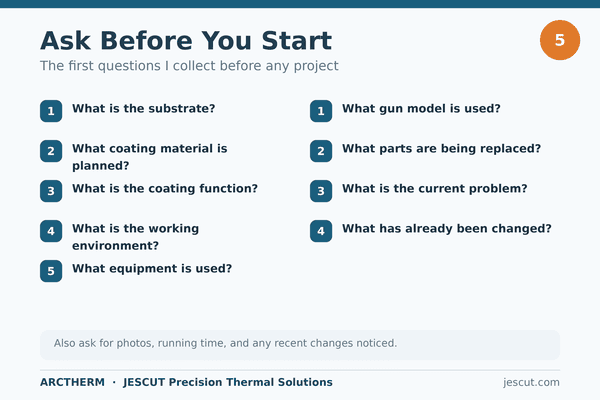
Before any thermal spray project, I ask about substrate, coating material, coating function, service environment, equipment model, gun type, consumable condition, current defect, and stability symptoms.
The question list I use before I discuss details
I prefer clear questions over fast assumptions. A beginner may not know every process setting. That is fine. A beginner can still collect useful facts. These facts help a process engineer, a supplier, and a maintenance team speak the same language.
I start with the substrate. I ask what the base material is and what shape the part has. Then I ask what coating material is planned. If the customer does not know, I ask the function instead. Does the coating need wear resistance, corrosion resistance, a thermal barrier, repair build-up, conductivity, or insulation? Then I ask where the part will work. Temperature, load, chemicals, and cycling all matter.
After that, I ask about the equipment. I need the system brand, gun model, and current consumables. I also ask about the current problem. Is the arc unstable? Is the flame length changing? Is the coating inconsistent? Is the cathode or anode life too short? Is the barrel wearing fast? These symptoms guide the next step.
My beginner checklist
| Question I ask | Why I ask it | What answer helps me |
|---|---|---|
| What is the substrate? | I need to understand heat risk and bonding needs | Material grade, hardness, size, and part shape |
| What coating material is planned? | I need to connect material with process route | Powder, wire, or rod details if available |
| What is the coating function? | I need to know the real goal | Wear, corrosion, heat, repair, electrical use |
| What is the working environment? | I need to judge service stress | Temperature, media, load, speed, and cycle |
| What equipment is used? | I need to know the process platform | Brand, power source, feeder, gas setup |
| What gun model is used? | I need to check compatibility | METCO, TAFA, SG-type, or other exact model |
| What parts are being replaced? | I need to understand wear points | Cathode, anode, barrel, nozzle, chamber |
| What is the current problem? | I need to avoid guessing | Unstable arc, flame change, short life, bad coating |
| What has already been changed? | I need to avoid repeating the same mistake | Recent part, gas, powder, wire, or parameter changes |
I also ask for photos when possible. I ask for old part condition. I ask for the running time if it is available. I ask for abnormal sound, color, or spray shape if the operator noticed it. These small clues often save time.
I do not use the checklist to prove that one supplier is right. I use it to make the first conversation better. When the first questions are better, the project has less risk. The buyer can avoid buying only by price. The engineer can avoid testing the wrong route. The maintenance team can avoid changing parts without knowing why the system failed.
Conclusion
I believe beginners succeed faster when they judge the task, process route, gun condition, consumables, and stability together before they chase parameters.
"Cold spraying - Wikipedia", https://en.wikipedia.org/wiki/Cold_spraying. An authoritative overview defines thermal spraying as a group of coating processes in which feedstock materials are deposited onto a prepared surface to form a coating. Evidence role: definition; source type: encyclopedia. Supports: Thermal spraying is commonly defined as a family or group of coating processes rather than one single technology.. ↩
"Warm spraying—a novel coating process based on high ...", https://pmc.ncbi.nlm.nih.gov/articles/PMC5099653/. Technical reviews of thermal spraying describe the process as the projection of heated or accelerated feedstock particles onto a substrate, where they accumulate to form a coating. Evidence role: mechanism; source type: paper. Supports: Thermal spray processes generally involve heating and/or accelerating feedstock particles toward a substrate to build a coating.. ↩
"Substrate temperature effects on the splat formation, microstructure ...", https://www.academia.edu/12713690/Substrate_temperature_effects_on_the_splat_formation_microstructure_development_and_properties_of_plasma_sprayed_coatings. Research literature on thermal spray microstructure explains that coatings develop through the accumulation of individual splats or particles, producing a layered deposit on the substrate. Evidence role: mechanism; source type: paper. Supports: Thermal spray coatings form through repeated particle impact, spreading, solidification, and accumulation into a coating layer.. ↩
"An Influence of Oxygen Flow Rate and Spray Distance on the ... - PMC", https://pmc.ncbi.nlm.nih.gov/articles/PMC9505576/. Reviews of HVOF spraying report that the process can produce comparatively dense, low-porosity coatings and is widely applied to wear-resistant coating systems. Evidence role: general_support; source type: paper. Supports: HVOF spraying is widely used to produce relatively dense coatings, including wear-resistant carbide and metal alloy coatings.. Scope note: The source would support the general association between HVOF and dense wear-resistant coatings, not prove that HVOF is the best route for every wear application. ↩
"Atmospheric Plasma Spray", https://engineering.virginia.edu/labs-groups/wadley-intelligent-processing-materials-group/user-facilities/atmospheric-plasma-spray. Technical reviews of atmospheric plasma spraying describe its use for depositing ceramic and other high-melting-point materials because the plasma jet can provide very high process temperatures. Evidence role: general_support; source type: paper. Supports: Atmospheric plasma spraying is commonly used for ceramic and high-melting-point coating materials.. Scope note: The source would provide contextual support for common APS applications, while specific material suitability still depends on feedstock, parameters, and service conditions. ↩
"Atmospheric Plasma Spray", https://engineering.virginia.edu/labs-groups/wadley-intelligent-processing-materials-group/user-facilities/atmospheric-plasma-spray. Educational thermal spray references describe twin-wire arc spraying as a process in which two consumable wires are fed together, melted by an electric arc, and atomized toward the substrate. Evidence role: definition; source type: education. Supports: Twin-wire arc spraying uses two consumable wire electrodes and an electric arc to melt the feedstock before atomization and deposition.. ↩
"Advancements in Cold Spray Additive Manufacturing - PMC", https://pmc.ncbi.nlm.nih.gov/articles/PMC11595822/. Research and institutional descriptions of cold spray identify it as a solid-state deposition process in which particles accelerated to high velocities bond to the substrate without intentional melting. Evidence role: mechanism; source type: research. Supports: Cold spray is generally characterized as a solid-state process in which particles are accelerated to high velocity and bond without bulk melting.. Scope note: The source would support the general distinction between cold spray and melting-based spray processes, while local heating and plastic deformation may still occur during impact. ↩
"Thermal Spray Coating - Curtiss-Wright Surface Technologies", https://surfacetechnologies.curtisswright.com/our-services/engineered-coatings/thermal-spray-coating. Thermal spray handbooks and process-selection guides state that coating process choice depends on the intended service function, substrate constraints, environmental exposure, coating requirements, and equipment capability. Evidence role: expert_consensus; source type: institution. Supports: Process selection for thermal spray coatings commonly considers service environment, desired coating function, substrate properties, coating thickness, and available equipment.. Scope note: The source would support the decision factors in general terms, not validate any specific project decision without detailed engineering data. ↩
"Ceramic thermal barrier coatings for commercial gas turbine engines", https://ui.adsabs.harvard.edu/abs/1991JOM....43c..50M/abstract. Research on thermal barrier coatings documents their use on gas-turbine components, where ceramic coating systems help reduce heat flow into metallic parts exposed to high-temperature gases. Evidence role: case_reference; source type: research. Supports: Thermal barrier coatings are used on turbine components to reduce heat transfer and improve high-temperature durability.. Scope note: The source would support turbine use as a common application context, not show that every turbine-related part requires a thermal barrier coating. ↩
"Cold Spray: Over 30 Years of Development Toward a Hot Future", https://pmc.ncbi.nlm.nih.gov/articles/PMC9059919/. Studies of thermal spray processing note that substrate temperature and heat input can influence residual stress, distortion risk, and metallurgical changes in heat-sensitive components. Evidence role: mechanism; source type: paper. Supports: Substrate heat input during coating can affect distortion, residual stress, and metallurgical condition, especially for heat-sensitive parts.. Scope note: The source would support the general mechanism; actual heat tolerance depends on the substrate alloy, part geometry, and process parameters. ↩
"[PDF] A Perspective on Plasma Spray Technology - Columbia University", http://www.columbia.edu/cu/seas/earth/wtert/newwtert/Research/sofos/Plasma_%20spraying_Nov2014.pdf. Plasma torch studies report that cathode and anode erosion or geometry changes can influence arc attachment and stability, which are important for repeatable plasma spray operation. Evidence role: mechanism; source type: paper. Supports: Electrode condition in plasma spray torches can affect arc attachment, arc stability, and torch operation.. Scope note: The source would support the mechanism linking electrode condition and arc behavior, not diagnose a particular instability without operating data. ↩
"[PDF] Design and Development of a High Velocity Oxy-Fuel Thermal ...", https://scholarworks.utep.edu/cgi/viewcontent.cgi?article=2209&context=open_etd. HVOF process studies show that torch geometry and combustion-flow conditions influence jet structure, particle acceleration, and flame stability during spraying. Evidence role: mechanism; source type: paper. Supports: HVOF torch geometry and condition, including combustion chamber and nozzle or barrel features, affect gas flow, combustion behavior, and spray jet stability.. Scope note: The source would support the general hardware-process relationship, while the effect of a specific worn part would require inspection and operating measurements. ↩