
Plasma spray guns can look like the obvious cause when ignition becomes difficult, the arc becomes unstable, or coating quality suddenly changes. I see this often in customer troubleshooting. The risk is costly: operators replace gun bodies or consumables too early, downtime grows, and the real cause stays hidden. A better method is symptom-based troubleshooting.
Troubleshooting plasma spray guns starts by reading the symptom, then checking consumables, assembly fit, gas supply, cooling, power settings, powder delivery, and process conditions before replacing parts. Arc instability, short consumable life, and coating defects may involve the gun, but they often come from the wider spray system and operating environment.
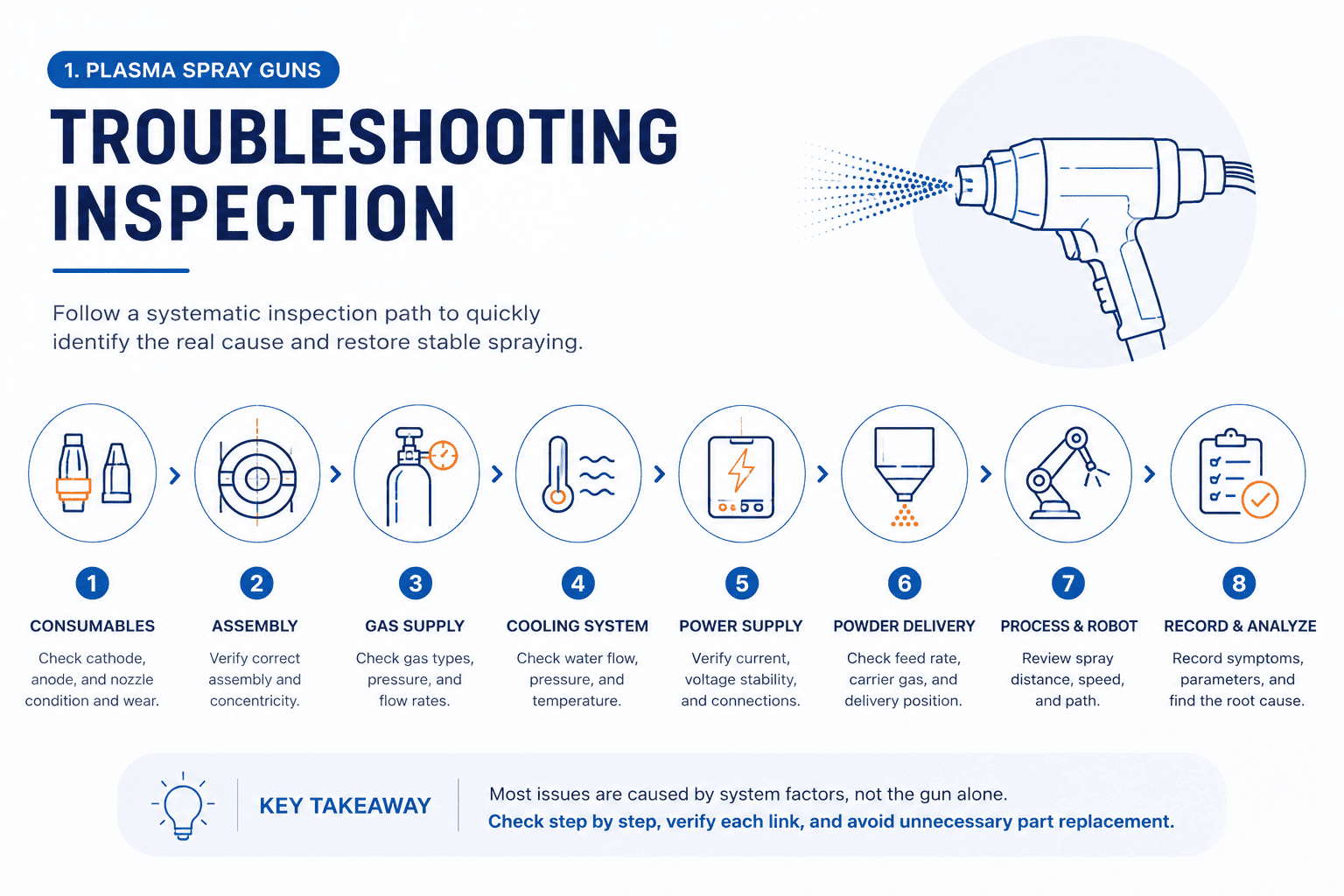
I manufacture and supply plasma spray gun bodies and consumables, so I often receive urgent questions that begin with, “Is the gun bad?” My answer is usually: maybe, but let us inspect in the right order first. That order saves time, parts, and production confidence.
Start with the Symptoms: What Are Your Plasma Spray Guns Telling You?
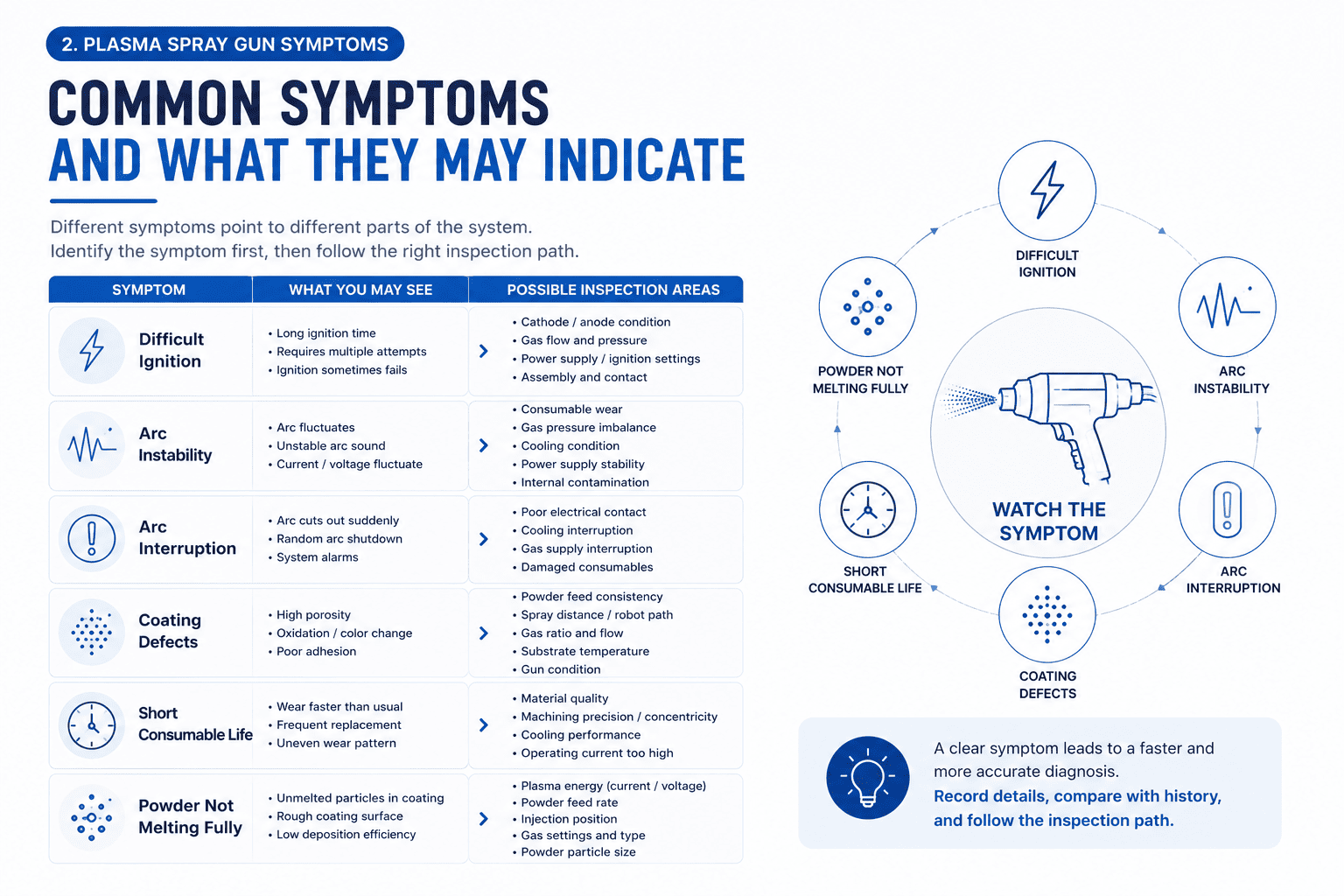
A plasma spray problem rarely begins with a complete failure. It usually starts with a warning sign: harder ignition, a drifting arc, unusual sound, powder not melting well, or a coating that no longer passes inspection. I treat each symptom as evidence, not as a final diagnosis.
The first step in troubleshooting plasma spray guns is to identify the exact symptom and when it appears. Difficult ignition, arc interruption, coating porosity, overspray changes, or short consumable life each point to different inspection paths. I recommend recording the symptom, operating parameters, consumable hours, and recent maintenance before replacing parts.
Why I start with symptoms instead of opinions
When a customer reports an unstable arc, the first suspect is often the gun body. I understand why. The plasma arc is inside the torch, and the operator sees the failure at the gun. However, the gun is only one part of a connected system.
A plasma spray process depends on several links working together:
- Cathode and anode condition
- Nozzle geometry and internal surface finish
- Correct assembly and concentricity
- Primary and secondary gas flow
- Cooling water flow, pressure, and temperature
- Power supply stability
- Powder feeding consistency
- Spray distance and robot path
- Maintenance habits and cleaning methods
If one link changes, the symptom may appear at the gun tip. That does not prove the gun body is the root cause.
Common symptoms and likely inspection areas
I like to organize the first inspection with a simple table. It prevents emotional decisions when production pressure is high.
| Symptom | Possible inspection areas | First practical check |
|---|---|---|
| Difficult ignition | Cathode tip, anode bore, gas flow, power parameters, assembly | Check electrode/nozzle condition and ignition settings |
| Arc instability | Consumable wear, gas pressure, cooling, power supply, internal contamination | Record arc sound, current/voltage fluctuation, and gas readings |
| Arc interruption | Poor contact, cooling issue, gas interruption, damaged parts | Check cable, water, gas, and part seating |
| Coating porosity increase | Powder feed, spray distance, gas ratio, part temperature, gun condition | Compare current parameters with approved process sheet |
| Short consumable life | Material quality, machining precision, cooling, concentricity, operating current | Inspect wear pattern, not only total hours |
| Powder not melting fully | Plasma energy, feed rate, injection position, powder size, gas settings | Check powder delivery and actual current/voltage |
A customer-style scenario I often recognize
A customer once reported that the arc became unstable after several production runs. The first message suggested a gun quality issue. I asked for photos of the cathode, anode, assembly area, cooling readings, and recent parameter changes. The point was not to deny the possibility of a gun issue. The point was to avoid replacing a precision gun body before checking the parts that experience direct arc erosion.
That is the mindset I recommend. A symptom is a direction, not a verdict.
What I ask operators to record
Good troubleshooting depends on simple records. I suggest keeping a small log for every spray cell.
- Gun model and consumable set
- Cathode/anode/nozzle running hours
- Current, voltage, and gas flow settings
- Cooling water inlet and outlet readings
- Powder type, batch, and feed rate
- Spray distance and robot program
- Sound, arc behavior, and visible plume change
- Coating test result or defect description
These notes do not need to be complicated. They just need to be consistent. When I receive a troubleshooting question with this information, I can usually narrow the risk much faster.
I do not recommend asking, “Is the gun bad?” as the first question. I recommend asking, “Which symptom appeared first, and what changed before it appeared?”
That small change improves the entire troubleshooting process for plasma spray guns.
Check the Entire Spray System Before Replacing Parts in Plasma Spray Guns?
Replacing parts too quickly feels safe, but it can hide the true fault. I see workshops change cathodes, anodes, nozzles, or even gun bodies while gas, cooling, powder feeding, or power settings remain unchecked. That approach increases cost and may not stabilize production.
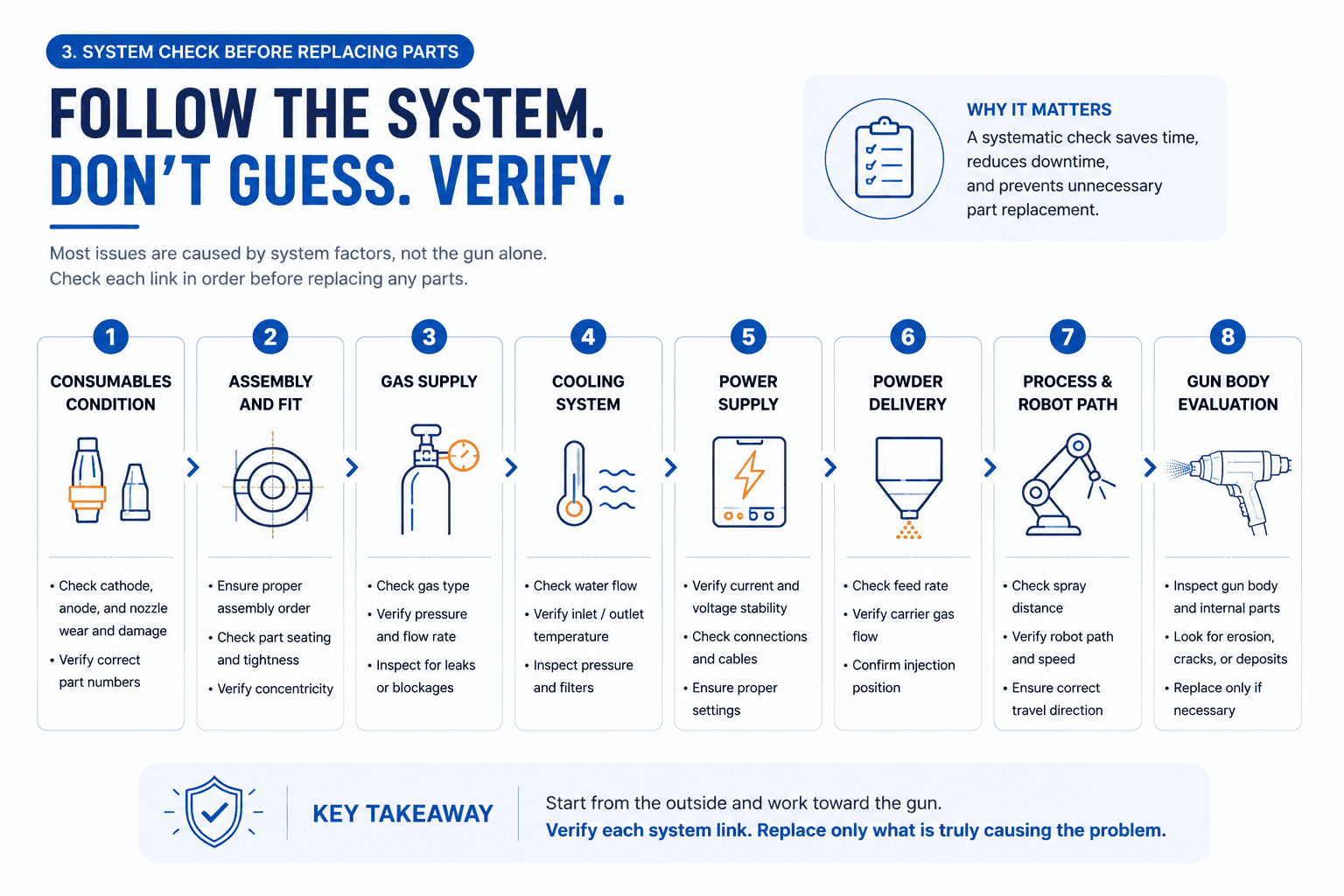
Before replacing parts in plasma spray guns, check the entire spray system in a fixed order: consumables, assembly fit, gas supply, cooling water, power output, powder delivery, and process settings. This sequence reduces false diagnosis and helps operators decide whether production can continue safely or must stop for deeper inspection.
The spray gun is part of a chain
I usually describe the plasma spray system as a chain of energy transfer. Electrical energy becomes a plasma arc. Gas becomes a high-temperature jet. Powder enters that jet and melts or softens. The molten particles impact the workpiece and form the coating.1
If the coating changes, the chain must be checked from beginning to end.
My practical inspection sequence
I prefer this order because it starts with the most accessible and most common failure points.
| Step | What I check | Why it matters |
|---|---|---|
| 1 | Consumable condition | Cathode and anode wear directly affect arc stability2 |
| 2 | Assembly fit | Poor seating or misalignment changes arc position |
| 3 | Gas supply | Incorrect flow or pressure changes plasma energy3 |
| 4 | Cooling system | Poor cooling accelerates wear and may deform parts4 |
| 5 | Power supply | Current and voltage instability affects arc behavior |
| 6 | Powder feeding | Feed rate variation changes coating thickness and melting |
| 7 | Robot/process settings | Spray distance and speed affect deposition and heat input |
| 8 | Gun body inspection | Damage, leakage, thread issues, or internal wear may be confirmed |
This order is not a universal laboratory procedure. It is a practical field sequence that I have found useful in customer support.
Consumables first, but not consumables only
Cathodes, anodes, and nozzles work in a severe environment. In atmospheric plasma spraying, arc temperatures can exceed several thousand degrees Celsius.5 The parts face thermal shock, erosion, electrical load, and cooling stress. It is reasonable to inspect them early.
However, I avoid a narrow conclusion. A worn anode may be the result, not the cause. Poor cooling, wrong gas flow, excessive current, or assembly misalignment may create abnormal wear.
For example, if a nozzle bore shows uneven erosion on one side, I would ask:
- Was the part installed concentrically?
- Was the mating surface clean?
- Was the cooling flow normal?
- Was the current higher than usual?
- Was the consumable compatible with the gun model?
- Was the powder injection position correct?
The answer may involve both part quality and use condition.
Gas and cooling checks are not optional
Plasma spray guns rely on stable gas flow and effective cooling. I often see these two areas underestimated because operators assume the control panel reading is enough.
I recommend checking:
- Gas supply pressure at the source and near the system
- Gas purity and correct gas selection
- Flowmeter calibration and actual flow
- Cooling water flow rate
- Cooling water pressure
- Inlet and outlet temperature difference
- Filter blockage
- Leaks, restrictions, or air in the line
Cooling is especially important for consumable life. If cooling is weak, the electrode or nozzle may overheat. That can cause faster erosion, surface cracking, thread damage, or changes in arc attachment behavior.
Power and powder must be part of the same conversation
A plasma spray gun may be blamed for coating variation when the real issue is powder delivery. Powder feed rate, carrier gas, injector position, and powder condition can all change coating results.6
If the powder feed fluctuates, the coating may show:
- Thickness variation
- Unmelted particles
- Porosity changes
- Rougher surface
- Lower deposition efficiency
- Poor repeatability between parts
At the same time, power settings matter. A small change in current, voltage, or gas mix can change particle temperature and velocity.7 That is why I ask for the process sheet when I help review a problem. The gun cannot be separated from the recipe.
When should you stop production?
I am careful with this question because every site has its own safety rules and quality requirements. Still, I suggest stopping for inspection when operators see:
- Repeated arc interruption
- Visible water leakage
- Burning smell or abnormal overheating
- Severe current or voltage fluctuation
- Consumable damage after very short operation
- Coating defects that affect safety-critical parts
- Abnormal sound that continues after parameter correction
For aerospace, power generation, heavy machinery, and other demanding applications, I believe it is better to pause early than to create a batch of questionable coating.
When Consumable Wear Becomes a Useful Diagnostic Signal?
Consumable wear is easy to treat as a cost problem only. I see it differently. A cathode, an anode, or a nozzle records what happened inside the arc zone. If wear becomes abnormal, the worn surface can guide the next troubleshooting step.
Consumable wear becomes a useful diagnostic signal when operators examine the wear pattern, not only the service hours. Uneven erosion, rapid bore enlargement, discoloration, cracking, poor seating marks, or repeated early failure may indicate cooling problems, assembly misalignment, parameter stress, material issues, or machining compatibility concerns.

What I look for on worn parts
As a manufacturer of gun bodies and consumables, I care about material, machining, and fit. However, I also know that a good part can fail early under poor operating conditions. That is why I ask customers to share clear photos from several angles before I comment.
I usually inspect these features:
- Cathode tip shape
- Anode internal bore wear
- Nozzle outlet roundness
- Discoloration or overheating marks
- Thread condition
- Sealing surface marks
- Evidence of contamination
- Symmetry of erosion
- Burn marks near contact areas
These details say more than a simple statement like “the part only lasted a short time.”
Wear pattern examples and what they may suggest
| Wear pattern | Possible meaning | Recommended next check |
|---|---|---|
| Even gradual erosion | Normal arc wear | Compare hours with process history |
| One-sided anode wear | Misalignment, poor seating, uneven flow | Check assembly concentricity and mating surfaces |
| Rapid cathode tip damage | High current stress, ignition issue, material concern, cooling issue | Check current, gas, cooling, and cathode grade |
| Blue or dark discoloration | Excess heat or poor cooling | Check water flow, blockage, and temperature |
| Cracked nozzle or anode | Thermal shock, installation stress, cooling problem | Check torque, cooling, and start-stop habits |
| Rough internal bore | Erosion, contamination, machining or cleaning issue | Check surface finish, powder backflow, and cleaning tools |
These signs do not prove one single cause. They point to the next responsible check.
Why precision matters in consumables
Plasma spray consumables are not simple metal pieces. They control arc position, gas flow, cooling paths, and particle heating conditions. Small geometry errors can become large process problems.
In our manufacturing work, I pay special attention to:
- Dimensional accuracy
- Internal bore roughness
- Concentricity
- Material selection
- Copper-tungsten joining quality
- Surface finish
- Repeatability between batches
For critical components, we use precision CNC machining and control key dimensions tightly. In applications like APS cathodes and anodes, internal geometry and stable fit matter because the arc must remain predictable. If the bore is rough or the connection is poor, arc behavior may become less stable.
At the same time, I avoid saying that every short-life issue proves a part defect. That would be inaccurate. The same consumable can perform differently under different cooling, current, gas, and maintenance conditions.
A customer-style scenario about short life
A customer once reported that consumables had a much shorter life than expected. The first concern was part quality. That was a reasonable question, and I treated it seriously. But I also asked for operating current, gas settings, water condition, installation photos, and the worn parts.
The useful clue was not only the short service time. The useful clue was the wear pattern. If wear is symmetrical and gradual, I think differently than if the bore is burned on one side. If the cathode tip is damaged after ignition, I ask about starting conditions and gas timing. If sealing surfaces show marks, I ask about assembly and cleaning.
Maintenance habits can change wear life
Operators often focus on parameter settings, but maintenance habits also matter. I recommend avoiding aggressive cleaning tools that scratch internal surfaces. I also recommend checking that parts are dry, clean, and correctly seated before installation.
Good habits include:
- Use clean gloves when handling precision consumables.8
- Inspect sealing and contact surfaces before assembly.
- Follow the correct tightening sequence and torque guidance.
- Avoid mixing worn parts with new parts without inspection.
- Record running hours by actual process, not by calendar days.
- Store cathodes, anodes, and nozzles in clean packaging.
- Replace damaged seals before they create secondary faults.
I see consumables as both working parts and diagnostic parts. When a plasma spray system becomes unstable, the worn components often tell the most honest story.
Avoid Misdiagnosis: Why Many Plasma Spray Gun Problems Are Actually Process Problems?
Misdiagnosis is expensive. A workshop may replace the gun, replace consumables, adjust parameters, and still see the same coating defect. I have seen this pattern in troubleshooting conversations. The root issue is often that the team treats a process symptom as a single hardware failure.
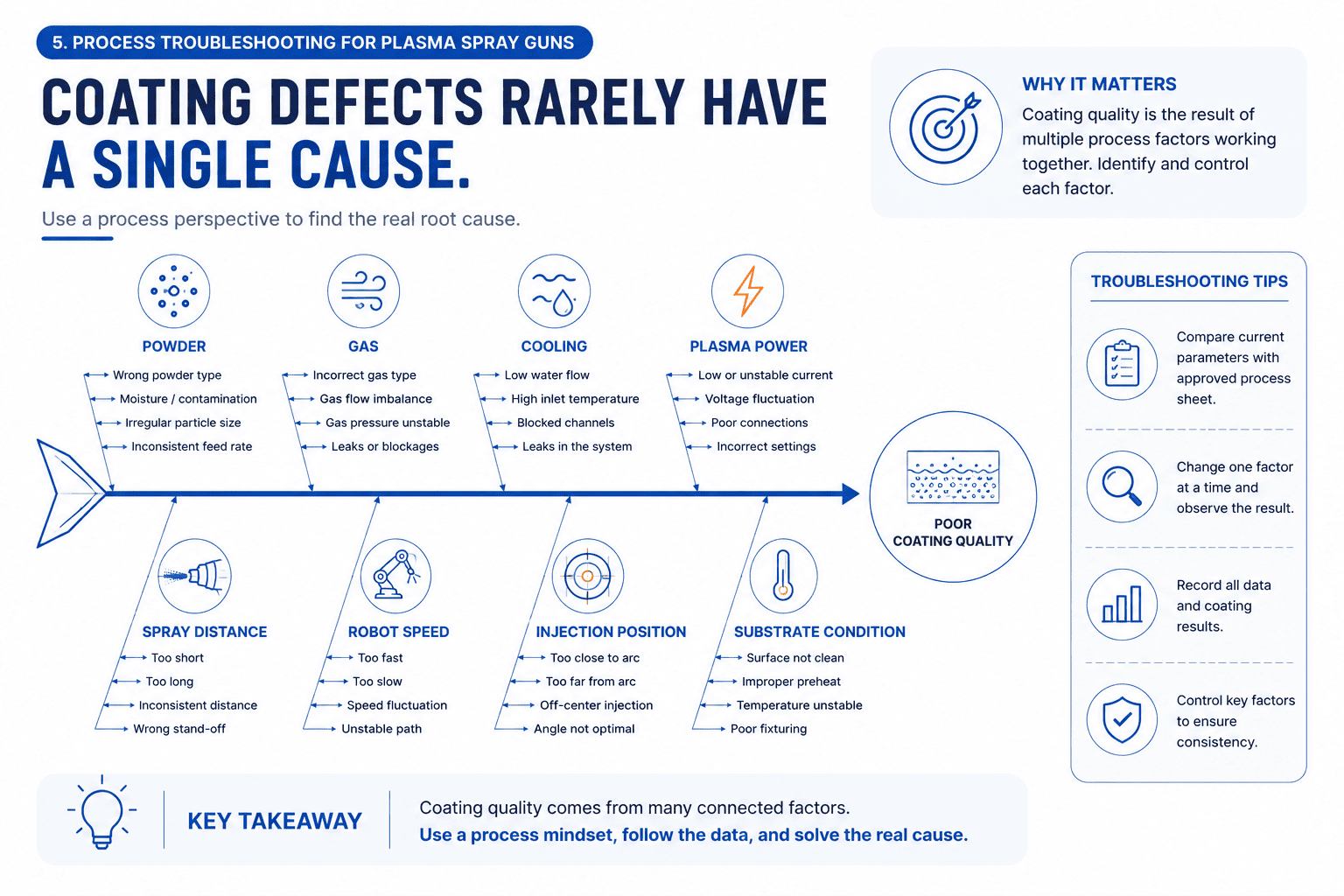
Many plasma spray gun problems are actually process problems because coating quality depends on powder feed, spray distance, gas flow, robot motion, substrate preparation, part temperature, and power settings. The gun may still need inspection, but operators should compare the full process condition against the approved spray procedure before blaming one component.
Coating defects have many parents
A coating defect can appear after the spray plume changes, but it may not originate inside the gun. Coating quality depends on how particles are heated, accelerated, and deposited.
I usually divide process-related causes into five groups:
- Energy input: current, voltage, gas type, gas flow
- Particle delivery: powder size, feed rate, carrier gas, injector position
- Spray geometry: spray distance, angle, robot speed, overlap
- Substrate condition: grit blasting, cleanliness, preheat, surface roughness
- Environment and handling: humidity, masking, cooling between passes, operator routine
If any group changes, the coating can change.
Common coating defects and process checks
| Coating issue | Possible process causes | Gun-related checks still needed |
|---|---|---|
| High porosity | Low particle temperature, wrong distance, excess feed rate9 | Arc stability, nozzle wear, gas flow through gun |
| Unmelted particles | Low energy, high feed rate, wrong powder size | Electrode wear, gas flow, injector alignment |
| Poor bond strength | Bad surface prep, wrong preheat, low particle velocity10 | Arc energy, spray distance, gun angle |
| Thickness variation | Robot speed, feed fluctuation, standoff variation | Powder injector, plume stability, nozzle condition |
| Rough surface | Powder issue, cooling rate, overspray, distance | Nozzle wear and arc stability |
| Oxidation | Atmosphere, particle overheating, dwell time | Gas ratio and arc condition |
This table is not a final diagnosis. It is a practical way to avoid tunnel vision.
A customer-style scenario about coating fluctuation
A coating quality fluctuation was once first blamed on the gun. The operators saw the same gun model and same consumable type, so the gun felt like the likely cause. I asked whether the powder batch, feed calibration, spray distance, robot path, or substrate preparation had changed.
That question matters because production teams sometimes change small details without connecting them to coating results. A new powder batch may have a slightly different flow behavior. A worn feeder wheel may create pulsing. A robot program adjustment may change dwell time. A fixture change may alter spray distance by several millimeters. In thermal spray, those “small” changes can be large.
Why approved process windows matter
A stable plasma spray process should have an approved window. The window may include:
- Current range
- Voltage range
- Primary gas and secondary gas flow
- Powder feed rate
- Carrier gas flow
- Spray distance
- Traverse speed
- Overlap ratio
- Substrate preheat range
- Maximum part temperature
- Cooling air settings
- Consumable replacement limits
When the coating drifts, I recommend comparing actual values against this window. Do not rely only on memory. Production memory is useful, but it can miss gradual drift.
The difference between gun fault and process drift
I often use these questions to separate likely gun issues from likely process drift:
-
Did the problem appear immediately after installing a part?
If yes, inspect assembly, compatibility, and part condition. -
Did the problem appear gradually over several runs?
If yes, check consumable wear, powder feeder drift, cooling restriction, and parameter drift. -
Did the defect follow one gun to another booth?
If yes, the gun or consumable set becomes more suspicious. -
Did the defect remain with the booth after changing guns?
If yes, gas, power, powder feeding, robot motion, or booth conditions become more suspicious. -
Did the issue start after changing powder, fixture, operator, or program?
If yes, process change should be investigated early.
This comparison is simple, but it prevents many wrong purchases and repeated downtime.
Compatibility matters, but it should be discussed carefully
Third-party consumables and replacement parts can work well when they are correctly designed, precisely machined, and compatible with the gun model. They can also create risk if geometry, material, cooling passages, or fit differ from the required design.
I do not believe the useful question is “original or non-original?” The better question is:
Does this part match the required geometry, material performance, precision, and process stability for this specific plasma spray gun and application?
For high-demand industries, I recommend validating replacement parts through controlled trials, coating tests, and wear tracking.11 That approach is more reliable than judging only by price or brand.
My practical rule for avoiding misdiagnosis
I use one rule in troubleshooting: change one variable at a time when possible.
If the team changes the cathode, anode, powder batch, robot program, gas setting, and spray distance in one shift, nobody can confidently identify the real cause. A controlled inspection may feel slower at first, but it is faster than random replacement.
For production supervisors, I recommend a short decision checklist:
- Can we reproduce the symptom?
- Did the symptom begin after a known change?
- Are current readings within the approved window?
- Are gas and cooling values verified, not assumed?
- Do worn consumables show normal or abnormal patterns?
- Is powder feed stable?
- Is the coating defect measured, photographed, and logged?
- Have we changed only one variable before retesting?
This checklist helps operators protect both coating quality and production time.
Frequently Asked Questions
Why does my plasma spray gun have an unstable arc?
An unstable arc may come from worn cathodes or anodes, poor assembly fit, gas flow variation, weak cooling, power supply fluctuation, or contamination. I recommend checking consumables first, then gas, water, power, and process settings before deciding that the gun body is defective.
How do I know if consumable wear is normal or abnormal?
Normal wear is usually gradual and reasonably symmetrical. Abnormal wear may show one-sided erosion, cracking, discoloration, rapid bore enlargement, or very short life. I suggest comparing wear patterns with operating hours, current, cooling data, and installation condition.
Can poor coating quality be caused by something other than the gun?
Yes. Poor coating quality may result from powder feed fluctuation, spray distance error, gas setting drift, robot speed changes, substrate preparation issues, or part temperature variation. The gun should still be inspected, but coating defects should be treated as system-level problems.
Should I replace the gun body when ignition becomes difficult?
I would not replace the gun body as the first step. Difficult ignition often relates to electrode condition, nozzle wear, gas timing, power settings, assembly contact, or contamination. Inspect the consumables and system conditions first, then evaluate the gun body if the symptom remains.
What records help troubleshoot plasma spray guns faster?
Useful records include consumable running hours, current and voltage, gas flow, cooling water readings, powder feed rate, spray distance, robot program, coating test results, and photos of worn parts. These records help identify patterns and reduce unnecessary part replacement.
Conclusion
Troubleshooting common issues in plasma spray guns is a symptom-based decision process, not a quick blame decision. I recommend starting with the visible symptom, checking consumable wear, confirming assembly, verifying gas and cooling, reviewing power and powder delivery, and comparing actual production conditions with the approved process window. If your team is facing unstable arc behavior, short consumable life, or coating fluctuation, contact us with your gun model, consumable photos, and process details. I can help you review the risk points and choose the next inspection step.
"Thermal spraying", https://en.wikipedia.org/wiki/Thermal_spraying. A technical reference on plasma spraying describes the process as an electric-arc-generated plasma gas jet that heats and accelerates powder particles before they impact a substrate and build a coating. Evidence role: mechanism; source type: education. Supports: A university or textbook-style source should explain that plasma spraying uses an electric arc to create a high-temperature plasma jet that heats and accelerates feedstock particles onto a substrate to form a coating.. ↩
"Effect of Anode Arc Root Position on the Behavior of the DC Non-transferred ...", https://www.academia.edu/14098958/Effect_of_Anode_Arc_Root_Position_on_the_Behavior_of_the_DC_Non_transferred_Plasma_Jet_at_Field_Free_Region. Studies of plasma torch operation link electrode erosion and arc attachment dynamics to changes in arc voltage and stability, providing a mechanistic basis for inspecting cathodes and anodes during troubleshooting. Evidence role: mechanism; source type: paper. Supports: A research paper should connect electrode erosion, arc attachment behavior, or anode/cathode condition with arc voltage fluctuation or instability in plasma torches.. Scope note: The source would support the mechanism generally, not prove that electrode wear caused a specific field failure. ↩
"The relevance of nitrogen-based, high-enthalpy plasmas for effective ...", https://pmc.ncbi.nlm.nih.gov/articles/PMC12695877/. Thermal spray research shows that plasma gas parameters influence jet enthalpy, temperature, and velocity, supporting the troubleshooting practice of verifying gas flow and pressure when plasma energy appears to change. Evidence role: mechanism; source type: paper. Supports: A paper should show that plasma gas flow rate, composition, or pressure affects plasma jet temperature, enthalpy, velocity, or particle heating.. Scope note: The exact sensitivity depends on torch design, gas composition, and operating current. ↩
"Condition Monitoring of a Three-Cathode Cascaded Plasma ...", https://pmc.ncbi.nlm.nih.gov/articles/PMC9501464/. Research on plasma torches identifies heat removal and cooling conditions as factors affecting electrode temperature, erosion, and component life, supporting the claim that weak cooling can accelerate wear or deformation. Evidence role: mechanism; source type: paper. Supports: A technical paper should explain that cooling affects the thermal load and service life of plasma torch electrodes, nozzles, or other components.. Scope note: The source would establish the general mechanism rather than quantify wear for every gun model. ↩
"Thermal spraying", https://en.wikipedia.org/wiki/Thermal_spraying. Published descriptions of atmospheric plasma spraying report plasma jet temperatures in the several-thousand-degree Celsius range, supporting the statement that torch internals operate under extreme thermal conditions. Evidence role: statistic; source type: paper. Supports: A peer-reviewed source should report typical plasma jet or arc temperature ranges in atmospheric plasma spraying that are well above several thousand degrees Celsius.. Scope note: Reported temperatures vary by torch design, gas composition, current, and measurement location. ↩
"A Perspective on Plasma Spray Technology", http://www.columbia.edu/cu/seas/earth/wtert/newwtert/Research/sofos/Plasma_%20spraying_Nov2014.pdf. Experimental and modeling studies of plasma spraying show that powder feed and injection conditions affect particle trajectories, heating, and deposition behavior, supporting their inclusion in coating-quality troubleshooting. Evidence role: mechanism; source type: paper. Supports: A research source should support that feed rate, carrier gas, injector position, or powder properties influence particle heating and coating microstructure or quality.. Scope note: The relative importance of each variable depends on powder material, torch configuration, and parameter set. ↩
"A Perspective on Plasma Spray Technology", http://www.columbia.edu/cu/seas/earth/wtert/newwtert/Research/sofos/Plasma_%20spraying_Nov2014.pdf. Thermal spray diagnostics literature reports that torch power and plasma gas composition influence in-flight particle temperature and velocity, supporting the link between parameter changes and coating response. Evidence role: mechanism; source type: paper. Supports: A paper should show that plasma torch current, voltage, or gas mixture affects in-flight particle temperature and velocity.. Scope note: The source would support the relationship in general, while the magnitude of change is process-specific. ↩
"Guidance for Industry and FDA Staff", https://www.fda.gov/media/90612/download. Institutional clean-handling guidance for precision parts commonly recommends gloves or equivalent controls to reduce transfer of oils, particles, and other contaminants during handling. Evidence role: general_support; source type: institution. Supports: An institutional source should support the general practice of using clean gloves or clean handling methods to prevent contamination of precision components.. Scope note: This supports the cleanliness principle generally and may not be specific to plasma spray consumables. ↩
"A Perspective on Plasma Spray Technology", http://www.columbia.edu/cu/seas/earth/wtert/newwtert/Research/sofos/Plasma_%20spraying_Nov2014.pdf. Studies of plasma-sprayed coating microstructure report that particle thermal state, stand-off distance, and feed rate can influence porosity formation. Evidence role: mechanism; source type: paper. Supports: A research source should connect particle temperature, stand-off distance, and powder feed rate with porosity in plasma-sprayed coatings.. Scope note: Porosity is material- and process-dependent, so these factors should be treated as possible causes rather than a complete diagnostic rule. ↩
"The Adhesion Strength of a Plasma Sprayed Silicon Bond Coating on a ...", https://vtechworks.lib.vt.edu/items/1a5b995d-1a80-47dc-9995-ee5deee3ed59. Thermal spray adhesion studies associate coating bond strength with substrate surface preparation, thermal condition, and particle impact behavior, supporting these variables as checks when bond strength is poor. Evidence role: mechanism; source type: paper. Supports: A peer-reviewed source should describe how substrate surface preparation, preheating, and particle impact conditions affect adhesion or bond strength in thermal spray coatings.. Scope note: The source would support likely mechanisms, while actual bond failure may also involve material chemistry, residual stress, and testing conditions. ↩
"THERMAL SPRAYED COATINGS (METALLIZATION) PROGRAM", https://connect.ncdot.gov/resources/Materials/MaterialsResources/Thermal%20Sprayed%20Coatings%20(Metalization)%20Program.pdf. Thermal spray quality standards emphasize process qualification, documented controls, and coating testing, supporting the use of controlled trials and wear tracking when replacement parts are introduced in demanding applications. Evidence role: expert_consensus; source type: institution. Supports: A standards or institutional source should support the need for process qualification, coating testing, and documented control when changing thermal spray components or procedures.. Scope note: Standards may not prescribe the exact validation protocol for every gun model or industry. ↩