I see many coating defects treated as small surface issues. That mistake can hide the real instability, and the same defect can return again.
Common HVOF coating defects often show that the spray system is unstable. I check powder condition, gas settings, feed rate, spray distance, substrate preparation, temperature control, and spray gun consumable condition before I blame one single cause.
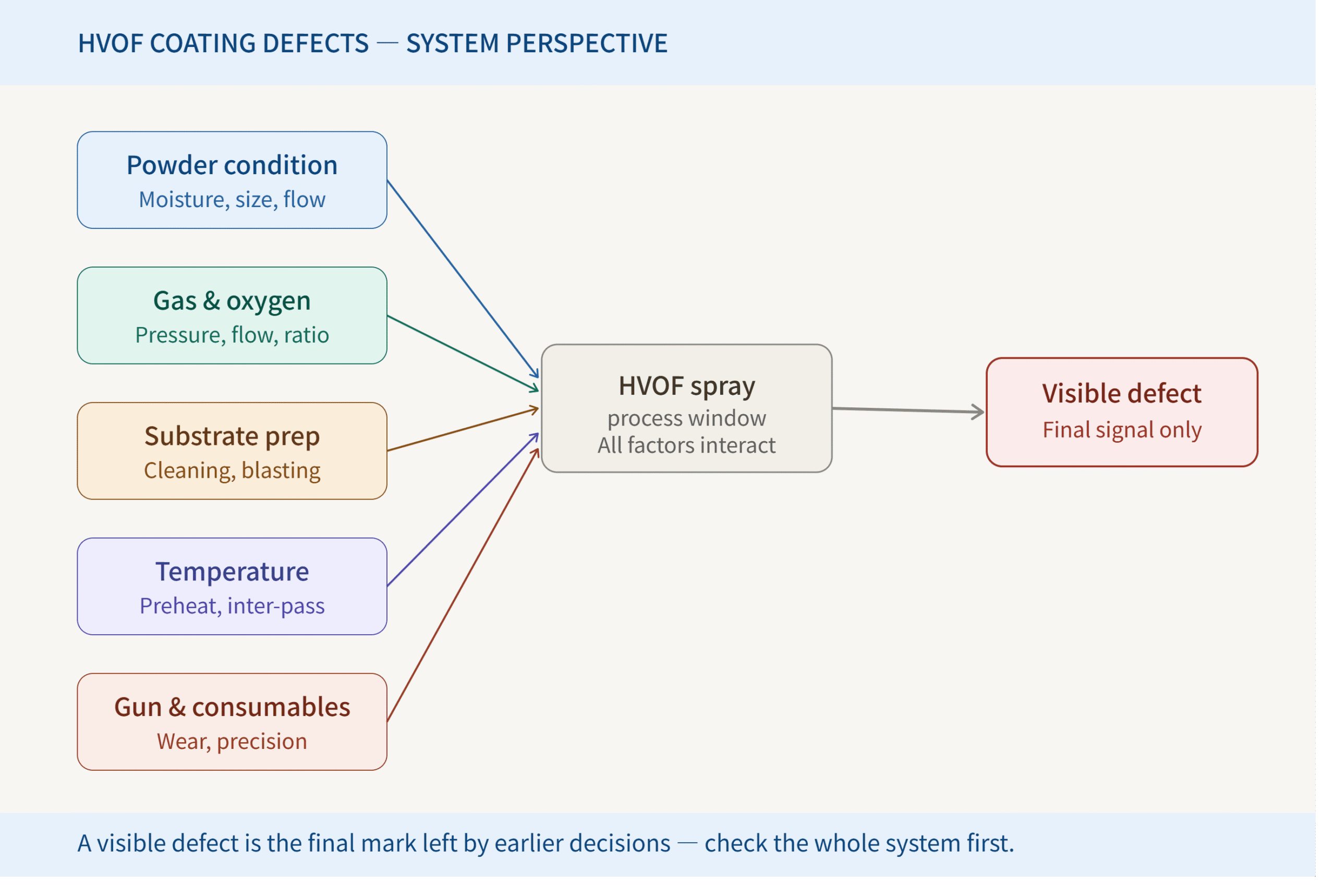
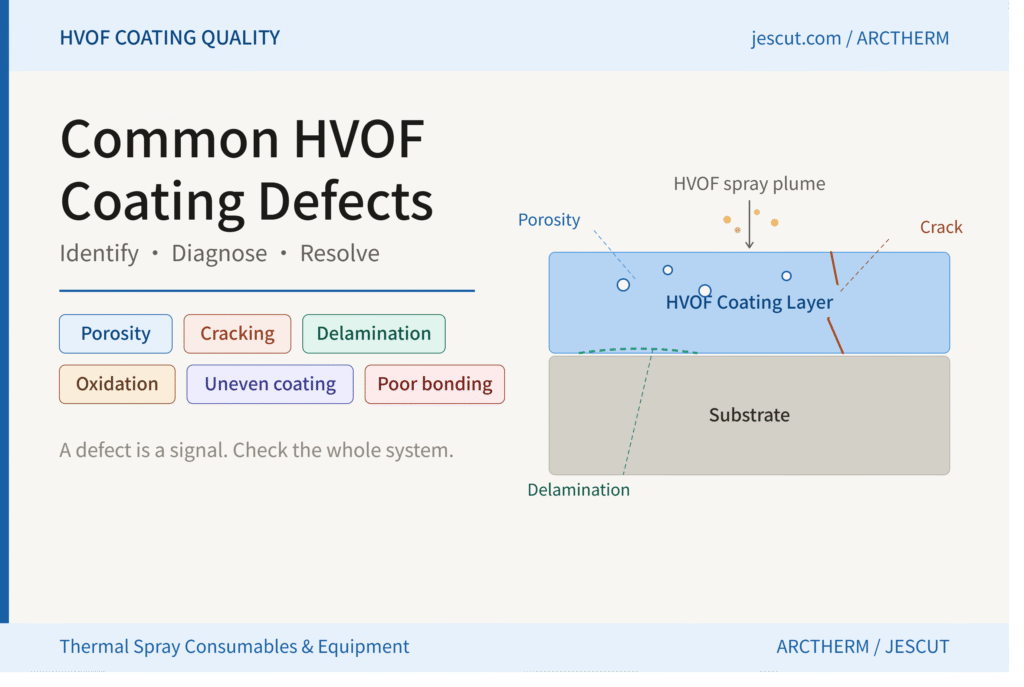
I look at HVOF, or High Velocity Oxygen Fuel spraying1, as a system. I do not look at the coating alone. A visible defect is only the final mark left by many earlier choices. I have learned this from manufacturing HVOF spray guns, barrels, combustion chambers, nozzles, and related consumables. A small change in part precision or wear can affect flame stability.2 A small change in powder flow can affect particle heating.3 A small change in substrate preparation can affect bonding.4 When I see porosity, cracking, delamination, poor bonding, oxidation, unmelted particles, or uneven coating, I see a signal. I then ask what changed in the system before I ask who made the mistake.
Common HVOF Coating Defects and What They May Indicate?
I often see teams chase the defect name first. That can waste time, because the same defect can come from different weak points.
Common HVOF coating defects can indicate problems in particle heating, particle speed, surface preparation, powder flow, temperature control, or equipment stability. I use the defect as a starting clue, not as the final answer.
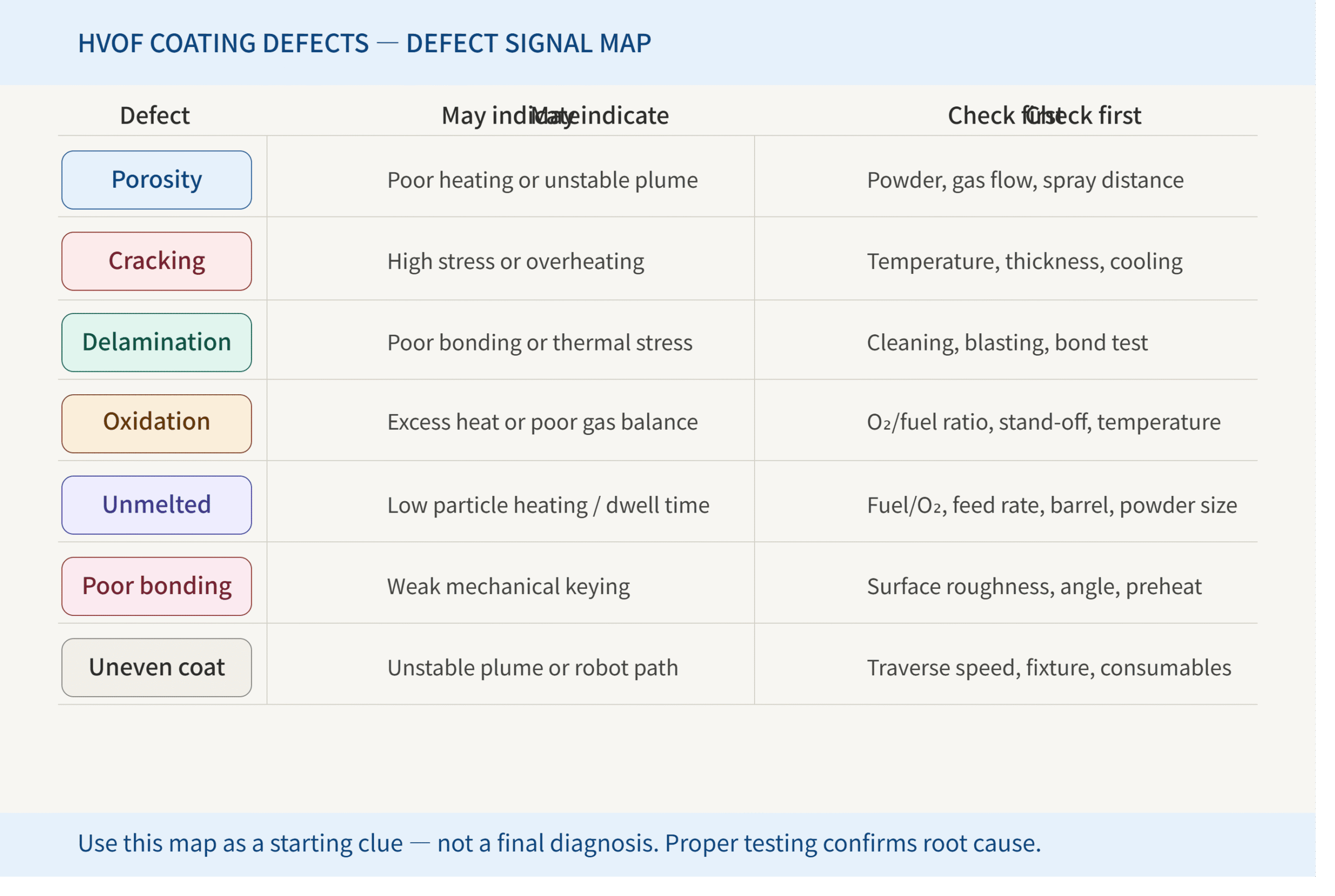
I do not use a defect list as a final diagnosis. I use it as a map. Each defect points me toward several checks. I still need proper testing when the part is critical. A visual check can guide the next step, but it cannot replace metallographic cross-section, porosity measurement, bond strength testing, or hardness testing.5
| Defect I see | What it may indicate | What I usually check first |
|---|---|---|
| Porosity | Weak particle packing, poor heating, unstable spray plume, wrong distance6 | Powder condition, gas flow, feed rate, spray distance, gun wear |
| Cracking | High stress, overheating, wrong thickness build, poor cooling7 | Substrate temperature, pass strategy, coating thickness, material match |
| Delamination | Poor bonding, dirty surface, low roughness, thermal stress8 | Cleaning, grit blasting, preheating, masking, bond test need |
| Poor bonding | Weak mechanical keying or weak particle impact | Surface roughness, spray angle, particle velocity, preheat state |
| Oxidation | Too much heat exposure or wrong atmosphere around spray stream | Oxygen/fuel balance, stand-off distance, powder path, part temperature |
| Unmelted particles | Low particle heating or poor dwell time | Fuel/oxygen condition, powder feed rate, barrel condition, powder size |
| Uneven coating | Unstable plume or inconsistent robot path | Traverse speed, spray distance, fixture, gun alignment, consumables |
I treat these signs with care. Porosity does not always mean bad powder. Cracking does not always mean wrong parameters. Delamination does not always mean poor blasting. I have seen how a worn barrel or a changing combustion chamber condition can disturb the flame and particle stream. I have also seen how a clean and precise gun cannot save a poorly prepared surface. This is why I prefer a balanced check. I ask if the powder is dry and consistent. I ask if the gas supply is stable. I ask if the operator used the same spray distance. I ask if the substrate was cleaned and roughened in the same way. I also ask if the gun parts are still within a stable working condition. That order keeps the discussion fair.
Why HVOF Coating Defects Usually Have Multiple Causes?
I do not trust one-cause answers in HVOF spraying. They sound simple, but they often send the team in the wrong direction.
HVOF coating defects usually have multiple causes because powder heating, particle speed, substrate condition, temperature, gas flow, and gun condition all work together. I check the whole process window before I accept one explanation.
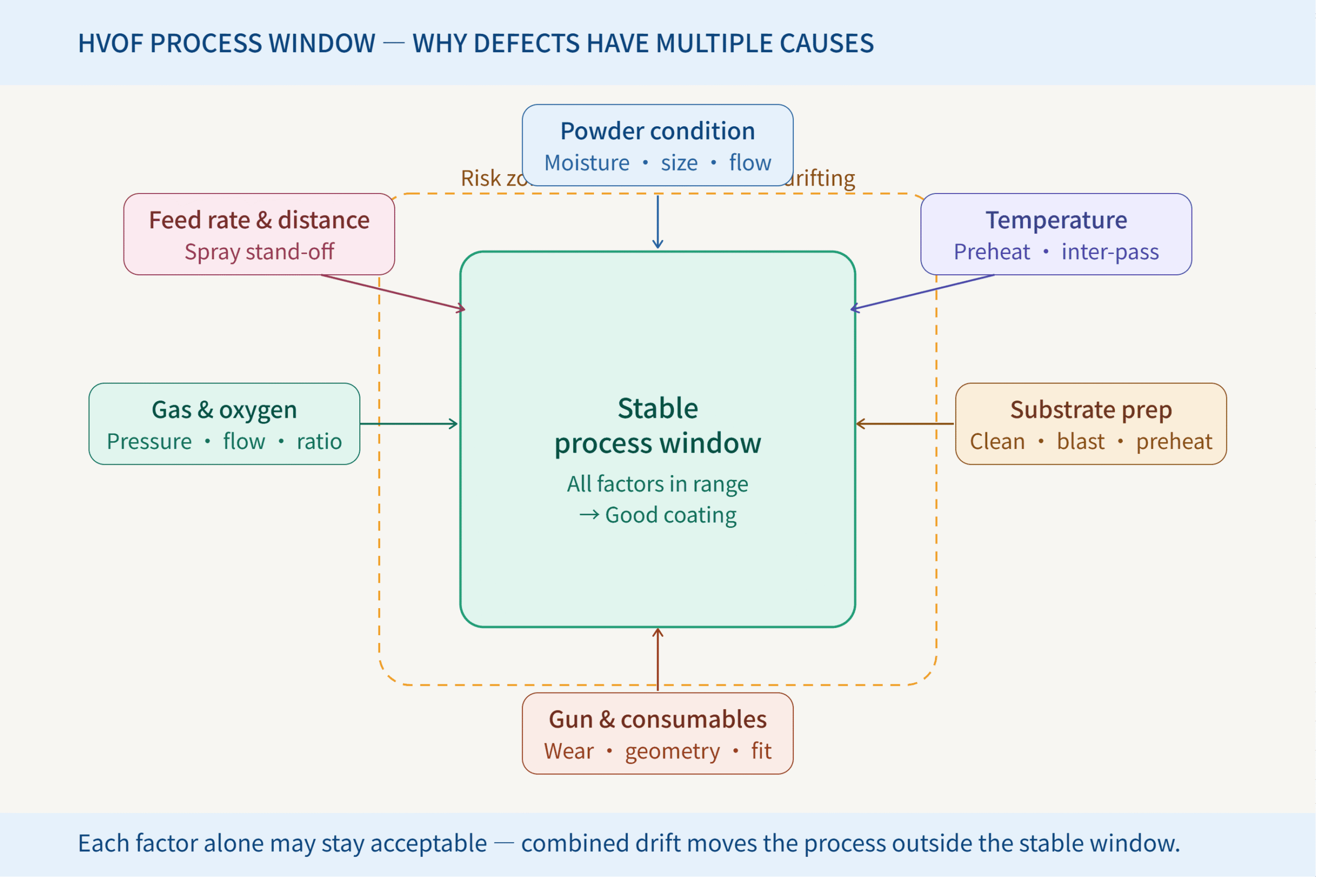
I see HVOF as a narrow process window. The coating quality depends on the particles arriving at the surface with the right heat, speed, angle, and flow.9 The substrate also needs the right surface state. If one item moves slightly, the coating may still look acceptable. If several items move together, defects appear.10 That is why a batch can fail even when no one changed one large setting.
| Process area | What can move out of control | Possible coating signal |
|---|---|---|
| Powder | Moisture, size spread, flow change, lot variation | Porosity, unmelted particles, uneven build |
| Gas and oxygen | Pressure change, flow drift, unstable supply | Oxidation, low density, poor heating |
| Feed rate | Too much powder or unstable powder stream11 | Unmelted particles, rough surface, thickness variation |
| Spray distance | Too close or too far from the part | Overheating, poor bonding, porosity |
| Substrate preparation | Oil, dust, weak blasting, wrong roughness | Delamination, poor bond strength |
| Temperature control | Too hot or too cold during spraying | Cracking, stress, poor adhesion |
| Masking and fixturing | Shadow areas, poor edge control, wrong exposure | Uneven coating, weak edges |
| Gun and consumables | Wear, erosion, poor concentricity, part variation | Flame instability, batch variation, rough coating |
I try to avoid blaming the powder supplier, the operator, or the equipment too quickly. I have no benefit in making the diagnosis personal. A fair diagnosis protects time and trust. If the powder feed rate is high and the barrel is worn, the same visual defect may become worse. If the substrate is slightly under-prepared and the part temperature is not controlled, poor bonding may appear even when the spray plume looks normal. If the nozzle or combustion chamber has wear, the flame shape may change in a way that the team does not notice at first. I think this is the main risk. The real issue can be spread across several small causes. Each cause may look acceptable alone. Together, they can move the process outside the stable range.
The Often-Overlooked Role of Spray Gun and Consumable Condition?
I often see teams check powder, gas, and operators first. I understand that habit, but I think the spray gun deserves equal attention.
Worn or inconsistent HVOF gun parts can contribute to flame and particle instability. I check barrels, combustion chambers, nozzles, and other consumables when defects repeat across batches or appear without clear process change.
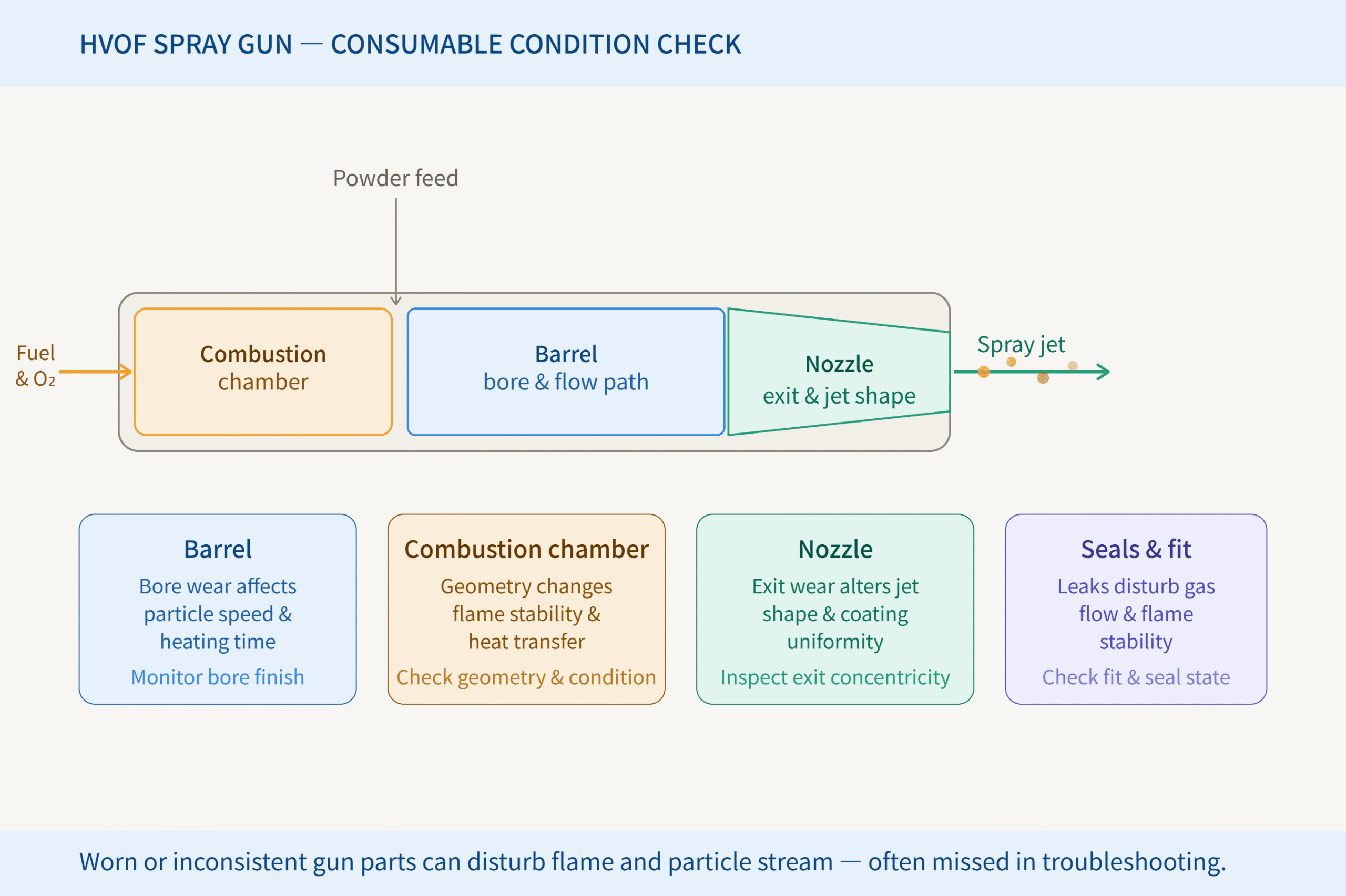
I manufacture HVOF spray guns and consumable parts, so I pay close attention to precision, wear, and repeatability. I do not claim that replacing parts solves every coating problem. That would be too simple. I do believe that gun condition is often missed during troubleshooting. The spray gun creates the flame environment. The consumables guide energy, flow, and particle movement.12 If these parts wear, the same parameter setting may not create the same result.
| Gun or consumable area | Why I check it | What may change in spraying |
|---|---|---|
| Barrel | The bore condition affects flow and particle path | Particle speed, heating time, plume shape |
| Combustion chamber | The combustion state depends on stable geometry | Flame stability, heat transfer, noise change |
| Nozzle | The exit condition affects jet shape | Spray focus, coating uniformity, overspray |
| Seals and fitting areas | Leaks or poor fit can disturb stable gas flow | Flame fluctuation, start-up instability |
| Part concentricity | Alignment affects the center of the spray stream | Uneven coating and edge variation |
| Surface finish of inner bore | Roughness can affect flow behavior and wear | More variation over time |
In our own production, we focus on precision machining because small errors can become process noise. We use CNC machining for high consistency. We control key dimensions, roundness, and inner bore finish for HVOF barrels and related parts. We pay attention to combustion chambers because their condition affects the working environment inside the gun. I share this not as a sales point, but as a practical reminder. A spraying team can run the correct powder and still struggle if the gun parts are not stable. A maintenance team can change parameters again and again, while the real change came from gradual erosion. A buyer can compare coating batches, while the consumable life stage is different between the two runs. I prefer to record part life, part lot, inspection notes, and visible wear. These simple records can make the defect discussion much more useful.
How to Troubleshoot Defects Without Guesswork?
I dislike random parameter changes. They can hide the real cause, and they can create a new defect while chasing the first one.
I troubleshoot HVOF coating defects by checking one area at a time. I record powder, parameters, substrate preparation, temperature, gun condition, and test results before I change the process again.
I use a step-by-step path because HVOF has too many moving parts. Guesswork feels fast at first. It becomes slow when the defect returns. I first define the defect in a simple way. I ask where it appears, when it appears, and whether it is new or repeated. I then connect the defect to the batch record. I look for changes in powder lot, gas supply, feed rate, spray distance, robot program, fixture, substrate cleaning, grit blasting, preheat, and cooling. I then check the gun and consumables. I do not wait until every other item is blamed.
| Step I use | Question I ask | Evidence I want |
|---|---|---|
| 1. Confirm the sign | What do I actually see? | Photos, location map, visual notes |
| 2. Check the batch record | What changed from the last good batch? | Powder lot, settings, operator notes, gas data |
| 3. Review substrate preparation | Was the surface ready for bonding? | Cleaning record, roughness check, masking check |
| 4. Review thermal control | Was the part temperature stable? | Preheat notes, inter-pass temperature, cooling method |
| 5. Inspect gun condition | Are wear parts still stable? | Barrel wear, chamber condition, nozzle state, seal check |
| 6. Use proper testing | What does the coating structure show? | Cross-section, porosity, hardness, bond strength when needed |
| 7. Change with control | What single change will I test? | Trial record, before-after comparison |
I try to make each change traceable. If I change powder feed rate, I do not also change the barrel and spray distance at the same time unless safety or production need forces me. If I replace a worn nozzle, I record the old part condition and the new part batch. If I clean and re-blast a part, I record the roughness and surface state. This habit reduces arguments. It also helps me avoid the common trap of blaming the last person who touched the job.
I also separate visual inspection from final confirmation. A coating may look smooth and still have high porosity. A coating may look rough and still meet a certain function. A visible crack may be surface level, or it may pass through the coating. I do not want to make lab claims from a photo. I use visual signs to choose the next check. I use proper testing when the decision matters. That may include metallographic cross-section, porosity measurement, bond strength testing, hardness testing, or other tests required by the drawing or customer standard. This keeps the troubleshooting practical and honest.
Conclusion
I treat HVOF coating defects as system signals. I check powder, process, substrate, temperature, and gun condition before I accept any single cause.
"Thermal spraying - Wikipedia", https://en.wikipedia.org/wiki/Thermal_spraying. A general technical reference defines high-velocity oxygen fuel spraying as a thermal spray process in which fuel and oxygen combustion accelerates coating particles toward a substrate. Evidence role: definition; source type: encyclopedia. Supports: A neutral reference should define HVOF as High Velocity Oxygen Fuel spraying and describe it as a thermal spray coating process.. ↩
"[PDF] Analysis of a High Velocity Oxygen-Fuel (HVOF) Thermal Spray ...", https://www.osti.gov/servlets/purl/10116459. Experimental and modeling studies of HVOF torches report that nozzle and combustion-chamber geometry influence gas flow, jet structure, and particle acceleration, supporting the link between gun condition and process stability. Evidence role: mechanism; source type: paper. Supports: A source should explain that HVOF torch geometry, nozzle condition, or component wear can influence combustion flow, jet stability, and particle behavior.. Scope note: The source may support the mechanism generally rather than quantify the effect of a specific manufacturer’s barrel, chamber, or nozzle. ↩
"Statistical Comparison of Processing Different Powder Feedstock in ...", https://www.academia.edu/112322543/Statistical_Comparison_of_Processing_Different_Powder_Feedstock_in_an_HVOF_Thermal_Spray_Process. Studies of HVOF spray parameters show that powder feed rate and particle loading can change in-flight particle temperature and velocity, which in turn affects particle melting and coating formation. Evidence role: mechanism; source type: paper. Supports: A source should show that powder feed rate or particle loading affects particle temperature, dwell time, or melting state in HVOF spraying.. Scope note: The exact magnitude of the effect depends on powder chemistry, particle size distribution, torch design, and operating parameters. ↩
"[PDF] Microstructure and Properties of HVOF-Sprayed Protective Coatings", https://inldigitallibrary.inl.gov/sites/sti/sti/4045032.pdf. Research on thermal spray adhesion shows that substrate roughness and cleanliness produced by surface preparation influence mechanical interlocking and measured bond strength of sprayed coatings. Evidence role: mechanism; source type: paper. Supports: A source should support that surface roughness, cleanliness, or grit blasting affects mechanical interlocking and bond strength of thermal spray or HVOF coatings.. Scope note: The evidence is usually material- and preparation-specific, so it supports the general principle rather than a single universal roughness value. ↩
"Investigation of Mechanical Properties of Twin Wire Arc Repair of ...", https://pmc.ncbi.nlm.nih.gov/articles/PMC8723824/. Thermal spray testing standards and professional handbooks describe metallographic examination, porosity assessment, adhesion or bond testing, and hardness measurement as established methods for evaluating coating quality beyond visual inspection. Evidence role: expert_consensus; source type: institution. Supports: A standards or professional reference should identify metallography, porosity measurement, adhesion or bond testing, and hardness testing as accepted methods for evaluating thermal spray coatings.. Scope note: The source supports the need for additional testing generally; the required tests for a specific part still depend on the drawing, service conditions, and customer specification. ↩
"An Influence of Oxygen Flow Rate and Spray Distance on the ... - PMC", https://pmc.ncbi.nlm.nih.gov/articles/PMC9505576/. Published studies of HVOF coatings report that porosity varies with spray parameters such as stand-off distance, particle temperature, and particle velocity, linking pore formation to the in-flight particle state and deposition conditions. Evidence role: mechanism; source type: paper. Supports: A source should show that HVOF coating porosity is influenced by particle temperature, velocity, deposition conditions, or stand-off distance.. Scope note: The source may not address every listed cause in the same experiment, and porosity mechanisms differ by coating material. ↩
"[PDF] Microstructure, deformation and cracking characteristics of thermal ...", https://groups.seas.harvard.edu/hutchinson/papers/492.pdf. Thermal spray research identifies residual stress, thermal gradients, and coating thickness as factors that can promote cracking when stresses exceed the fracture resistance of the coating system. Evidence role: mechanism; source type: paper. Supports: A source should support that residual stress, thermal history, coating thickness, and cooling conditions can contribute to cracking in thermal spray or HVOF coatings.. Scope note: The evidence supports cracking mechanisms broadly; whether overheating or cooling caused a specific crack requires material-specific testing and process records. ↩
"(PDF) Residual stresses and adhesion of thermal spray coatings", https://www.academia.edu/8498557/Residual_stresses_and_adhesion_of_thermal_spray_coatings. Studies of thermal spray adhesion describe delamination as an interfacial failure that can be promoted by inadequate surface preparation, contamination, insufficient mechanical interlocking, or residual and thermal stresses. Evidence role: mechanism; source type: paper. Supports: A source should explain that delamination can occur when adhesion is reduced by contamination or insufficient roughness, or when interfacial stresses exceed bond strength.. Scope note: The source supports common delamination mechanisms and does not by itself diagnose the cause of delamination in any particular coating batch. ↩
"Prediction of In-Flight Particle Properties and Mechanical ... - PMC", https://pmc.ncbi.nlm.nih.gov/articles/PMC10532925/. Reviews of thermal spray processing emphasize that particle temperature, velocity, trajectory, and impact conditions govern splat formation and therefore influence coating microstructure, porosity, adhesion, and mechanical properties. Evidence role: expert_consensus; source type: paper. Supports: A source should support that in-flight particle state and impact conditions affect coating microstructure and properties in thermal spraying.. Scope note: The statement is a general process principle; the optimum temperature, velocity, and angle depend on the coating material and equipment configuration. ↩
"[PDF] Microstructure and Properties of HVOF-Sprayed Protective Coatings", https://inldigitallibrary.inl.gov/sites/sti/sti/4045032.pdf. Design-of-experiments and parameter studies in HVOF spraying show that coating properties are affected by multiple interacting variables, supporting the use of a process-window rather than a single-cause approach. Evidence role: general_support; source type: paper. Supports: A source should show that HVOF coating properties are influenced by interacting process parameters such as gas flow, feed rate, stand-off distance, and substrate temperature.. Scope note: The source may demonstrate parameter interactions for selected materials and conditions rather than proving all defect combinations listed in the article. ↩
"An Influence of Oxygen Flow Rate and Spray Distance on the ... - PMC", https://pmc.ncbi.nlm.nih.gov/articles/PMC9505576/. Thermal spray parameter studies report that powder feed rate influences particle heating and deposition behavior, with changes in feed conditions affecting coating roughness, unmelted particle content, and build rate. Evidence role: mechanism; source type: paper. Supports: A source should show that powder feed rate and feed stability affect particle heating, surface roughness, deposition rate, or coating thickness uniformity.. Scope note: The relationship can be non-linear and depends on powder size, material, torch power, and carrier-gas settings. ↩
"[PDF] Design and Development of a High Velocity Oxy-Fuel Thermal ...", https://scholarworks.utep.edu/cgi/viewcontent.cgi?article=2209&context=open_etd. Modeling and experimental work on HVOF torches shows that combustion-chamber and nozzle geometry determine gas temperature, pressure, velocity fields, and particle trajectories, thereby affecting heat and momentum transfer to the powder. Evidence role: mechanism; source type: paper. Supports: A source should explain how the combustion chamber, barrel, and nozzle shape the flame jet and control particle heating and acceleration.. Scope note: The evidence supports the physical mechanism generally and may not evaluate the exact consumable designs discussed by the article’s author. ↩