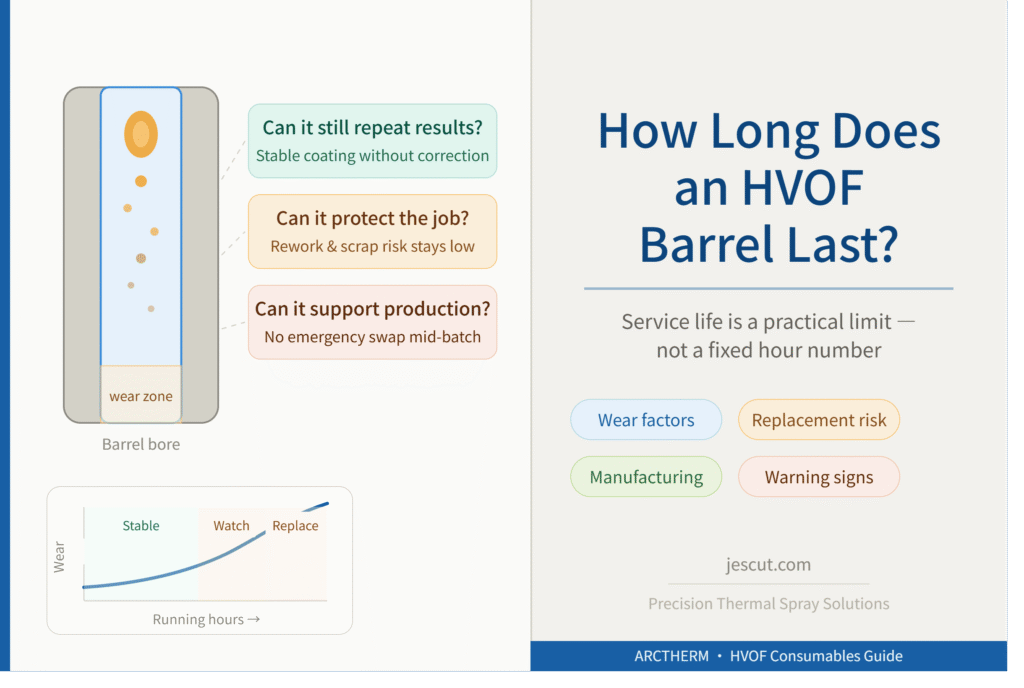
I see many teams lose coating stability before they notice barrel wear. I also see them keep spraying until rework becomes expensive.
I treat HVOF barrel life as a conditional service range, not a fixed hour number1. In many shops, the barrel may be discussed in tens of spraying hours, and some stable processes may run longer. I judge replacement by coating results, spray stability, wear signs, and process risk.
I learned this lesson from production inspection and after-sales feedback. A simple hour number feels easy. It also feels safe for purchasing. But the real question is not only “How long can I use it?” The better question is “When does continued use start risking coating quality, rework, powder waste, or downtime?” I will explain how I look at this decision as a manufacturer and tester of HVOF barrels, combustion chambers, and related thermal spray consumables.
“How Long Does an HVOF Barrel Last?” — Why There Is No Fixed Number?
I understand why buyers ask for one lifetime number. I also know that one number can hide real process risk.
I do not give one guaranteed lifetime for every HVOF barrel because each application runs under different heat load, powder type, fuel setting, cooling condition, and maintenance habit2. I use service hours only as a reference, and I confirm the replacement point by field symptoms and inspection results.
I see barrel life as a risk decision
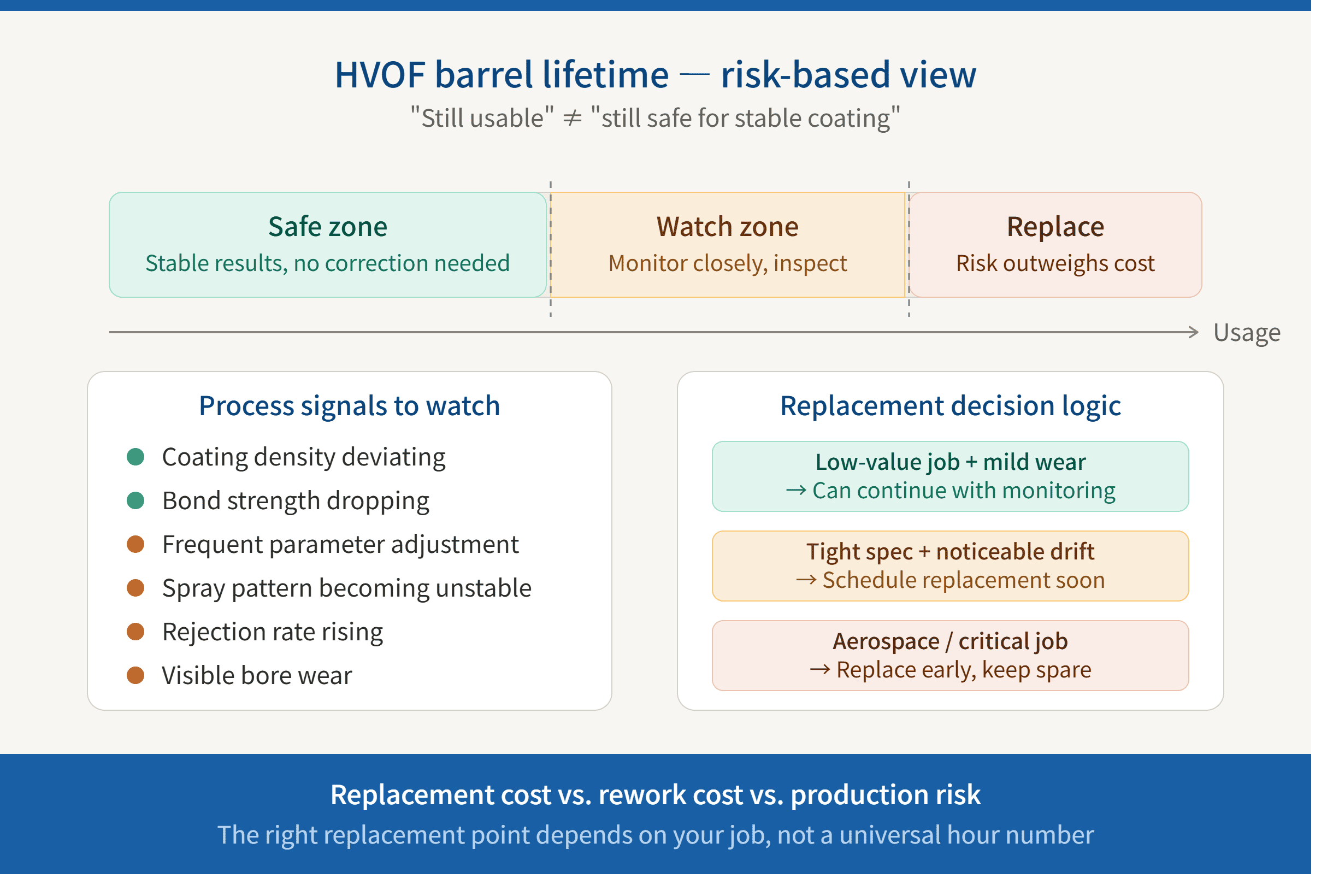
When I talk with coating shops, I usually separate “still usable” from “still safe for stable coating.” A barrel may still fit the gun. It may still allow ignition. It may still produce a coating. But that does not mean it is still the best choice for a critical job. I have seen customers continue using a barrel because the visible surface looked acceptable. Then they started to change parameters more often. They adjusted gas flow. They adjusted powder feed. They adjusted spray distance. They did this to recover the same coating result. That is usually a warning sign.
| Question I ask | What it means in practice |
|---|---|
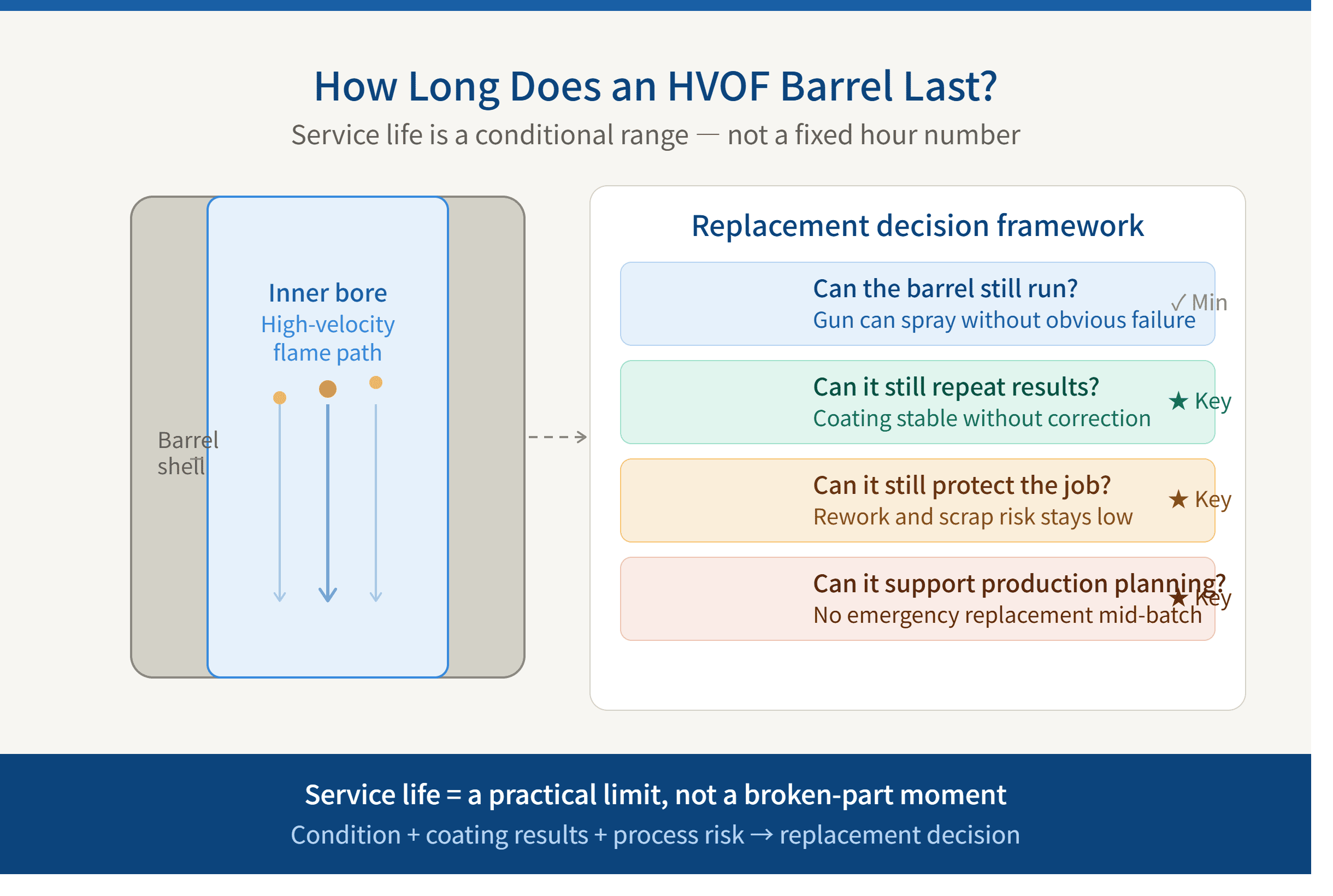
| Can the barrel still run? | The gun can still spray without an obvious failure. |
| Can the barrel still repeat results? | The coating quality remains stable without constant correction. |
| Can the barrel still protect the job? | The risk of rework, downtime, and scrap stays acceptable. |
| Can the barrel still support production planning? | The team can finish the batch without emergency replacement. |
I prefer the second, third, and fourth questions. A barrel is not just a metal part. It is part of the flame path and particle acceleration path.3 Its condition can affect the spray stream.4 So I treat the end of life as a practical limit, not a broken-part moment. For non-critical jobs, a team may accept more variation. For aerospace, energy, medical, or high-value wear coating work, the acceptable risk is much lower. This is why I never like a simple promise such as “this barrel lasts exactly X hours.” I think that kind of answer is too easy, and it may lead the user to ignore real signals from the process.
What Actually Determines HVOF Barrel Wear and Service Life?
I have seen the same barrel design behave differently in different shops. The part matters, but the process also matters.
HVOF barrel service life is mainly shaped by heat load, fuel and oxygen settings, powder type, particle erosion, cooling condition, spray cycle, gun alignment, cleaning method, and maintenance discipline. I also consider coating stability the most practical field signal.
I look beyond the barrel itself
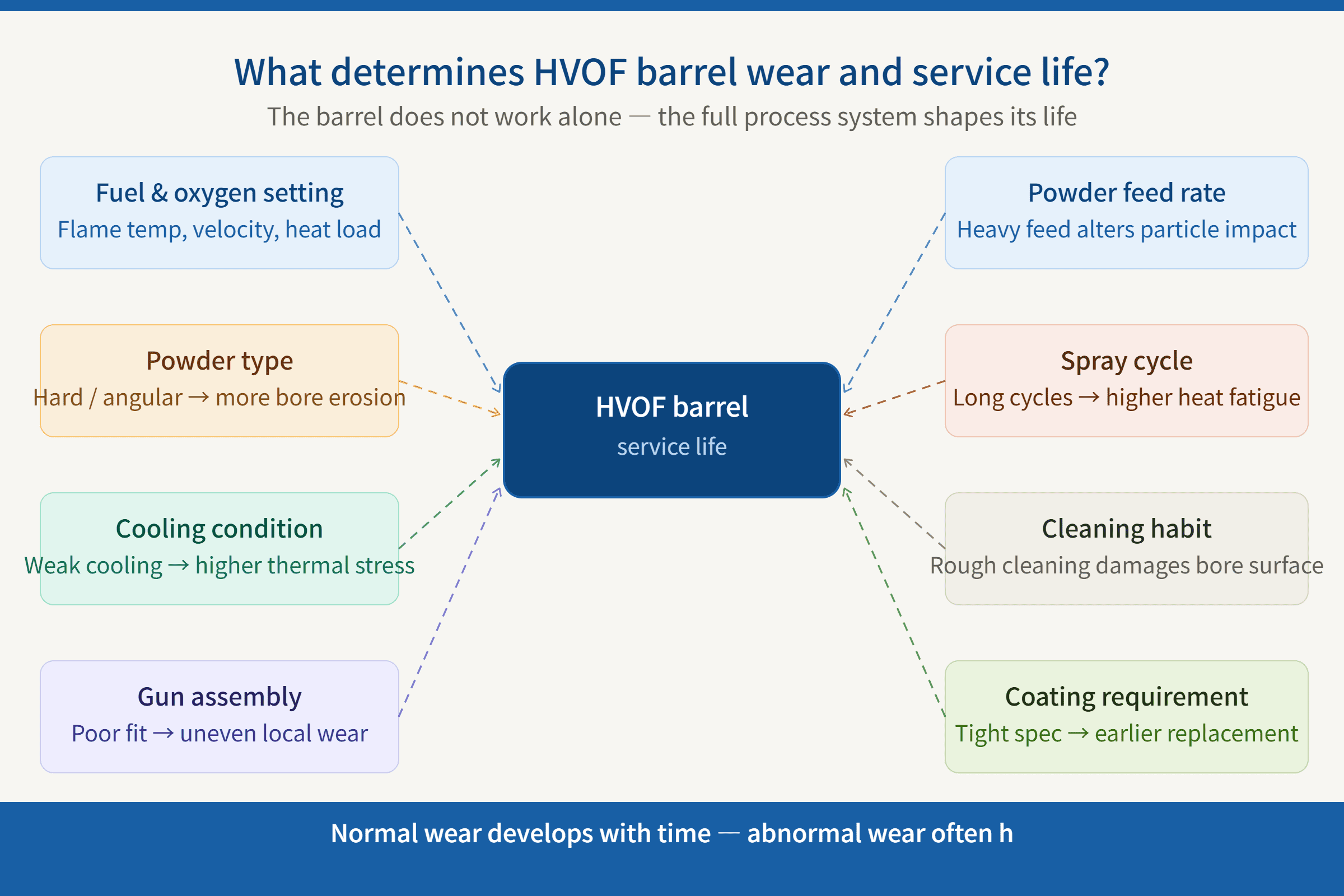
I manufacture HVOF barrels, so I care deeply about bore quality, hardness, roundness, and dimensional control. But I also know the barrel does not work alone. It works inside a full spraying system. A high-heat process can shorten life. A hard powder can increase erosion. A poor cooling condition can change the thermal load. A long continuous spray cycle can be harder than a short test run. A small alignment problem can also increase local wear.
| Factor | How I see its effect on barrel life |
|---|---|
| Fuel and oxygen setting | It changes flame temperature, velocity, and heat load.5 |
| Powder type | Hard or angular powders can increase inner bore erosion.6 |
| Powder feed rate | Heavy feed can change particle impact and build-up behavior. |
| Cooling condition | Weak cooling can raise thermal stress and reduce stability.7 |
| Spray cycle | Long continuous spraying may create higher heat fatigue.8 |
| Gun assembly | Poor fit or alignment can create uneven wear. |
| Cleaning habit | Rough cleaning can damage the bore surface or edge. |
| Coating requirement | Tight specifications may require earlier replacement. |
I often ask customers about their real operating condition before I discuss replacement cycles. I ask about the equipment model, powder material, fuel type, spray parameters, coating target, and daily running hours. I also ask whether the team has to change parameters more often than before. That answer is useful. If the same job used to run with stable settings, but now needs constant correction, I see that as a stronger signal than an hour counter alone.
I also separate normal wear from abnormal wear. Normal wear develops with time. Abnormal wear may come from wrong assembly, damaged sealing, bad cooling, wrong cleaning, or process drift. When a customer sends photos or used parts, I can often help them think through possible causes. I do not claim I can know every field detail from a photo. But I can often see enough to start a useful technical discussion.
Manufacturing Factors That Influence Barrel Durability and Consistency?
I believe process control starts before the barrel reaches the spray room. A good barrel must be repeatable, not just attractive.
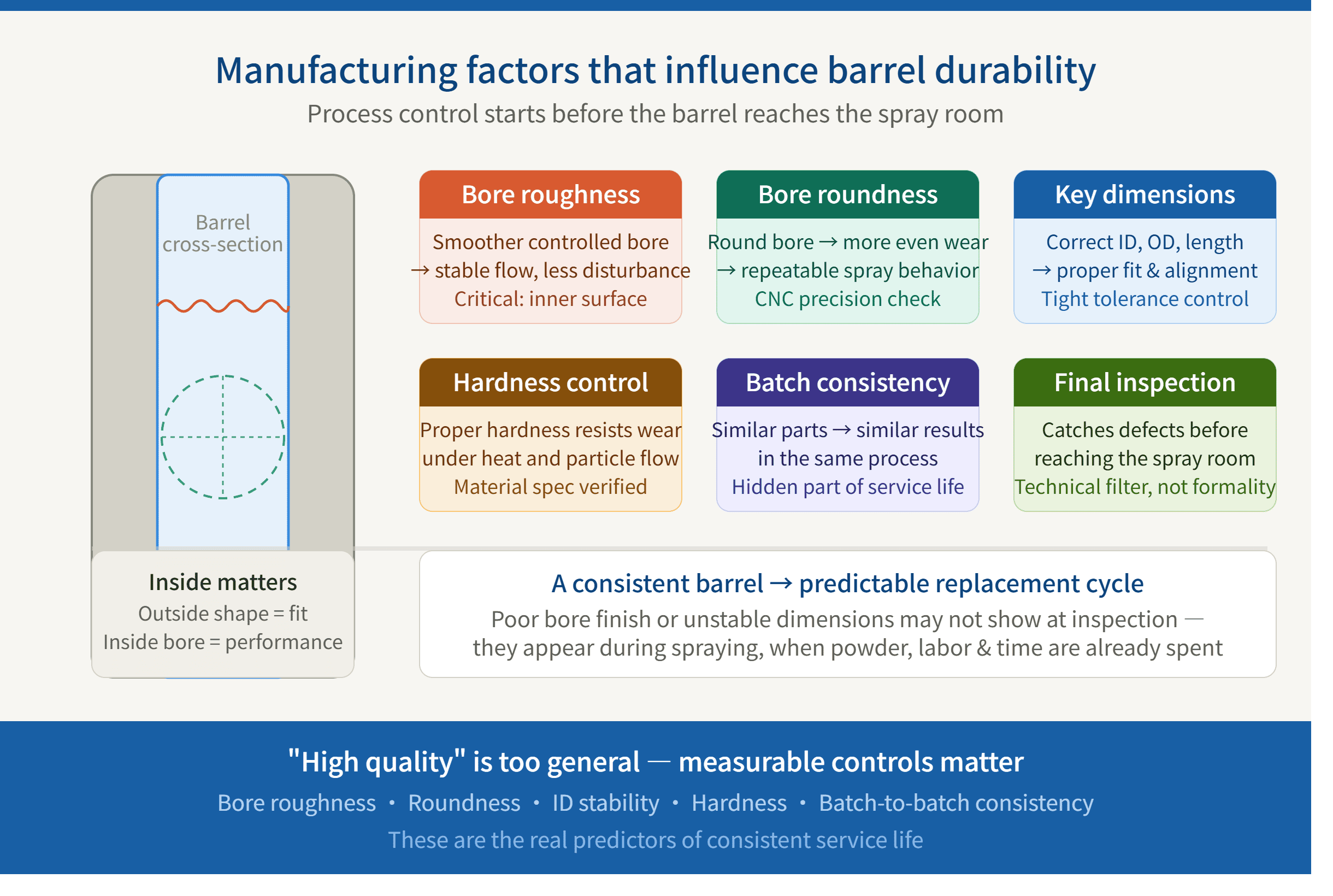
The manufacturer-controlled factors include bore roughness, bore roundness, hardness, key dimensions, concentricity, batch consistency, material control, and final inspection. I focus on these points because they influence spray stability and reduce the chance of early or uneven wear.
I focus on the inside surface because the spray stream cares about it
In my workshop, I pay close attention to the bore. The outside shape matters for fit. The inside condition matters for the flow path. For HVOF barrels, the bore surface can affect heat behavior, particle flow, and wear pattern9. I use precision CNC machining and strict inspection because small differences can become real problems in spraying. In our production, we control key dimensions tightly. We also check bore roughness, roundness, and hardness because these points are tied to consistency10.
| Manufacturing point | Why I control it |
|---|---|
| Bore roughness | A smoother controlled bore can support stable flow and reduce unwanted disturbance. |
| Bore roundness | A round bore helps keep wear more even and supports repeatable spray behavior. |
| Key dimensions | Correct dimensions help fit, alignment, and stable gun assembly. |
| Hardness control | Proper hardness helps resist wear under heat and particle flow. |
| Batch consistency | Similar parts should give similar results in the same process. |
| Final inspection | Inspection catches defects before the part reaches the customer. |
I do not like to describe barrel quality only with words such as “high quality” or “long life.” Those words are too general. I prefer measurable controls. For example, I care about whether the internal bore roughness is controlled. I care about whether the inner diameter is stable. I care about whether the part is made in a way that avoids random differences from one piece to another. In our related thermal spray consumables, we use high-precision CNC equipment and tight inspection for critical dimensions. For many plasma spray cathodes and anodes, we also use strict geometric control and stable joining technology because the interface affects performance. The same thinking applies to HVOF barrels. A part that is not consistent can make the user blame the process, powder, or operator when the real issue starts with the component.
I also think final inspection is not a formality. It is a technical filter. If a barrel has poor bore finish, poor roundness, or unstable key dimensions, the problem may not appear on the desk. It may appear during spraying. That is the worst time to discover it, because powder, labor, and machine time are already being spent. This is why I see manufacturing consistency as a hidden part of service life. A consistent barrel helps the user build a more predictable replacement cycle.
Practical Signs It May Be Time to Replace an HVOF Barrel?
I do not wait only for visible damage. I watch the coating result and the operator’s behavior.
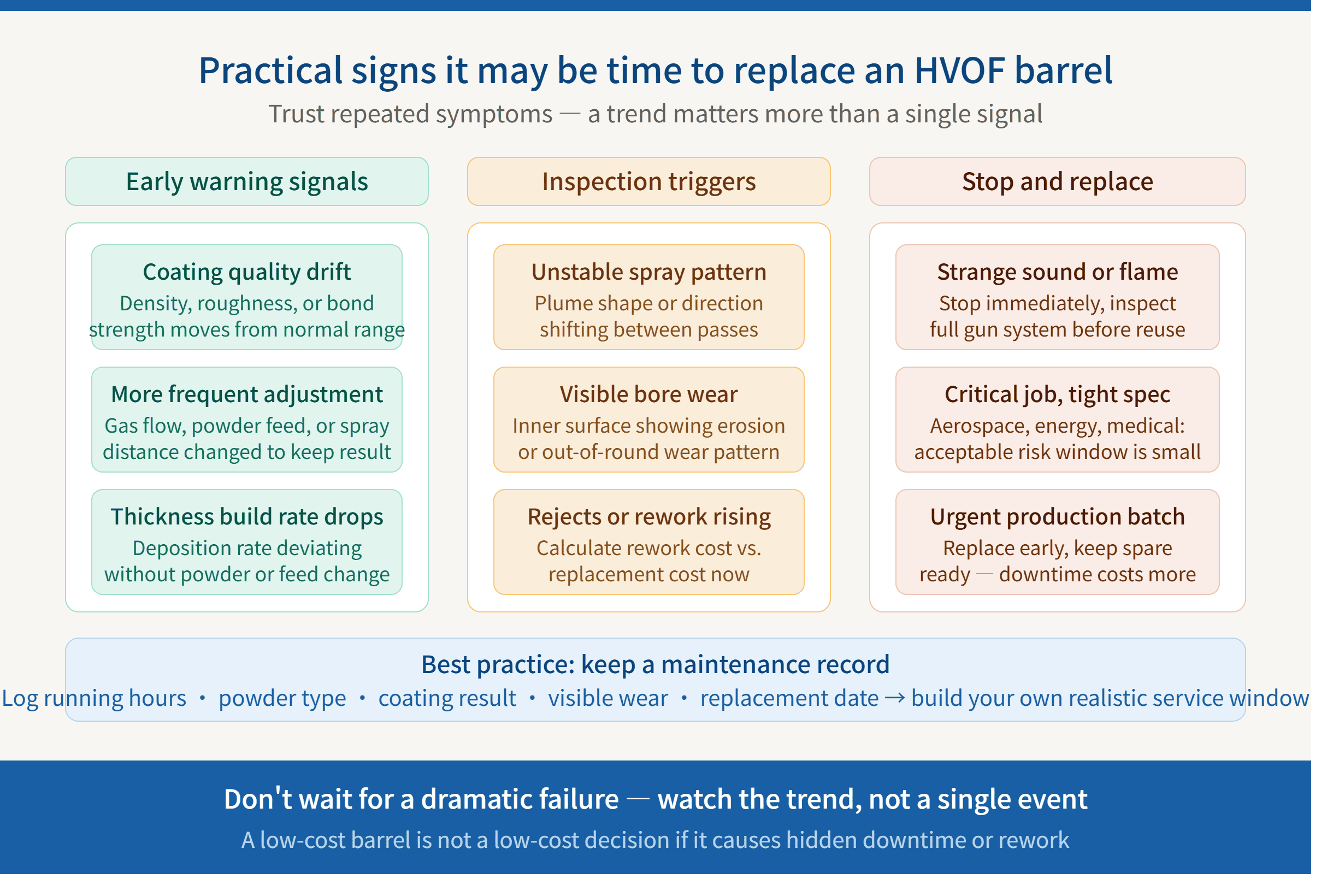
It may be time to replace an HVOF barrel when coating quality starts to fluctuate, spray pattern changes, the operator must often adjust parameters, visible bore wear appears, or production risk becomes higher than the cost of replacement.
I trust repeated symptoms more than one single clue
A used barrel can show many signs. Some are visible. Some are only visible in the coating result. I always tell teams not to wait for a dramatic failure. The more useful signal is a trend. If coating density, roughness, bond strength, or thickness build rate starts to move away from the normal window, the barrel should be part of the inspection list.11 If the operator keeps changing settings to keep the same result, the barrel should also be checked. This is especially true when the powder, gun, fuel, and program have not changed.
| Practical sign | What I would check next |
|---|---|
| Coating quality fluctuation | I would compare recent results with the normal process record. |
| Frequent parameter adjustment | I would check whether the barrel condition is changing the spray stream. |
| Unstable spray pattern | I would inspect bore wear, alignment, and gun assembly. |
| Visible inner bore wear | I would compare the wear with past used barrels from the same process. |
| More rejects or rework | I would calculate the risk of continued use against replacement cost. |
| Strange sound or flame behavior | I would stop and inspect the gun system before more spraying. |
I like to use a simple rule in daily production planning. If the barrel is cheap to replace compared with the value of the job, I replace it earlier. If the coating specification is tight, I replace it earlier. If the customer job is urgent, I keep spares ready. A low-cost barrel is not always a low-cost decision if it causes hidden downtime or rework. At the same time, I do not say every barrel should be replaced early without reason. That would waste money. I prefer a record-based method.
A good maintenance team can record running hours, powder type, fuel setting, coating result, visible wear, and replacement date.12 After several cycles, the team can build its own realistic service window. This window is much more useful than a general number from any supplier. I can help customers review these records when they share them with me. I usually ask for the equipment model, operating conditions, coating quality symptoms, and photos of visible wear. With those details, I can help judge whether the barrel is near the replacement point, or whether another process issue may be causing the problem.
Conclusion
I do not treat HVOF barrel life as one fixed number. I judge it by wear, coating stability, process risk, and manufacturing consistency.
"[PDF] Microstructure and Properties of HVOF-Sprayed Protective Coatings", https://inldigitallibrary.inl.gov/sites/sti/sti/4045032.pdf. A study of HVOF thermal spraying describes coating formation and equipment performance as dependent on process variables such as fuel, oxygen, powder feed, and thermal conditions, supporting the view that barrel life is best evaluated in relation to operating conditions rather than by a universal hour limit. Evidence role: general_support; source type: paper. Supports: A source should support that HVOF equipment wear and process stability are affected by process parameters and operating conditions, making fixed service-life numbers unreliable without context.. Scope note: This would provide contextual support for condition-dependent service life, not a direct published lifetime range for this specific barrel design. ↩
"An Influence of Oxygen Flow Rate and Spray Distance on the ... - PMC", https://pmc.ncbi.nlm.nih.gov/articles/PMC9505576/. Published HVOF process research identifies fuel-oxygen conditions, powder characteristics, feed rate, and thermal management as variables that influence particle heating, acceleration, and deposition behavior, providing a mechanistic basis for treating these factors as contributors to barrel wear and service stability. Evidence role: mechanism; source type: paper. Supports: A source should explain how HVOF operating parameters and material feed affect temperature, particle velocity, erosion, and coating outcomes.. Scope note: The evidence would support the mechanisms affecting wear and stability; it may not quantify the independent contribution of each factor to barrel life. ↩
"[PDF] Design and Development of a High Velocity Oxy-Fuel Thermal ...", https://scholarworks.utep.edu/cgi/viewcontent.cgi?article=2209&context=open_etd. Educational descriptions of HVOF spraying explain that powder particles are injected into a high-temperature, high-velocity combustion gas stream and accelerated through the gun nozzle or barrel before impact on the substrate, supporting the characterization of the barrel as part of the flame and particle-acceleration path. Evidence role: definition; source type: education. Supports: A source should define the HVOF process and describe how combustion gases accelerate particles through the gun barrel or nozzle toward the substrate.. Scope note: The source may describe generic HVOF gun geometry rather than the exact barrel configuration used by every equipment model. ↩
"[PDF] Design and Development of a High Velocity Oxy-Fuel Thermal ...", https://scholarworks.utep.edu/cgi/viewcontent.cgi?article=2209&context=open_etd. Thermal spray modeling and experimental studies report that nozzle geometry and flow-path conditions influence gas dynamics and particle acceleration, supporting the claim that changes in barrel condition can alter the HVOF spray stream. Evidence role: mechanism; source type: paper. Supports: A source should show that nozzle or barrel geometry affects gas flow, particle velocity, plume shape, or spray stream characteristics in thermal spraying.. Scope note: This would support the physical mechanism; it may not isolate field-worn barrels as the only cause of spray-stream variation. ↩
"[PDF] Analysis of a High Velocity Oxygen-Fuel (HVOF) Thermal Spray ...", https://www.osti.gov/servlets/purl/10116459. HVOF process studies show that oxygen-fuel ratio and total gas flow influence combustion temperature, jet velocity, and particle heating, supporting the statement that fuel and oxygen settings alter flame temperature, velocity, and heat load. Evidence role: mechanism; source type: paper. Supports: A source should support that oxygen-fuel ratio and gas flow rate affect combustion temperature, jet velocity, and thermal loading in HVOF systems.. Scope note: The exact magnitude of these changes depends on the fuel chemistry, gun design, and operating window. ↩
"Erosive Wear Mechanisms of Materials—A Review of ... - PMC", https://pmc.ncbi.nlm.nih.gov/articles/PMC11990582/. Solid-particle erosion literature reports that particle hardness, angularity, velocity, and impact angle are major determinants of erosive wear, providing a mechanistic basis for expecting hard or angular HVOF powders to increase inner-bore erosion. Evidence role: mechanism; source type: paper. Supports: A source should support that hard and angular particles tend to produce higher solid-particle erosion under impact or high-velocity flow conditions.. Scope note: This evidence is likely general to erosion mechanics and may not directly measure erosion inside a specific HVOF barrel. ↩
"(PDF) Overview of Thermal Spray - Academia.edu", https://www.academia.edu/28667353/Overview_of_Thermal_Spray. Research on thermal spray systems and high-temperature component design indicates that cooling conditions control component temperature and thermal gradients, supporting the claim that weak cooling can increase thermal stress and contribute to unstable operation. Evidence role: mechanism; source type: paper. Supports: A source should explain that cooling affects component temperature, thermal gradients, and stress in high-temperature spray equipment.. Scope note: The source may establish the heat-transfer principle without directly testing HVOF barrel replacement thresholds. ↩
"A Mini-Review on the Thermal Fatigue Properties of Copper ... - PMC", https://pmc.ncbi.nlm.nih.gov/articles/PMC10217097/. Materials-engineering literature on thermal fatigue shows that repeated or sustained thermal gradients in metallic components can initiate damage and reduce service life, providing contextual support for linking long continuous HVOF spray cycles with higher heat-fatigue risk. Evidence role: mechanism; source type: paper. Supports: A source should support that sustained high thermal exposure and repeated thermal cycling can produce thermal fatigue in metallic components.. Scope note: This is contextual support from thermal fatigue principles; the exact fatigue response depends on barrel material, cooling, geometry, and spray parameters. ↩
"[PDF] Initial Assessment of Erosion/Abrasion Issues Related to Gas ... - INFO", https://info.ornl.gov/sites/publications/Files/Pub199658.pdf. Studies of rough-wall internal flow and particle-laden erosion show that surface roughness can alter boundary-layer behavior, heat transfer, and particle-wall interaction, supporting the view that an HVOF barrel bore surface may affect heat behavior, particle flow, and wear pattern. Evidence role: mechanism; source type: paper. Supports: A source should support that internal surface roughness affects turbulent flow, heat transfer, and particle-wall interactions in high-velocity gas-particle systems.. Scope note: This evidence would be mechanistic and partly analogous unless the source specifically studies HVOF barrel bores. ↩
"Erosive Wear Mechanisms of Materials—A Review of ... - PMC - NIH", https://pmc.ncbi.nlm.nih.gov/articles/PMC11990582/. Manufacturing and tribology research links surface finish, geometric tolerance, and hardness with wear behavior and repeatability in precision components, supporting the claim that bore roughness, roundness, and hardness are relevant to HVOF barrel consistency. Evidence role: general_support; source type: paper. Supports: A source should support that surface finish, geometric accuracy, and hardness influence wear and repeatable behavior in components exposed to flow, heat, or erosion.. Scope note: The support is likely general to precision and wear-sensitive components rather than a direct statistical study of HVOF barrel batches. ↩
"Investigation on Microstructure, Mechanical and Wear Properties of ...", https://pmc.ncbi.nlm.nih.gov/articles/PMC8231858/. HVOF coating studies report that process conditions affect coating porosity or density, surface roughness, adhesion strength, and deposition behavior, supporting the use of deviations in these properties as signals for inspecting the spray system, including the barrel. Evidence role: expert_consensus; source type: paper. Supports: A source should support that HVOF coating properties such as porosity, roughness, adhesion, and deposition rate are sensitive to process conditions and spray stream stability.. Scope note: The evidence would support inspection as a reasonable troubleshooting step, not prove that barrel wear is the cause of every coating-property deviation. ↩
"[PDF] rcm guide | nasa", https://www.nasa.gov/wp-content/uploads/2023/06/nasa-rcmguide.pdf. Maintenance and reliability guidance treats operating history, inspection findings, condition indicators, and replacement records as essential inputs for condition-based maintenance decisions, supporting the practice of recording HVOF barrel running hours, process conditions, coating results, visible wear, and replacement dates. Evidence role: expert_consensus; source type: institution. Supports: A source should support that maintenance records, operating history, inspection results, and replacement dates are standard inputs for condition-based or reliability-centered maintenance.. Scope note: This supports the maintenance method generally; it may not prescribe the exact HVOF-specific fields listed in the article. ↩