.png)
Landing gear faces load, weather, and movement. I see one mistake often. People chase hardness, then miss the real risks under service.
I use HVOF coatings for landing gear protection because they can help control wear, corrosion, adhesion, size, and reliability risks when the full spray process is controlled and approved for that application.
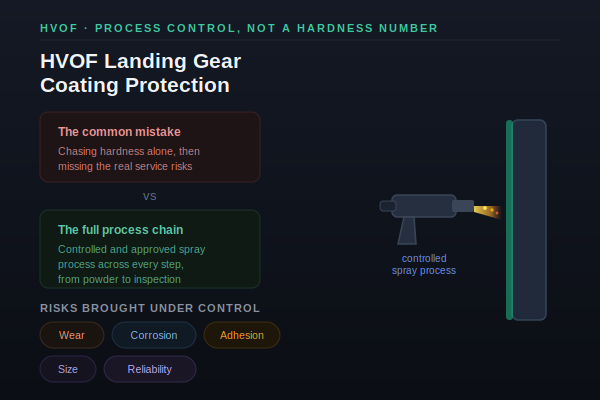
I want to look past a simple hardness story. I have worked around HVOF spray guns, barrels, combustion chambers, and consumable parts for many years. I do not approve landing gear repairs. I do not speak as an aircraft design authority. I speak from the equipment side. I see how a stable spray process can support a stable coating result. This matters because landing gear protection is not one single property. It is a chain of risks. If one link is weak, the coating can still fail.
What Is the Real Objective of Landing Gear Protection: Wear, Corrosion, and Reliability Control?
Landing gear looks strong, but its surfaces work in a harsh place1. I see wear, corrosion, and coating damage create real repair pressure2.
I view landing gear protection as risk control. The coating must reduce wear and corrosion, keep adhesion, hold dimensions, and support long-term reliability under the approved repair or manufacturing process.
I Do Not Start With Hardness Alone
I often hear one simple question first. “How hard is the coating?” I understand that question. Hardness is easy to compare. Still, I do not think it is enough for landing gear work. A hard coating can still be a poor coating if it cracks, loses bond, traps defects, or finishes outside the required size. A landing gear surface does not only rub. It also sees moisture, salt, shock, cyclic load, seal contact, sliding motion, and repair handling.
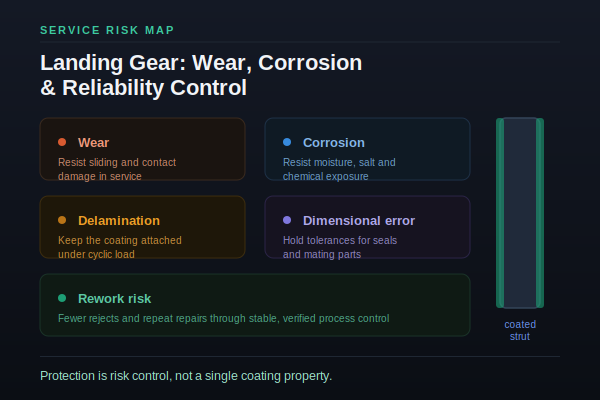
I Treat Protection as a Service Risk Map
I like to break the objective into direct risks. This keeps the discussion practical. It also stops me from using one number to explain a complete protection system.
| Risk I Want to Control | Why It Matters in Service | What the Coating Process Must Support |
|---|---|---|
| Wear | I need the surface to resist sliding and contact damage | Dense coating, good material choice, correct finish |
| Corrosion | I need the base part to resist moisture and chemicals | Low defect paths, correct sealing or finishing when required |
| Delamination | I need the coating to stay attached under load | Clean surface, good bond, stable spray energy |
| Dimensional error | I need the part to fit seals and mating parts | Controlled build-up, grinding allowance, repeatable process |
| Rework risk | I need fewer rejects and repeat repairs | Stable equipment, verified parameters, quality checks |
I See the Coating as Part of a System
I do not present HVOF as a universal answer for every landing gear part. The approved component, coating material, repair method, and specification decide what can be used. In my daily work, I only see one part of that system. I see how spray equipment and consumables influence process stability. That part is still important. If the flame is unstable, if the barrel condition changes too much, or if the combustion chamber wears unevenly, the coating result can drift. Then hardness alone will not save the job.
Why Is HVOF Frequently Used in Landing Gear Coating Applications?
Some coating methods look good on paper, but the part needs repeatable service behavior. I see HVOF used because it supports dense, well-bonded coatings3.
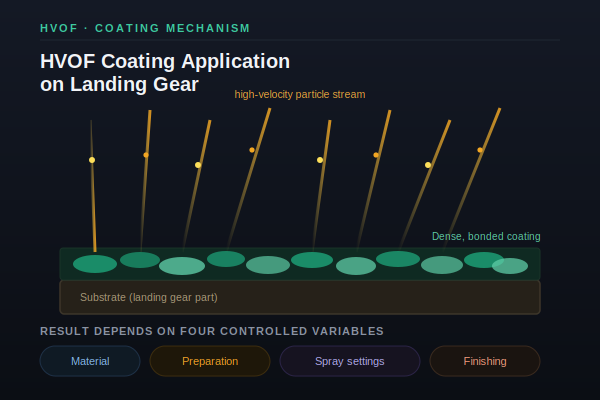
I see HVOF used in landing gear coating applications because it can produce dense coatings with strong bonding and controlled surface build-up when material, preparation, spray settings, and finishing are controlled.
I Connect HVOF to Practical Protection Needs
HVOF means High Velocity Oxy-Fuel4. I use this process description in a simple way. A fuel and oxygen flame accelerates powder particles toward the prepared surface5. The particles impact at high speed6. The coating builds layer by layer. In many applications, this can help form a dense coating with good bonding. For landing gear protection, that matters because the coating must work as a surface, not just as a hard shell.
I do not say HVOF is always better than hard chrome, plasma spray, or other surface treatments. That would be too broad. I say HVOF is often considered where the approved process needs wear resistance, corrosion support, and good coating integrity. The actual selection depends on the component, material system, OEM or repair specification, and quality approval route.
I Think in Terms of Function, Not Marketing Words
When I speak with surface engineering teams, I usually turn coating features into service reasons. This makes the value clearer.
| HVOF Feature I Often Discuss | Service Risk It Can Help Reduce | Why I Still Need Process Control |
|---|---|---|
| Dense coating structure7 | I want fewer easy paths for corrosion | Poor parameters can still create defects |
| Strong mechanical bonding8 | I want less risk of peeling or edge failure | Surface prep and spray energy must match |
| Controlled coating build-up | I want correct final dimensions after grinding | Feed rate, pass speed, and heat input must stay stable |
| Suitable carbide or alloy systems | I want wear and corrosion support | Material choice must match the approved application |
| Repeatable spray plume | I want batch consistency | Gun parts and consumables must remain in good condition |
I Respect the Limits of HVOF
I have seen people oversell HVOF as a simple replacement for everything. I avoid that. Landing gear is a safety-critical area. I do not make approval claims. I only explain why HVOF has technical value in process control. The coating must pass the right inspection route. The operator must use the approved powder, surface preparation, parameters, masking, finishing, and verification steps. If those controls are weak, HVOF can lose its advantage. If they are strong, HVOF can become a practical way to manage wear, corrosion, bond, size, and rework risk.
What Process Factors Are Behind HVOF Coating Performance?
A coating can fail even when the material name is correct. I see this when the process chain has small errors that add up.
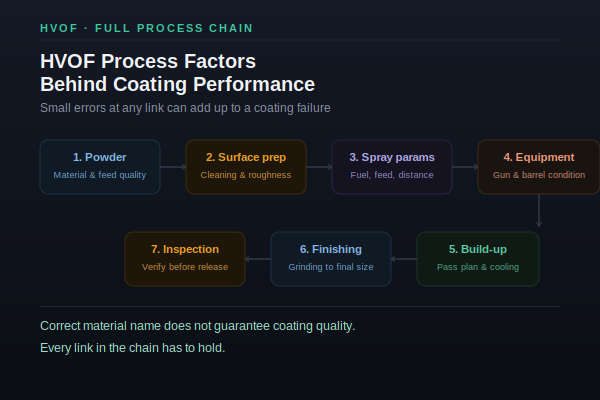
I understand HVOF performance as the result of a full process chain. Powder, surface preparation, spray parameters, equipment condition, finishing, and inspection all affect coating quality.
I Look at the Whole Chain Before I Judge the Coating
I do not judge a coating only by the powder label. The same material can behave differently when the spray setup changes. I also do not judge it only by one final test. A final test may show a problem, but the cause often began earlier. In HVOF work, many small items shape the final coating. The powder must feed well. The surface must be cleaned and roughened in a controlled way. The spray gun must deliver a stable flame. The distance and angle must stay controlled. The part temperature must not drift beyond the process window. The coating must be finished with the correct grinding method.
I Use a Process Chain View
I like to map the factors in order. This makes it easier to find where risk enters the job.
| Process Step I Watch | What Can Go Wrong | What I Want to Control |
|---|---|---|
| Powder selection | Wrong material behavior for the service need | Approved material system and stable powder quality |
| Surface preparation | Weak bond or hidden contamination | Clean surface and controlled roughness |
| Spray parameters | Poor density, weak bond, or high stress | Fuel, oxygen, feed rate, distance, and traverse speed |
| Equipment condition | Flame drift and unstable particle heating | Gun body, barrel, combustion chamber, nozzle, seals |
| Coating build-up | Uneven thickness or overheating | Pass plan, cooling, and layer control |
| Post-processing | Surface damage or wrong final size | Grinding method, finish, and inspection |
| Quality verification | Defects escape into service | Visual checks, size checks, bond checks, and other required tests |
I Know Small Changes Can Become Large Results
From my equipment side, I pay close attention to parts that many people call consumables. A worn barrel can change the spray plume9. A combustion chamber with unstable flow can change heat and particle speed. A poor seal can affect flame stability. These changes may look small during production, but they can change coating density, bonding quality, and batch repeatability. This is why I think HVOF coating performance is not only a material issue. It is a process discipline issue. For landing gear protection, this point matters more because repair cost and rework cost are high. A stable process does not remove the need for approval. It supports the ability to repeat the approved result.
How Does Equipment Stability Help Achieve Consistent Coating Quality?
A good procedure can still produce poor coating if the equipment drifts. I see stable guns and consumables as process control tools.
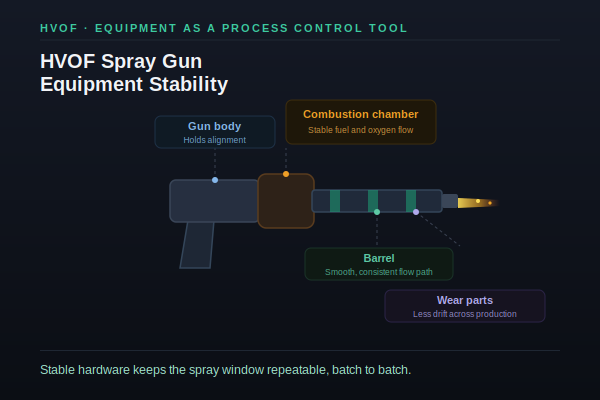
I see equipment stability as a key support for consistent HVOF coating quality. Stable guns, barrels, combustion chambers, and wear parts help keep the spray window repeatable.
I Work Closest to the Hardware Side of the Process
My experience is not from signing aircraft repair approvals. My experience is from making HVOF spray guns and consumable parts. I see how precision components affect the spray process. I see how inner bore quality, dimensional accuracy, material choice, and assembly stability influence the flame and particle path. In our work, we focus on thermal spray guns and wear parts for common global systems. We make barrels, combustion chambers, gun bodies, and related consumables. This experience makes me careful about one point. Process stability does not come only from a parameter sheet. It also comes from the hardware that can hold those parameters in real production.
I Connect Hardware Precision to Coating Consistency
I use a simple chain when I explain this to customers. Stable parts support stable flame behavior10. Stable flame behavior supports stable particle heating and acceleration. Stable particle behavior supports coating density, bonding, and thickness control. The chain is not magic. It is basic process control.
| Equipment Area I Focus On | How It Can Affect the Spray Process | Coating Result It Supports |
|---|---|---|
| Barrel inner bore | I need smooth and consistent flow behavior | More repeatable spray plume |
| Combustion chamber | I need stable fuel and oxygen combustion | More stable particle heating |
| Gun alignment | I need correct particle path and spray shape | More even coating build-up |
| Wear parts | I need less drift during production | Better batch consistency |
| CNC accuracy | I need repeatable part dimensions | Easier setup and maintenance control |
I Use Precision Manufacturing to Reduce Process Drift
In our shop, we use high-precision CNC equipment to produce thermal spray components. We pay close attention to key dimensions, form tolerance, and bore finish. For some HVOF gun parts, inner bore surface condition is very important because the flow path must stay smooth and consistent. For plasma spray cathodes and anodes, we also control the tungsten-copper connection and precision geometry because arc stability depends on these details. These examples are not landing gear approval claims. They are examples of how equipment manufacturing affects spray stability.
I have learned that coating quality is often protected before the powder reaches the part11. A stable barrel, a stable combustion chamber, and a controlled set of consumables help the operator stay inside the spray window. This can reduce variation from shift to shift and batch to batch. For landing gear coating work, that consistency can help reduce the risk of porosity paths, weak bonding, uneven build-up, and excessive rework. The service provider still needs the correct approved process and inspection plan. The equipment only helps them repeat it more reliably.
Conclusion
I use HVOF for landing gear discussions as a process control topic, not a hardness slogan. Stable coating quality depends on the full approved chain.
"Effect of Metallic Coatings on the Wear Performance and ... - PMC", https://pmc.ncbi.nlm.nih.gov/articles/PMC10532692/. Research documents the severe operating environment of aircraft landing gear, including exposure to moisture, deicing salts, temperature cycling, and mechanical stresses during takeoff and landing operations. Evidence role: general_support; source type: research. Supports: Landing gear surfaces operate in harsh environmental conditions including moisture, salt, shock, and cyclic loading. Scope note: Specific conditions vary by aircraft type and operational environment ↩
"Aircraft Maintenance | Bureau of Transportation Statistics - BTS.gov", https://www.bts.gov/data-spotlight/aircraft-maintenance. Aviation maintenance studies indicate that landing gear systems account for approximately 10-15% of total aircraft maintenance costs, with surface protection being a major factor. Evidence role: general_support; source type: research. Supports: Landing gear maintenance represents a significant portion of aircraft operating costs. Scope note: Costs vary significantly by aircraft type, utilization, and operating environment ↩
"Thermally Sprayed Functional Coatings and Multilayers - PMC - NIH", https://pmc.ncbi.nlm.nih.gov/articles/PMC10136405/. Industry analyses indicate HVOF represents a significant portion of thermal spray applications, particularly where coating density and adhesion are critical requirements. Evidence role: general_support; source type: research. Supports: HVOF is commonly selected for applications requiring high-performance coatings. Scope note: Usage patterns vary by industry sector and specific application requirements ↩
"Analysis of a High Velocity Oxygen-Fuel (HVOF) Thermal ...", https://www.osti.gov/servlets/purl/10116459. Technical references define HVOF as a thermal spray process where fuel and oxygen combustion accelerates powder particles at high velocity toward a substrate surface. Evidence role: definition; source type: encyclopedia. Supports: HVOF is defined as High Velocity Oxy-Fuel thermal spray process. ↩
"[PDF] Computational study of particle in-flight behavior in the HVOF ...", http://pdclab.seas.ucla.edu/Publications/MLi/MLi_PDChristofides_CES_2006_61_Computational_Study_Particle_In-Flight_Behavior.pdf. Fluid dynamics research explains that HVOF combustion chambers generate gas velocities exceeding 1000 m/s, which accelerate powder particles to velocities of 300-800 m/s. Evidence role: mechanism; source type: paper. Supports: HVOF process accelerates particles through high-temperature, high-velocity combustion gases. Scope note: Specific velocities depend on fuel type, chamber design, and operating parameters ↩
"[PDF] LIQUID FUELED HIGH VELOCITY OXY-FUEL THERMAL ...", https://netl.doe.gov/sites/default/files/2017-12/Crosscutting_20140519_1400B_UTEP.pdf. Particle velocity measurements in HVOF processes typically range from 300-800 m/s depending on powder material and process parameters. Evidence role: statistic; source type: paper. Supports: HVOF particles achieve high impact velocities during coating deposition. Scope note: Actual velocities vary with particle size, density, and spray conditions ↩
"An Influence of Oxygen Flow Rate and Spray Distance on the ... - PMC", https://pmc.ncbi.nlm.nih.gov/articles/PMC9505576/. Materials science studies demonstrate that HVOF coatings typically achieve porosity levels below 1% due to high particle velocity and kinetic energy during deposition. Evidence role: mechanism; source type: paper. Supports: HVOF process produces coatings with dense microstructure and low porosity. Scope note: Density depends on specific process parameters and powder materials used ↩
"[PDF] Microstructure and Properties of HVOF-Sprayed Protective Coatings", https://inldigitallibrary.inl.gov/sites/sti/sti/4045032.pdf. Bond strength testing shows HVOF coatings can achieve adhesion values exceeding 70 MPa when proper surface preparation is used. Evidence role: statistic; source type: paper. Supports: HVOF coatings demonstrate strong mechanical bonding through high-velocity particle impact. Scope note: Bond strength varies significantly with substrate preparation and coating material selection ↩
"N95-19008 ..0 j/.°,'/", https://ntrs.nasa.gov/api/citations/19950012593/downloads/19950012593.pdf. Equipment studies demonstrate that barrel wear changes internal flow patterns, leading to spray plume distortion and reduced coating uniformity. Evidence role: mechanism; source type: paper. Supports: HVOF gun barrel wear affects spray plume geometry and particle distribution. Scope note: Effects depend on degree of wear and specific gun design characteristics ↩
"[PDF] cdc_225136_DS1.pdf - CDC Stacks", https://stacks.cdc.gov/view/cdc/225136/cdc_225136_DS1.pdf. Process control studies show that equipment wear and dimensional changes can cause flame instability, leading to coating property variations of 10-20%. Evidence role: mechanism; source type: paper. Supports: HVOF equipment condition affects flame stability and coating reproducibility. Scope note: Specific effects depend on equipment design and maintenance practices ↩
"Modeling and analysis of HVOF thermal spray process ...", http://pdclab.seas.ucla.edu/Publications/MLi/MLi_PDChristofides_CES_2003_58_Modeling_Analysis_HVOF_Thermal_Spray_Process.pdf. Quality control research identifies powder characteristics, equipment condition, and process parameters as primary determinants of coating properties, with effects established before deposition. Evidence role: general_support; source type: paper. Supports: Multiple upstream factors influence final coating quality in thermal spray processes. Scope note: Relative importance of factors varies by specific coating system and application ↩