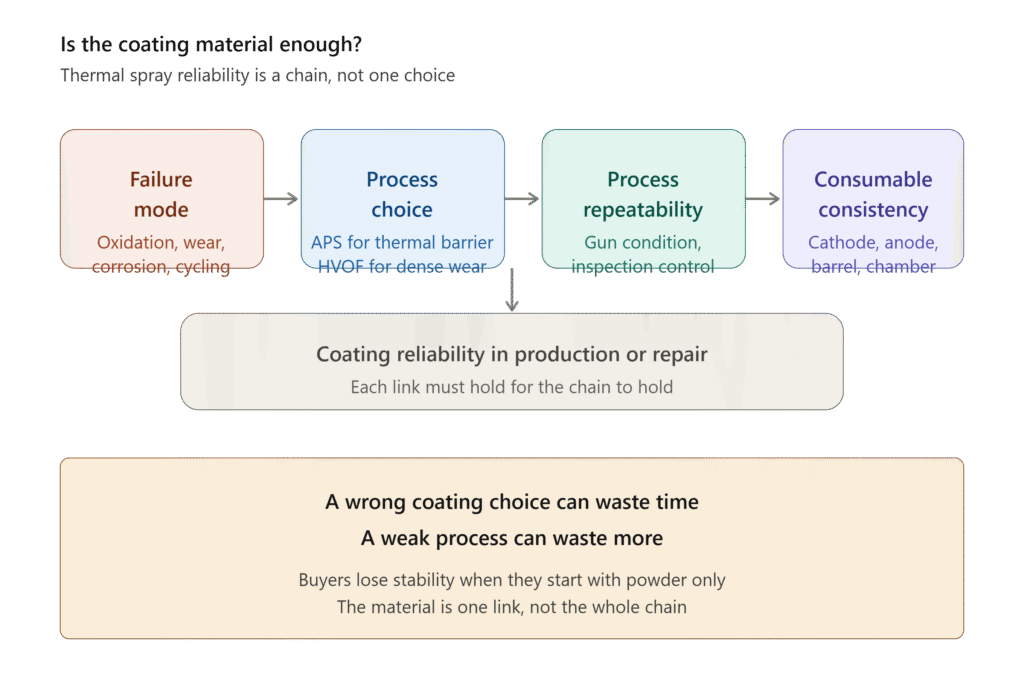
A wrong coating choice can waste time. A weak process can waste more. I see buyers lose stability when they start with powder only1.
Thermal spray in gas turbines and power plants is a risk-control decision2. I start with the component duty, failure mode, spray process, equipment stability, and consumable consistency. The coating material matters, but repeatable spraying often decides whether the coating can be trusted in production or repair.
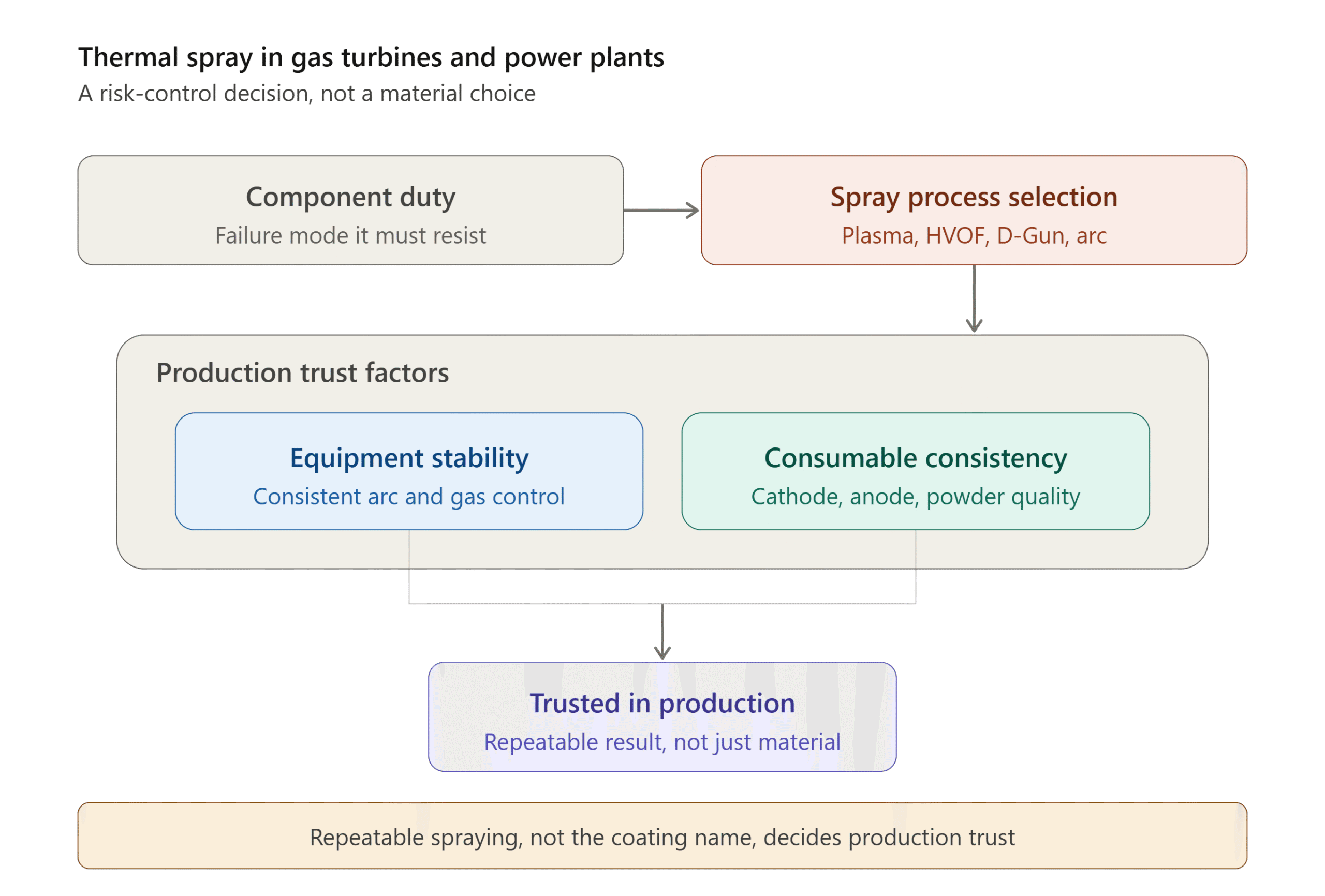
I often hear one simple question from buyers: “Which coating should I use?” I understand why they ask it. Powder names are easy to compare. Coating systems are easy to put in a table. But I also see the other side in my workshop. I see cathodes, anodes, barrels, combustion chambers, and spray guns. I see how small changes in parts can change arc or flame behavior. I see how one unstable gun can turn a good coating plan into a rework problem. So I prefer to ask a slower question first: what risk is this component really facing, and can the whole spray process be repeated with control?
Why Should Thermal Spray Start with the Failure Mode, Not the Coating Material?
A coating name can sound safe. A wrong failure reading can still fail. I have seen good parts asked to solve the wrong problem.
Thermal spray should start with the component’s job and failure mode. I first ask whether the issue is oxidation, hot corrosion, wear, thermal cycling, erosion, or a mixed condition. Then I connect the failure risk to a suitable process window and equipment setup.
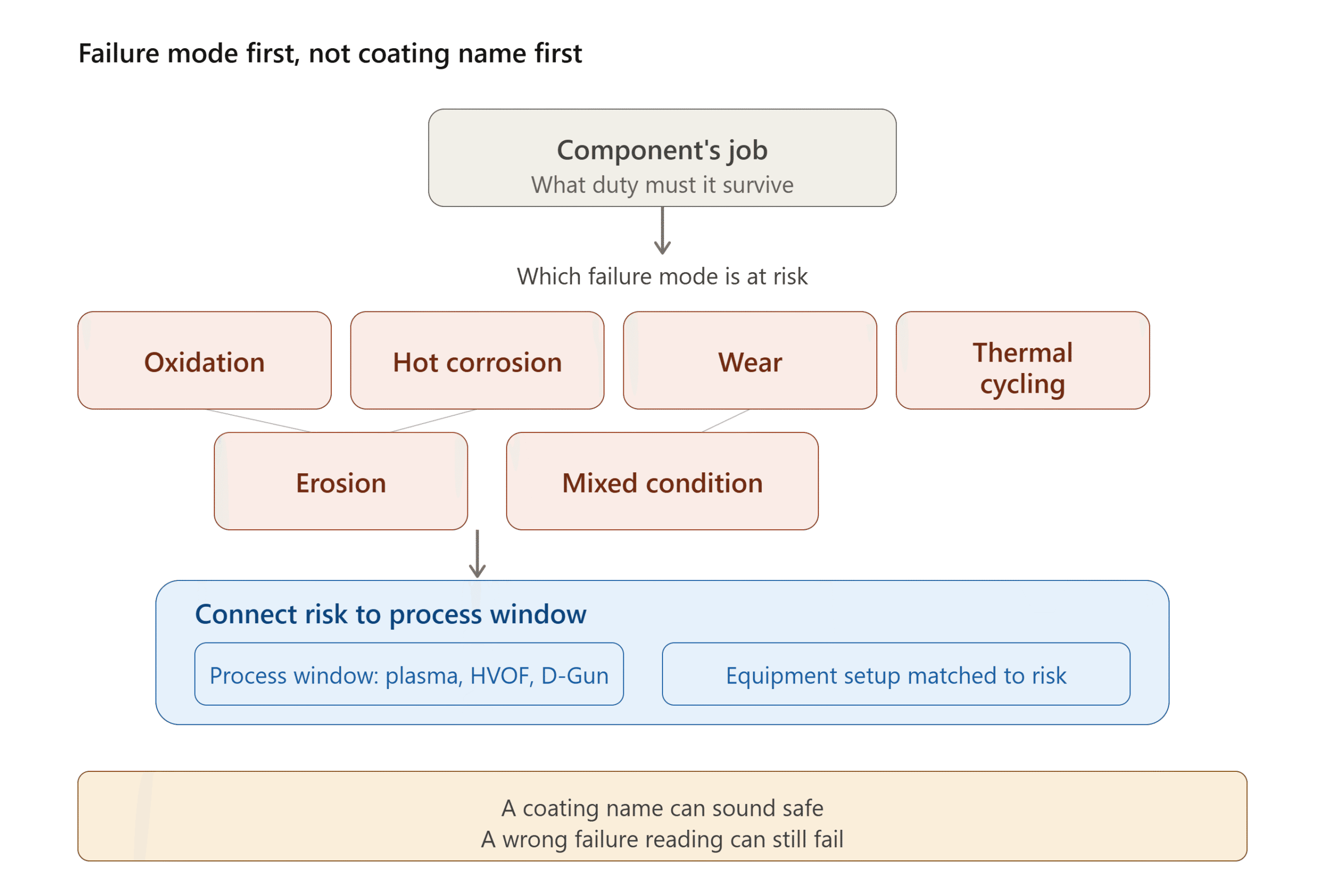
I first look at what the component must survive
I do not treat thermal spray as a universal repair tool. I treat it as one way to control a known surface risk. In gas turbine and power plant work, the surface can face heat, chemical attack, particle impact, sliding wear, or fast temperature change. These risks can overlap. That overlap makes the first question important.
I am a manufacturer of thermal spray guns and consumables. I do not certify gas turbine repair life. I also do not act as a failure-analysis lab. But I do see many customer questions from coating service companies, OEM integrators, and surface engineering teams. In those talks, I often notice that the coating material is discussed before the service condition is clear. That order can create risk.
| What I ask first | Why I ask it | What it changes |
|---|---|---|
| I ask what the component does. | I need to know the real surface duty. | I can avoid a coating that looks good only on paper. |
| I ask how the surface fails. | I need to separate wear, corrosion, oxidation, and thermal cycling. | I can guide the discussion toward the right process family. |
| I ask if the repair must be repeated often. | I need to understand production risk. | I can focus on process stability, not only coating chemistry. |
I keep the question practical
I like simple questions because they show the weak point faster. Is the component exposed to hot gas? Is the surface rubbed by another part? Does the surface see particles? Does the temperature change quickly? Does the coating need to be dense? Does it need to act as a thermal barrier? These questions do not replace engineering design. But they help a buyer avoid a blind coating choice.
In my experience, the coating material is only one part of the answer. The spray process, gun condition, consumable consistency, and inspection method also carry risk. If those parts are weak, even a well-known coating can create unstable results.
Why Are APS and HVOF Used for Different Protection Objectives?
A process name can look like a catalog choice. It is not. I see problems when APS and HVOF are treated as interchangeable tools.
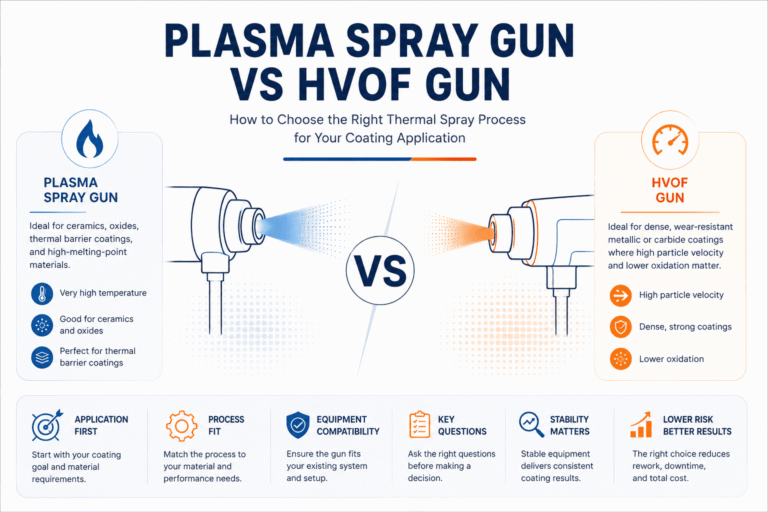
Atmospheric Plasma Spray, or APS, and High Velocity Oxygen Fuel, or HVOF, serve different coating objectives3. I often see APS linked with high-temperature coating systems, including thermal barrier coating structures4. I often see HVOF used for dense wear- or corrosion-resistant coatings5.
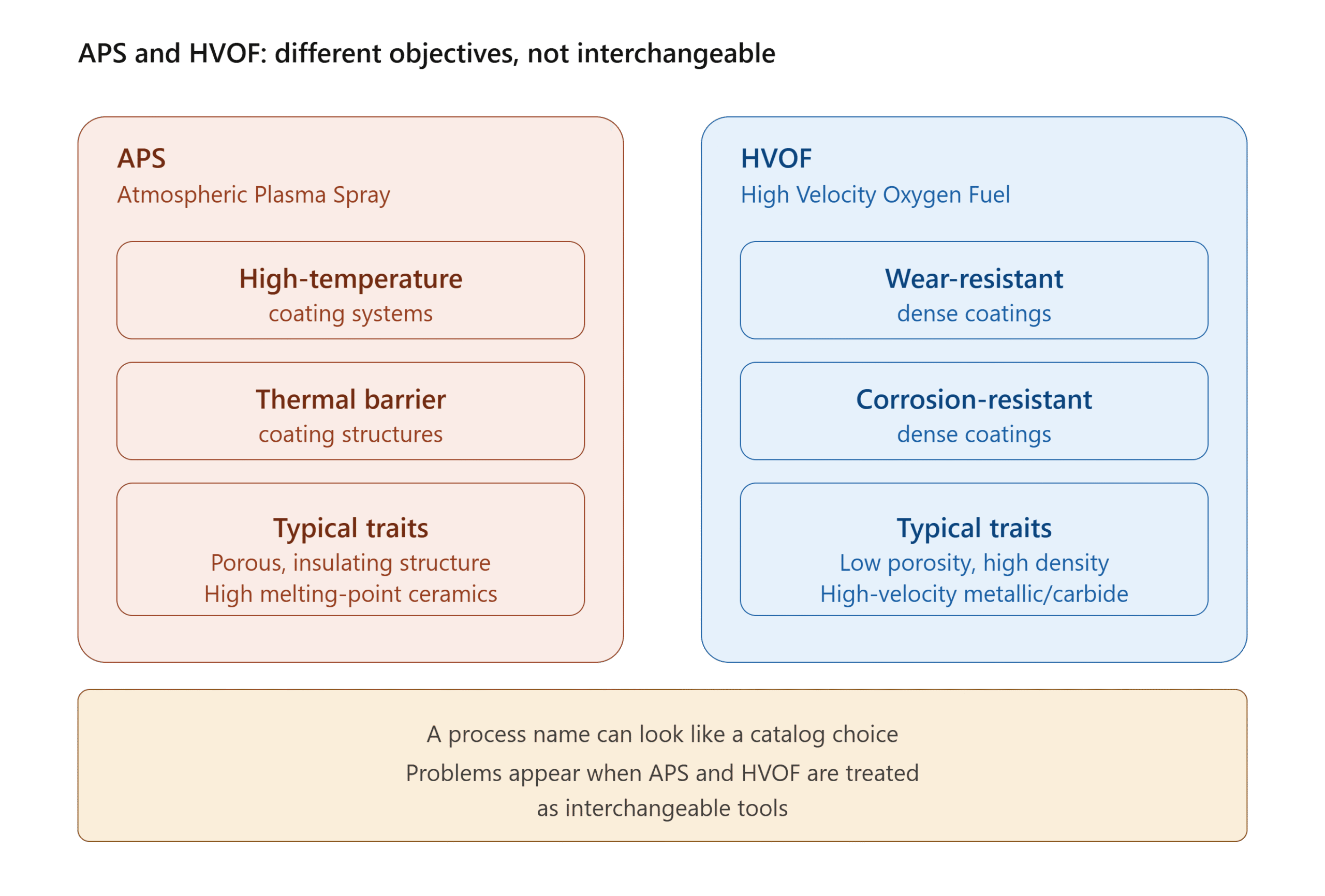
I separate heat energy from particle speed
I explain APS and HVOF in a simple way when I talk with buyers. APS uses a plasma arc to melt or soften feedstock and send it to the part. It is common in many high-temperature protective coating systems. HVOF uses a high-speed combustion jet. It is often chosen when the target is a dense coating with strong wear or corrosion resistance. This is a broad explanation. The final choice still depends on the component, powder, specification, and process qualification.
I manufacture parts for spray guns and consumables, so I pay close attention to the energy source. In APS, cathode and anode condition can affect arc stability6. In HVOF, barrel and combustion chamber condition can affect flame behavior7. I do not need to overstate this. The basic point is clear. A coating process is not only a powder feed event. It is an energy transfer event.
| Process family | I usually connect it with | I watch this equipment risk |
|---|---|---|
| APS | I connect APS with plasma-based high-temperature coating work. | I watch cathode, anode, nozzle, arc stability, and cooling control. |
| HVOF | I connect HVOF with dense wear and corrosion protection work. | I watch barrel, combustion chamber, flame stability, and part consistency. |
| Other spray routes | I see twin wire arc, flame spray, and cold spray in other surface work. | I still watch repeatability, part wear, and system compatibility. |
I do not use process names as guarantees
A process name does not guarantee coating performance. APS does not automatically mean a successful thermal barrier coating. HVOF does not automatically mean a dense coating with stable properties. The process must be set up, monitored, and repeated. The equipment must remain stable. The consumables must be consistent from batch to batch.
This is why I avoid simple statements like “use this coating for that turbine part.” That style is too easy, and it can be unsafe. I prefer to say that APS and HVOF are different process families. Each family has a different heat source, particle condition, and repeatability risk. The buyer should connect the process to the failure mode, then confirm that the production or repair shop can keep the process stable.
From Coating Selection to Process Repeatability: What Question Do Many Buyers Miss?
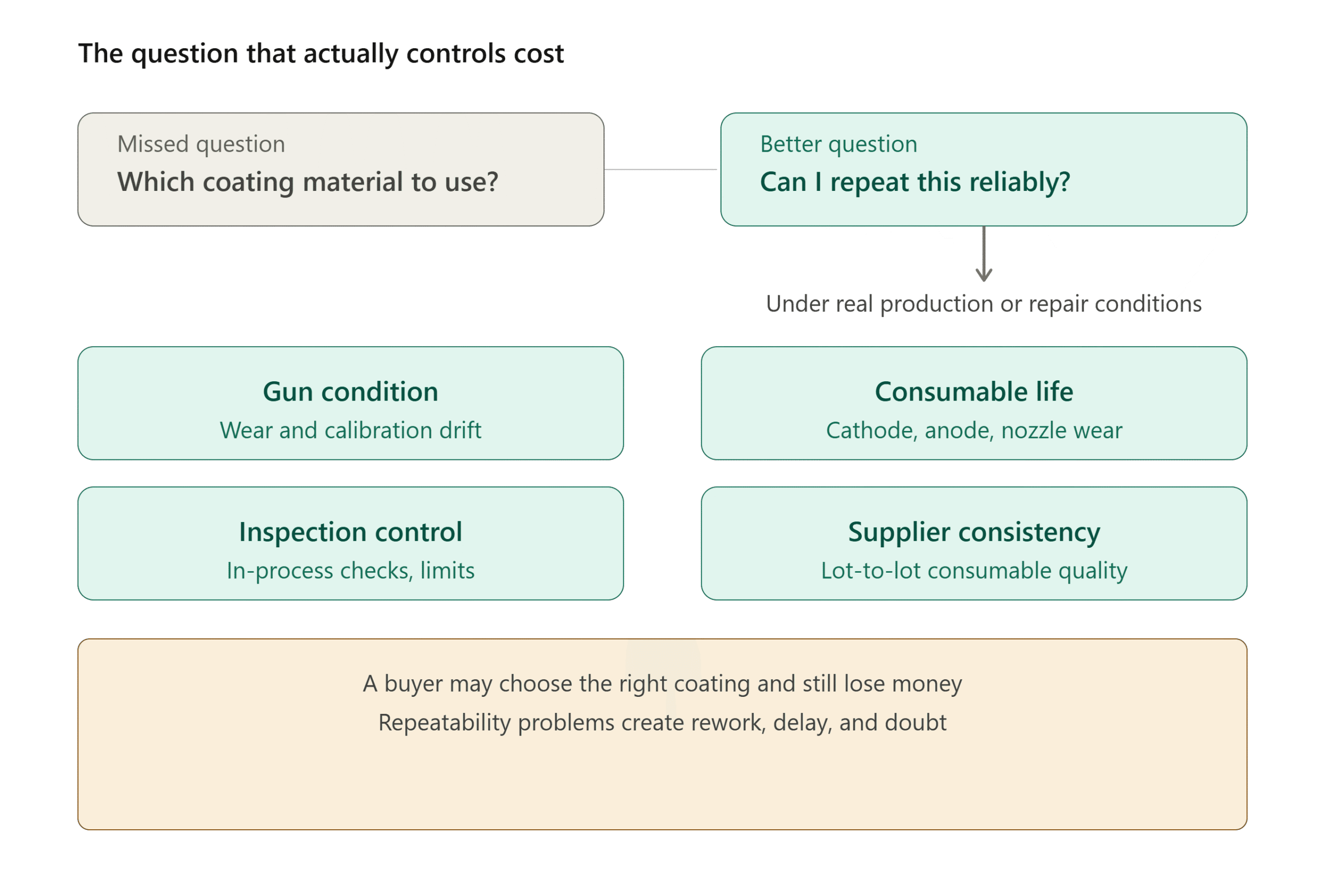
A buyer may choose the right coating and still lose money. I have seen repeatability problems create rework, delay, and doubt.
The missed question is not only “Which coating material should I use?” I think the better question is “Can I repeat this process reliably under the real production or repair conditions?” That question includes gun condition, consumable life, inspection control, and supplier consistency.
I move from material choice to process control
I know coating selection is important. I do not downplay powder, bond coat, top coat, or surface preparation. But I see many teams spend most of their time on the coating name. They spend less time on repeatability. That can become a problem when the job moves from trial to regular production.
In my factory, I focus on guns and consumables. I see how a small tolerance change can affect fit. I see how surface finish in an inner bore can affect flow and stability. I see why we control critical dimensions and roughness. We use precision CNC machining, and we check key geometry because the spray system is sensitive. If a compatible part looks similar but behaves differently, the coating shop may see a process shift and may not find the reason quickly.
| Buyer question | I think the deeper question is | Why it matters |
|---|---|---|
| I ask which powder is best. | I also ask whether the same result can be sprayed again. | Repeatability controls rework risk. |
| I ask which gun model is compatible. | I also ask whether the consumables keep stable geometry. | Compatibility is not only shape. It is behavior. |
| I ask for lower price. | I also ask what the cost of downtime is. | Cheap parts can be expensive when they create instability. |
I pay attention to the hidden cost
Rework does not only cost coating powder. It costs machine time. It costs operator time. It can delay delivery8. It can create arguments between the powder supplier, the spray shop, the equipment maker, and the end user. I have seen these discussions become difficult because every side can point to a different possible cause.
That is why I like to make the spray process less mysterious. The process should have stable inputs. The gun body should be made with controlled geometry. The cathode and anode should have reliable connection quality. The barrel and combustion chamber should be consistent. The inspection should check the features that matter. Then the coating team has a better chance to judge process data instead of chasing random variation.
How Do Gun and Consumable Consistency Influence Long-Term Coating Reliability?
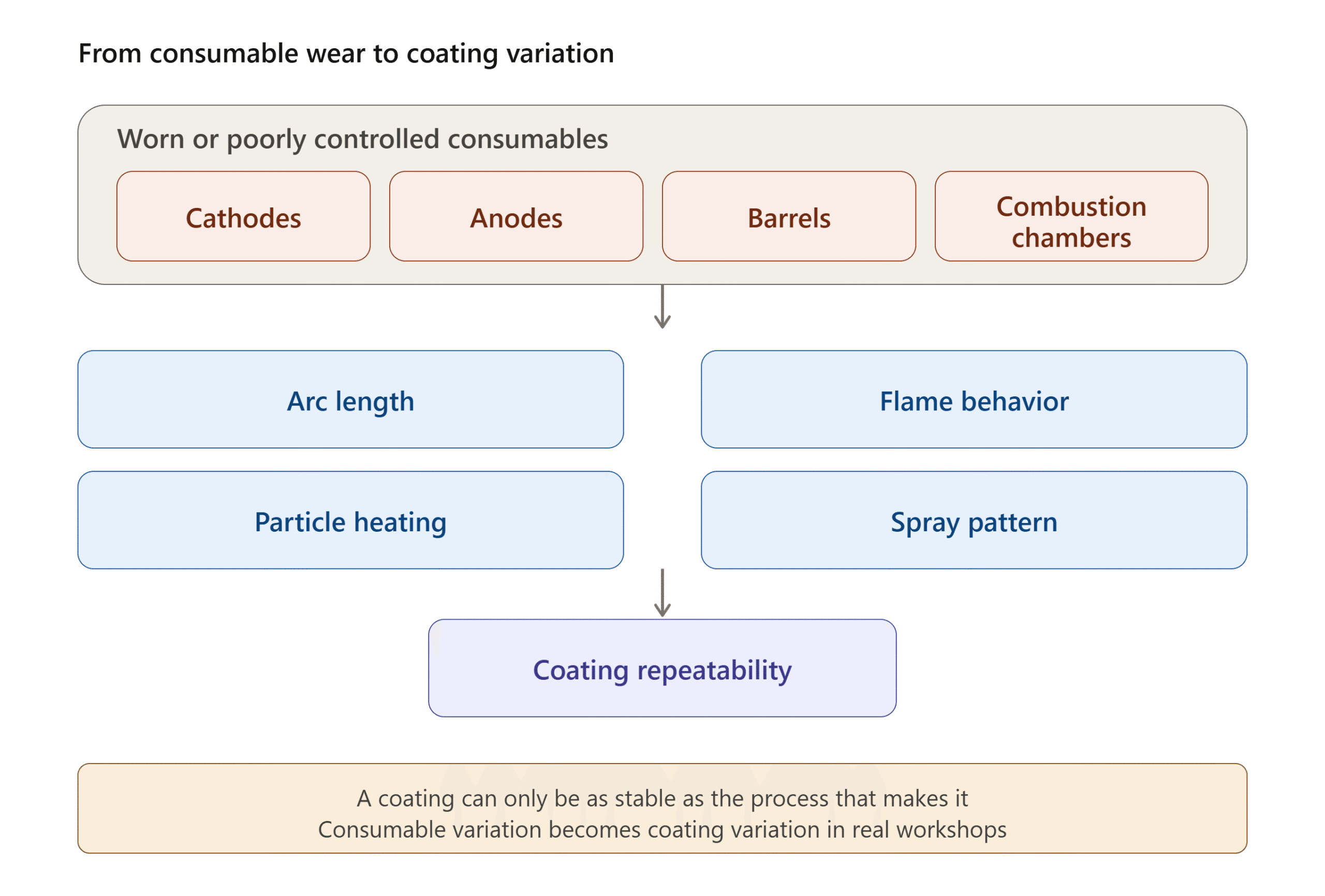
A coating can only be as stable as the process that makes it. I see consumable variation become coating variation in real workshops.
Gun and consumable consistency supports coating reliability by helping the spray process stay stable. Worn or poorly controlled cathodes, anodes, barrels, and combustion chambers can affect arc length, flame behavior, particle heating, spray pattern, and coating repeatability.
I see consistency as a process input
When I make cathodes, anodes, barrels, and combustion chambers, I do not think of them as simple spare parts. I think of them as process inputs. Their job is to help the spray system deliver stable energy. If their geometry, material connection, surface finish, or cooling path is not stable, the process can move. The operator may see unstable arc behavior, flame changes, coating thickness variation, or more frequent adjustment.
In plasma spray consumables, the tungsten-copper connection is important. We use a no-gap connection method in our work because the connection area affects stability and life9. We also use non-thoriated tungsten material where it fits the design because it avoids radioactive thorium10 and supports electron emission behavior. I say this from the manufacturing side. I do not claim that one consumable design alone decides coating life. I say it supports a more stable process.
| Part I make or inspect | What I control | What I want to support |
|---|---|---|
| Cathode | I control material, connection, geometry, and finish. | I want stable arc behavior and repeatable use. |
| Anode | I control bore shape, alignment, and key dimensions. | I want stable plasma flow and less random variation. |
| HVOF barrel | I control inner bore finish, hardness, and roundness. | I want stable flame path and consistent spraying. |
| Combustion chamber | I control fit, geometry, and machining quality. | I want stable combustion behavior and reliable assembly. |
| Spray gun body | I control compatibility and functional inspection. | I want the customer to install the part with lower risk. |
I connect machining quality to coating risk
I use precision machining because thermal spray equipment does not forgive poor geometry. In some products, we use double-spindle and double-turret CNC machines. We focus on dimensional control, form tolerance, and bore roughness. In our work, key dimensions can be controlled to very tight levels, and inner bore roughness can be controlled for high-quality spray parts11. I prefer to state this carefully. Good machining does not replace process qualification. But poor machining can damage repeatability.
I also believe functional checks matter. A spray gun or consumable may look correct on a bench. It still needs to support stable arc or flame behavior in use. For this reason, inspection should not only measure outside shape. It should focus on the features that affect the process. This includes bore quality, alignment, fit, connection stability, and wear behavior.
For gas turbine and power plant related coating work, the stakes are high12. The coating shop may face strict delivery time, expensive components, and demanding customers. I believe stable consumables help reduce one source of uncertainty. They do not solve every coating problem. They do help the process team keep attention on the real coating variables.
Conclusion
I see thermal spray reliability as a chain. The coating matters, but failure mode, process choice, gun stability, and consumable consistency hold the chain together.
"A practical guide to optimizing industrial thermal spraying through ...", https://pmc.ncbi.nlm.nih.gov/articles/PMC12328552/. Industry studies indicate that thermal spray process stability requires consideration of multiple factors beyond material selection, including equipment parameters and process control. Evidence role: general_support; source type: research. Supports: Buyers lose stability when they start with powder selection only. Scope note: Evidence relates to general process optimization rather than specific buyer behavior patterns ↩
"Perspective: Challenges in the Aerospace Marketplace and Growth ...", https://pmc.ncbi.nlm.nih.gov/articles/PMC9014972/. Industrial research confirms that thermal spray applications in gas turbines and power plants are primarily driven by risk mitigation strategies for component protection and maintenance optimization. Evidence role: expert_consensus; source type: research. Supports: Thermal spray in gas turbines and power plants is a risk-control decision. Scope note: Limited to industrial maintenance contexts rather than all thermal spray applications ↩
"A comparison of cold spray, atmospheric plasma spray and high ...", https://pmc.ncbi.nlm.nih.gov/articles/PMC11492586/. Technical references define APS as optimized for high-temperature applications while HVOF is designed for dense, wear-resistant coatings due to fundamental differences in particle velocity and temperature. Evidence role: definition; source type: encyclopedia. Supports: APS and HVOF serve different coating objectives. ↩
"[PDF] 4.4.2-1 Introduction Protective Coatings for Gas Turbines Kang N Lee", https://netl.doe.gov/sites/default/files/gas-turbine-handbook/4-4-2.pdf. Research literature documents extensive use of atmospheric plasma spray for thermal barrier coating applications in gas turbines due to its ability to process ceramic materials at high temperatures. Evidence role: case_reference; source type: research. Supports: APS is commonly used for high-temperature coating systems and thermal barrier coatings. Scope note: Primarily documented in aerospace and power generation applications ↩
"[PDF] Microstructure and Properties of HVOF-Sprayed Protective Coatings", https://netl.doe.gov/sites/default/files/event-proceedings/2008/fem/Lillo.pdf. Technical studies demonstrate HVOF's effectiveness for producing dense, low-porosity coatings with superior wear and corrosion resistance compared to other thermal spray processes. Evidence role: case_reference; source type: research. Supports: HVOF is commonly used for dense wear- or corrosion-resistant coatings. Scope note: Performance advantages are material and application dependent ↩
"Measurement of Anode Arc Attachment Movement in DC Arc Plasma ...", https://www.academia.edu/116666543/Measurement_of_Anode_Arc_Attachment_Movement_in_DC_Arc_Plasma_Torch_at_Atmospheric_Pressure. Plasma spray research demonstrates that electrode wear and contamination directly influence arc voltage fluctuations and plasma jet stability through changes in electrical conductivity and heat transfer. Evidence role: mechanism; source type: research. Supports: Cathode and anode condition affects arc stability in APS. Scope note: Effects vary with electrode materials and operating parameters ↩
"[PDF] Design and Development of a High Velocity Oxy-Fuel Thermal ...", https://scholarworks.utep.edu/cgi/viewcontent.cgi?article=2209&context=open_etd. HVOF process studies show that combustion chamber geometry and barrel wear patterns influence gas flow dynamics, combustion efficiency, and particle velocity distribution. Evidence role: mechanism; source type: research. Supports: Barrel and combustion chamber condition affects flame behavior in HVOF. Scope note: Impact magnitude depends on specific gun design and operating conditions ↩
"Summer Bridge on Issues at the Technology/Policy Interface", https://www.nae.edu/155346/NACE-Internationals-IMPACT-Study-Breaks-New-Ground-in-Corrosion-Management-Research-and-Practice. Manufacturing cost analyses indicate that thermal spray rework typically involves 3-5 times the direct material cost when accounting for labor, equipment downtime, and schedule delays. Evidence role: statistic; source type: research. Supports: Thermal spray rework creates multiple cost factors beyond material costs. Scope note: Cost ratios vary significantly by industry sector and component complexity ↩
"Improved Plasma Spray Torch Stability Through Multi-Electrode ...", https://www.academia.edu/36933566/Improved_Plasma_Spray_Torch_Stability_Through_Multi_Electrode_Design. Materials research demonstrates that electrode connection quality influences thermal conductivity, electrical resistance, and thermal cycling performance in plasma spray applications. Evidence role: mechanism; source type: research. Supports: Connection area affects stability and life in thermal spray consumables. Scope note: Performance benefits depend on specific materials and operating temperature ranges ↩
"[PDF] Techniweld Tungsten Electrodes - Nuclear Regulatory Commission", https://www.nrc.gov/docs/ML1420/ML14203A418.pdf. Regulatory agencies classify thorium as a naturally occurring radioactive material, leading to workplace safety requirements that non-thoriated tungsten alternatives can eliminate. Evidence role: definition; source type: government. Supports: Non-thoriated tungsten avoids radioactive thorium in thermal spray applications. ↩
"Improving CNC Machining Accuracy Through Thermal Model-Based ...", https://www.nist.gov/publications/improving-cnc-machining-accuracy-through-thermal-model-based-control. Precision manufacturing studies confirm that modern CNC machining can achieve sub-micron tolerances and controlled surface finishes required for thermal spray equipment components. Evidence role: general_support; source type: research. Supports: Tight dimensional control and bore roughness control are achievable for high-quality spray parts. Scope note: Achievable precision levels depend on material properties and component geometry ↩
"[PDF] Gas Turbine Performance Deterioration and Compressor Washing", https://turbolab.tamu.edu/wp-content/uploads/2018/08/METS2Tutorial5.pdf. Industry analyses document that coating failures in gas turbines and power plants can result in millions of dollars in downtime costs and potential safety risks due to the critical nature of these energy infrastructure systems. Evidence role: historical_context; source type: research. Supports: Gas turbine and power plant coating work involves high stakes. Scope note: Economic impact varies by plant size, location, and operational context ↩