I see one common problem in plasma spray work: the arc looks small, but the cost grows fast when coating results move.
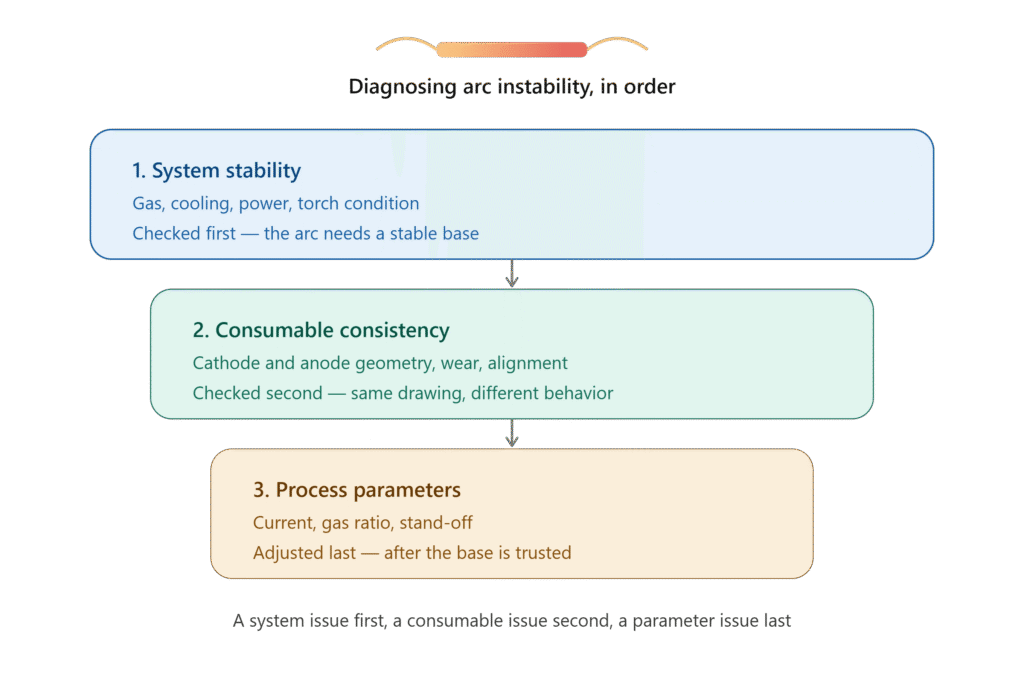
Plasma spray arc instability usually comes from a mix of gas flow, cooling, power condition, torch condition, cathode and anode wear, alignment, part dimensions, and process settings. I treat it as a system stability issue first, then a consumable consistency issue, and then a parameter issue.
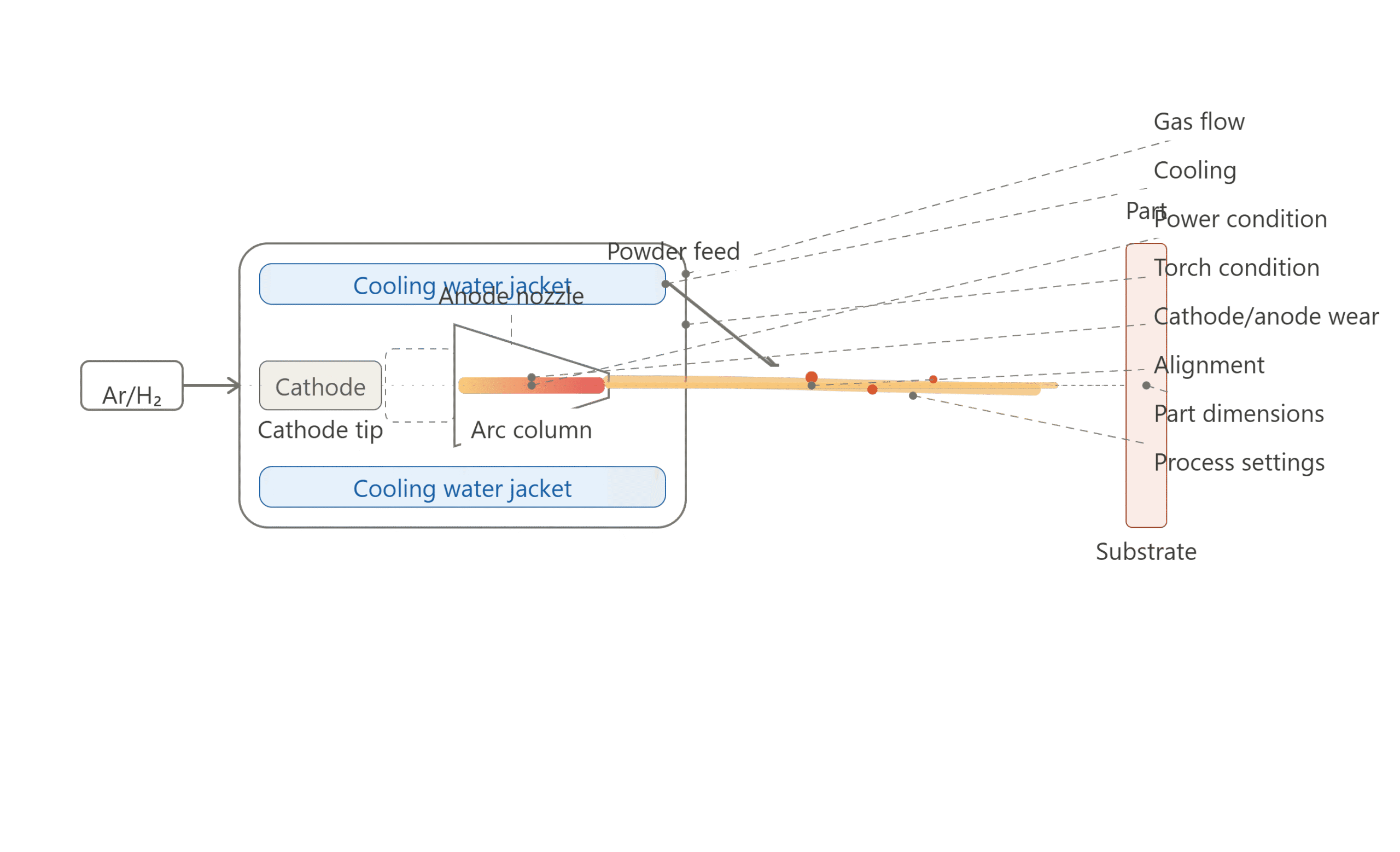
I have learned that arc instability is rarely a single bad number on a screen. I have also learned that a part can fit into a torch and still behave poorly when the arc starts. When I look at this problem from the manufacturing side, I start with basic operating conditions. I then look at the torch, cathode, anode, gaps, fit, and wear marks. After that, I review process parameters. This order saves time, and it also helps me avoid blaming the wrong part too early.
Why Arc Instability Is More Than a Parameter Problem?
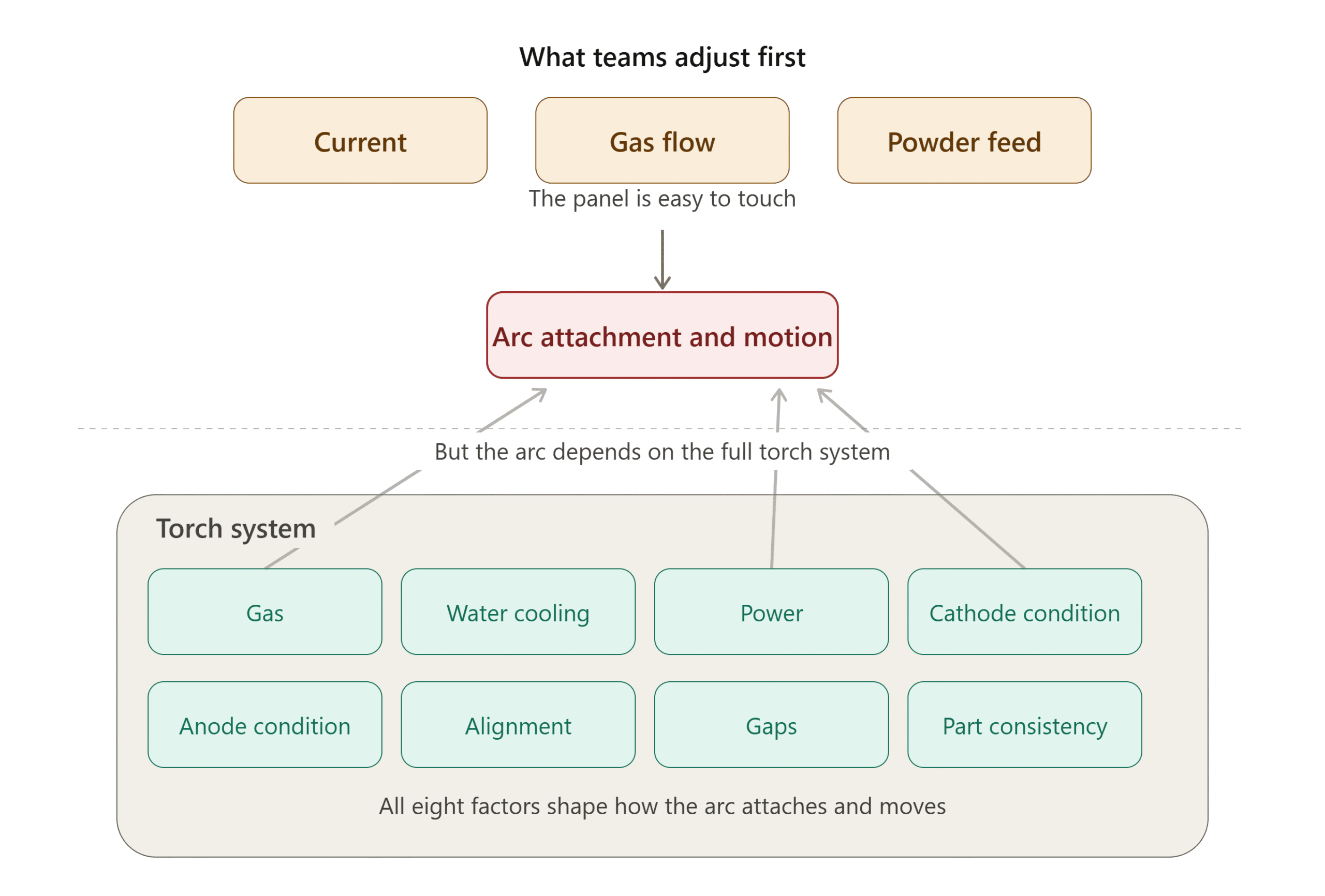
I see many teams change current, gas, or powder feed first, and I understand why. The panel is easy to touch.
Plasma spray arc instability is more than a parameter problem because the arc depends on the full torch system1. Gas, water, power, cathode condition, anode condition, alignment, gaps, and part consistency all affect how the arc attaches and moves.
I treat arc instability as a risk to coating quality, not only as a machine alarm. An unstable arc can change particle heating2. It can change particle speed. It can also make the spray plume move in a way that is hard to control. In a spray shop, this can mean rework, scrap, extra masking time, and lost production hours. In an OEM or equipment integration team, this can mean a wrong decision about a replacement part or a torch design.
I do not say that parameters are unimportant. I only say that parameters are not the whole story. A stable process needs a stable base. If the torch body has poor condition, if the cathode has abnormal erosion, or if the anode bore has wear, a parameter change may only hide the problem for a short time.
How I separate parameter issues from system issues
| Area I check | What I look for | Why it matters |
|---|---|---|
| Gas supply | Flow stability, gas type, leaks, pressure drop | The arc needs a steady gas path |
| Cooling | Flow, temperature, blockage, seal condition | Heat changes wear and arc behavior |
| Power | Connection, cable, output stability | The arc needs stable energy input |
| Torch parts | Fit, wear, alignment, key dimensions | The arc root follows the real geometry |
| Parameters | Current, voltage, gas ratio, stand-off | Settings only work when the hardware is stable |
I use this table as a practical reminder. I do not want to tune a process around an unstable part. I want the torch and consumables to behave in a repeatable way first. Then I can make parameter changes with more confidence.
What to Check Before Replacing Cathodes and Anodes?
I often see cathodes and anodes replaced too quickly. This can waste parts and leave the real cause still inside the system.
Before I replace cathodes and anodes, I confirm gas, cooling, power, cable condition, seals, torch assembly, and operating history. I then inspect wear, erosion, arc root marks, alignment, gaps, bore condition, and key dimensions before I change settings.
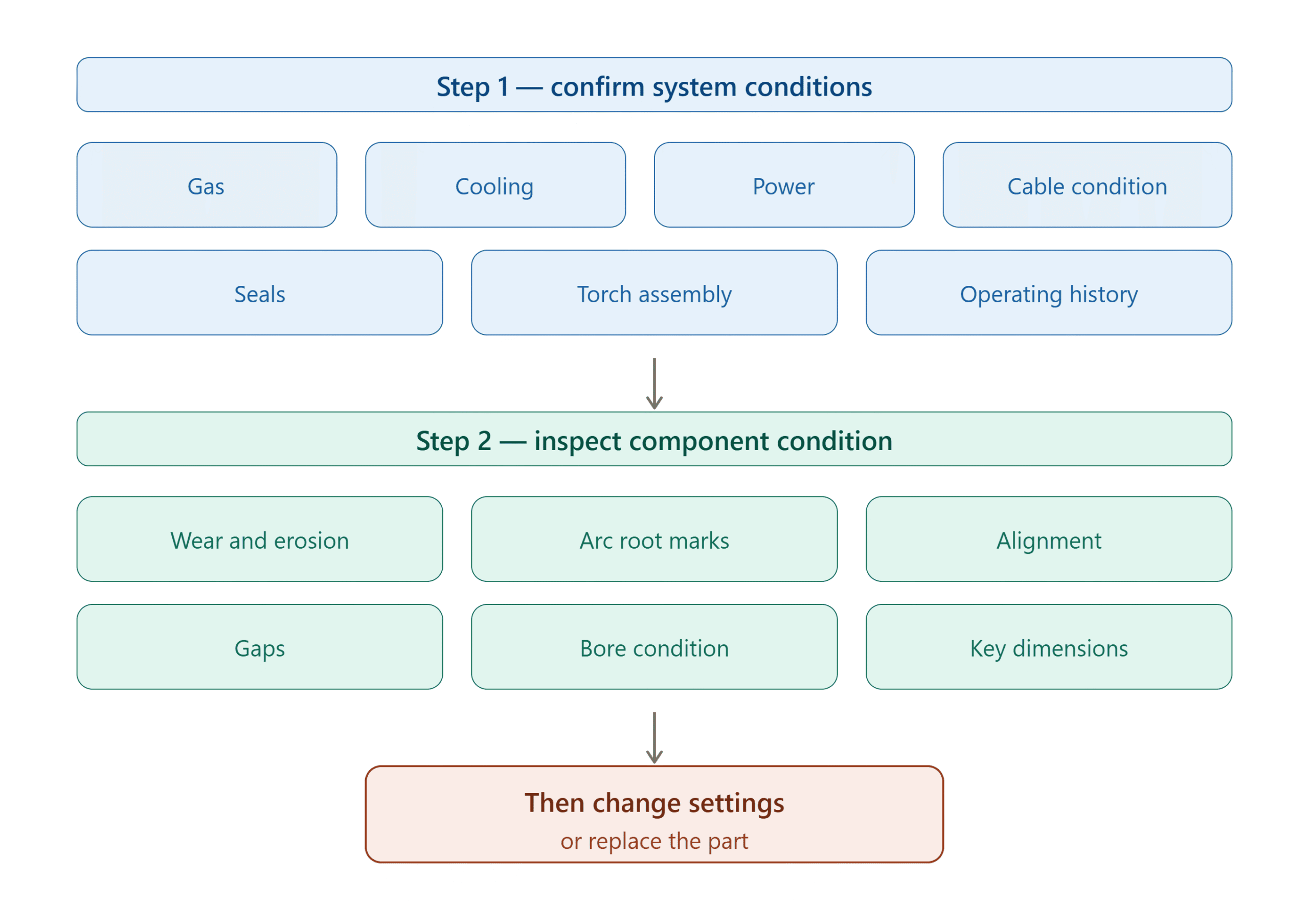
I prefer a fixed inspection order because it keeps my judgment clean. I start with conditions outside the torch. I check gas supply because unstable gas can move the arc3. I check cooling because poor cooling can raise local temperature and speed up wear4. I check power and cable condition because a weak connection can look like a torch problem. I also check assembly, seals, and any sign of leakage because a small assembly issue can change arc behavior.
After this, I inspect the cathode and anode. I look at the cathode tip shape, erosion pattern, and surface condition5. I look at the anode bore, arc track, and signs of uneven wear. I also look at the torch alignment and the gap between parts. A cathode or anode can still look acceptable at a quick glance, but the arc root can tell a different story.
My practical pre-replacement checklist
| Step | My check | My reason |
|---|---|---|
| 1 | I confirm gas flow and pressure | I need steady gas before I judge parts |
| 2 | I confirm cooling flow and temperature | I need heat control before I judge wear |
| 3 | I inspect cables and power connection | I need stable input energy |
| 4 | I check seals and assembly order | I need the torch built as intended |
| 5 | I inspect cathode erosion | I need to understand arc attachment |
| 6 | I inspect anode bore and wear marks | I need to see where the arc worked |
| 7 | I measure key gaps and dimensions | I need geometry, not only visual fit |
| 8 | I review parameters | I tune after the base is stable |
I do not use this order because it is complex. I use it because it is simple. It helps me avoid replacing a good part. It also helps me find a part that fits mechanically but does not support stable arc behavior during operation.
How Consumable Consistency Influences Arc Stability?
I manufacture consumable parts, so I pay close attention to a hard truth. A part can match the drawing loosely and still perform differently.
Consumable consistency influences arc stability through cathode geometry, anode bore quality, coaxiality, gap control, material consistency, and heat transfer. Small changes can move the arc root, change erosion, and make two “same” parts behave differently in the same torch.
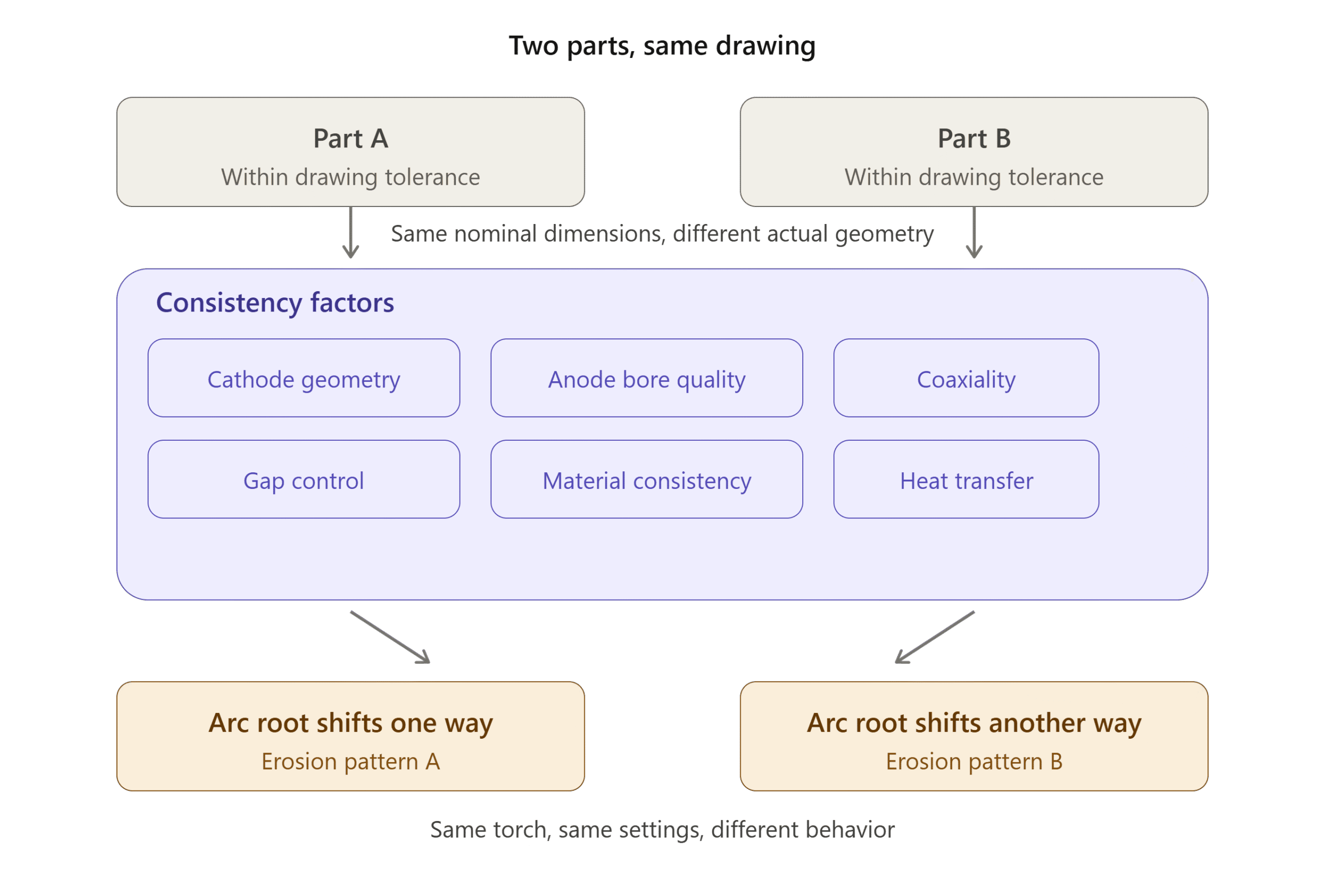
I see consumables as functional parts, not only replacement parts. In plasma spray, the cathode and anode help shape where the arc starts, where it attaches, and how it moves. If coaxiality is poor, the arc path may not be balanced6. If a gap is inconsistent, the arc may start or attach in a different way. If a bore surface is rough or uneven, the arc root may not behave as expected.
I also look at material and joining quality with care. Tungsten-copper connection quality can affect electrical and thermal behavior7. Conductivity and heat dissipation can affect how a cathode or anode survives under heat. Material consistency can affect wear. I do not present these points as the only cause of arc instability. I present them as factors that can add risk when the process is already demanding.
What I focus on in manufacturing
| Manufacturing point | What I control | Possible effect in use |
|---|---|---|
| Cathode shape | Tip form, concentricity, surface finish | More repeatable arc start and attachment |
| Anode bore | Bore size, roundness, roughness | More consistent arc root behavior |
| Part fit | Key outside dimensions and seating faces | Better alignment in the torch |
| Gap control | Functional distance between electrodes | Less random change in arc path |
| Material quality | Tungsten, copper, and joining condition | More stable heat and current path |
| Final check | Visual, dimensional, and functional inspection | Lower risk before shipment |
In our own work, we use precision CNC machining for key torch and consumable parts8. We focus on dimensions, bore surface quality, and consistency because these points are not cosmetic. I also value functional checks on spray guns because a part drawing cannot show every operating issue. A stable arc needs a stable geometry and a stable material path. This is where manufacturing discipline becomes part of process reliability.
A Practical Troubleshooting Sequence?
I like simple troubleshooting because production pressure is already high. A clear order helps me move faster without guessing.
A practical troubleshooting sequence starts with operating conditions, then moves to torch assembly and consumable condition, then checks dimensions and wear patterns, and only then adjusts parameters. This sequence reduces false conclusions and helps separate machine issues from part consistency issues.
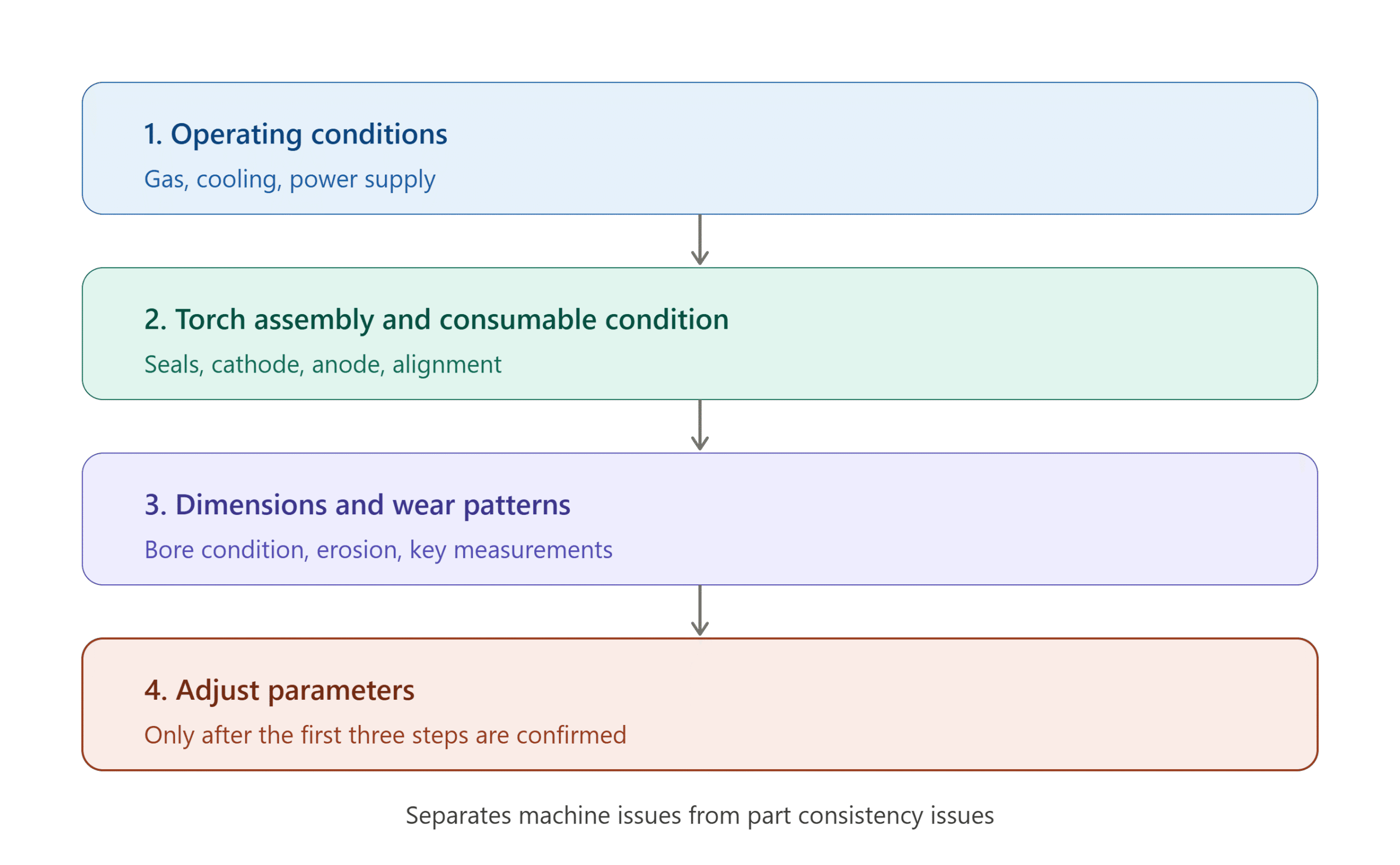
I use a step-by-step sequence when I discuss arc instability with technical buyers, OEM teams, or spray service teams. I first ask what changed. I look for a new gas cylinder, new cooling setting, new powder lot, new torch part, new operator practice, or new repair action. A recent change often gives the first clue9.
I then check the operating base. I confirm gas, cooling, power, and grounding. I do not want to measure a cathode while the cooling line is partly blocked. I then inspect the torch assembly. I check whether the parts are seated correctly. I check seals. I check for contamination. I then remove the cathode and anode if needed. I inspect wear marks and erosion. I compare the pattern with normal experience. I measure key dimensions when the visual check is not enough.
My sequence in shop language
| Order | My action | My decision point |
|---|---|---|
| 1 | I ask what changed recently | I look for the first cause |
| 2 | I confirm gas and cooling | I remove unstable supply causes |
| 3 | I confirm power and cable condition | I remove input energy causes |
| 4 | I check torch assembly | I remove fit and seal causes |
| 5 | I inspect cathode and anode wear | I judge arc root behavior |
| 6 | I check dimensions and alignment | I separate fit from function |
| 7 | I review parameters | I tune only after hardware is trusted |
| 8 | I record findings | I build repeatable judgment |
This sequence also helps me avoid a common buying mistake. I do not want a customer to buy a part only because it can be installed. I want the part to support stable function in the torch. For that reason, I care about repeated dimensions, bore quality, material consistency, and internal functional checks. Stable, consistent spray guns and consumables cannot remove every process problem, but they can support a more reliable plasma spray operation.
Conclusion
I treat plasma spray arc instability as a system issue first, a consumable consistency issue second, and a parameter issue after that.
"Interaction Mechanism of Arc, Keyhole, and Weld Pool in ... - PMC", https://pmc.ncbi.nlm.nih.gov/articles/PMC10972108/. Research on plasma spray systems demonstrates that arc stability results from the interaction of gas dynamics, thermal management, electrical characteristics, and electrode geometry rather than any single parameter. Evidence role: mechanism; source type: paper. Supports: that plasma spray arc stability depends on multiple interacting system components including gas flow, cooling, power delivery, and electrode geometry. Scope note: The source may focus on specific torch designs or operating regimes rather than universal principles across all plasma spray configurations. ↩
"Capturing the Influence of Jet Fluctuations on Particles in Plasma ...", https://pmc.ncbi.nlm.nih.gov/articles/PMC8765765/. Studies of plasma spray particle dynamics show that arc voltage and current fluctuations directly alter plasma jet temperature and velocity fields, affecting the thermal and kinetic energy transfer to in-flight particles. Evidence role: mechanism; source type: paper. Supports: that arc instability in plasma spray processes affects particle heating and velocity, which in turn influences coating properties. Scope note: The magnitude of these effects depends on particle size, material properties, and the specific nature of the arc instability. ↩
"[PDF] Section 6.0: Plasma Arc Stability - VTechWorks", https://vtechworks.lib.vt.edu/server/api/core/bitstreams/3bf440a4-cfd2-4fea-a33f-9df09aff98fa/content. Plasma physics research indicates that gas flow perturbations alter the conductivity distribution within the discharge channel, causing the arc attachment point to shift as it seeks the path of least electrical resistance. Evidence role: mechanism; source type: paper. Supports: that gas flow variations influence arc attachment and movement in plasma torches through changes in local pressure, temperature, and electrical conductivity distributions. Scope note: The sensitivity to gas flow variations depends on torch geometry, operating power level, and gas composition. ↩
"The impact of tube voltage on the erosion of rotating x-ray anodes", https://pubmed.ncbi.nlm.nih.gov/39569840/. Research on plasma torch electrode degradation shows that inadequate cooling elevates surface temperatures, accelerating wear through increased evaporation rates, oxidation kinetics, and thermal stress cycling. Evidence role: mechanism; source type: paper. Supports: that electrode wear rates in plasma torches increase with temperature due to enhanced oxidation, evaporation, and thermomechanical stress. Scope note: Wear mechanisms vary with electrode material composition, arc current density, and atmospheric conditions. ↩
"Detection of Wear in One-Cathode Plasma Torch Electrodes and its ...", http://ui.adsabs.harvard.edu/abs/2007JTST...16..933M/abstract. Technical literature on plasma torch maintenance identifies cathode tip shape and erosion patterns as key diagnostic indicators, with specific wear patterns corresponding to different operating conditions such as excessive current density, oxidation, or arc instability. Evidence role: expert_consensus; source type: paper. Supports: that cathode tip geometry and erosion patterns provide diagnostic information about arc attachment behavior and operating conditions in plasma torches. Scope note: Interpretation of wear patterns requires experience with the specific torch design and operating conditions. ↩
"Predicted Anode Arc Attachment by LTE (Local Thermodynamic ...", https://pmc.ncbi.nlm.nih.gov/articles/PMC8428209/. Studies of plasma torch electrode geometry show that coaxiality errors create asymmetric electric fields, causing the arc to preferentially attach to regions of closer electrode spacing and resulting in non-uniform wear patterns. Evidence role: mechanism; source type: paper. Supports: that misalignment between cathode and anode in plasma torches creates asymmetric electric field distributions that lead to preferential arc attachment and unbalanced arc behavior. Scope note: The threshold for significant effects depends on the magnitude of misalignment relative to electrode gap and arc diameter. ↩
"[PDF] Thermal conductivity characterization of composite materials", https://researchrepository.wvu.edu/cgi/viewcontent.cgi?article=2718&context=etd. Materials research on tungsten-copper composites demonstrates that interface bonding quality significantly influences both electrical contact resistance and thermal boundary conductance, affecting heat dissipation and current distribution in electrode applications. Evidence role: mechanism; source type: paper. Supports: that the interface quality in tungsten-copper composite electrodes affects thermal and electrical conductivity through contact resistance and thermal boundary resistance. Scope note: The practical significance depends on the specific joining method, interface microstructure, and operating current density. ↩
"Thermal spraying - Wikipedia", https://en.wikipedia.org/wiki/Thermal_spraying. Manufacturing engineering literature indicates that modern CNC machining centers routinely achieve tolerances in the range of ±0.01-0.025 mm and surface finishes below 1.6 μm Ra, which are suitable for precision thermal spray torch components. Evidence role: general_support; source type: education. Supports: that CNC machining can achieve the dimensional tolerances and surface finishes typically required for plasma torch electrodes and components. Scope note: Actual achievable tolerances depend on specific machine capability, tooling, material properties, and part geometry. ↩
"Root Cause Analysis: What It Is & How to Perform One", https://online.hbs.edu/blog/post/root-cause-analysis. Quality management and maintenance literature consistently identifies recent changes to equipment, materials, procedures, or personnel as high-probability root causes when new problems emerge, forming a standard first step in systematic troubleshooting methodologies. Evidence role: expert_consensus; source type: education. Supports: that investigating recent changes is a fundamental troubleshooting principle in manufacturing and maintenance. ↩