A weak cathode can make a good spray job unstable.1 I have seen one small part create arc noise, coating drift, and unwanted downtime.
A reliable aftermarket Metco F4-compatible cathode can be a safe choice when it is validated by manufacturing control, stable arc behavior, repeatable service life, and batch consistency. I do not judge it only by price. I compare unverified consumable risk against controlled replacement reliability.
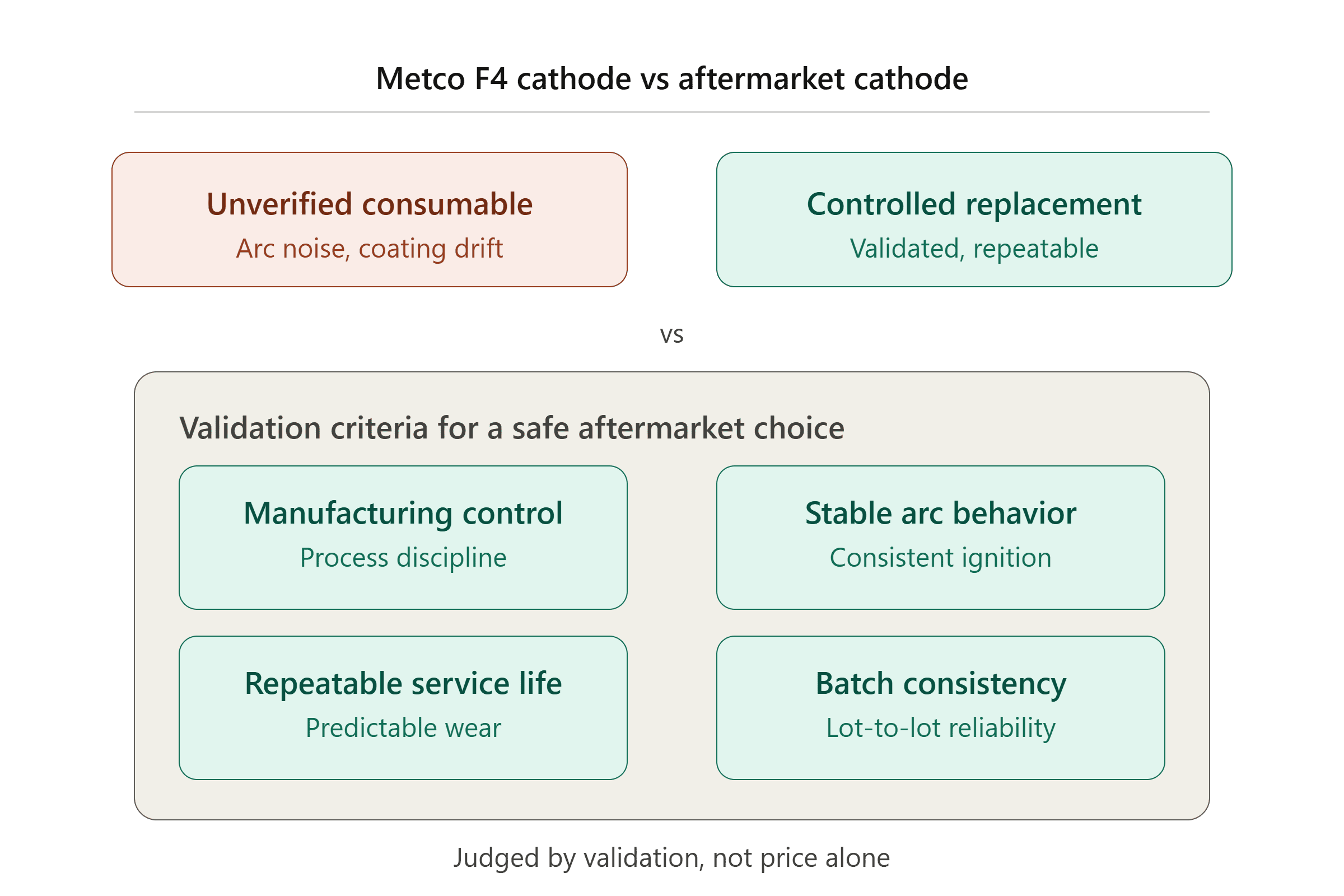
I work with thermal spray consumables every day. I respect the Metco F4 cathode as a standard part in plasma spray work. I also know that many service providers and OEM users need stable aftermarket choices. The real question is not simple. It is not only “OEM or cheaper copy.” I usually ask a more useful question. Can this supplier control the cathode well enough to reduce risk in real production? If that question matters to you, I think the next sections will help you read the part, the supplier, and the trial result with a clearer mind.
Why Metco F4 Cathodes Are the Industry Benchmark?
A process becomes risky when the reference point is unclear. I always start with the benchmark before I compare any replacement part.
Metco F4 cathodes are a benchmark because they are tied to a widely used plasma spray gun platform, known process standards, stable user habits, and long field history.2 I treat them as the reference for fit, arc behavior, replacement planning, and process repeatability.
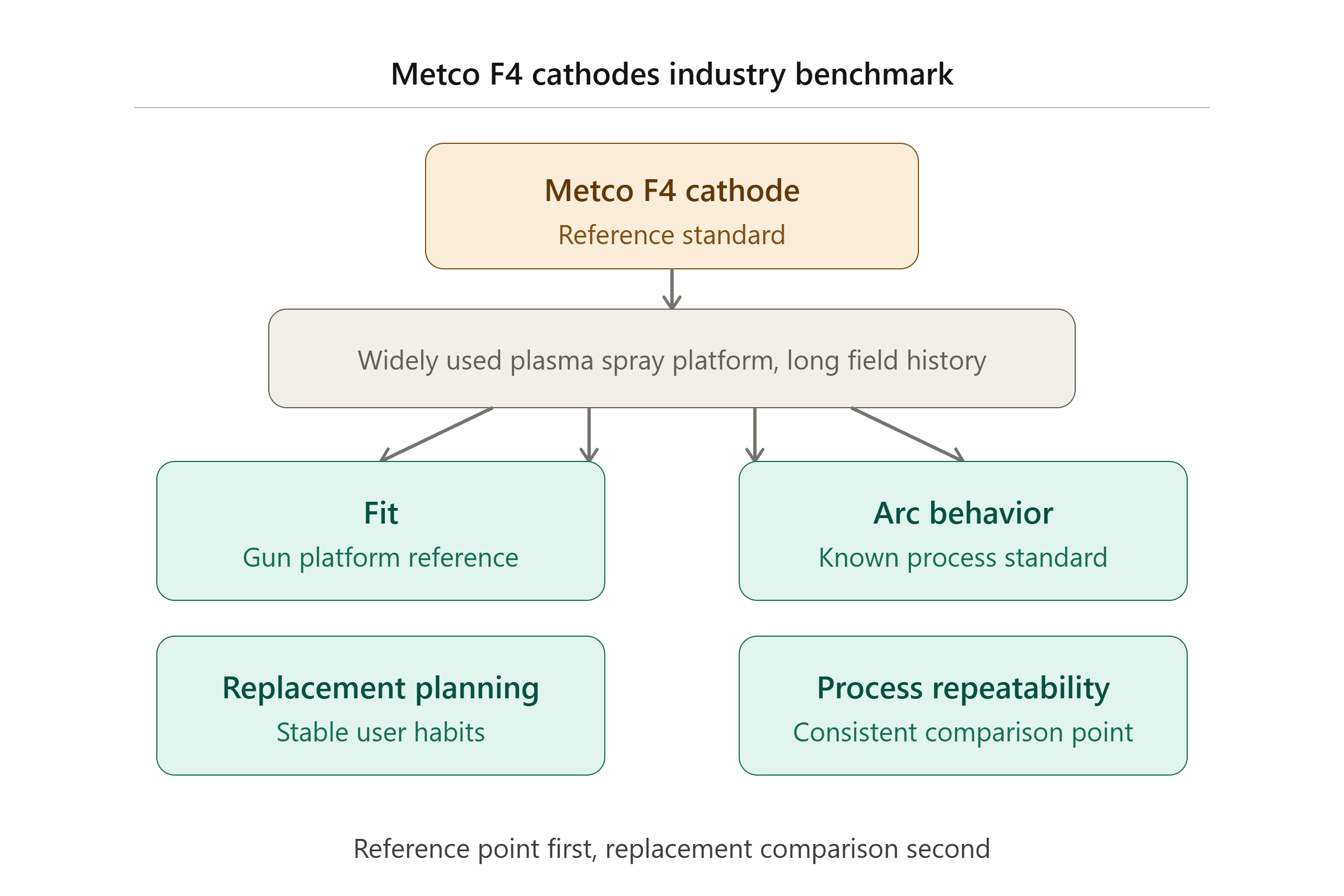
I do not talk about Metco F4 cathodes as ordinary metal pieces. I see them as part of a full plasma spray system. The cathode works with the anode, gas flow, power supply, gun body, cooling, and process recipe.3 A stable benchmark gives operators a known starting point. It also gives purchasing teams a safer reference when they compare other parts.
In my own work, I use the OEM part as the reference when I develop and check F4-compatible cathodes. I do not use this reference to attack the OEM part. I use it to understand what must not be lost. The important point is simple. A cathode must help the arc stay stable.4 It must also support repeatable coating results over many replacements.
| What I Compare | Why It Matters | What I Want To See |
|---|---|---|
| Fit in the gun | Poor fit can change contact and alignment | Smooth assembly without force |
| Arc stability | Arc noise affects coating consistency | Stable arc under normal parameters |
| Service life | Short life raises downtime | Predictable replacement interval |
| Batch repeatability | One good piece is not enough | Similar behavior across pieces |
| Supplier support | Problems need fast discussion | Clear answers and corrective action |
When a user asks me if an aftermarket cathode can replace the original part, I do not answer with a simple yes. I ask about the process, the gun condition, the anode condition, the power level, and the expected coating target. I also ask if the user can run a small trial. The OEM cathode remains the safest reference point. A qualified aftermarket cathode must be measured against that reference with care.
Why “Same Dimensions” Do Not Guarantee the Same Performance?
A cathode can look correct on the table and still behave poorly in the gun. I have seen this cause wrong expectations.
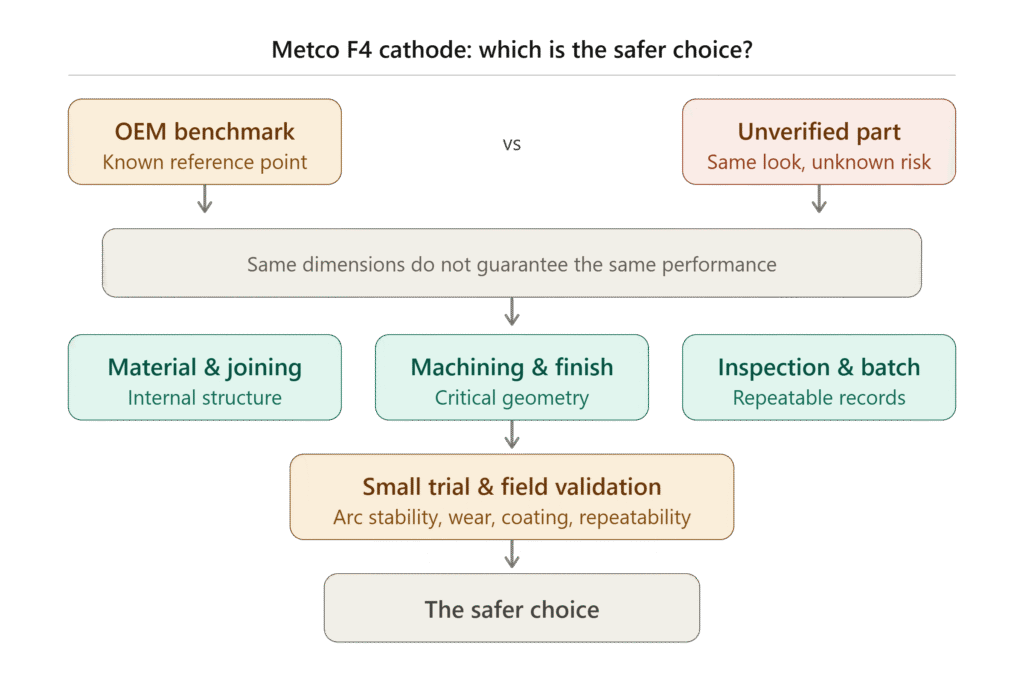
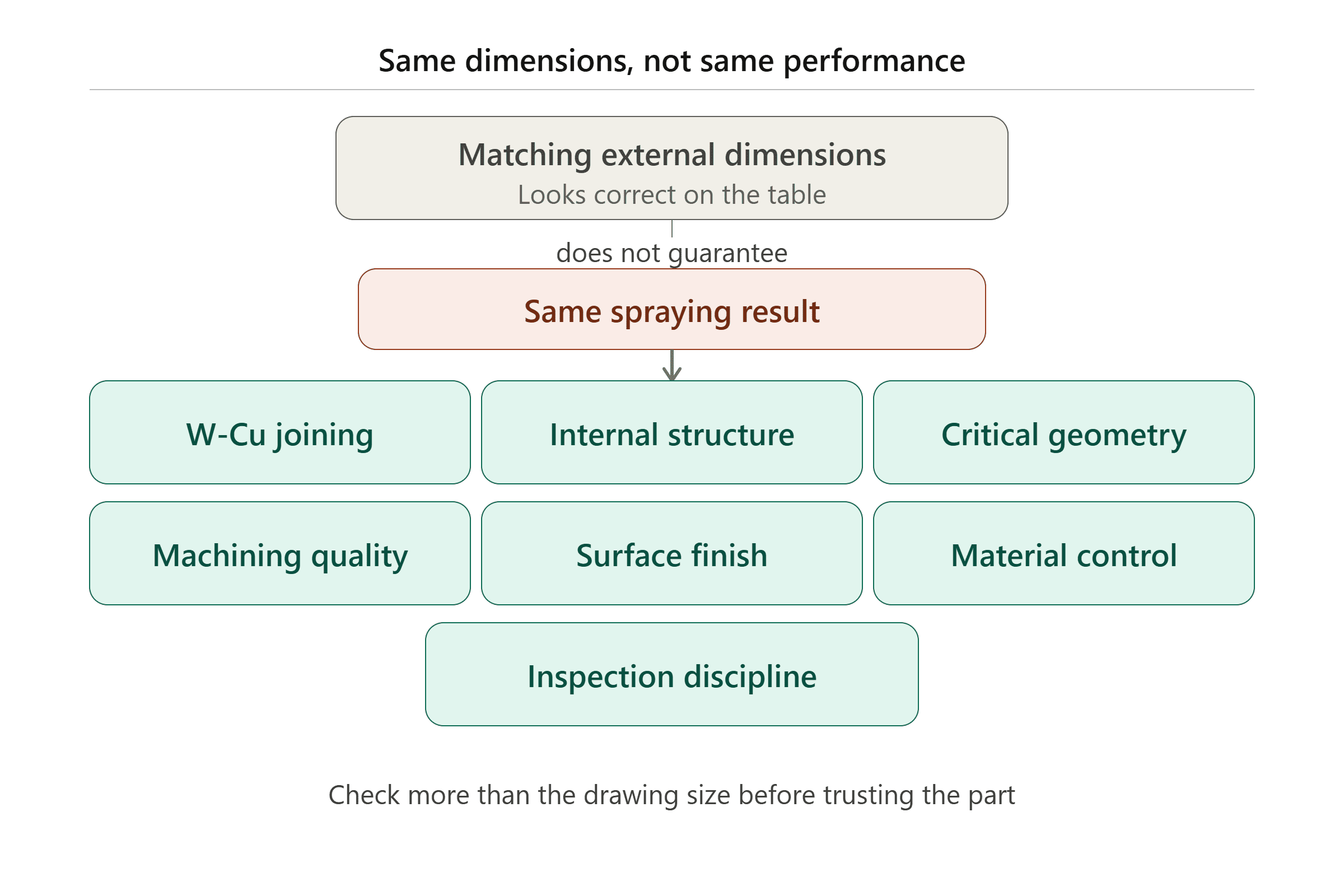
Same external dimensions do not guarantee the same spraying result because cathode performance also depends on tungsten-copper joining, internal structure, critical geometry, machining quality, surface finish, material control, and inspection discipline.5 I check more than the drawing size before I trust the part.
Many buyers first look at dimensions. I understand this habit. A cathode must fit the gun. If the outside size is wrong, the part fails before spraying starts. Yet I do not stop there. In plasma spraying, a cathode works under heat, current, gas flow, and arc erosion.6 A small hidden weakness can become a large process issue.
One key area is the tungsten-copper connection.7 In our production, I pay close attention to the joining area because it affects heat transfer, electrical behavior, and service stability. If this connection has gaps or weak bonding, the cathode may not behave the same way under load.8 The outside shape may still look acceptable.
I also focus on critical dimensions and geometric tolerance. Some surfaces guide assembly. Some surfaces affect arc position.9 Some features influence cooling and heat balance. I use precision CNC machining because repeatability matters more than one perfect sample.
| Area I Check | Risk If It Is Poor | Practical Effect In Spraying |
|---|---|---|
| Tungsten-copper joining | Heat and current path may be unstable | Short life or unstable arc |
| Critical diameter | Gun fit may change | Assembly issue or misalignment |
| Concentricity | Arc position may shift | Coating fluctuation |
| Surface finish | Local heat and wear may change | Less stable erosion behavior |
| Batch machining | Parts may vary lot by lot | Unpredictable replacement results |
I also avoid blaming the cathode for every issue. The anode, gun body, gas setting, cooling, powder feed, and power supply can all affect the result. This is why I prefer controlled testing. I look at the cathode as one important part inside a larger process. I do not treat “same dimensions” as proof. I treat it only as the first gate.
The Real Comparison: Unverified Parts vs Controlled Manufacturing?
A low-cost part becomes expensive when it stops a line. I have heard this concern many times from overseas spraying shops.
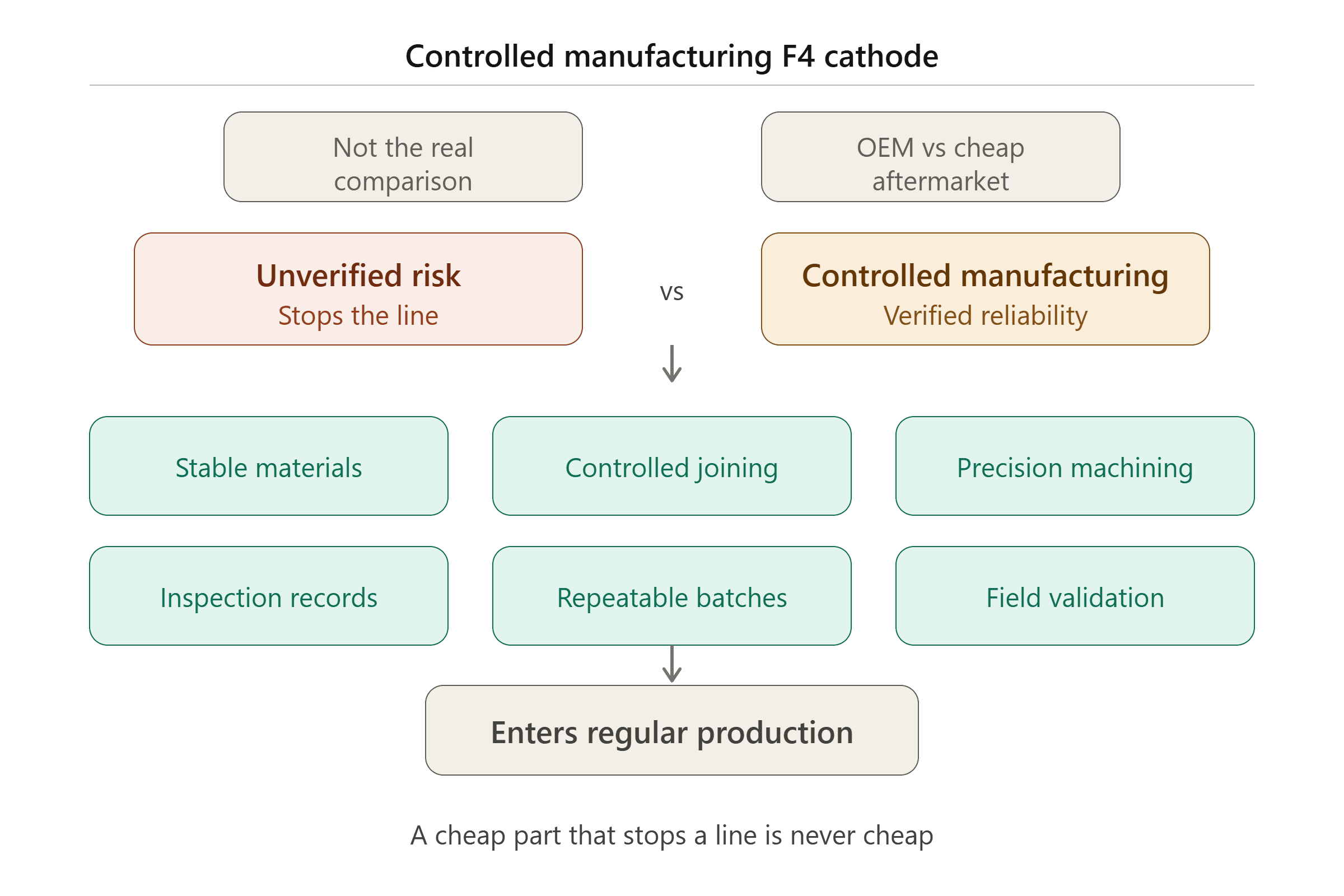
The real comparison is not OEM versus cheap aftermarket. I compare unverified consumable risk against controlled manufacturing reliability. A responsible aftermarket cathode should show stable materials, controlled joining, precision machining, inspection records, repeatable batches, and field validation before it enters regular production.
When I discuss aftermarket F4-compatible cathodes with customers, price is never the full subject. It is only one part of the decision. The larger subject is risk. A service provider wants fewer arc problems. An end user wants stable coating quality. An OEM customer wants repeatable supply. No one wants a part that saves money on the invoice but creates downtime on the shop floor.
In our manufacturing work, I focus on the steps that make each batch repeatable. I care about material selection, tungsten-copper joining, CNC machining, and outgoing inspection. I also care about how feedback is handled after the customer runs the parts. A good supplier should not only ship the cathode. The supplier should also understand what the user is trying to control.
| Buying View | Weak Aftermarket Part | Controlled Aftermarket Part |
|---|---|---|
| Price | Looks attractive at first | Must connect to total cost |
| Arc behavior | Unknown and inconsistent | Checked by trial and feedback |
| Lifetime | One piece may be fine, next may fail | More predictable across batches |
| Inspection | Basic size check only | Critical dimensions and geometry checked |
| Supplier answer | Vague claims | Clear process explanation |
| Repeat orders | Risk remains high | Confidence can grow over time |
I do not claim that every aftermarket cathode is equal to the OEM part. That would be careless. I also do not claim that a controlled aftermarket cathode is always better. That would not be fair. I see a better path. The buyer should separate unknown parts from controlled parts.
A controlled manufacturer should be able to explain the process in normal words. The supplier should know where the failure risks are. The supplier should know which dimensions are critical. The supplier should understand why arc stability matters more than appearance. The supplier should also accept small-batch validation before larger use. In my view, this is where aftermarket value becomes real. It comes from lower total risk, not from a lower price tag alone.10
How to Evaluate a Reliable Aftermarket F4 Cathode Before Use?
A trial without a plan can mislead you. I have seen users test parts but miss the signs that matter.
I evaluate an aftermarket F4 cathode by checking supplier process control first, then running a small trial. I watch arc stability, cathode wear, coating consistency, anode condition, gun behavior, replacement frequency, and batch repeatability before I approve larger use.
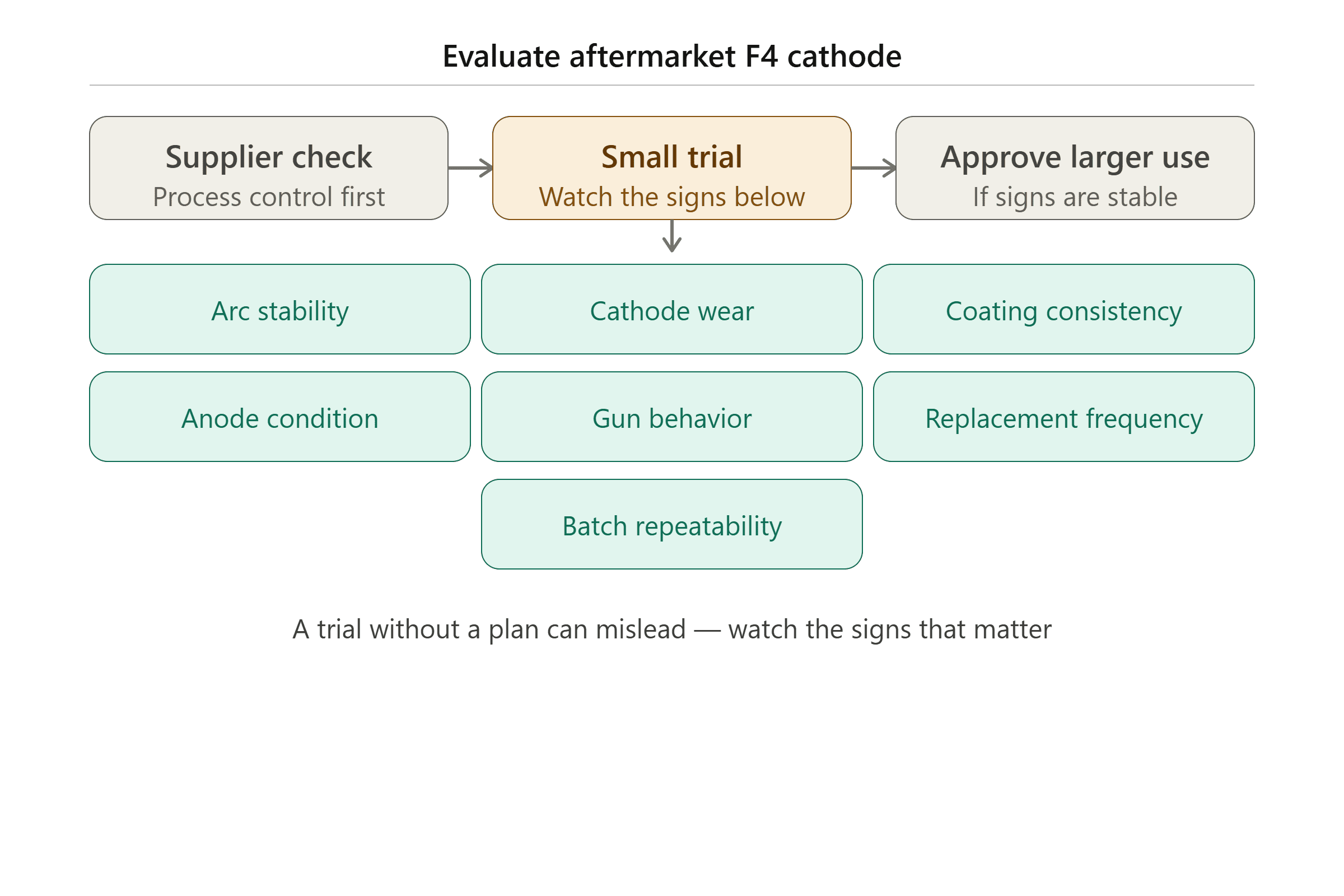
I suggest a simple path when a customer wants to try an aftermarket F4-compatible cathode. I start before the test. I ask what the supplier can explain. A reliable supplier should talk clearly about material control, joining control, machining equipment, critical dimension inspection, and batch records. The answer does not need to sound fancy. It needs to be specific.
Next, I prefer a small-batch field trial. The trial should not change too many things at once. If the user changes the cathode, the anode, the powder, the gas recipe, and the power setting at the same time, the result becomes unclear.11 I usually suggest that the user keep the known process as stable as possible. Then the user can observe the cathode with better judgment.
| Step I Recommend | What I Ask Or Check | Why I Do It |
|---|---|---|
| Supplier review | Joining process, material, machining, inspection | I want to see process control |
| Drawing and fit check | Critical dimensions and assembly feel | I want to prevent basic fit risk |
| Small trial | Limited quantity under known parameters | I want real field behavior |
| Arc observation | Arc length, noise, stability | I want to see process confidence |
| Wear review | Cathode erosion and replacement timing | I want predictable use |
| Coating review | Coating appearance and process consistency | I want no quality surprise |
| Batch follow-up | Repeat test with another lot if needed | I want stable supply, not one lucky batch |
I also remind users to check the full spray system. A worn anode can create problems.12 A damaged gun body can change alignment. Poor cooling can raise heat stress. A wrong parameter can make a good cathode look bad. I have learned that fair testing protects both the buyer and the supplier.
If the first trial is stable, I do not jump straight to full conversion in every case. I prefer a controlled increase. The user can run more parts, record replacement frequency, and compare coating results over time. If repeat orders show the same behavior, confidence becomes stronger. This is how I like to build trust. I do not build it with big claims. I build it with clear manufacturing control and repeatable field feedback.
Conclusion
I treat aftermarket F4 cathodes as risk-controlled choices, not cheap copies. I trust them only when manufacturing control and field validation support stable use.
"[PDF] A Perspective on Plasma Spray Technology - Columbia University", http://www.columbia.edu/cu/seas/earth/wtert/newwtert/Research/sofos/Plasma_%20spraying_Nov2014.pdf. A peer-reviewed thermal-spray study documents that electrode condition and erosion can alter arc behavior and plasma-jet stability, providing a technical basis for treating cathode weakness as a source of spray-process instability. Evidence role: mechanism; source type: paper. Supports: Electrode condition and cathode erosion can influence arc stability and plasma-jet behavior in plasma spraying.. Scope note: The support may be general to plasma spray guns rather than specific to the Metco F4 cathode. ↩
"Atmospheric Plasma Spray", https://engineering.virginia.edu/labs-groups/wadley-intelligent-processing-materials-group/user-facilities/atmospheric-plasma-spray. Published atmospheric plasma-spray studies identify the Metco F4 gun as a commonly used research and production-relevant platform, supporting its role as a practical reference point for compatible cathodes. Evidence role: historical_context; source type: paper. Supports: Published thermal-spray studies frequently identify the Metco F4 or F4-type gun as the equipment used for atmospheric plasma spraying experiments.. Scope note: Frequent appearance in the literature supports contextual benchmark status but does not by itself prove universal industry dominance. ↩
"Atmospheric Plasma Spray", https://engineering.virginia.edu/labs-groups/wadley-intelligent-processing-materials-group/user-facilities/atmospheric-plasma-spray. An educational source on plasma spraying explains that the plasma gun operates through the interaction of cathode and anode electrodes, process gas, electrical power, cooling, and selected spray parameters. Evidence role: definition; source type: education. Supports: Plasma spray gun operation depends on coordinated interaction among electrodes, working gas, power supply, cooling, and process settings.. Scope note: The source would support the general operating principle, not the performance of any specific aftermarket cathode. ↩
"Simulation of Arc Root Fluctuation in a DC Non-Transferred Plasma ...", https://ui.adsabs.harvard.edu/abs/2012JTST...21..636H/abstract. A peer-reviewed study of plasma-torch electrodes shows that cathode condition and arc-root behavior are linked to arc stability, supporting the claim that the cathode is not merely a passive fit component. Evidence role: mechanism; source type: paper. Supports: Cathode geometry, material state, and erosion affect arc attachment and stability in plasma torches.. Scope note: The mechanism may be demonstrated in plasma torches generally and may require cautious transfer to the specific F4 gun. ↩
"Recent Research Advances in Plasma Spraying of Bulk-Like Dense ...", https://pmc.ncbi.nlm.nih.gov/articles/PMC8797376/. Technical studies of plasma-torch electrodes indicate that electrode material state, geometry, and surface condition influence erosion and arc behavior, supporting the view that matching external dimensions alone is not sufficient evidence of equivalent performance. Evidence role: general_support; source type: paper. Supports: Electrode performance in plasma spraying depends on material properties, geometry, surface condition, and manufacturing quality, not only external dimensions.. Scope note: The evidence is likely to support the general principle rather than each listed manufacturing factor individually. ↩
"[PDF] Section 3.0: Plasma Torch Design - VTechWorks", https://vtechworks.lib.vt.edu/bitstreams/d632b148-48f7-4dbc-a219-8eb5382f6957/download. A peer-reviewed source on plasma-torch electrode erosion describes cathodes as operating under high electrical current, intense thermal loading, plasma-gas flow, and erosive arc attachment conditions. Evidence role: mechanism; source type: paper. Supports: Cathodes in plasma spray or plasma torch systems are exposed to high current, high temperature, gas flow, and erosion processes.. Scope note: The source may describe plasma torches broadly and not only atmospheric plasma spray F4 cathodes. ↩
"Engineering performance of tungsten network reinforced copper ...", https://pmc.ncbi.nlm.nih.gov/articles/PMC10866055/. Materials research on tungsten-copper composites reports that these materials are used where high thermal and electrical conductivity must be combined with high-temperature resistance, which contextualizes why the tungsten-copper connection in a cathode is performance-relevant. Evidence role: mechanism; source type: paper. Supports: Tungsten-copper materials combine high-temperature resistance with thermal and electrical conductivity, and interface quality can affect heat and current transfer.. Scope note: Such sources may address tungsten-copper composites generally rather than the exact joining method used in an F4-compatible cathode. ↩
"[PDF] Thermal contact resistance across a copper-silicon interface", https://www.osti.gov/servlets/purl/554855. Materials-engineering literature shows that voids or poor bonding at conductive interfaces can increase thermal contact resistance and affect electrical-current paths, supporting the concern that a defective tungsten-copper joint may change cathode behavior under load. Evidence role: mechanism; source type: paper. Supports: Interface voids and weak bonding can increase thermal or electrical resistance and alter component behavior under load.. Scope note: The evidence is a materials-mechanism analogy unless the source tests plasma-spray cathodes directly. ↩
"Predicted Anode Arc Attachment by LTE (Local Thermodynamic ...", https://pmc.ncbi.nlm.nih.gov/articles/PMC8428209/. Studies of plasma-torch arc attachment report that electrode geometry and surface state influence arc-root location and movement, supporting the claim that certain machined surfaces can affect arc position. Evidence role: mechanism; source type: paper. Supports: Electrode geometry and surface condition can affect arc attachment and arc-root position in plasma torches.. Scope note: The support may be for plasma torches generally and may not isolate the specific surface features of a Metco F4-compatible cathode. ↩
"[PDF] Major equipment life cycle cost analysis by Edward P. O'Connor", https://dr.lib.iastate.edu/bitstreams/9cc741a3-8603-4628-8890-d1ae29f0bded/download. Lifecycle-cost and total-cost frameworks used in engineering and procurement account for reliability, maintenance, downtime, and replacement effects in addition to purchase price, supporting the article's distinction between low price and lower total risk. Evidence role: general_support; source type: government. Supports: Lifecycle or total-cost approaches account for downtime, reliability, maintenance, and replacement risk rather than acquisition price alone.. Scope note: The evidence supports the decision framework generally and does not quantify the cost impact of any specific cathode. ↩
"Conceptualizing Experimental Controls Using the Potential ... - PMC", https://pmc.ncbi.nlm.nih.gov/articles/PMC12609828/. Educational sources on experimental design explain that changing several variables simultaneously can confound cause-and-effect interpretation, supporting the article's advice to keep spray-process conditions stable during a cathode trial. Evidence role: expert_consensus; source type: education. Supports: Experimental design principles require control of variables or structured factorial designs to avoid confounding causes.. Scope note: The principle is methodological and not specific to thermal spraying. ↩
"[PDF] Solving an Anode Burning Problem in Sandia's Low Pressure ... - OSTI", https://www.osti.gov/servlets/purl/1146616. Research on plasma-torch electrode erosion reports that anode wear can influence arc behavior and operating stability, supporting the warning that spray problems may arise from the anode as well as the cathode. Evidence role: mechanism; source type: paper. Supports: Anode erosion or wear can affect arc behavior, voltage fluctuations, and plasma spray process stability.. Scope note: The source may describe general plasma torch behavior and may not provide diagnostic rules for a specific F4 gun. ↩