A cathode can fail early, stop production, and create doubt. I see this problem most often when one part gets blamed too fast.
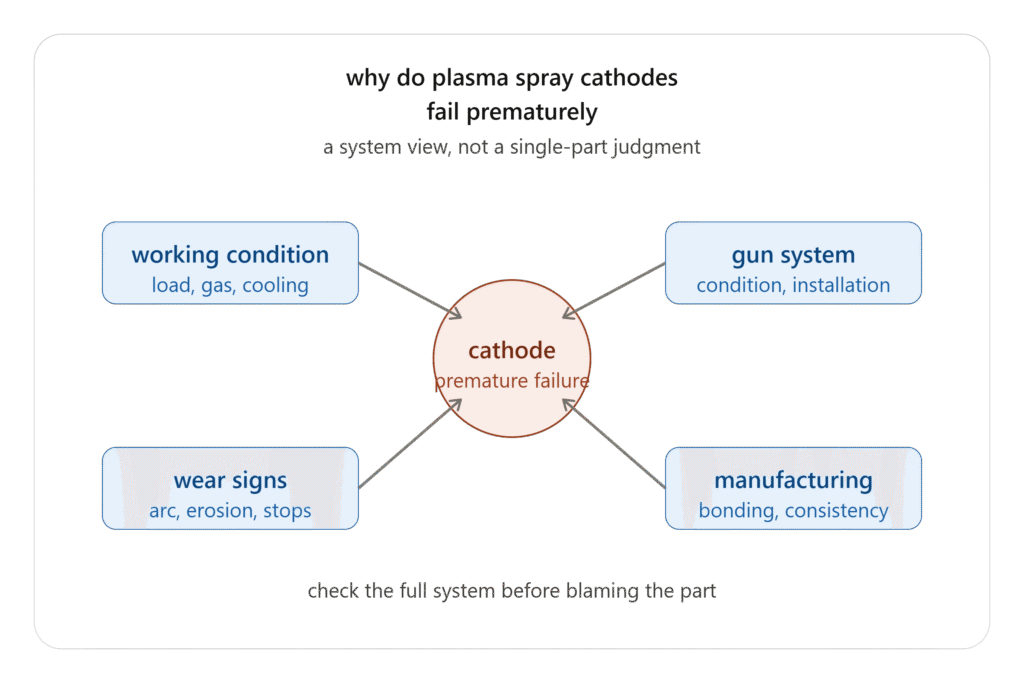
A plasma spray cathode fails prematurely when the arc load, gas, cooling, gun condition, installation, related consumables, or cathode manufacturing consistency1 is not stable. We should check the full system before we decide that the cathode itself is the only cause.
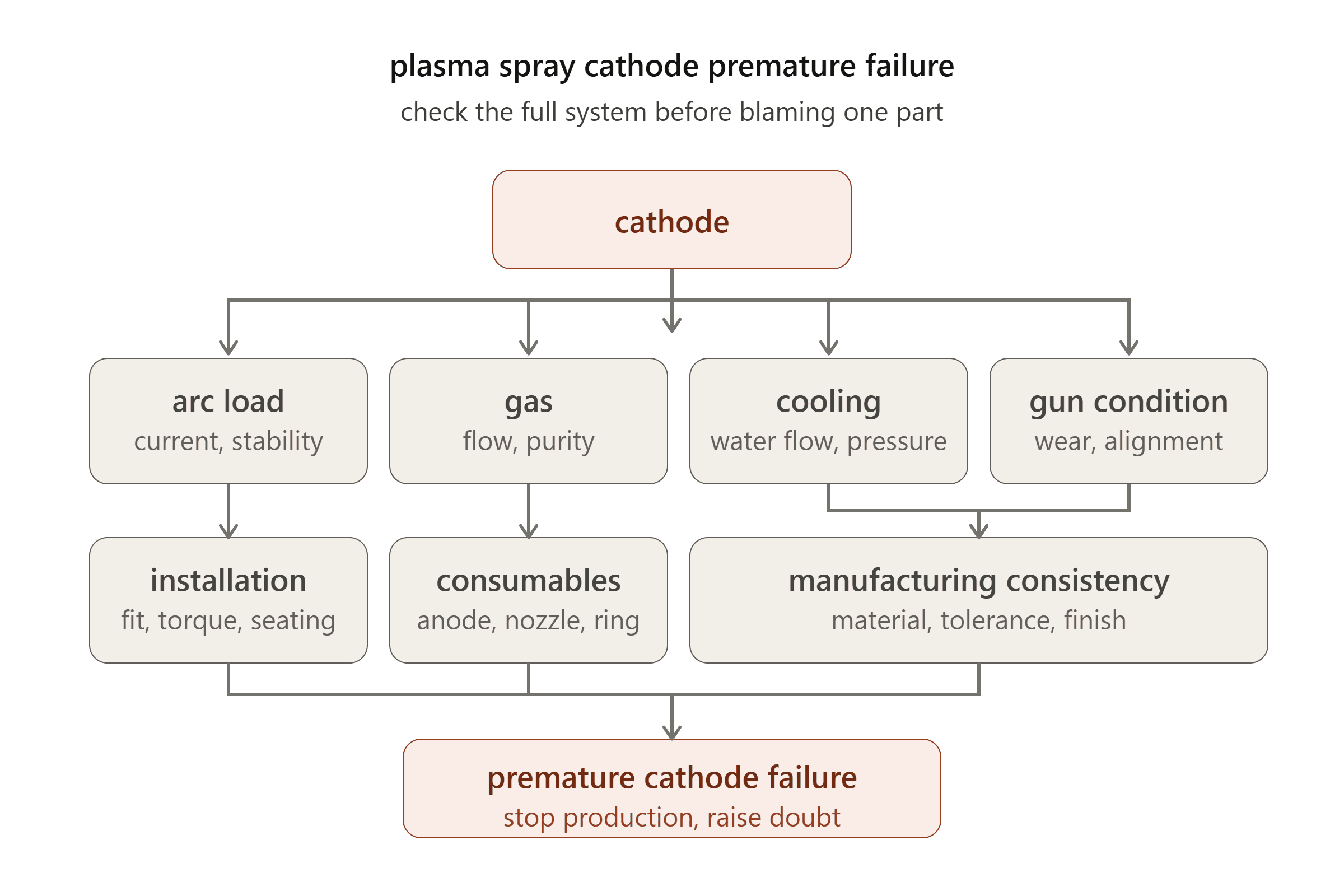
When a customer tells me that a cathode did not last long enough, I do not start with one simple answer. I first ask how the gun was used. I ask about current, voltage, plasma gas, spray distance, powder feed, cooling water, and gun condition. I also ask if the same problem happened in one piece, one batch, or only with one operator. This first conversation often gives more value than a fast judgment, because cathode life is not only a material question. It is a system question. If we want less downtime and more stable spraying, we need to look at the cathode, the gun, and the process together.
Why Can Cathode Life Not Be Judged by Hours Alone?
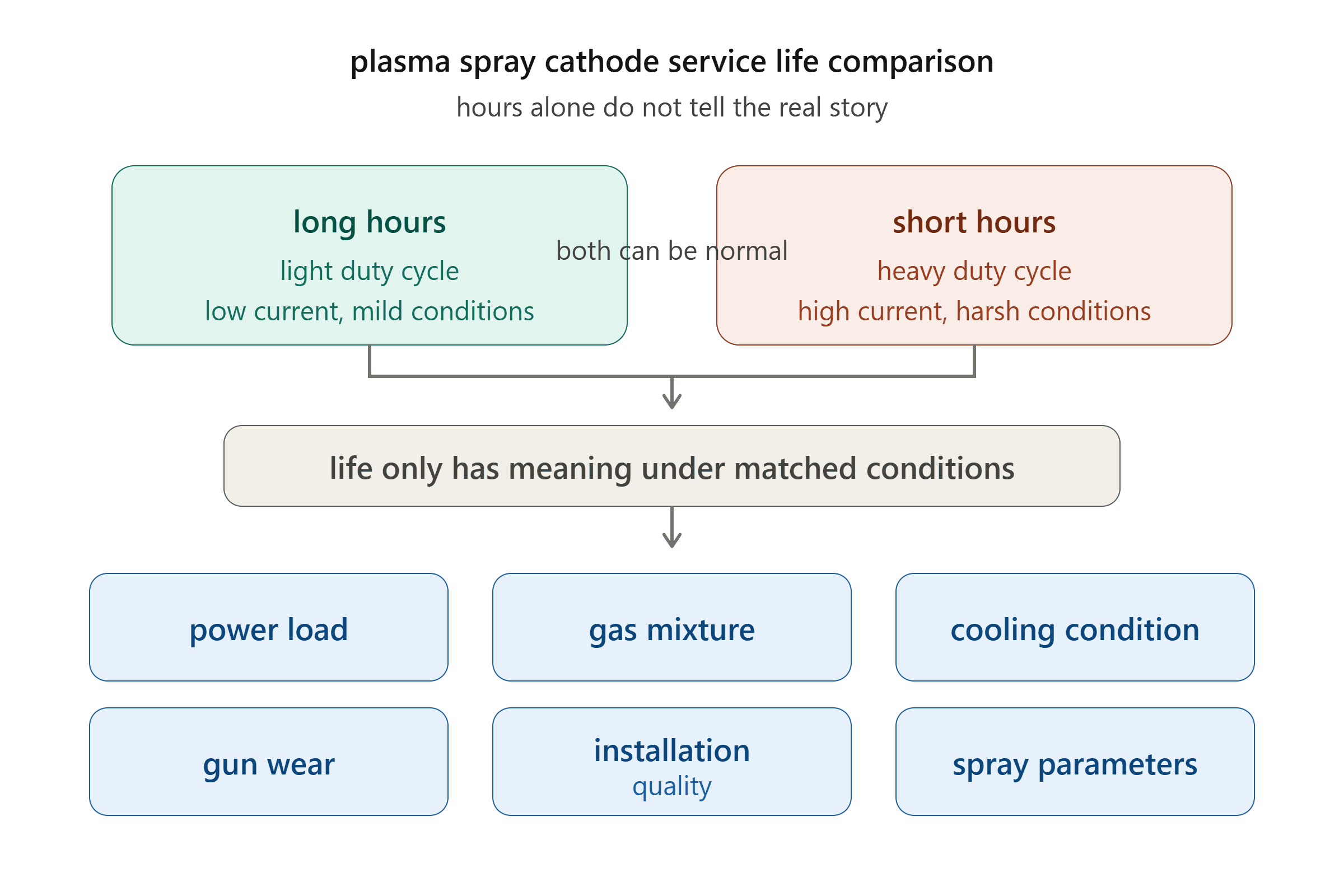
A short life number looks serious, but it can mislead us. I have seen long hours in light duty and short hours in heavy duty.
A cathode life result only has meaning when we know the power load, gas mixture, cooling condition, gun wear, installation quality, and spray parameters.2 We should compare cathodes under the same working conditions, not only by total operating hours.
I first define the working load
When I discuss cathode life with a process manager, I usually ask for the real operating window. I do this because “hours” alone can hide the real stress level. A cathode used at a high current with aggressive gas will not behave like a cathode used at a lower load. A gun with poor cooling will also change the result. The same cathode design can show different life in two workshops, even when both teams believe they are using a normal process.
| Factor I check | Why it matters | What I ask the user to confirm |
|---|---|---|
| Current and voltage | Higher arc load raises thermal stress3 | Actual set value and real running value |
| Plasma gas | Gas mix changes arc behavior and erosion4 | Gas type, flow, purity, and stability |
| Cooling water | Poor cooling increases local heat5 | Flow rate, pressure, temperature, and blockage |
| Gun condition | Worn parts disturb the arc6 | Anode condition, insulator, seals, and alignment |
| Installation | Poor fit can cause unstable contact | Torque, seating surface, and part cleanliness |
I prefer to compare cathode life in the same gun, same parameter, and same operator routine. This method is not perfect, but it removes many wrong assumptions. In my own production and customer communication, I have seen that life variation often becomes easier to understand after we separate normal heavy-duty wear from abnormal early failure.
I separate normal wear from premature failure
A cathode is a consumable. It should wear.7 We should not treat all wear as a defect. The real question is whether the wear pattern is expected for the process. If a cathode runs shorter than expected but the arc is stable and the wear is even, the process load may be high. If the cathode shows abnormal tip damage, arc instability, or sudden failure, then we need deeper checking.
| Result | Possible meaning | My next step |
|---|---|---|
| Even wear with stable arc | Normal consumption or high load | Compare with process history |
| Very fast tip erosion | Arc concentration or overload | Check parameters and cooling |
| Unstable arc from start | Fit, gas, gun, or cathode issue | Check installation and system |
| Large batch-to-batch change | Process change or supplier consistency | Compare records and dimensions |
This is why I do not give one universal cathode life number. A fixed number can sound useful, but it can also create a false standard. I would rather help the user build a fair comparison condition.
What Are the Common Signs of Premature Cathode Failure?
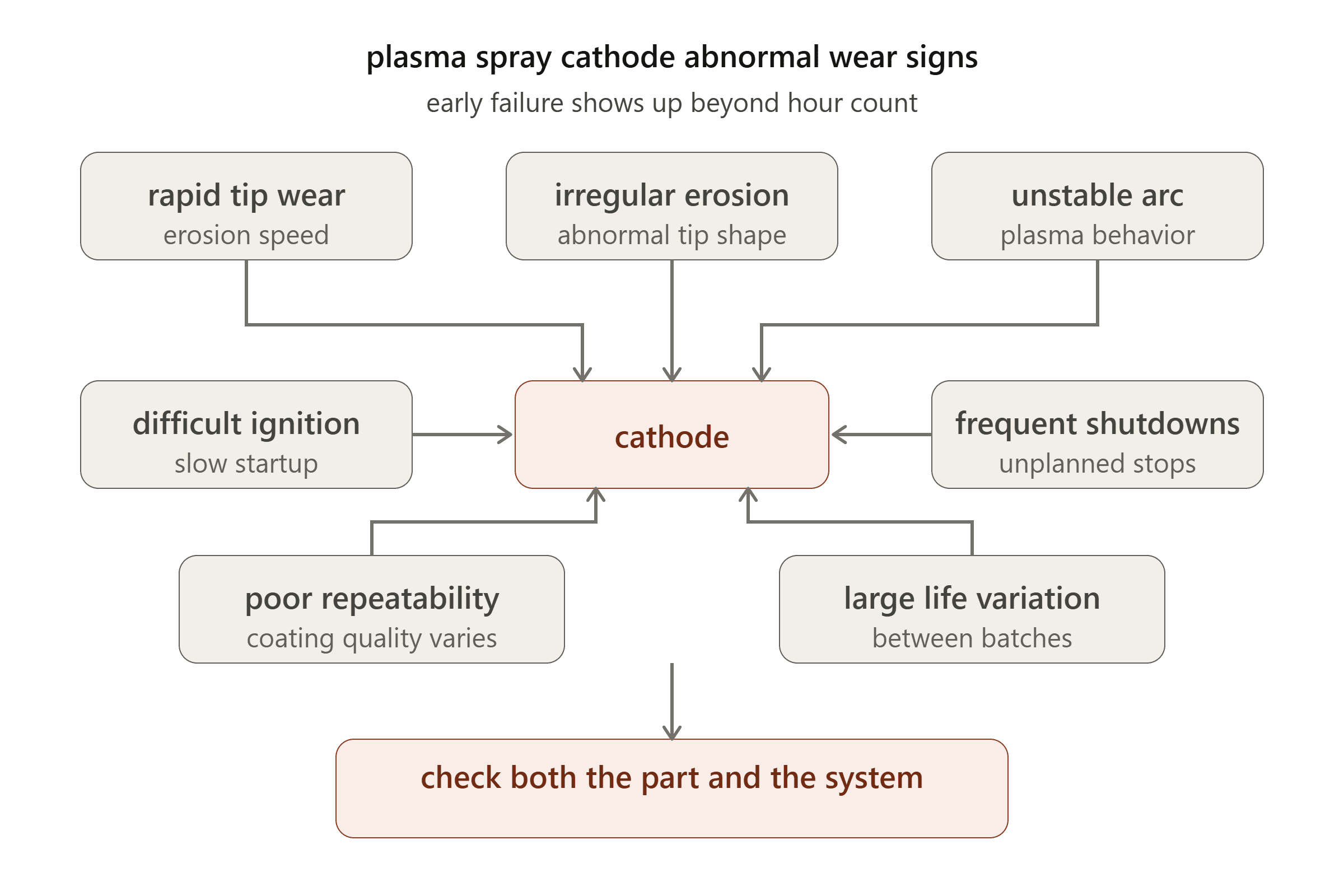
Early failure is not only a short hour count. I usually see unstable arc behavior, fast erosion, abnormal tip shape, frequent stops, or large life variation.
Premature cathode failure can appear as rapid tip wear, irregular erosion, unstable plasma arc, difficult ignition, frequent shutdowns, poor coating repeatability8, or big life differences between batches. These signs show that we should check both the part and the system.
I look at the symptom before I decide the cause
When a customer sends a photo of a used cathode, I do not judge only from the color or the missing material. A photo helps, but it does not tell the full story. I need to know when the symptom appeared. I also need to know whether the arc became unstable before the visible damage. In many cases, the earliest sign is not the final shape of the cathode. The earliest sign is a change in the spray process.
| Sign I hear from users | What it may suggest | What I do not assume too fast |
|---|---|---|
| Difficult arc start | Fit issue, gas issue, or contact issue | I do not assume bad tungsten only |
| Arc length changes often | Gas flow or gun condition may be unstable | I do not blame one part first |
| Tip wears fast | High load, cooling issue, or material issue | I do not ignore parameters |
| Cathode cracks or burns | Severe heat stress or poor bonding risk | I do not confirm without checking |
| Life changes by batch | Supplier consistency or process change | I do not ignore production records |
I also pay attention to related consumables. The cathode works with the anode, nozzle, seals, and gun body. If the anode wear changes the arc attachment9, the cathode can be affected. If the water channel has scale, the cathode can face more heat. If the gas purity is poor, arc behavior can become less stable. These details can make a good cathode look bad.
I treat variation as a serious clue
One early failure can happen because of many reasons. A pattern is more important. If ten cathodes from the same batch fail in a similar way under the same process, I will study the part more closely. If only one cathode fails after a maintenance change, I will check installation and gun condition first. If two suppliers show different stability under the same real condition, I will compare dimensions, interface quality, and batch control.
In our own work, I pay close attention to repeated feedback. I do not want to defend the part without evidence. I also do not want the customer to replace suppliers when the real problem is cooling water or gun wear. A wrong decision can waste money and still leave the coating line unstable.
What Is a Practical Troubleshooting Process Before Blaming the Cathode?
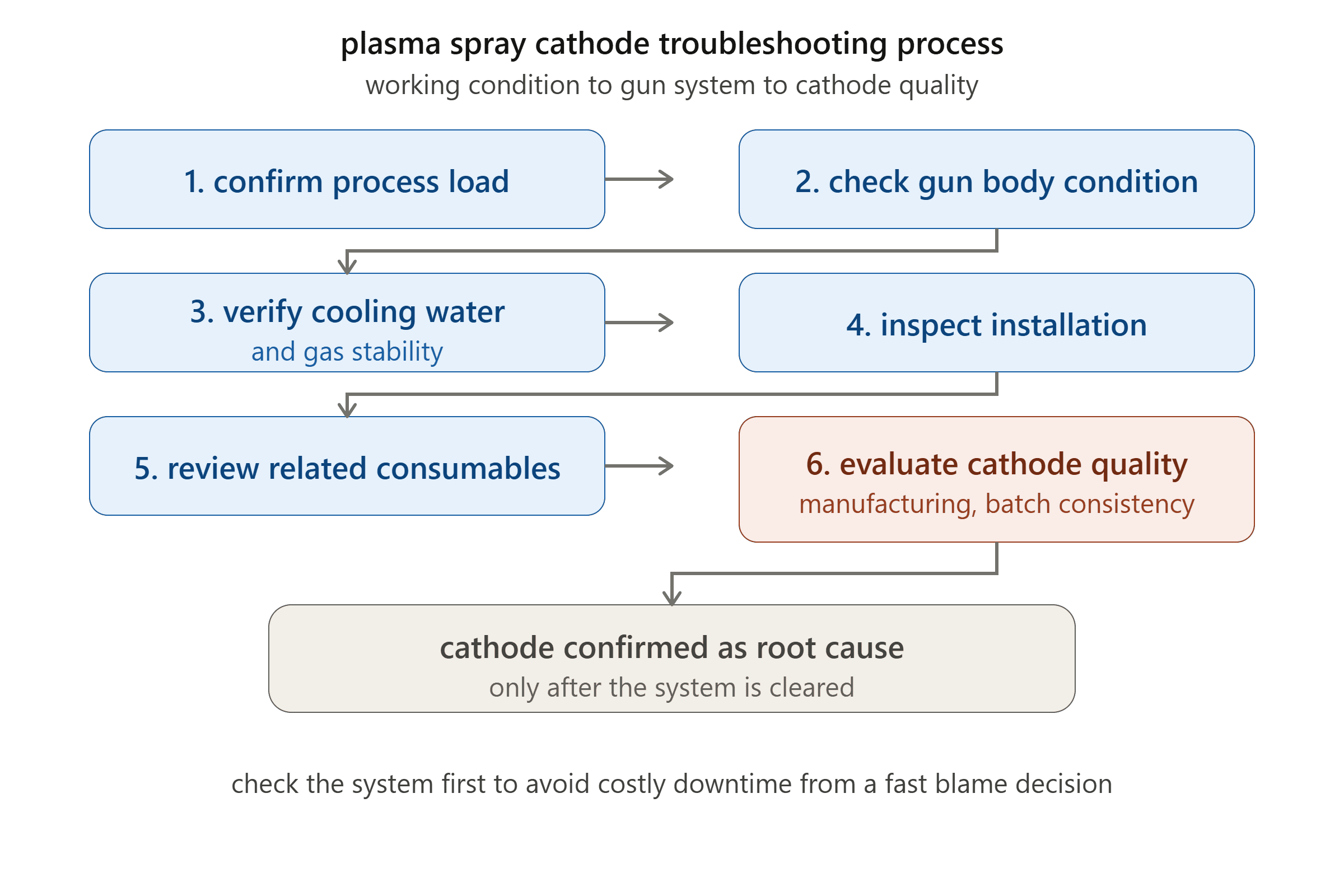
A fast blame decision can cost more downtime. I prefer a simple checking order that moves from working condition to gun system to cathode quality.
Before blaming the cathode, we should confirm process load, check gun body condition, verify cooling water and gas stability, inspect installation, review related consumables, and then evaluate cathode manufacturing quality and batch consistency.
I start with the process record
My first step is to collect basic facts. I ask for current, voltage, gas flow, gas type, powder type, spray time per cycle, and cooling water data. I also ask whether the operator changed any setting. This step sounds simple, but it often finds the first clue. A small current change or a different gas bottle can change cathode wear.10 A longer continuous spray cycle can raise thermal stress. A clogged filter can reduce cooling without a clear alarm.
| Step | What I check | Why I check it |
|---|---|---|
| 1 | Parameter load | The cathode may be working beyond normal duty |
| 2 | Cooling water | Poor cooling can create early heat damage |
| 3 | Plasma gas | Flow and purity affect arc stability |
| 4 | Gun body | Wear or misalignment can disturb the arc |
| 5 | Installation | Poor seating can create unstable contact |
| 6 | Related consumables | Anode and seals affect the cathode environment |
| 7 | Cathode batch | Manufacturing consistency must still be checked |
I like this order because it protects both sides. The user avoids a wrong purchasing decision. The supplier avoids a wrong technical conclusion. Both sides can speak about evidence instead of feeling.
I check the gun as a working system
The gun body can hide many problems. A worn seat, damaged thread, old seal, or dirty contact surface can change how the cathode works. Cooling channels can also become less effective over time. The gun may still spray, but the arc may no longer behave as designed. This condition can shorten consumable life without causing an obvious machine error.
I also ask users to compare parts in a controlled way. I prefer an A/B check with the same gun, same settings, same water condition, and same operator. If possible, I ask them to test a known stable cathode batch beside the new batch. This test is not a laboratory analysis, but it is useful for production decisions. If both parts fail early, the system needs more attention. If only one batch fails under the same condition, I will focus on cathode manufacturing data.
I do not skip the installation detail
Installation is easy to overlook. A small burr, dust, oil, or wrong tightening method can affect contact and alignment. I have seen cases where the part looked correct, but the seating surface was not clean. The result was unstable behavior during operation. This kind of issue is frustrating because it looks like a part quality issue from the outside.
For this reason, I suggest a simple habit. Clean the contact area. Check the mating surface. Use the correct installation method. Confirm the cathode is seated fully. Record the part batch and running condition. This habit helps the user find patterns faster.
How Does Cathode Manufacturing Consistency Affect Service Life?
Manufacturing quality cannot fix a bad process, but it can reduce unwanted variation. I focus on stable bonding, accurate geometry, and repeatable batches.
Cathode manufacturing consistency affects service life through tungsten-copper interface stability, gap-free bonding, key dimensions, concentricity, surface finish, fit quality, and batch control.11 Good manufacturing does not promise a miracle lifespan, but it supports stable arc behavior and predictable wear.
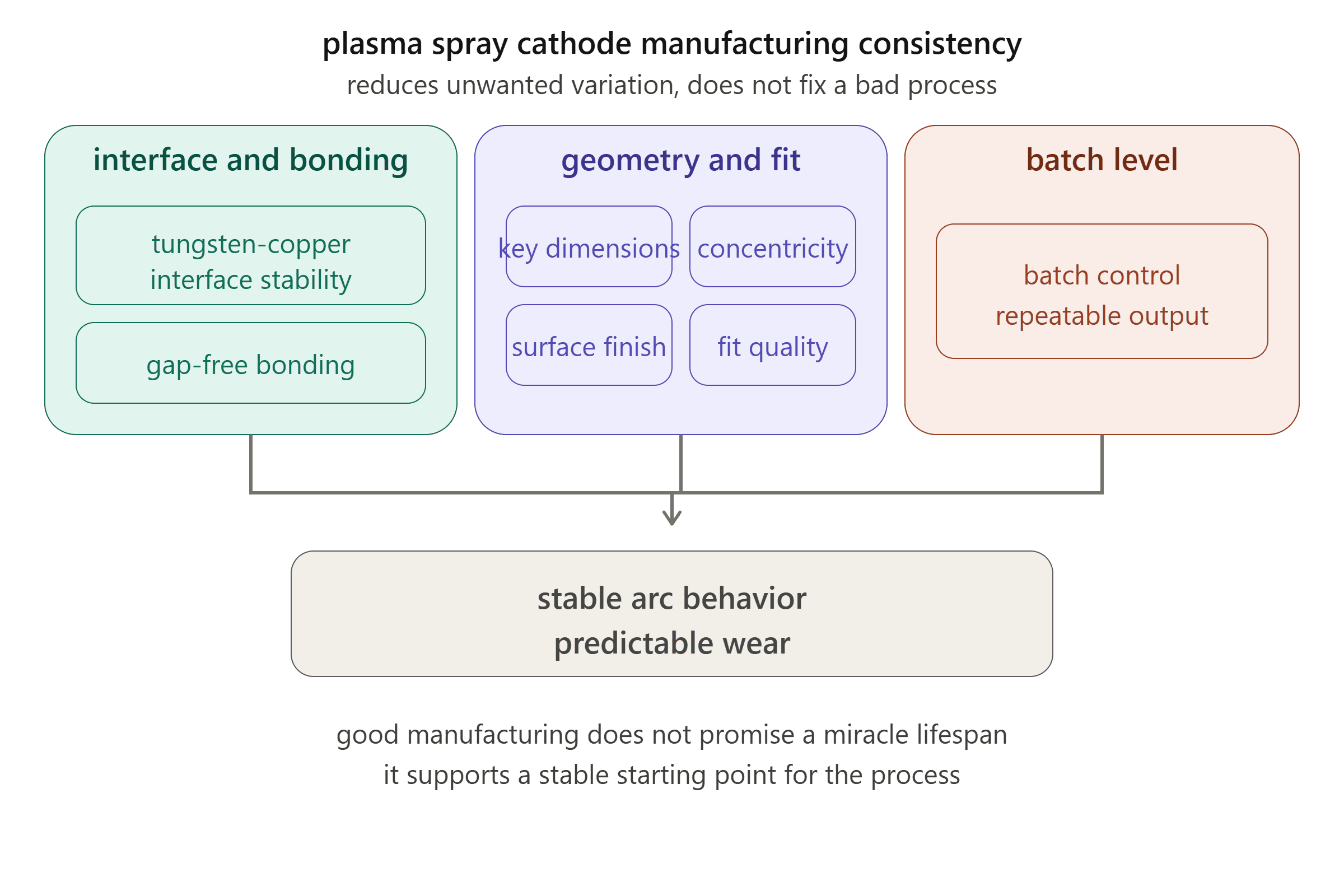
I focus on the tungsten-copper connection
For plasma spray cathodes, the tungsten-copper connection is one of the key points I care about in production. The connection must handle heat, electrical load, and repeated operation. If the interface is not stable, the cathode may become less predictable under high power. I do not describe every failure as an interface failure, because that would be too simple. Still, I treat this area as a serious manufacturing control point.
In our production work, we use a gap-free connection concept and vacuum casting technology for tungsten-copper bonding. The goal is not to claim an impossible life number. The goal is to reduce weak points at the interface and support repeatable performance. A stable interface gives the cathode a better chance to work as designed, especially when the gun and process are also stable.
| Manufacturing point | Why I control it | Practical effect for users |
|---|---|---|
| Tungsten-copper interface | It carries heat and current | More stable behavior under load |
| Gap-free bonding | Gaps can create weak heat transfer areas | Lower risk of abnormal variation |
| Key dimensions | Fit affects alignment and contact | More repeatable installation |
| Concentricity | Arc position depends on geometry | More stable arc behavior |
| Surface quality | Poor surface can affect fit and contact | Less installation uncertainty |
| Batch records | Variation must be traceable | Easier troubleshooting |
I control geometry because the arc is sensitive
A cathode is a small part, but the gun is sensitive to small errors. Key dimensions, concentricity, and geometric tolerance can affect the arc.12 If a cathode is not consistent, two pieces may behave differently even under the same setting. This is why I care about precision machining. In our workshop, we use high-precision CNC equipment for critical consumables. We also pay attention to repeatability, not only one beautiful sample.
For plasma spray cathodes and anodes, we use Japanese Miyano and TAKAMAZ dual-spindle, dual-turret CNC machines for precision machining. This helps us finish key features in a controlled process. The purpose is to keep the part consistent from piece to piece. For critical dimensions, we target tight control. In production thinking, a stable batch is often more valuable than one part that performs well by chance.
I treat inspection as part of the product
A cathode is not finished when machining is finished. I believe inspection is part of the product. We check key dimensions, shape and position tolerance, fit areas, and surface condition. For related gun products, we also run functional checks. This habit helps us catch variation before it reaches the user.
Still, I keep the boundary clear. Even a well-made cathode cannot overcome severe cooling loss, wrong gas flow, damaged gun parts, or unsuitable spray parameters. Manufacturing consistency supports service life, but the system must support the cathode too. This is why I often tell customers that sourcing and troubleshooting belong together. A stable supplier helps. A stable process helps. A healthy gun helps. The best result usually comes when all three are controlled.
Conclusion
Premature cathode failure is usually a system problem. I check process, gun health, cooling, gas, installation, and manufacturing consistency before I make a final judgment.
"[PDF] Section 10.0: Electrode Erosion - VTechWorks", https://vtechworks.lib.vt.edu/bitstream/handle/10919/36917/Sec10.pdf. Authoritative thermal spray references describe electrode life as sensitive to operating power, plasma gas composition and flow, cooling efficiency, torch component condition, installation/fit, and consumable quality, identifying these as common contributors to premature electrode erosion and instability. Evidence role: general_support; source type: education. Supports: That cathode life in plasma spraying is influenced by torch operating power, gas composition/flow, cooling efficiency, condition of anode/nozzle and other components, installation/fit, and manufacturing consistency of consumables.. Scope note: Such sources summarize common factors across torch designs and may not quantify the relative impact for a specific gun model or process window. ↩
"[PDF] Characterization of Longevity of Thermal Spray Non-skid Coating ...", https://www.waru.edu/sites/default/files/Migrated/CopDocuments/Characterization%20of%20Longevity%20of%20Thermal%20Spray%20Non-skid%20Coating%20Under%20Alternative%20Sealants%20and%20Topcoats.pdf. Thermal spray handbooks advise that electrode service life depends on the operating window (power, gas, cooling, torch state) and should be compared under matched conditions to yield meaningful conclusions. Evidence role: expert_consensus; source type: education. Supports: That electrode service life is strongly condition-dependent and should be compared only under equivalent operating parameters to avoid misleading conclusions.. Scope note: Guidance is typically qualitative and may not provide a universal formula for normalizing life across all torch types. ↩
"Investigation of Electrode Erosion Parameters in Direct and ...", https://ui.adsabs.harvard.edu/abs/2020PlPhR..46..115K/abstract. Experimental studies on plasma torches report that raising arc current/power increases electrode thermal loading and is associated with higher erosion rates and shortened electrode life. Evidence role: mechanism; source type: research. Supports: That higher arc power increases electrode thermal loading and correlates with higher erosion or wear rates in plasma torches.. Scope note: Relationships can be torch-specific and influenced by gas composition and cooling; not all datasets cover industrial spray guns. ↩
"[PDF] A Perspective on Plasma Spray Technology - Columbia University", http://www.columbia.edu/cu/seas/earth/wtert/newwtert/Research/sofos/Plasma_%20spraying_Nov2014.pdf. Research on Ar–H2 and Ar–He plasma torches indicates that gas composition significantly modifies arc properties and thermal loads, which in turn affects electrode erosion rates. Evidence role: mechanism; source type: research. Supports: That adding gases like H2 or He to argon alters arc characteristics and heat transfer, influencing electrode erosion behavior.. Scope note: Findings may vary with nozzle geometry and operating range; not all gas mixes or concentrations are covered. ↩
"[PDF] A Perspective on Plasma Spray Technology - Columbia University", http://www.columbia.edu/cu/seas/earth/wtert/newwtert/Research/sofos/Plasma_%20spraying_Nov2014.pdf. Thermal analyses and experiments on plasma torches show that degraded cooling increases electrode temperatures, which accelerates thermal wear and failure modes. Evidence role: mechanism; source type: research. Supports: That reduced cooling effectiveness leads to higher electrode temperatures and elevated risk of thermal damage or erosion.. Scope note: Quantitative thresholds depend on specific torch designs and water circuit architecture. ↩
"Predicted Anode Arc Attachment by LTE (Local Thermodynamic ...", https://pmc.ncbi.nlm.nih.gov/articles/PMC8428209/. Studies of plasma torches document that anode/nozzle wear changes geometry and arc attachment behavior, which can destabilize the arc and impact cathode erosion. Evidence role: mechanism; source type: research. Supports: That erosion or dimensional changes of torch components alter arc attachment and stability, influencing opposing electrode wear.. Scope note: Evidence is often derived from specific torch configurations and diagnostic conditions. ↩
"Thermal spraying - Wikipedia", https://en.wikipedia.org/wiki/Thermal_spraying. Reference overviews of plasma spraying describe the anode and cathode as consumable electrodes that erode and require replacement during routine operation. Evidence role: definition; source type: encyclopedia. Supports: That plasma spray guns use electrodes (anode and cathode) as consumable components subject to wear and periodic replacement.. Scope note: Encyclopedic sources provide general descriptions and may not detail specific service intervals or wear rates. ↩
"Condition Monitoring of a Three-Cathode Cascaded Plasma Spray ...", https://pmc.ncbi.nlm.nih.gov/articles/PMC9501464/. Technical studies and troubleshooting guides report that electrode wear is linked to unstable arc behavior, ignition problems, abnormal tip erosion, frequent interruptions, and variability in coating output. Evidence role: general_support; source type: research. Supports: That electrode degradation in plasma spray torches is associated with unstable arcs, ignition difficulties, abnormal erosion patterns, and process unreliability.. Scope note: Reported symptoms can also arise from gas supply or power issues; diagnosis typically requires corroborating measurements. ↩
"[PDF] Section 10.0: Electrode Erosion - VTechWorks", https://vtechworks.lib.vt.edu/bitstream/handle/10919/36917/Sec10.pdf. Investigations of arc attachment in plasma torches show that anode geometry and wear influence arc root position, which can change the loading conditions experienced by the cathode. Evidence role: mechanism; source type: research. Supports: That erosion or geometry changes at the anode can alter arc attachment locations and thereby modify thermal/electrical loading on the cathode.. Scope note: Effects depend on torch design and operating conditions; some studies use diagnostic torches rather than production spray guns. ↩
"Investigation of Electrode Erosion Parameters in Direct and ...", https://ui.adsabs.harvard.edu/abs/2020PlPhR..46..115K/abstract. Experimental studies indicate that even modest adjustments in current or gas composition/purity can affect arc characteristics and lead to measurable changes in electrode wear. Evidence role: general_support; source type: research. Supports: That modest variations in current or gas composition/purity can alter arc stability and electrode erosion rates.. Scope note: Magnitude of sensitivity varies by torch type and operating regime; not all studies use industrial-grade gas supplies. ↩
"Thermal stability enhancement of low temperature Cu-Cu bonding ...", https://pmc.ncbi.nlm.nih.gov/articles/PMC12728164/. Materials and torch engineering studies link W–Cu interface quality and geometric tolerances to thermal/electrical contact performance, which influences electrode longevity and process stability. Evidence role: mechanism; source type: research. Supports: That the integrity of the tungsten–copper interface and geometric precision affect heat/electrical transfer and thereby electrode life and stability.. Scope note: Evidence often comes from controlled specimens or specific torch designs and may infer life benefits rather than directly measure field service hours. ↩
"Section 3.0: Plasma Torch Design - VTechWorks", https://vtechworks.lib.vt.edu/bitstreams/d632b148-48f7-4dbc-a219-8eb5382f6957/download. Educational and technical sources explain that electrode and nozzle geometry, including alignment and concentricity, influence where and how the arc attaches, with consequences for arc stability. Evidence role: mechanism; source type: education. Supports: That torch geometry and alignment influence arc attachment/location and stability, affecting process behavior.. Scope note: Discussions are often qualitative; quantitative sensitivity to specific tolerance bands is usually torch-specific. ↩