A worn F4 electrode can still ignite, yet it may quietly push the arc, coating, and production schedule into trouble1.
I do not treat F4 electrode replacement as a fixed-hour decision. I replace it when its condition begins to affect arc stability, ignition, coating consistency, parameter control, or downtime risk under the actual spray conditions. Hours can guide me, but process behavior should decide the timing.
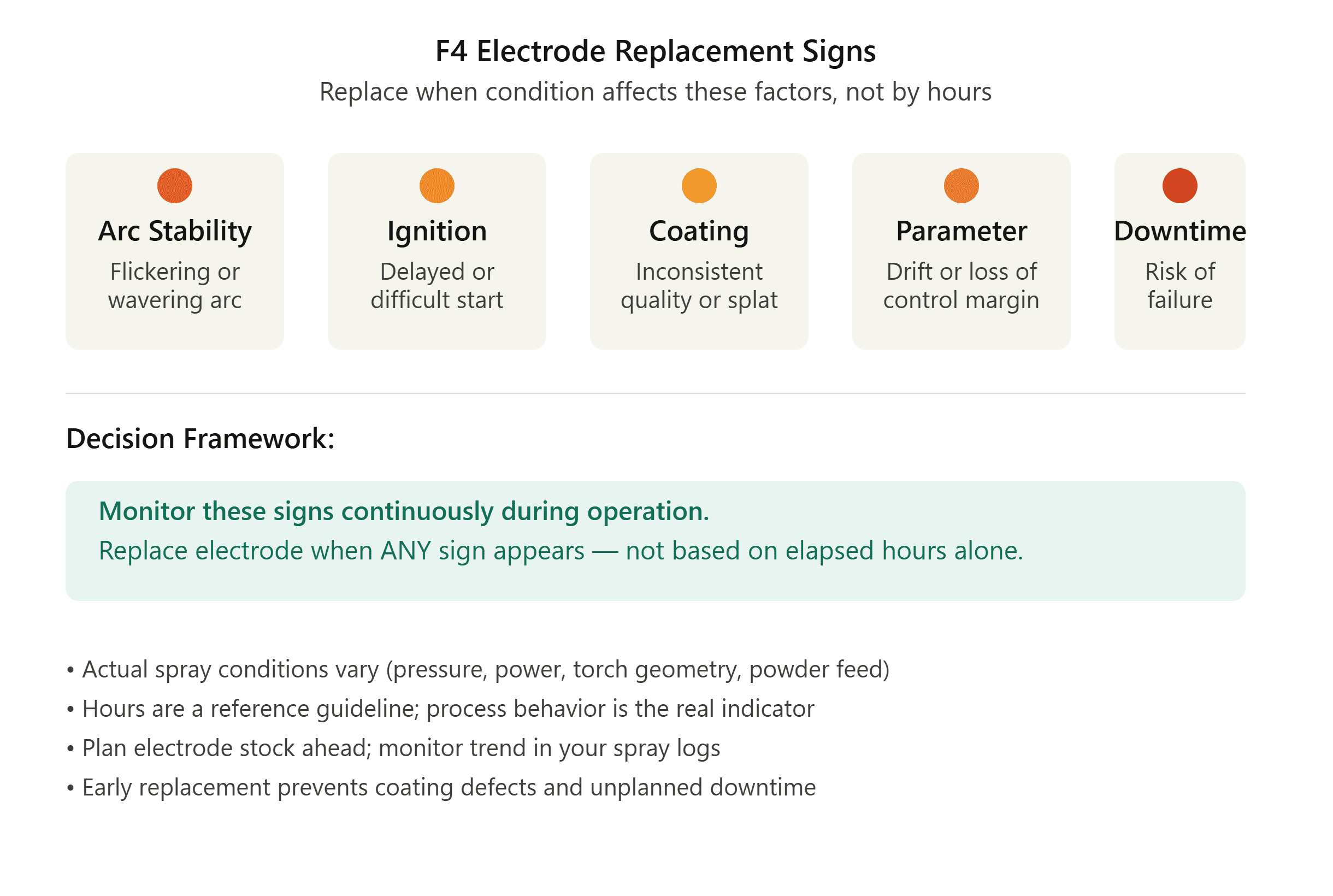
I have seen many teams ask for one simple number. I understand why they ask. A fixed interval looks clean on a maintenance sheet. It also feels safe during planning. In real production, the better question is different. I ask when the electrode starts to create risk. That risk may appear before total failure. It may appear as voltage drift. It may appear as unstable ignition. It may appear as coating variation that the operator has to chase during the shift. When I look at F4 electrodes from a consumable manufacturing and customer support point of view, I try to connect the part condition with the process result. That is where the replacement decision becomes more useful.
Why There Is No Universal Replacement Interval for F4 Electrodes?
If I use only hours, I may replace a good electrode too early, or I may keep a weak one in production too long.
I use operating hours as a starting reference only. Actual F4 electrode life depends on spray power, plasma gas, cooling condition, gun condition, powder type, job cycle, and continuous running time2. I need to judge the electrode together with process behavior.
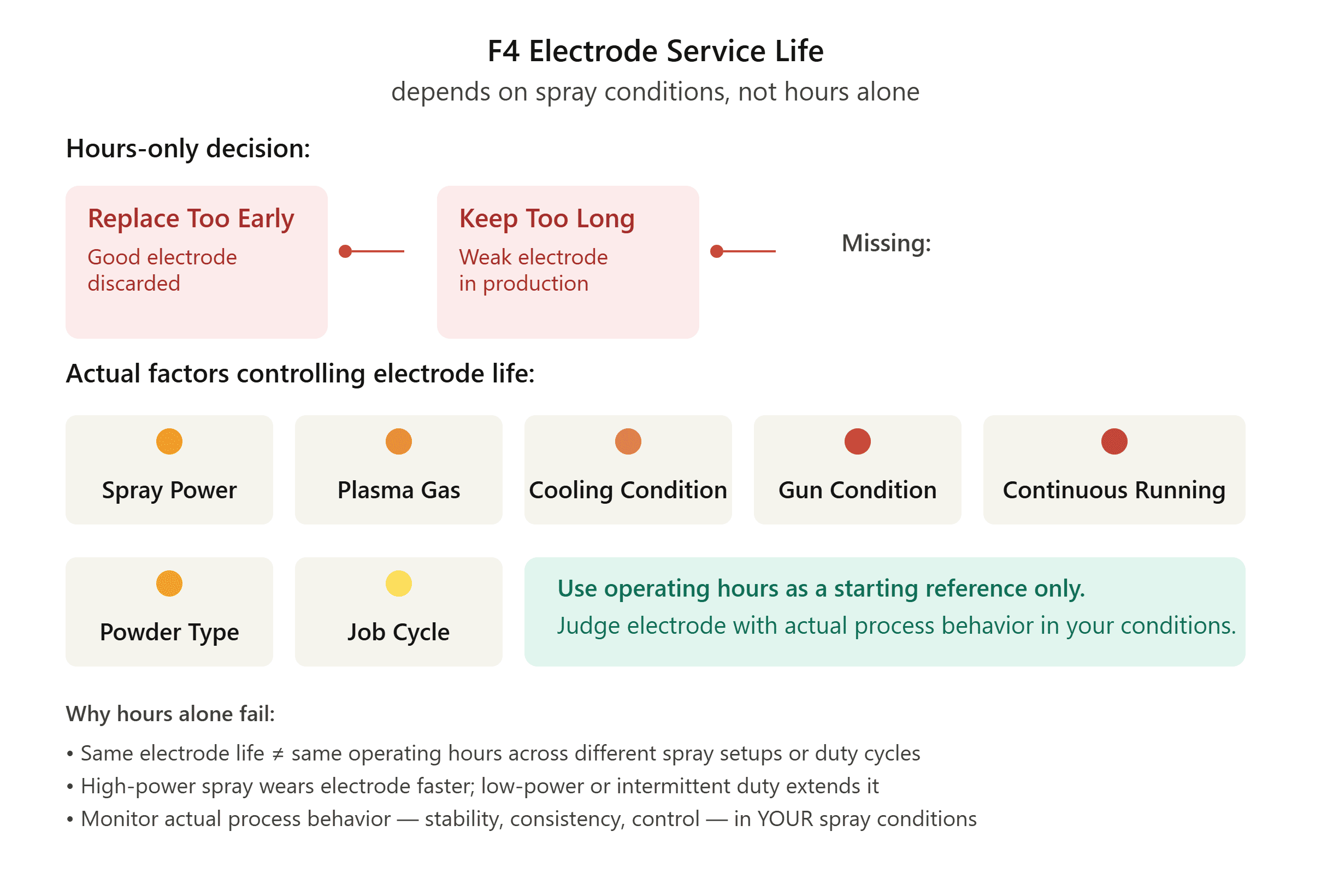
I treat hours as a guide, not as the final rule
From my side as a consumable manufacturer, I often hear customers ask whether an F4 electrode should be changed after a certain number of hours. I can give a typical range only as a rough reference. I cannot give one number that fits every shop. One customer may run high current for long batches. Another customer may run shorter cycles with lower load. These two electrodes do not live the same life.
I also look at the full system. The electrode is one part of a hot and fast process. The cooling path, nozzle condition, gas flow, powder loading, cable condition, and gun alignment all affect the arc. If one of these items changes, the electrode may wear faster or behave differently.
| Factor I check | Why it matters for replacement timing |
|---|---|
| Current and voltage load | Higher load can speed up tip wear and arc stress3 |
| Plasma gas and flow | Gas choice and flow can change arc shape and heat load4 |
| Cooling condition | Weak cooling can make wear less predictable5 |
| Continuous spray time | Long runs can build more thermal stress6 |
| Powder and coating task | Some jobs push the arc harder than others |
| Gun and nozzle condition | A worn surrounding part can make a good electrode perform badly |
I also remind customers that the electrode is not judged alone. I prefer to compare the electrode hours with voltage trend, ignition behavior, coating result, and operator adjustment history. This gives a clearer picture than hours alone.
Signs That an F4 Electrode Should Be Replaced?
If the arc becomes unstable, the electrode may already be telling me that the safe production window is getting smaller.
Common replacement signs include unstable arc behavior, harder ignition, visible tip erosion, abnormal wear, coating fluctuation, and repeated parameter adjustment7. I pay close attention when the operator must keep changing current, voltage, gas, or other settings to maintain the same spray result.
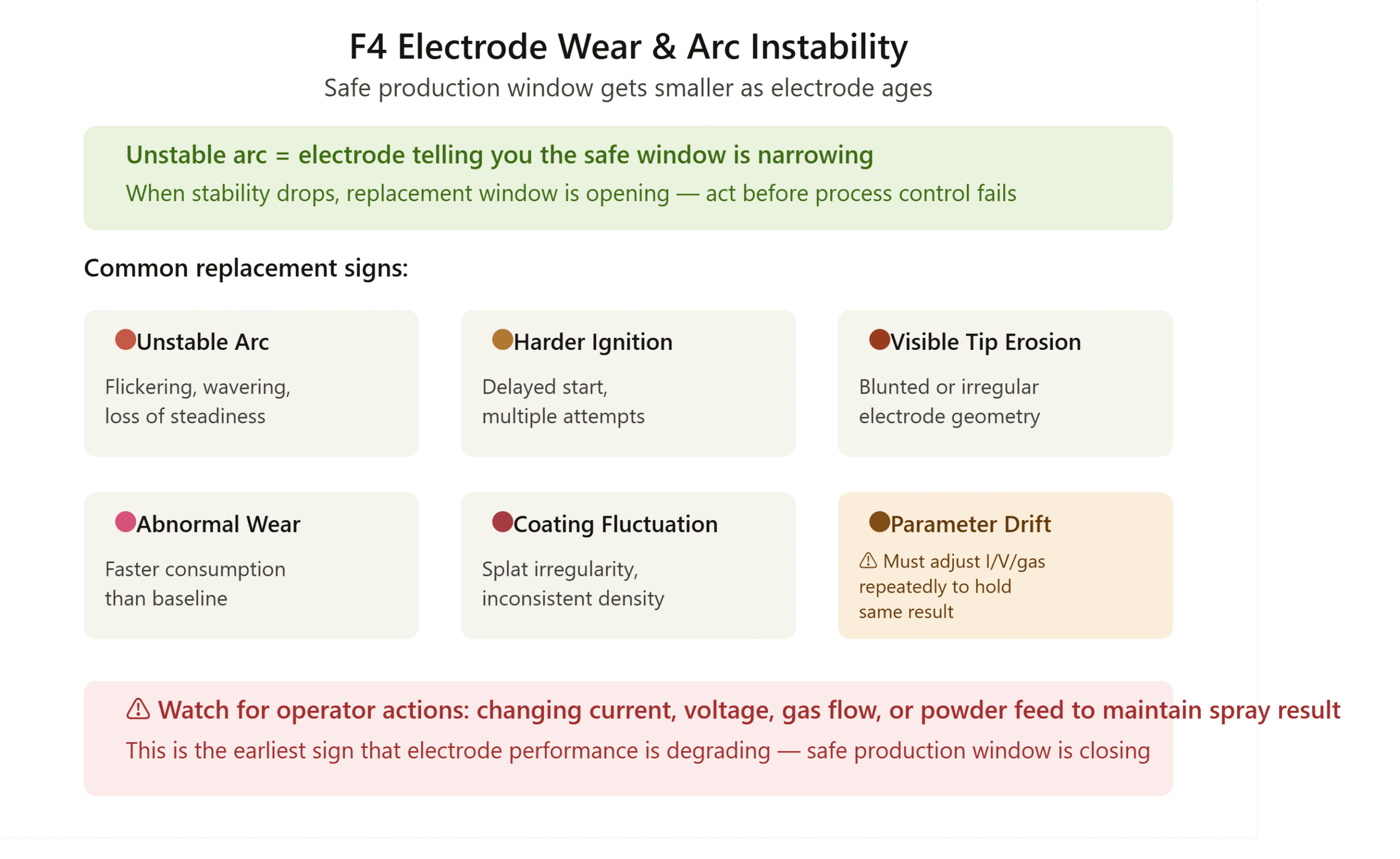
I look for process signals before I wait for failure
I do not wait for an electrode to completely fail before I take action. In many cases, the electrode gives small warnings first. The arc may start normally on Monday, then become harder to ignite after several production cycles. The voltage may drift more than usual8. The sound of the torch may change. The coating may still be acceptable, but the operator may need more correction during the shift.
I also inspect the electrode tip when maintenance is possible. Visible erosion is important, but it is not the only sign. I check whether the wear pattern looks normal. I look for deformation, burning, uneven loss, and signs that the arc may not have been centered or stable.
| Sign I notice | What it may mean |
|---|---|
| Harder ignition | The electrode surface or geometry may no longer support stable starting |
| Voltage drift | The arc condition may be changing during operation |
| Unstable arc sound | The plasma may be less steady than before |
| Tip erosion or deformation | The working shape may have moved outside the useful range |
| Coating thickness variation | The spray plume may be shifting or losing consistency |
| More operator adjustment | The electrode may still work, but it may no longer be stable |
I always connect these signs with recent work history. If the same job, same powder, same parameters, and same gun setup suddenly need more correction, I take the electrode condition seriously. This does not mean the electrode is always the only cause. It means I should not ignore it.
When an Electrode Still Works but Is Already Affecting Production?
An F4 electrode can still start the arc, but it may already be costing me coating stability and production time.
I separate “able to ignite” from “suitable for production.” If the electrode forces more parameter correction, causes coating drift, increases inspection concern, or raises downtime risk, I consider replacement even when it can still run.
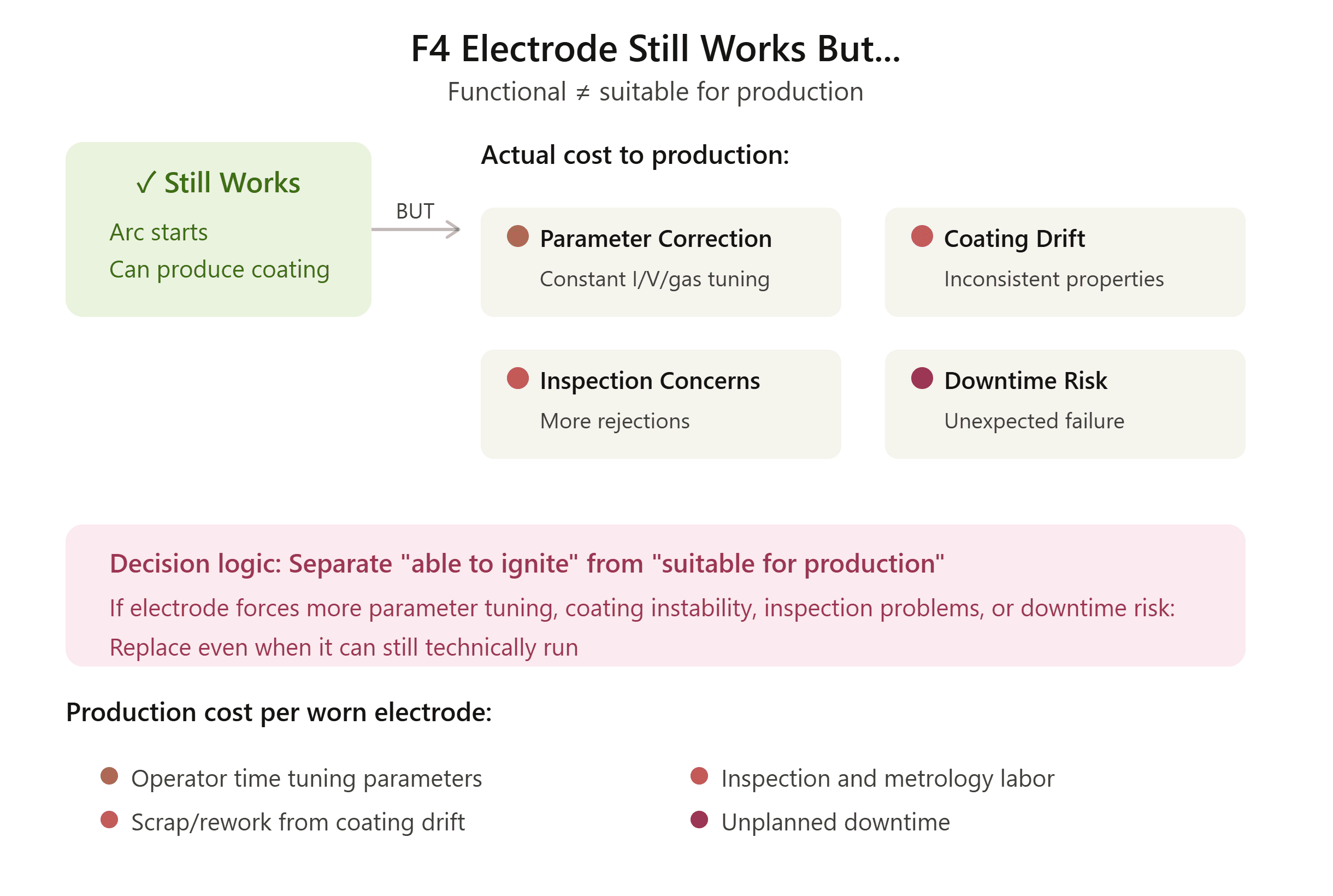
I pay attention to the gray zone
The most difficult decision is not a dead electrode. A dead electrode is easy to replace. The difficult decision is the gray zone. The electrode still ignites. The operator can still spray. The part may still pass at first glance. But the process is no longer calm. I have heard this story many times in customer discussions. The team says the electrode still works, yet they need to adjust parameters more often. They also see more coating variation near the end of a batch.
This gray zone matters because thermal spray production depends on repeatability9. If the operator has to chase the process, the real cost is not only the electrode price. The cost may include rework, extra inspection, lost shift time, delayed delivery, and risk to customer trust.
| Production symptom | Why I treat it as a warning |
|---|---|
| More frequent parameter changes | The process window may be narrowing |
| More coating checks needed | The team may no longer trust the same setup |
| Small shifts in spray result | The arc or plume may be changing |
| Longer setup time | The worn electrode may slow the production rhythm |
| Higher operator stress | The process may depend too much on manual correction |
| Risk of mid-batch stoppage | The electrode may fail at a more expensive time |
I often suggest that teams define an internal limit. For example, they can record normal voltage behavior for a stable electrode. They can also record how often the operator needs to adjust during a standard job. When the current electrode moves outside that normal pattern, the team has a better reason to replace it. This method is practical because it uses the customer’s own process as the reference.
How Consumable Quality Influences Electrode Service Life?
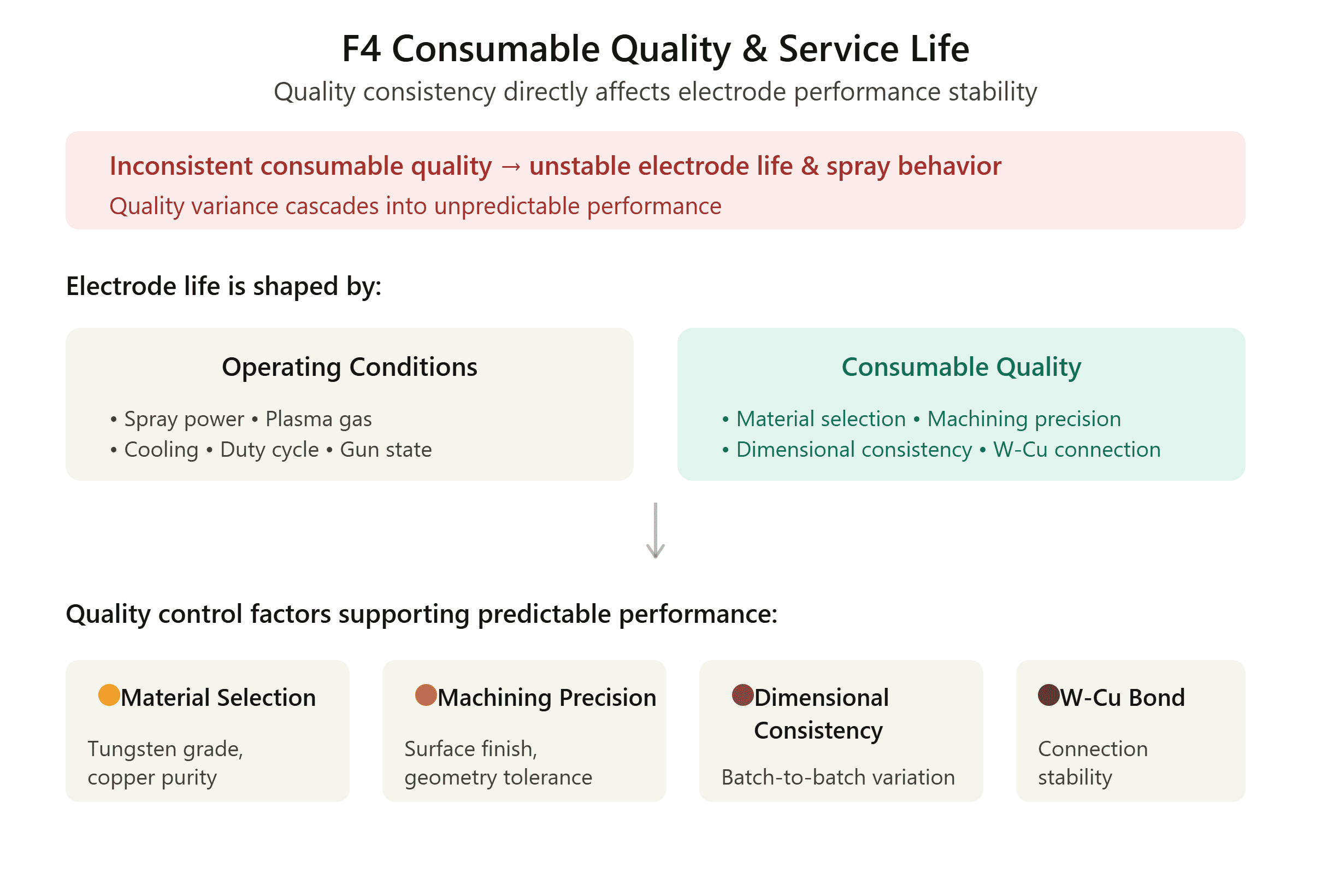
If consumable quality is inconsistent, I cannot expect the electrode to give stable life or stable spray behavior.
Electrode life is affected by operating conditions and consumable quality. Material selection, machining precision, dimensional consistency, and tungsten-copper connection stability can help support more predictable performance10, but they cannot guarantee one fixed lifetime for every spray condition.
I focus on consistency before I talk about life
From a manufacturing point of view, I believe predictable performance starts before the electrode reaches the customer. The material must be suitable. The geometry must be consistent. The surface finish and key dimensions must stay within a tight range. The tungsten-copper connection must be stable because this area affects heat and electrical behavior. If the connection is weak or inconsistent, the electrode may show uneven performance under load.
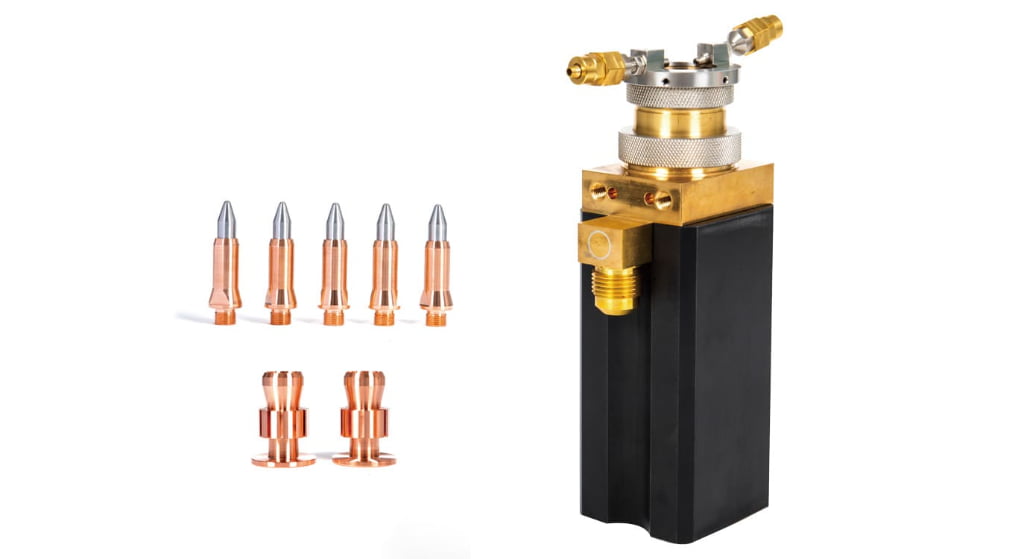
In my work with ARCTHERM consumables, I pay close attention to precision machining and connection quality. We use high-precision CNC processes for critical parts, and we control key dimensions closely. For plasma spray cathodes and anodes, small changes can matter. A small geometry change may affect arc position11. A surface or connection issue may affect heat transfer. These details may not create a dramatic failure on the first start, but they can reduce repeatability over time.
| Quality area I control | How it can affect electrode behavior |
|---|---|
| Material selection | It affects emission behavior and wear stability |
| Machining accuracy | It affects fit, arc position, and repeatability |
| Tip geometry | It affects how the arc starts and sits |
| Dimensional consistency | It reduces variation between batches |
| Tungsten-copper connection | It affects electrical and thermal stability |
| Inspection before shipment | It reduces avoidable variation in the field |
I do not say that a better electrode gives one fixed lifetime in every shop. That would not be honest. I say that better manufacturing control helps make the electrode more predictable12. This matters for maintenance teams because predictable wear is easier to plan. It also matters for process teams because stable consumables reduce one source of variation.
Conclusion
I replace F4 electrodes by process condition, not by hours alone. I watch arc stability, coating consistency, adjustment frequency, visible wear, and consumable quality.
"[PDF] A Perspective on Plasma Spray Technology - Columbia University", http://www.columbia.edu/cu/seas/earth/wtert/newwtert/Research/sofos/Plasma_%20spraying_Nov2014.pdf. Research demonstrates that electrode wear progressively affects arc stability and coating uniformity before complete failure occurs. Evidence role: mechanism; source type: research. Supports: Worn electrodes can continue functioning while degrading process quality. Scope note: Studies may focus on specific electrode materials or operating conditions ↩
"[PDF] A Perspective on Plasma Spray Technology - Columbia University", http://www.columbia.edu/cu/seas/earth/wtert/newwtert/Research/sofos/Plasma_%20spraying_Nov2014.pdf. Technical studies confirm that electrode wear rates vary significantly based on operating power, gas composition, thermal management, and material interactions. Evidence role: general_support; source type: paper. Supports: Multiple operational parameters influence electrode service life. Scope note: Research may not cover all electrode types or operating parameter combinations ↩
"Determining Material Removal and Electrode Wear in Electric ... - PMC", https://pmc.ncbi.nlm.nih.gov/articles/PMC12842793/. Materials research shows that higher current densities increase thermal and electrical stress on electrode surfaces, accelerating wear mechanisms. Evidence role: mechanism; source type: research. Supports: Increased electrical load accelerates electrode degradation. Scope note: Wear rates depend on specific electrode materials and cooling effectiveness ↩
"Numerical Analysis of Physical Characteristics and Heat Transfer ...", https://pmc.ncbi.nlm.nih.gov/articles/PMC9104753/. Plasma physics research demonstrates that gas composition and flow rates directly affect arc constriction, temperature distribution, and heat transfer to electrodes. Evidence role: mechanism; source type: paper. Supports: Gas parameters influence arc shape and thermal distribution. Scope note: Effects vary with specific gas mixtures and torch designs ↩
"Effect of geometric parameters of electrodes on skin heating for the ...", https://pmc.ncbi.nlm.nih.gov/articles/PMC10560826/. Engineering studies show that inadequate thermal management leads to non-uniform temperature distributions, causing irregular wear patterns and reduced service life predictability. Evidence role: mechanism; source type: research. Supports: Cooling system performance affects electrode wear consistency. Scope note: Cooling effects depend on specific torch design and operating conditions ↩
"Mitigation of excessive fatigue associated with functional electrical ...", https://pmc.ncbi.nlm.nih.gov/articles/PMC6370345/. Materials science research indicates that prolonged high-temperature exposure causes thermal stress accumulation and microstructural changes in electrode materials. Evidence role: mechanism; source type: paper. Supports: Extended operation increases cumulative thermal stress. Scope note: Stress effects vary with electrode material composition and thermal cycling patterns ↩
"Criteria for the selection of materials for implanted electrodes", https://pubmed.ncbi.nlm.nih.gov/12971619/. Industry maintenance standards identify arc instability, ignition difficulties, and coating variations as primary indicators for electrode replacement timing. Evidence role: expert_consensus; source type: institution. Supports: Multiple indicators signal electrode replacement needs. Scope note: Indicator significance may vary with specific equipment and application requirements ↩
"[PDF] Section 6.0: Plasma Arc Stability - VTechWorks", https://vtechworks.lib.vt.edu/server/api/core/bitstreams/3bf440a4-cfd2-4fea-a33f-9df09aff98fa/content. Electrical engineering research shows that electrode surface changes alter arc attachment characteristics, leading to increased voltage fluctuations and reduced stability. Evidence role: mechanism; source type: paper. Supports: Electrode degradation affects electrical stability. Scope note: Voltage behavior depends on power supply characteristics and arc length control systems ↩
"Thermal spraying - Wikipedia", https://en.wikipedia.org/wiki/Thermal_spraying. Industry standards emphasize that consistent process parameters and equipment condition are critical for achieving repeatable coating properties and meeting quality specifications. Evidence role: expert_consensus; source type: institution. Supports: Process repeatability is essential for thermal spray quality. Scope note: Repeatability requirements vary with specific coating applications and quality standards ↩
"Effect of electrode manufacturing defects on electrochemical ...", https://impact.ornl.gov/en/publications/effect-of-electrode-manufacturing-defects-on-electrochemical-perf/. Materials engineering research confirms that electrode material properties, dimensional accuracy, and joint integrity significantly affect operational stability and service life predictability. Evidence role: general_support; source type: research. Supports: Manufacturing quality factors influence electrode performance consistency. Scope note: Performance benefits depend on specific operating conditions and application requirements ↩
"Double-Electrode Arc Welding Process - UKnowledge", https://uknowledge.uky.edu/cgi/viewcontent.cgi?article=1000&context=ece_facpub. Plasma physics research demonstrates that electrode surface geometry and tip configuration directly affect arc attachment points and stability characteristics. Evidence role: mechanism; source type: paper. Supports: Electrode geometry influences arc attachment and positioning. Scope note: Geometry effects vary with arc current, gas composition, and torch design parameters ↩
"High Performance Electrode Manufacturing Method", https://www.wpi.edu/offices/technology-commercialization/catalog/high-performance-electrode-manufacturing-method. Quality engineering principles demonstrate that tighter manufacturing controls reduce product variation and improve performance predictability across production batches. Evidence role: general_support; source type: institution. Supports: Manufacturing quality control improves product consistency. Scope note: Predictability improvements depend on specific control methods and measurement capabilities ↩