I often see teams chase powder and parameters first. That feels logical. But coating density problems can stay because the gun condition is quietly changing the process.
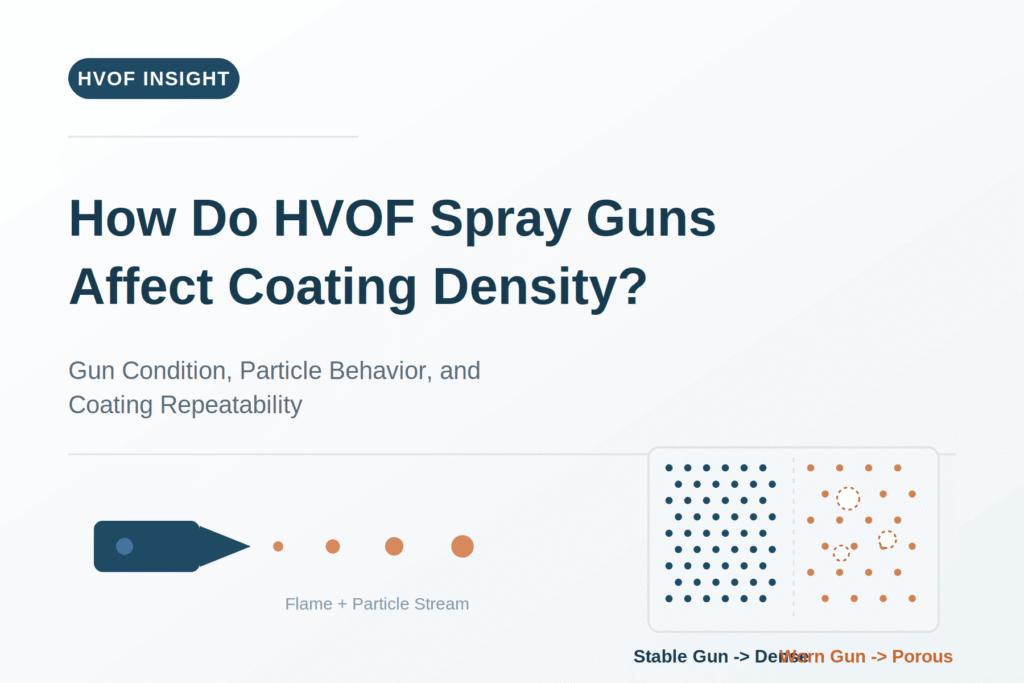
HVOF spray guns can affect coating density by changing flame stability, particle heating, particle speed, and repeatability.1 The gun does not control density alone, but worn barrels, unstable combustion chambers, poor bore quality, or inconsistent replacement parts can make dense coatings harder to repeat.2
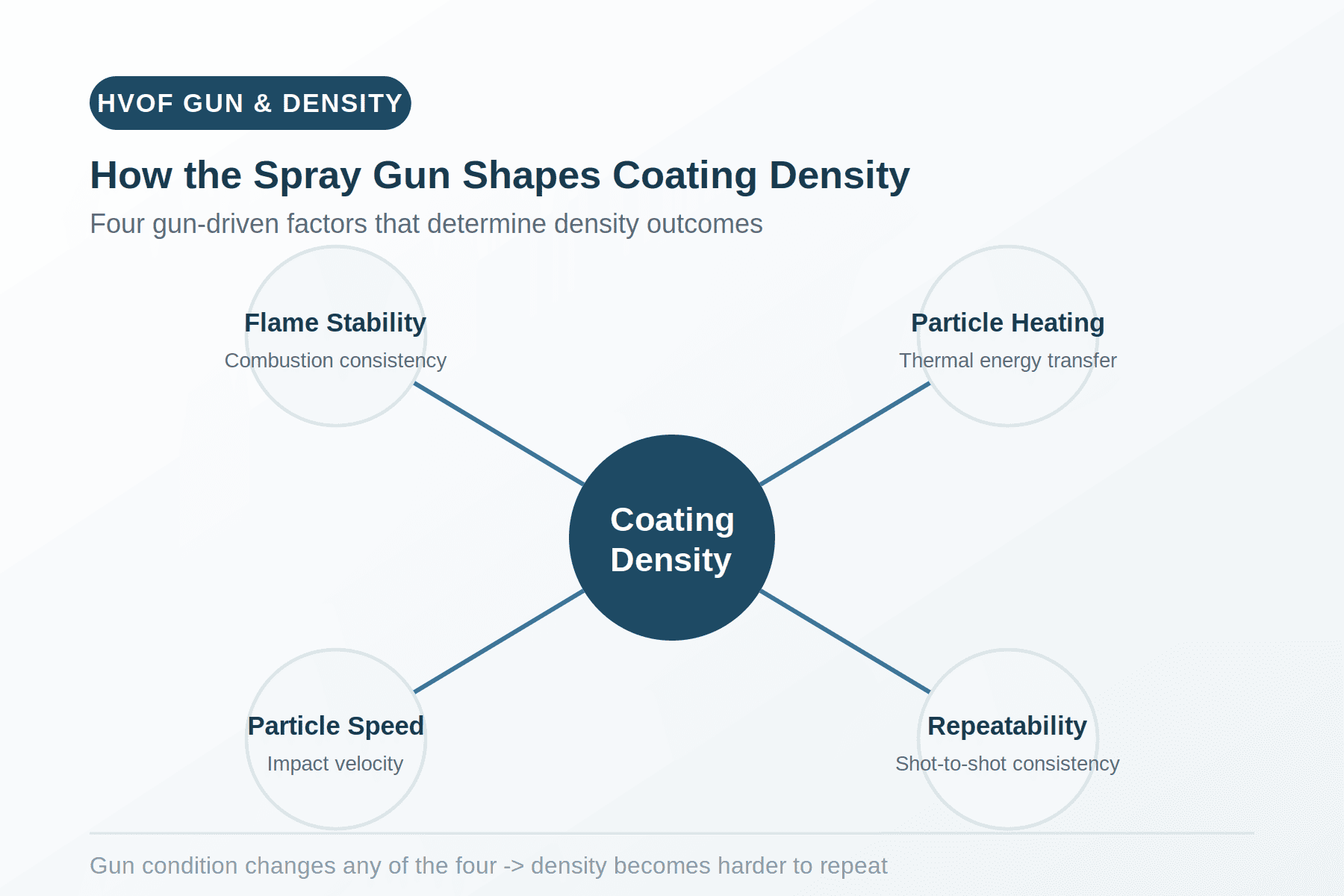
I have learned that coating density is rarely a one-part story.3 I look at powder, oxygen, fuel, carrier gas, stand-off distance, robot path, and surface preparation. I also look at the gun itself. In manufacturing and inspection practice, I have seen that small changes in barrels, combustion chambers, bore finish, and part geometry can make a stable process harder to hold. That is why I treat the HVOF gun as part of the coating system, not just a holder for consumables.
Why Is Coating Density a Process Outcome, Not a Single Variable?
I see many density problems become slow because the team wants one fast answer. That answer may not exist. The process can hide several small causes.
Coating density is the result of powder behavior, spray parameters, part preparation, and gun stability working together.4 I check the HVOF gun alongside powder and settings because gun wear or geometry changes can narrow the process window.
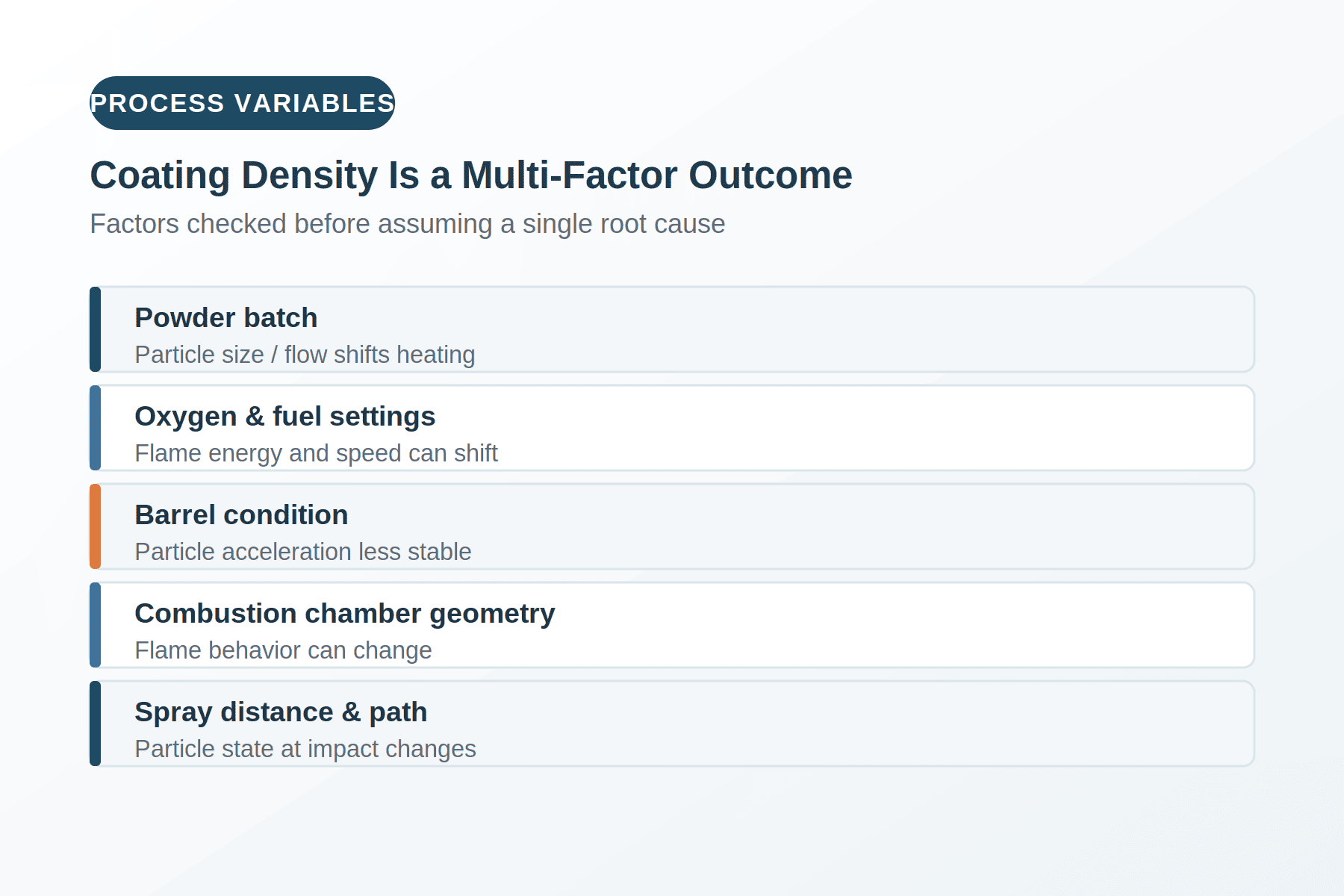
I do not treat density as a number created by one control knob. I treat it as a result created by many physical events. The powder must heat enough. The particles must move fast enough.5 The flame must stay stable. The spray pattern must remain repeatable. The part must be prepared in the right way. The gun must also hold its own geometry during operation.
In my work with HVOF spray guns and consumables, I often see a simple mistake. A shop changes only one part, then density changes, and the team blames powder first. Powder should be checked. Parameters should be checked. But I also ask what changed inside the gun path.
| Factor I check | How it can affect density risk | What I avoid assuming |
|---|---|---|
| Powder batch | Particle size and flow can change heating | I do not assume powder is always the cause |
| Oxygen and fuel settings | Flame energy and speed can shift | I do not use one recipe for all cases |
| Barrel condition | Particle acceleration can become less stable | I do not assume a barrel is good because it fits |
| Combustion chamber geometry | Flame behavior can change | I do not ignore small dimensional changes |
| Spray distance and path | Particle state at impact can change | I do not blame the gun without checking motion |
I prefer this kind of diagnosis because it saves time. It also avoids a false repair. A dense HVOF coating needs a wide enough and stable enough process window.6 A worn or inconsistent gun component may not create porosity by itself. But it can make the process more sensitive. Then a small powder change or parameter drift becomes a real coating rejection.
How Do HVOF Spray Gun Components Influence Process Stability?
I have seen stable jobs become unstable after small hardware changes. The gun still runs. The flame still looks present. But the coating result moves.
HVOF gun components influence process stability through combustion chamber geometry, barrel bore quality, roundness, wear, and dimensional consistency.7 These features can affect gas flow, flame shape, particle heating, and particle acceleration.
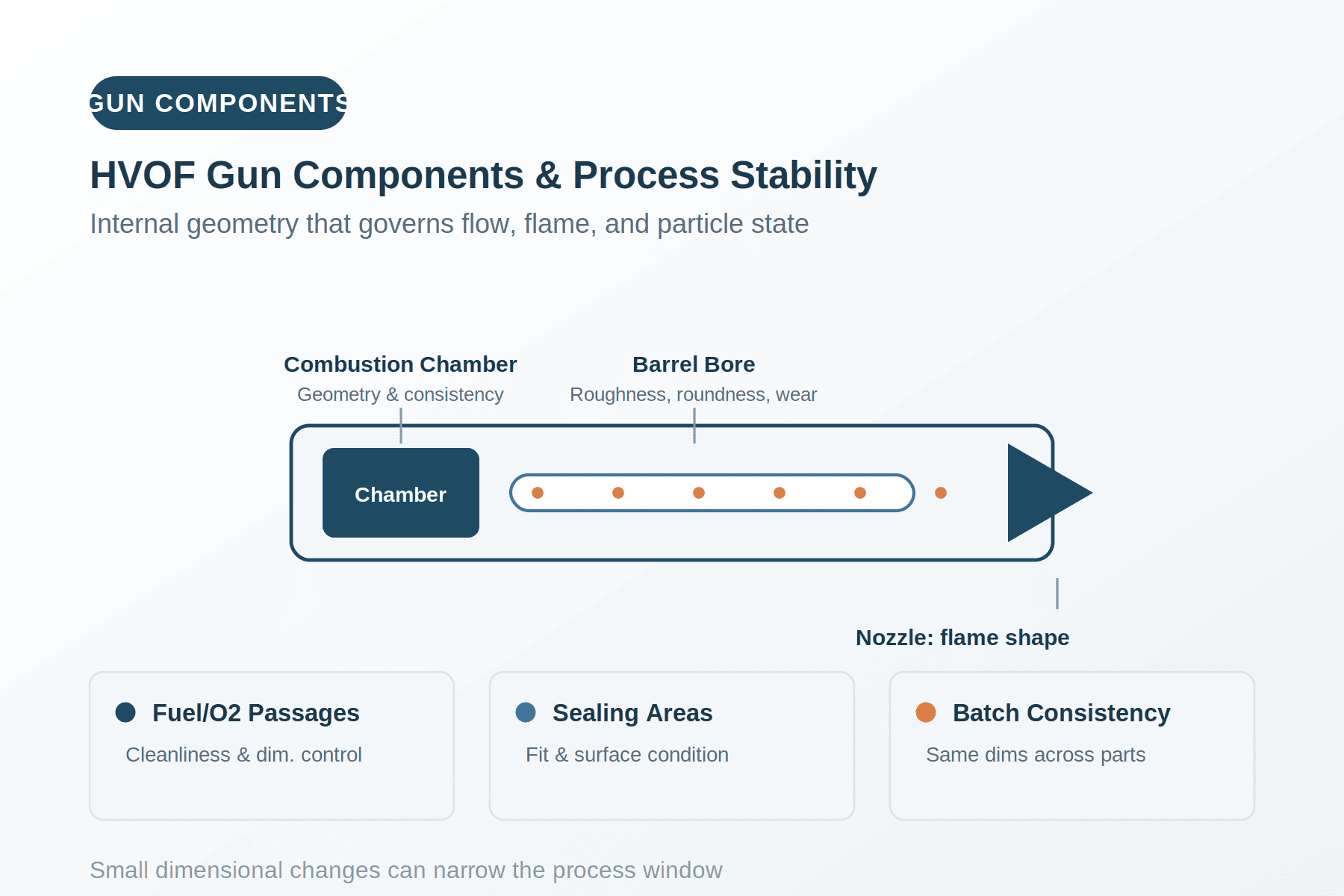
I look at an HVOF spray gun as a set of physical variables. I do not see it only as a model name. Two guns can share the same basic design. Two barrels can fit the same assembly. But they may not behave the same if the bore finish, inner geometry, and machining consistency are different.
In manufacturing and inspection practice, I pay special attention to bore roughness, roundness, and key dimensions. The inside surface is important because gas and particles do not move through a drawing. They move through a real hole with real surface marks, real wear, and real shape errors. A rougher or less consistent bore may disturb flow.8 A worn barrel may change the way particles accelerate.9 A combustion chamber with unstable geometry may affect flame behavior.
| Component area | What I look at | Why I care about density |
|---|---|---|
| Combustion chamber | Geometry and consistency | It can affect flame stability and heat delivery |
| Gun barrel bore | Roughness, roundness, and wear | It can affect flow and particle acceleration |
| Fuel and oxygen passages | Cleanliness and dimensional control | They can affect combustion balance |
| Sealing areas | Fit and surface condition | They can affect stable operation |
| Batch consistency | Same dimensions across parts | It can support repeatable coating results |
I also watch the difference between a visible problem and a functional problem. A part may look clean from the outside. It may install smoothly. The operator may not hear anything unusual. But the coating can still show higher porosity or less consistent microstructure. That is why I support visual checks with measured inspection. For critical HVOF barrels and combustion chambers, I believe bore quality and geometry control matter because they support stable operation before the spray job begins.
I do not claim that one barrel surface value creates one porosity value. That would be too simple. I only say that component stability can reduce risk. It can keep the process window from becoming too narrow. That is the practical point I care about.
Why Are Compatible Parts Not Always Functionally Equivalent?
I have heard the phrase “it is compatible” many times. I always ask one more question. I ask if it is also repeatable in real spraying.
A compatible HVOF part may fit the gun but still behave differently.10 Functional equivalence depends on machining quality, bore finish, geometry, materials, inspection standards, and batch consistency, not only external fit.11
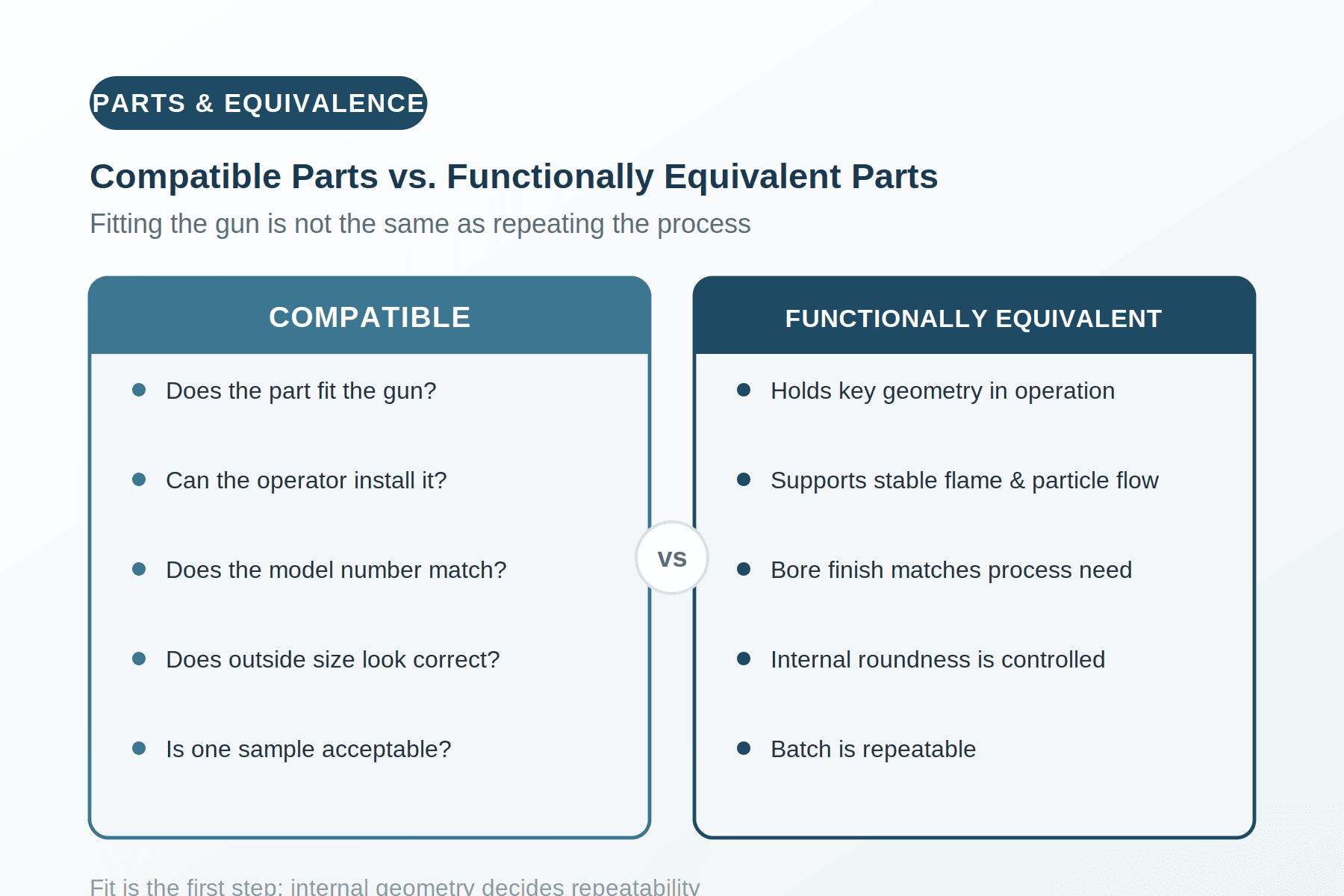
I respect compatibility because it matters. A part must fit. It must connect. It must be safe to assemble. But fit is only the first step. In HVOF spraying, the inside geometry often matters more than the outside shape that the operator can see. I have seen customers assume that a part is equivalent because the model number matches. That assumption can create long troubleshooting work when coating density changes after replacement.
Functional equivalence asks a deeper question. It asks whether the part can support the same flame behavior and particle stream under working conditions. That question brings machining quality into the discussion. It also brings inspection discipline into the discussion.
| “Compatible” question | “Functionally equivalent” question |
|---|---|
| Does the part fit the gun? | Does the part hold key geometry in operation? |
| Can the operator install it? | Does it support stable flame and particle flow? |
| Does the model number match? | Does the bore finish match the process need? |
| Does the outside size look correct? | Are internal roundness and dimensions controlled? |
| Is one sample acceptable? | Is the batch repeatable? |
I manufacture and inspect HVOF-related parts, so I look at this issue from the production side. I know that a drawing is not the same as a stable manufacturing process. A drawing can show a diameter. It may not show the full risk from roughness, tool marks, roundness, or batch drift. A shop may receive parts that fit well, but the coating result may still change because the internal path changed.
This is one reason I do not like the cheapest-part-only decision. I understand cost pressure. Every coating shop has it. But a rejected coating, a delayed order, or a long rework cycle also has cost. When I choose or produce replacement parts, I care about the hidden cost of unstable repeatability. I want the operator to change a consumable and keep spraying with confidence, not restart the whole process study.
What Should I Check When Density Problems Appear After Component Replacement?
I know the pressure when a coating fails after a part change. The team wants to spray again fast. But fast guessing often wastes more time.
When density problems appear after HVOF component replacement, I check the changed part, installation, wear pattern, bore condition, combustion stability, powder batch, and spray parameters together. I compare the new result with the last stable setup.
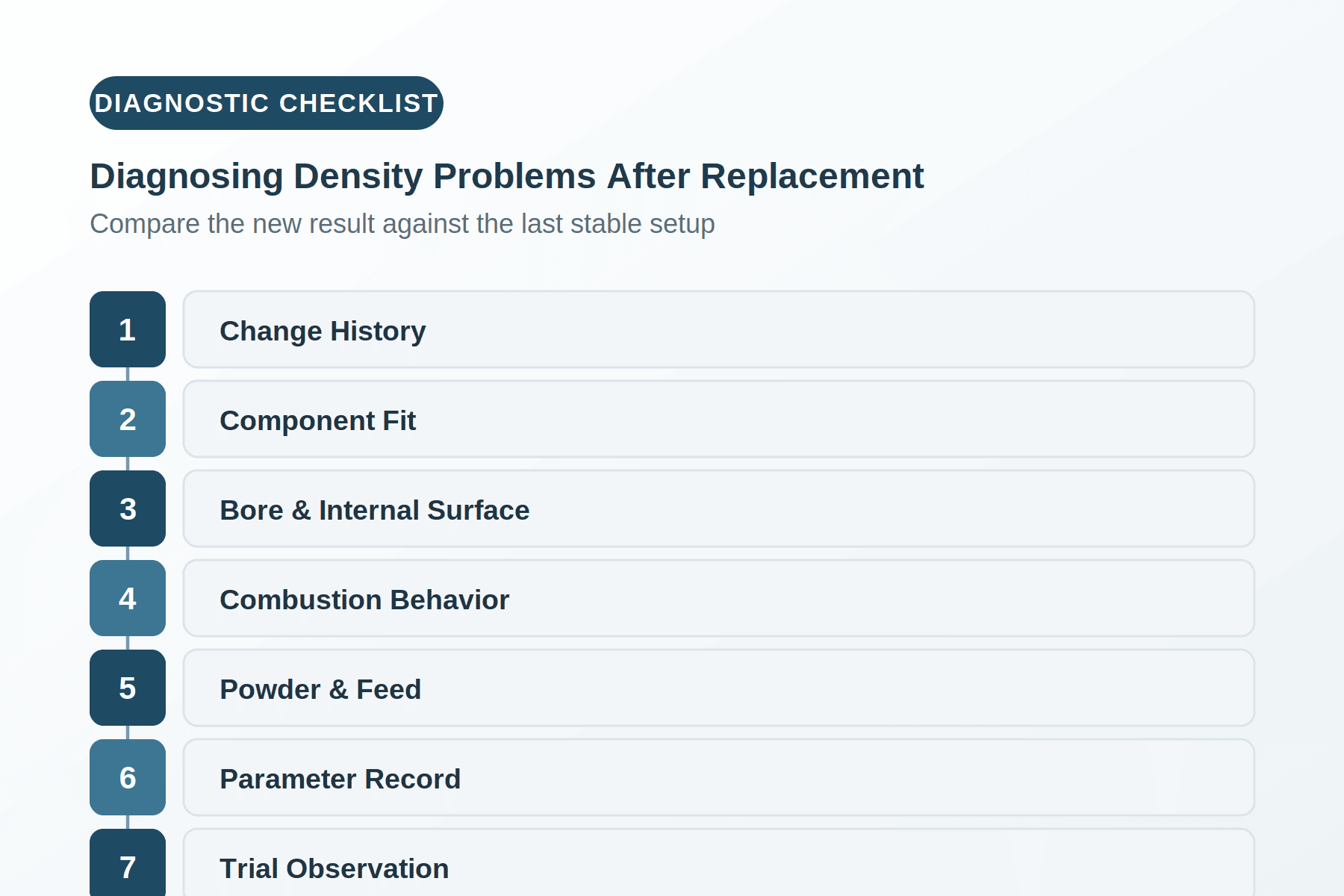
I start with a simple timeline. I ask what changed before the density problem appeared. If the answer includes a new barrel, combustion chamber, nozzle, or other gun part, I do not blame that part at once. I also do not ignore it. I place it on the same checklist as powder, parameters, and operating practice.
A useful check is to compare the new component with the last stable component. I look at wear marks, bore condition, fit, sealing surface, and any measured dimensions that are available. I also ask whether the operator changed fuel, oxygen, powder feed, stand-off distance, robot speed, or spray angle at the same time. The goal is not to protect a supplier or blame a supplier. The goal is to rebuild the stable condition.
| Check step | What I ask | Why it matters |
|---|---|---|
| Change history | What changed just before the problem? | It gives the first direction |
| Component fit | Did the new part install normally? | Poor fit can create unstable operation |
| Bore and internal surface | Is the bore clean, round, and smooth enough? | Flow and acceleration may change |
| Combustion behavior | Does the flame stay stable during spraying? | Flame instability can affect particle state |
| Powder and feed | Did the batch or feed rate change? | Powder still matters in density diagnosis |
| Parameter record | Are settings the same as the last accepted job? | Small setting changes can combine with hardware change |
| Trial observation | Does the spray pattern look repeatable? | It helps connect hardware to process behavior |
I also pay attention to repeated problems after each replacement. If density is good near the start of a component life, then becomes worse too early, I think about wear rate, material selection, cooling condition, and operating stress. If density changes immediately after installing a new part, I think more about dimensional difference, bore finish, or wrong part selection. These two cases are not the same.
In our own manufacturing practice, I place weight on precision machining and inspection because these checks reduce avoidable variables. For example, I care about stable inner bore quality for HVOF barrels and stable geometry for combustion chambers. I also care about consistent batches. These points do not replace coating tests. They support a more stable process before the coating test starts.
I recommend that shops keep one known-good component when possible.12 I also recommend that they record the component batch, spray hours, powder batch, and basic parameters for accepted coatings. This record gives the team a baseline. Without a baseline, every density problem becomes a debate. With a baseline, the team can compare one change at a time.
Conclusion
I treat HVOF coating density as a system result. The gun is not the only cause, but its components can strongly affect repeatability.
"Warm spraying—a novel coating process based on high-velocity ...", https://pmc.ncbi.nlm.nih.gov/articles/PMC5099653/. Studies of HVOF thermal spraying report that particle temperature and velocity, which are governed by combustion and gun-flow conditions, influence splat formation and coating porosity; this supports the mechanism by which gun behavior can affect density. Evidence role: mechanism; source type: paper. Supports: The source should show that HVOF particle temperature, velocity, and combustion conditions influence coating microstructure, including porosity or density.. Scope note: The source may support the physical mechanism generally rather than proving that every gun defect produces a measurable density change. ↩
"[PDF] Microstructure and Properties of HVOF-Sprayed Protective Coatings", https://inldigitallibrary.inl.gov/sites/sti/sti/4045032.pdf. Thermal-spray research indicates that HVOF gun geometry and component condition can alter gas dynamics and particle acceleration, providing a basis for treating worn or inconsistent gun parts as contributors to repeatability problems. Evidence role: general_support; source type: paper. Supports: The source should connect HVOF gun hardware condition or nozzle geometry with changes in particle behavior, coating quality, or process repeatability.. Scope note: The evidence is likely contextual unless it tests the exact barrel, chamber, or replacement-part designs discussed in the article. ↩
"An Influence of Oxygen Flow Rate and Spray Distance on the ... - PMC", https://pmc.ncbi.nlm.nih.gov/articles/PMC9505576/. Reviews of HVOF coating formation describe coating porosity as the outcome of interacting powder, gas-flow, spray-distance, and particle-state variables, supporting the view that density is not controlled by a single component or setting. Evidence role: expert_consensus; source type: paper. Supports: The source should show that HVOF coating porosity or density depends on interacting variables such as powder characteristics, gas flows, spray distance, and particle state.. ↩
"An Influence of Oxygen Flow Rate and Spray Distance on the ...", https://pmc.ncbi.nlm.nih.gov/articles/PMC9505576/. HVOF coating studies identify powder characteristics, spray parameters, substrate preparation, and equipment-related stability as contributors to coating microstructure and porosity, supporting a systems-level interpretation of coating density. Evidence role: expert_consensus; source type: paper. Supports: The source should support that powder characteristics, spray parameters, surface preparation, and equipment stability influence HVOF coating microstructure and density.. Scope note: A single source may discuss these factors collectively without quantifying the relative contribution of each factor in a given production case. ↩
"Prediction of In-Flight Particle Properties and Mechanical ... - PMC", https://pmc.ncbi.nlm.nih.gov/articles/PMC10532925/. Experimental and modeling studies of HVOF spraying show that in-flight particle temperature and velocity govern particle deformation on impact and are associated with coating porosity and density. Evidence role: mechanism; source type: paper. Supports: The source should show that particle temperature and velocity affect impact deformation and the resulting porosity or density of HVOF coatings.. ↩
"Thermal spraying - Wikipedia", https://en.wikipedia.org/wiki/Thermal_spraying. HVOF parameter-optimization studies describe acceptable coating porosity as occurring within controlled ranges of fuel, oxygen, feed, and spray-distance conditions, supporting the use of a stable process-window concept for dense coatings. Evidence role: general_support; source type: paper. Supports: The source should support that dense HVOF coatings are obtained within optimized ranges of process parameters and that parameter variation can affect porosity.. Scope note: The source may define the process window for a specific material system rather than for all HVOF coatings. ↩
"[PDF] Design and Development of a High Velocity Oxy-Fuel Thermal ...", https://scholarworks.utep.edu/cgi/viewcontent.cgi?article=2209&context=open_etd. Research on HVOF gun and nozzle design shows that internal geometry affects gas expansion, particle acceleration, and heat transfer, supporting the claim that component geometry and dimensional consistency can influence process stability. Evidence role: mechanism; source type: paper. Supports: The source should show that HVOF gun and nozzle geometry influence gas flow, particle acceleration, and process behavior.. Scope note: Evidence may address designed geometry changes rather than manufacturing deviations such as roundness error or batch-to-batch dimensional drift. ↩
"Laminar and Turbulent Flow in Wavy Pipes under Strong ... - arXiv", https://arxiv.org/html/2511.17458v1. Fluid-mechanics references show that internal surface roughness influences friction factor, pressure loss, and turbulent-flow behavior, providing a physical basis for concern that bore roughness can disturb flow in an HVOF gun passage. Evidence role: mechanism; source type: education. Supports: The source should explain that internal surface roughness affects flow resistance, turbulence, or boundary-layer behavior in ducts or pipes.. Scope note: This support is based on general internal-flow principles and may not directly measure roughness effects inside a specific HVOF barrel. ↩
"[PDF] Computational study of particle in-flight behavior in the HVOF ...", http://pdclab.seas.ucla.edu/Publications/MLi/MLi_PDChristofides_CES_2006_61_Computational_Study_Particle_In-Flight_Behavior.pdf. HVOF modeling and diagnostic studies report that nozzle and barrel geometry govern gas velocity fields and particle acceleration, supporting the inference that barrel wear can alter particle acceleration. Evidence role: mechanism; source type: paper. Supports: The source should support that HVOF nozzle or barrel geometry affects gas velocity and particle acceleration, so geometry changes from wear can alter particle velocity.. Scope note: The source may demonstrate the effect of geometry or nozzle design rather than documenting wear progression in production barrels. ↩
"Geometric dimensioning and tolerancing", https://en.wikipedia.org/wiki/Geometric_dimensioning_and_tolerancing. Engineering-tolerancing references distinguish assembly fit from functional requirements, supporting the point that an interchangeable HVOF part may install correctly while performing differently under operating conditions. Evidence role: definition; source type: education. Supports: The source should explain that engineering tolerances and functional requirements determine whether an interchangeable part performs equivalently, not merely whether it fits.. Scope note: The evidence is a general manufacturing principle rather than HVOF-specific proof. ↩
"System Performance and Process Capability in Additive Manufacturing", https://pmc.ncbi.nlm.nih.gov/articles/PMC7361965/. Quality-management and manufacturing references treat conformity as dependent on controlled specifications, materials, inspection, and process consistency, supporting the claim that functional equivalence requires more than external fit. Evidence role: general_support; source type: institution. Supports: The source should support that product conformity and functional performance depend on controlled specifications, inspection, materials, and production consistency.. Scope note: The source may establish general manufacturing-quality principles rather than HVOF-specific acceptance criteria. ↩
"[PDF] Risk Management Framework for Information Systems and ...", https://nvlpubs.nist.gov/nistpubs/SpecialPublications/NIST.SP.800-37r2.pdf. Process-control and root-cause-analysis guidance emphasizes comparing suspect conditions with a known baseline or control state, providing contextual support for retaining a known-good component for troubleshooting. Evidence role: general_support; source type: government. Supports: The source should support the use of baselines or control conditions in troubleshooting and process control.. Scope note: The source supports the diagnostic principle generally and may not specifically address HVOF gun components. ↩