I see teams lose coating stability, time, and money because they treat F4 consumables as simple spare parts. That small mistake becomes expensive fast.
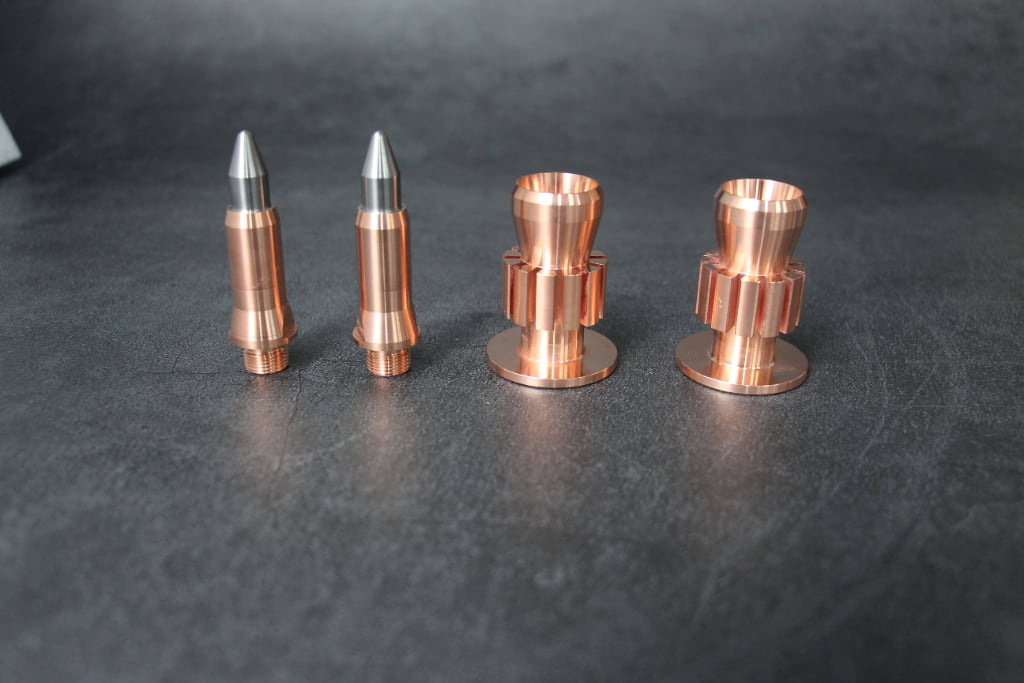
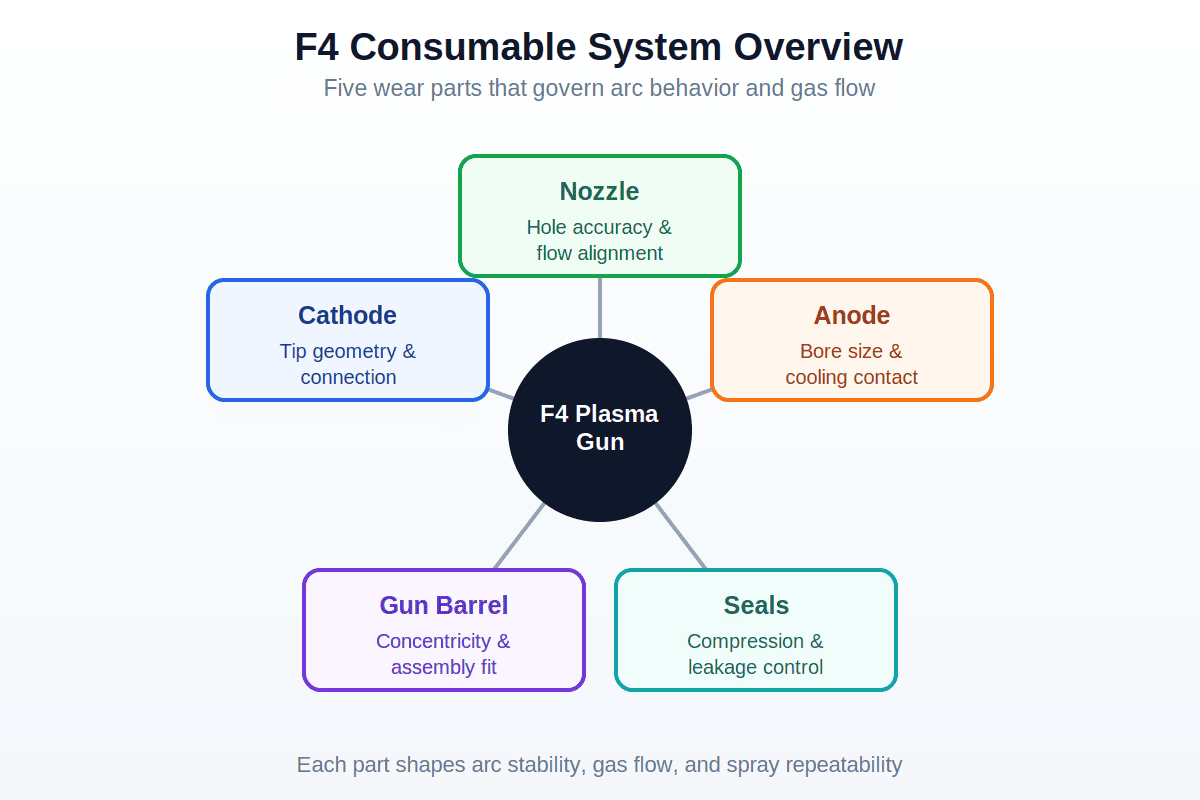
Metco F4 consumables include performance-critical parts such as cathodes, anodes, nozzles, gun barrels, and related components.1 I judge them by arc stability, gas flow control, service life, machining accuracy, and repeatable batch quality, not only by whether they can be installed.
I often start pre-sales talks with one simple question: what problem are you trying to prevent? Some buyers answer with a part number. Some answer with a price target. A better answer includes gun condition, spray pattern, failure history, and validation method. I write this guide because I have seen that the real risk is not only a wrong part. The real risk is a part that fits, runs for a short time, and then creates unstable spraying when the production schedule is already tight.
What “Metco F4 Consumables” Actually Include in a Thermal Spray System?
I see confusion when buyers use one phrase for many parts. That confusion can lead to wrong purchasing, wrong testing, and wrong blame after failure.
Metco F4 consumables usually refer to replaceable thermal spray gun parts that wear during plasma spraying.2 I mainly include cathodes, anodes, nozzles, gun barrels, seals, and related wear parts that affect arc behavior, gas flow, cooling, and spray stability.
I treat consumables as process parts, not shelf items
When I discuss F4-related consumables with a maintenance team, I do not only ask for a list of part names. I ask where the part sits in the spray process. A cathode and an anode do not only complete an electrical path. They help shape the arc.3 A nozzle does not only guide flow. It also affects how gas moves around the arc.4 A gun barrel or related body part does not only hold the assembly. It must support alignment, cooling, and stable operation.
I have seen customers compare two parts by weight, shape, and thread fit. That is only the start. A small change in inner bore finish, connection quality, or key dimension can change service life.5 It can also affect arc length or arc stability.6 I do not say that every spraying defect comes from consumables. Powder, gas, water cooling, cable condition, and parameters also matter.7 I only say that consumables are close enough to the process to deserve serious control.
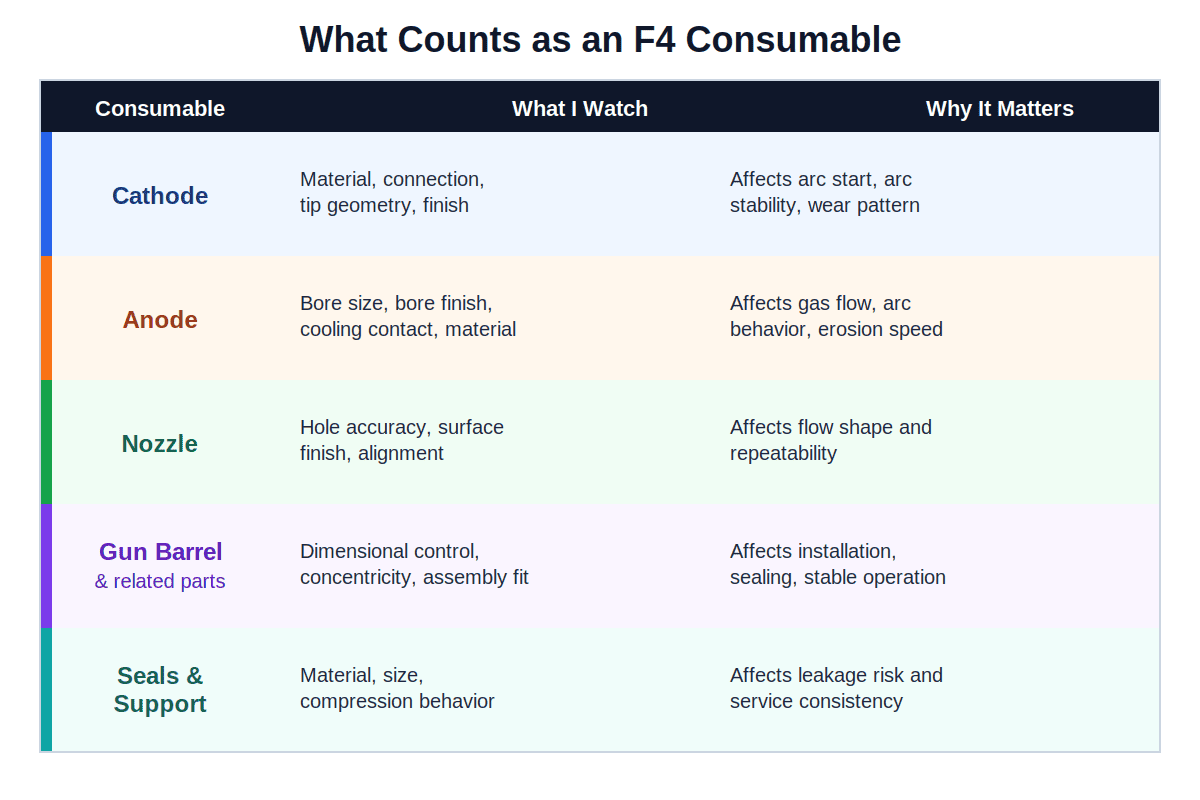
| Consumable area | What I watch | Why it matters in use |
|---|---|---|
| Cathode | Material, connection, tip geometry, finish | It affects arc start, arc stability, and wear pattern |
| Anode | Bore size, bore finish, cooling contact, material | It affects gas flow, arc behavior, and erosion speed |
| Nozzle | Hole accuracy, surface finish, alignment | It affects flow shape and repeatability |
| Gun barrel and related parts | Dimensional control, concentricity, assembly fit | It affects installation, sealing, and stable operation |
| Seals and support parts | Material, size, compression behavior | It affects leakage risk and service consistency |
I avoid calling the whole category “just replacement parts”
In my own manufacturing work, I see that a consumable can look simple after it is packed. It is not simple during production. I need control over raw material choice, machining sequence, bore finish, and inspection. For parts linked with arc behavior, I pay attention to dimensions that may not look important to a buyer at first glance. I also pay attention to repeatability from batch to batch, because one good sample does not prove long-term supply quality.
Why Compatibility Is Not Just “Fitment”: Understanding Real Operating Conditions?
I hear one question again and again: “Is it 100% compatible?” That question sounds safe, but it can hide the real operating risk.
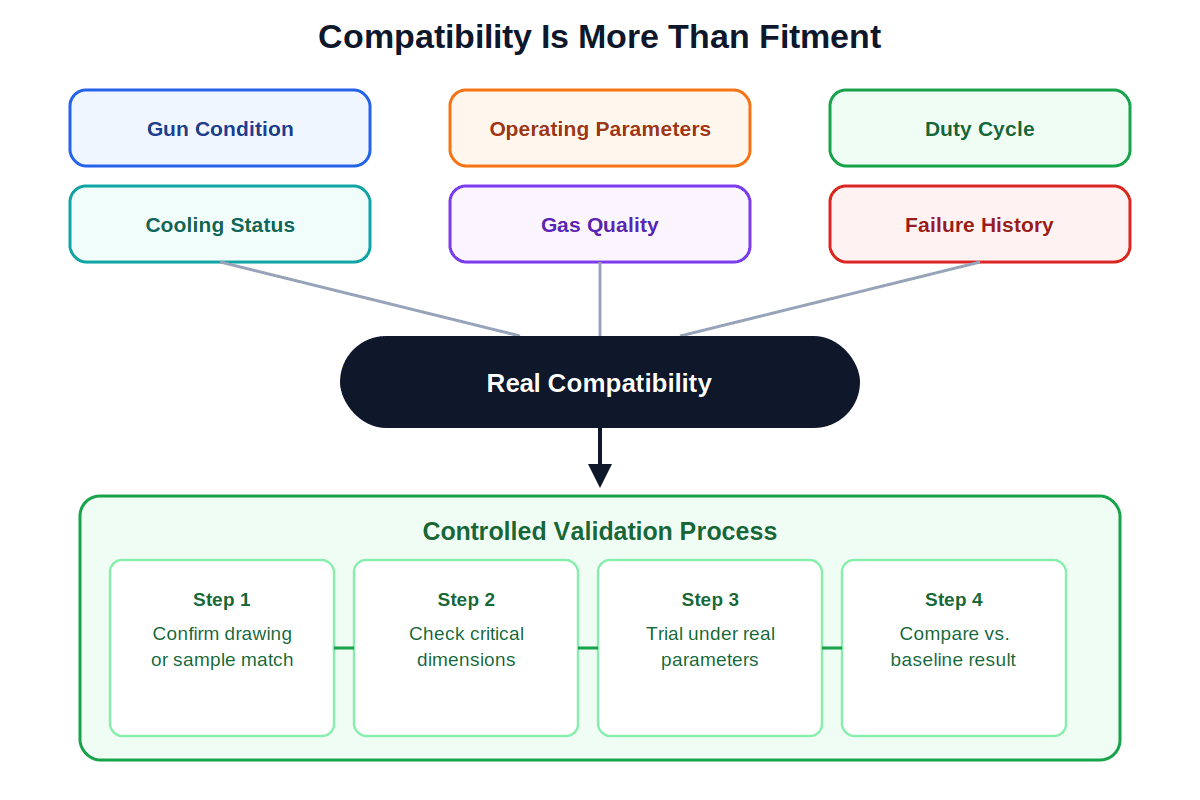
Compatibility means more than installation. I judge F4 consumable compatibility by gun condition, operating parameters, duty cycle, cooling status, gas quality, previous failure mode, and a controlled validation process under the buyer’s real spraying conditions.
I ask better questions before I answer compatibility
When a buyer asks if a consumable is compatible, I usually slow the discussion down. I may ask how old the gun is. I may ask if the gun body has wear, heat damage, thread damage, or sealing problems. I may ask what failure happened last time. Did the cathode wear too fast? Did the anode erode unevenly? Did the arc become unstable after a few hours? Did the operator change powder, gas, or current at the same time?
This matters because a part can be installed and still fail in a poor working environment. I cannot judge real compatibility by fitment alone. I need to know the operating pattern. A repair shop that sprays short test runs may see a different result from a factory that runs long production shifts.8 A team with stable cooling and clean gas may see different wear from a team with poor cooling or unstable gas pressure.9
| Question I ask | What the answer tells me |
|---|---|
| What gun model and condition do you use? | It helps me judge mechanical fit and wear risk |
| What parameters do you run? | It helps me understand heat load and arc demand |
| What is the current failure mode? | It helps me avoid repeating the same problem |
| How long is each spray cycle? | It helps me judge duty cycle stress |
| What acceptance test will you use? | It helps me define a fair validation process |
I use validation instead of empty promises
I do not like to promise that one consumable is suitable for all working conditions. That claim sounds strong, but it is not careful. I prefer a step-by-step validation. First, I confirm the part drawing or sample match. Then I check critical dimensions. Then I suggest a trial under normal customer parameters. Then the user should compare arc behavior, spray sound, coating result, wear pattern, and replacement interval against their normal baseline.
Customers commonly ask for “OEM alternative” parts because they want cost control and supply stability. I understand that. I also remind them that an alternative part should be validated as a working process part. It should not be judged only by the first installation. The best question is not “Can I mount it?” The better question is “Can it support stable production in my real process with acceptable service life and repeatable quality?”
Key Manufacturing Factors That Decide Consumable Performance and Stability?
A cheap consumable can look correct in a photo. The hidden risk starts when the arc, heat, gas flow, and cooling test the part in real use.
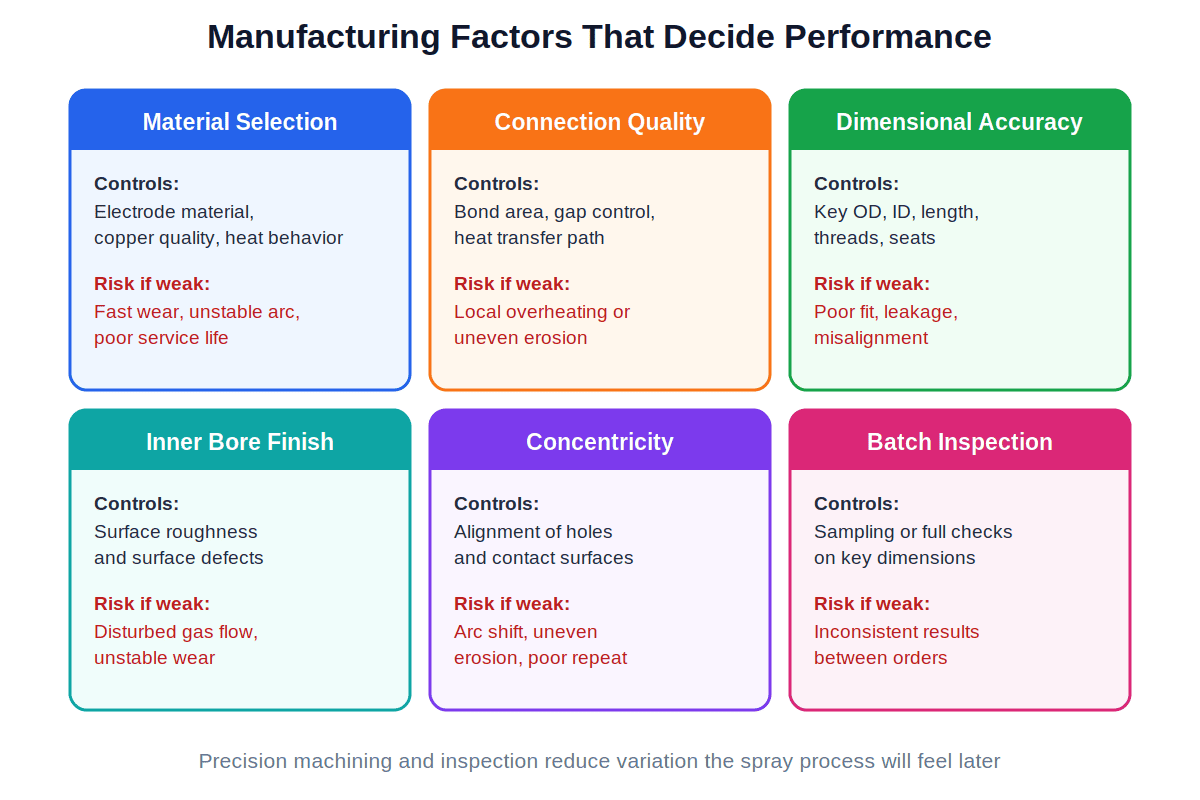
I focus on material control, connection quality, critical dimensions, bore finish, concentricity, precision machining, and inspection. These factors decide whether F4 consumables can support stable arc behavior, steady gas flow, and consistent batch performance.
I pay close attention to material and connection quality
In my experience, the first manufacturing question is material choice. For cathodes and anodes, material behavior under heat and arc load is critical. Some designs use tungsten-copper related structures or special electrode materials.10 The way the materials connect matters a lot. A weak or uneven connection can create local heat issues, unstable wear, or shorter life.11 In our own work, I pay special attention to connection control, including vacuum casting methods for tungsten-copper connection where applicable. I do not present this as magic. I present it as a manufacturing variable that must be controlled.
The second question is machining. A plasma spray consumable may have small dimensions that carry big process value. I care about inner bore quality, because gas flow and arc behavior can be sensitive to surface condition.12 I also care about coaxiality, hole position, and fine dimension control. We use precision CNC machining in our production work, including high-accuracy equipment, because small deviation can become a large process problem after assembly.
| Manufacturing factor | What I control | Possible risk when it is weak |
|---|---|---|
| Material selection | Electrode material, copper quality, heat behavior | Fast wear, unstable arc, poor service life |
| Connection quality | Bond area, gap control, heat transfer path | Local overheating or uneven erosion |
| Dimensional accuracy | Key OD, ID, length, threads, seats | Poor fit, leakage, misalignment |
| Inner bore finish | Roughness and surface defects | Disturbed gas flow and unstable wear |
| Concentricity | Alignment of holes and contact surfaces | Arc shift, uneven erosion, poor repeatability |
| Batch inspection | Sampling or full checks for key items | Inconsistent performance between orders |
I believe inspection must match the function of the part
I do not think inspection should stop at “looks good.” For F4-related consumables, I pay attention to key sizes, form and position tolerance, and inner bore roughness. In high-precision parts, I work toward tight dimensional control, often within very small tolerances when the design requires it. For inner bores, a fine finish such as low Ra values can be important. The goal is not to write impressive numbers on a brochure. The goal is to reduce variation that the spray process may feel later.
For gun bodies and related assemblies, I also care about flame or arc behavior checks where relevant. A stable arc length and stable arc behavior tell me more than a clean surface alone. Of course, the final field result still depends on the full system. The customer’s cooling, gas, powder, and parameter discipline remain important. I only claim what I can control: careful manufacturing, careful inspection, and honest discussion before selection.
Cost vs Stability: How Procurement Teams Should Evaluate F4 Consumables?
I see procurement teams save a few dollars per part, then lose more through downtime, emergency freight, short life, and unstable coating results.
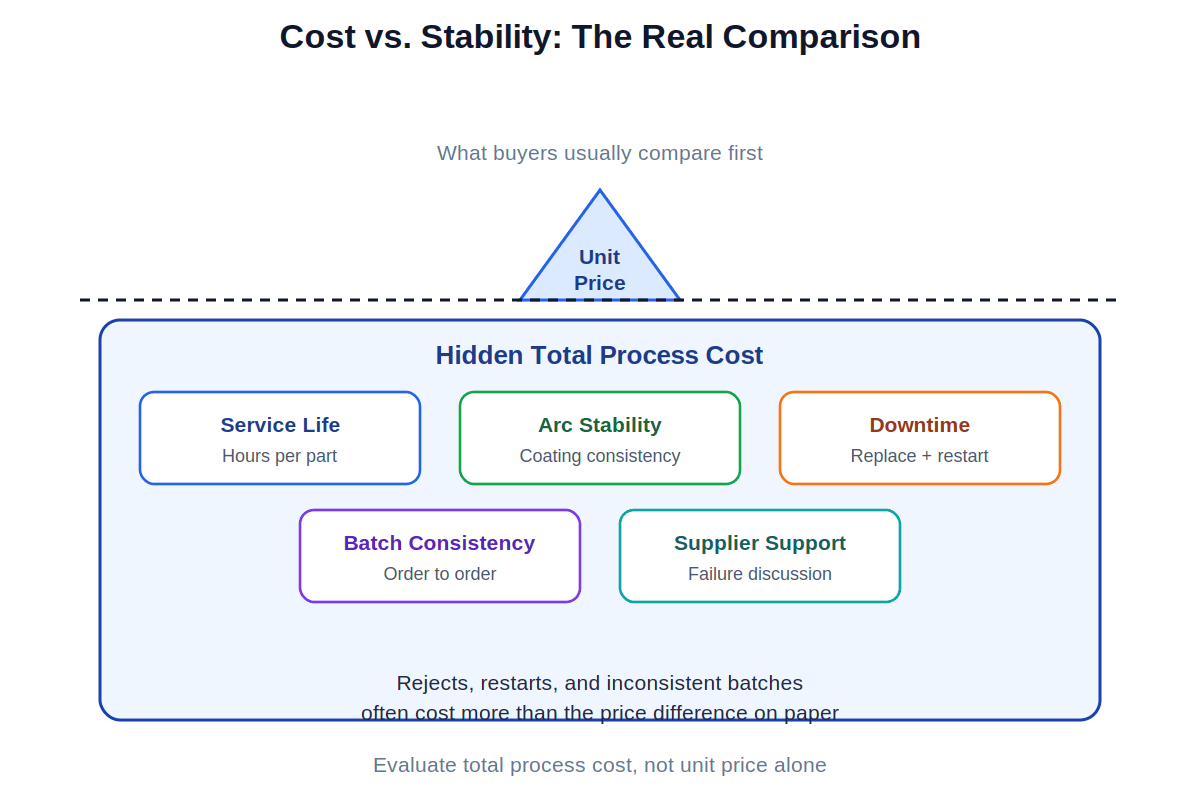
The real cost of F4 consumables includes purchase price, service life, downtime, spray stability, rejection risk, emergency replacement, and batch consistency. I suggest buyers compare total process cost, not only unit price.
I separate low price from good value
A lower unit price is not always wrong. I supply alternative consumables, so I understand the need for cost control. The problem starts when price becomes the only selection rule. A consumable that costs less but wears much faster may raise cost per spray hour. A part that causes unstable operation may create coating rejects. A supplier that cannot repeat the same quality in the next batch may create hidden risk for production planning.
When I speak with procurement teams, I suggest a simple cost view. First, calculate price per usable hour. Second, include downtime cost. Third, include operator time and restart time. Fourth, include coating reject risk. Fifth, include the value of stable supply. This view is more useful than a quotation table alone. It also makes supplier comparison fairer. A more expensive part can be poor value if it performs badly. A lower-priced alternative can be good value if it is made and checked well.
| Evaluation item | Simple question to ask | Why it protects the buyer |
|---|---|---|
| Unit price | What is the purchase price per piece? | It shows direct spending |
| Service life | How many hours or cycles can we reasonably expect? | It shows cost per usable period |
| Stability | Does the arc stay steady under normal settings? | It protects coating consistency |
| Downtime | How long does replacement and restart take? | It reveals hidden labor and schedule cost |
| Batch consistency | Does the next order perform like the first order? | It protects long-term production |
| Supplier support | Can the supplier discuss failure modes and selection? | It reduces blind purchasing risk |
I suggest a practical buying method
I believe the best procurement process is simple and disciplined. Start with a baseline. Use current OEM parts or current approved parts as the reference. Record service life, arc behavior, coating result, and failure mode. Then test the alternative consumable in a controlled way. Do not change powder, gas, current, and operator practice at the same time unless the test plan requires it. If too many things change, the result becomes hard to read.
I also suggest asking suppliers for concrete manufacturing and inspection information. Ask about material choice. Ask which dimensions are controlled. Ask how inner bores are finished. Ask how connection quality is managed. Ask what checks are done before shipment. A serious supplier should be able to answer in practical terms. The answer does not need to reveal private drawings or protected details. It should show real process control.
Customers commonly compare OEM parts, local alternatives, and overseas alternatives. I think that is reasonable. I only warn against two extreme views. One view says all replacement consumables are inferior. The other view says all alternatives are equal to OEM parts. Both views are too simple. Real reliability depends on manufacturing control, validation, and the real spray environment. A careful buyer should look for stable performance, honest limits, and repeatable batches.
Conclusion
I evaluate Metco F4 consumables by real process stability, service life, precision manufacturing, and fair validation, not by fitment or unit price alone.
"[PDF] A Perspective on Plasma Spray Technology - Columbia University", http://www.columbia.edu/cu/seas/earth/wtert/newwtert/Research/sofos/Plasma_%20spraying_Nov2014.pdf. A technical discussion of plasma-spray torch design identifies electrodes and nozzle assemblies as active elements in arc formation and plasma-gas delivery, supporting the treatment of these consumables as process-critical components rather than passive spare parts; the support is contextual if the source discusses plasma torches generally rather than the Metco F4 model specifically. Evidence role: general_support; source type: paper. Supports: A technical source should show that plasma spray guns use cathodes, anodes, nozzles, and related replaceable components that directly affect arc generation and spray operation.. Scope note: Likely supports the general plasma-spray mechanism rather than the exact Metco F4 consumable list. ↩
"[PDF] A Perspective on Plasma Spray Technology - Columbia University", http://www.columbia.edu/cu/seas/earth/wtert/newwtert/Research/sofos/Plasma_%20spraying_Nov2014.pdf. Literature on plasma-spray torch operation describes electrode and nozzle wear as a normal consequence of arc exposure, heat load, and plasma-gas flow, supporting the definition of these items as replaceable consumables in plasma spraying. Evidence role: definition; source type: paper. Supports: A source should define plasma spray torch consumables as replaceable parts such as electrodes and nozzles that are subject to operational wear.. ↩
"Predicted Anode Arc Attachment by LTE (Local Thermodynamic ...", https://pmc.ncbi.nlm.nih.gov/articles/PMC8428209/. Research on plasma-torch arcs shows that electrode configuration and arc-root attachment affect arc behavior and stability, supporting the statement that cathodes and anodes help shape the arc in plasma spraying. Evidence role: mechanism; source type: paper. Supports: A source should explain that plasma torch electrodes influence arc attachment, arc root movement, or arc column behavior.. ↩
"[PDF] Section 3.0: Plasma Torch Design - VTechWorks", https://vtechworks.lib.vt.edu/bitstreams/d632b148-48f7-4dbc-a219-8eb5382f6957/download. Studies of plasma-torch flow fields describe the nozzle as a controlling boundary for plasma-gas acceleration and arc-flow interaction, supporting the claim that nozzle design affects how gas moves around the arc. Evidence role: mechanism; source type: paper. Supports: A source should support that nozzle geometry and internal passages influence gas flow patterns around the arc in plasma spray torches.. ↩
"Condition Monitoring of a Three-Cathode Cascaded Plasma Spray ...", https://pmc.ncbi.nlm.nih.gov/articles/PMC9501464/. Research on plasma-torch electrode and nozzle erosion links wear rates to arc attachment, thermal loading, surface condition, and component geometry, providing mechanistic support for the claim that small manufacturing differences can affect consumable service life. Evidence role: mechanism; source type: paper. Supports: A source should show that surface condition, dimensional tolerances, or thermal/electrical contact quality influence plasma torch consumable wear or lifetime.. Scope note: The support may be based on plasma torch consumables broadly rather than measurements on Metco F4 parts specifically. ↩
"[PDF] Section 10.0: Electrode Erosion - VTechWorks", https://vtechworks.lib.vt.edu/bitstream/handle/10919/36917/Sec10.pdf. Experimental and modeling studies of plasma torches report that electrode condition and arc-root behavior affect arc voltage fluctuations and stability, supporting the claim that consumable variation can influence arc length or arc stability. Evidence role: mechanism; source type: paper. Supports: A source should support that electrode wear, nozzle geometry, or arc attachment changes can influence arc length, voltage fluctuation, or arc stability.. ↩
"Thermal spraying", https://en.wikipedia.org/wiki/Thermal_spraying. Reviews of plasma spraying identify powder properties, plasma-gas composition and flow, electrical parameters, cooling, and torch condition as interdependent variables affecting torch behavior and coating outcomes, supporting the article’s statement that consumables are only one part of the process. Evidence role: expert_consensus; source type: paper. Supports: A source should summarize that plasma spray coating quality and torch behavior are affected by powder characteristics, plasma gas, cooling, current, voltage, and related process parameters.. ↩
"Condition Monitoring of a Three-Cathode Cascaded Plasma Spray ...", https://pmc.ncbi.nlm.nih.gov/articles/PMC9501464/. Research on plasma-torch operation relates electrode erosion and thermal behavior to operating time, heat load, and arc conditions, providing contextual support for the distinction between short validation runs and long production shifts. Evidence role: general_support; source type: paper. Supports: A source should support that operating duration, duty cycle, or thermal cycling affects plasma torch wear, thermal state, or process stability.. Scope note: This would support the principle that operating duration matters, not necessarily quantify the difference between repair-shop and factory results. ↩
"[PDF] Section 10.0: Electrode Erosion - VTechWorks", https://vtechworks.lib.vt.edu/bitstream/handle/10919/36917/Sec10.pdf. Plasma-torch studies describe cooling and gas-flow conditions as factors that influence electrode temperature, arc attachment, and erosion, supporting the claim that different cooling and gas-quality conditions can produce different consumable wear outcomes. Evidence role: mechanism; source type: paper. Supports: A source should explain that cooling efficiency and gas-flow stability influence electrode/nozzle temperature, erosion, or arc behavior in plasma torches.. ↩
"W + Cu and W + Ni Composites and FGMs Prepared by Plasma ...", https://pmc.ncbi.nlm.nih.gov/articles/PMC7914529/. Materials studies and plasma-torch design literature describe the use of tungsten, copper, and tungsten-copper composite structures in high-temperature electrode applications, supporting the statement that some plasma-spray consumable designs use tungsten-copper-related or specialized electrode materials. Evidence role: general_support; source type: paper. Supports: A source should document the use of tungsten, copper, tungsten-copper composites, or specialized materials in plasma torch electrodes or electrode assemblies.. Scope note: The source may document common electrode material practice without confirming the material specification of any particular F4 consumable. ↩
"[PDF] Section 3.0: Plasma Torch Design - VTechWorks", https://vtechworks.lib.vt.edu/bitstreams/d632b148-48f7-4dbc-a219-8eb5382f6957/download. Studies of electrode materials and thermal contact resistance show that imperfect bonding or contact can concentrate heat and change erosion behavior, supporting the claim that weak or uneven connections may reduce consumable life. Evidence role: mechanism; source type: paper. Supports: A source should support that bonding quality, contact resistance, or thermal contact affects heat transfer and can contribute to localized overheating or accelerated electrode wear.. Scope note: The support may come from related electrode or thermal-contact systems rather than a direct test of Metco F4 consumables. ↩
"Condition Monitoring of a Three-Cathode Cascaded Plasma Spray ...", https://pmc.ncbi.nlm.nih.gov/articles/PMC9501464/. Fluid-flow and plasma-torch studies show that nozzle geometry and internal surface condition can affect gas-flow development and flow uniformity, providing mechanistic support for the claim that bore quality can matter for gas flow and arc behavior. Evidence role: mechanism; source type: paper. Supports: A source should support that internal surface roughness or bore geometry affects gas-flow behavior, which can influence plasma torch operation.. Scope note: The evidence may establish the flow mechanism generally and may not directly measure F4 consumable bore roughness. ↩