A worn F4 cathode can look small, but I have seen it create rough coatings, unstable arcs, rework, and downtime fast.1
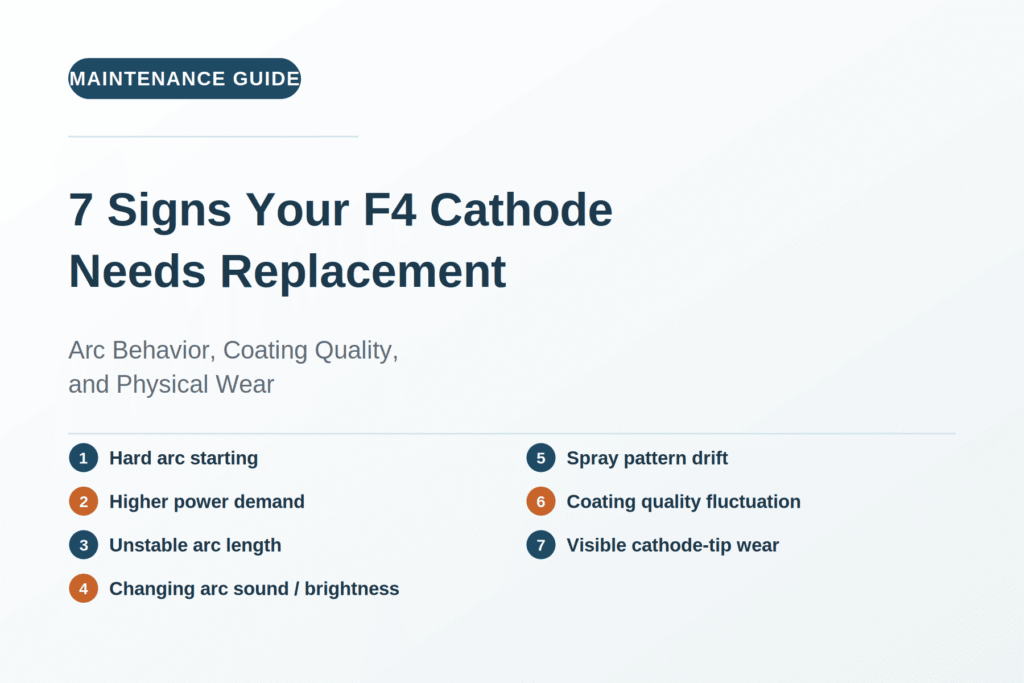
I look for seven signs: hard arc starting, higher power demand, unstable arc length, changing arc sound or brightness, spray pattern drift, coating quality fluctuation, and visible cathode-tip wear2. I treat these signs as inspection triggers, not final proof, because the anode, gas, powder, and settings also matter3.
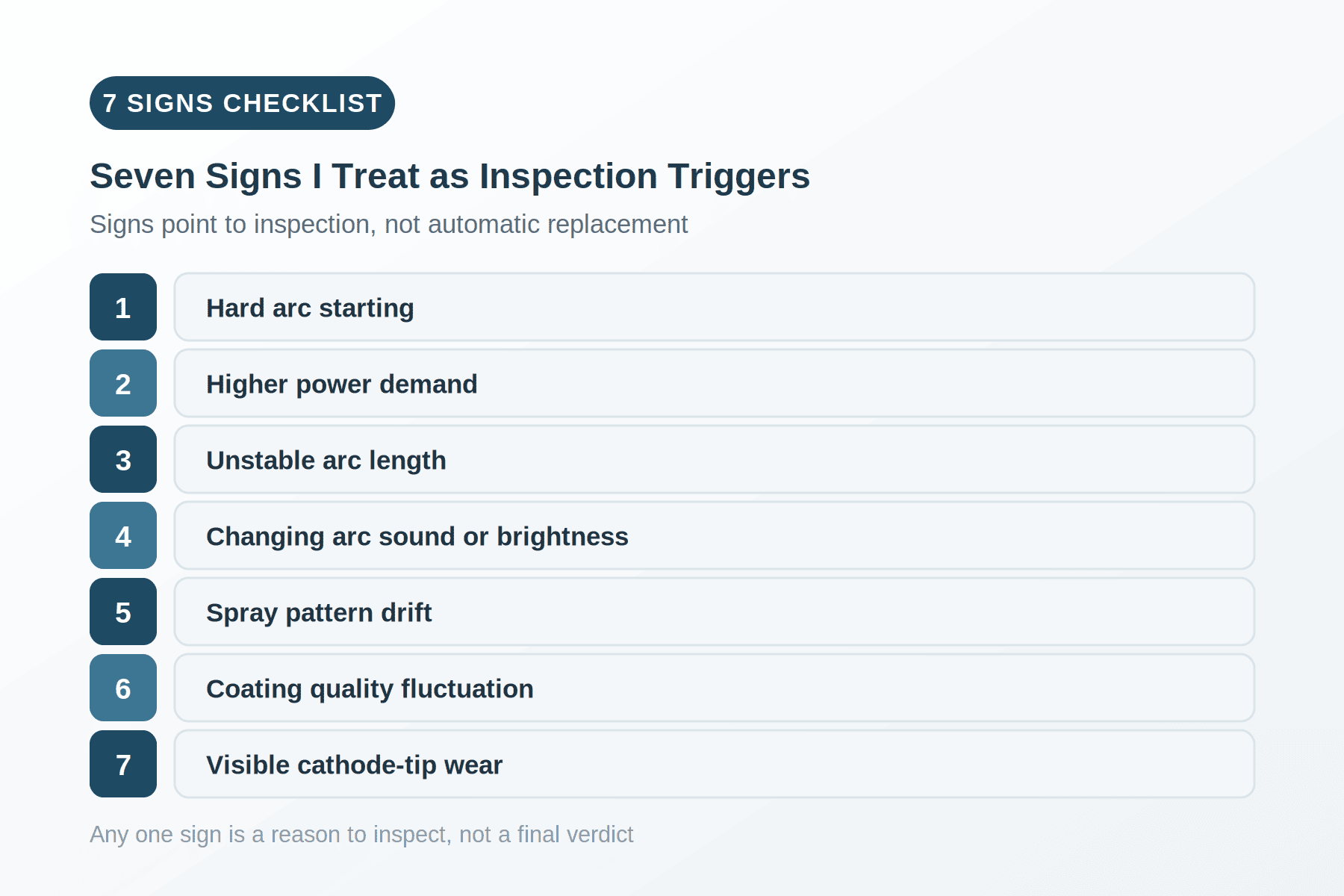
I do not judge an F4 cathode by hours alone. I use hours as one clue. I also look at arc behavior, spray results, and the cathode surface after safe shutdown.4 This habit has saved me from blaming the wrong part, and it has also stopped me from running a weak cathode too long.
When Arc Behavior Starts to Change: What Early Electrical Instability Signals Should I Watch?
A small change in arc starting can feel normal during a busy shift, but I treat it as an early warning before coating quality moves.
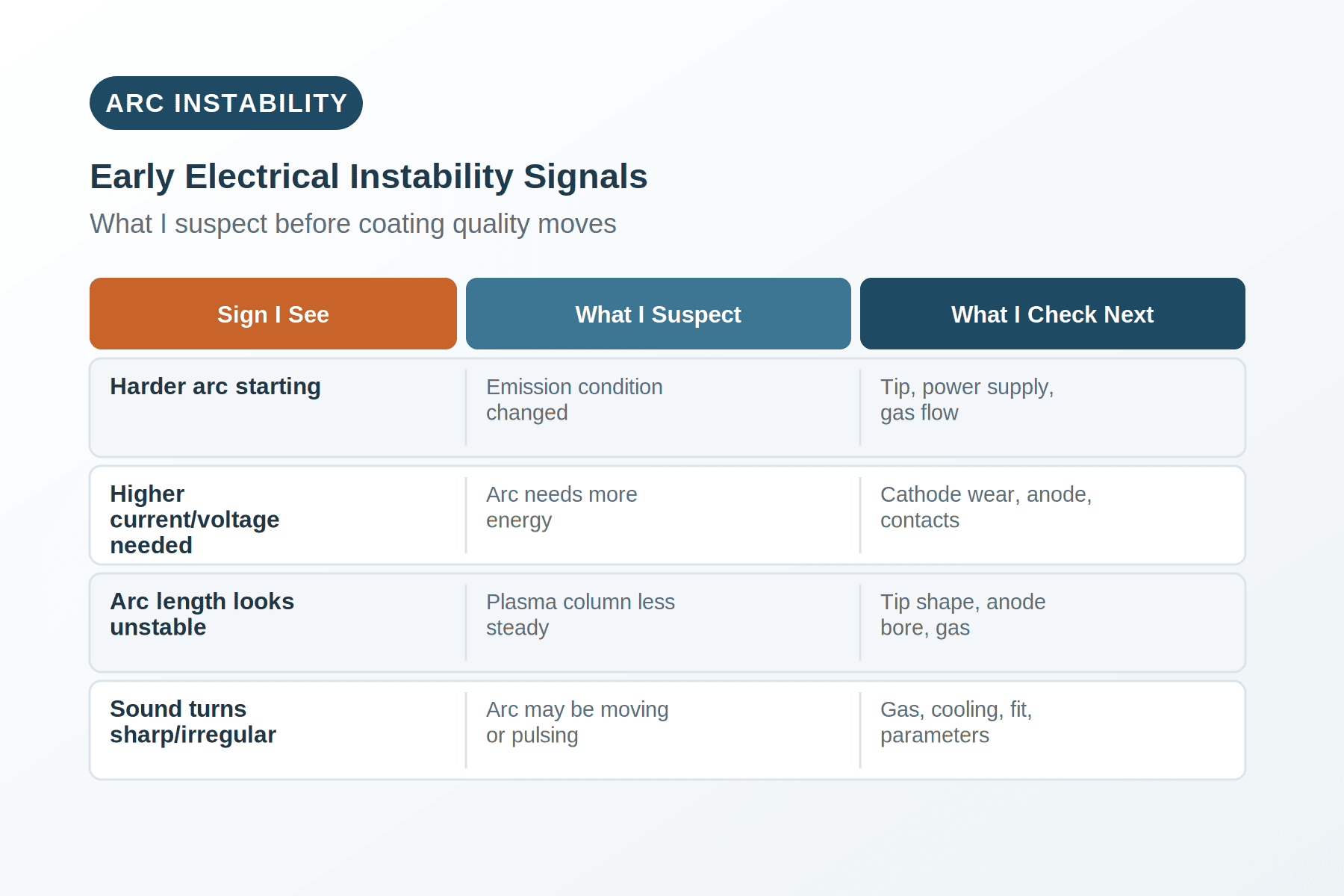
I watch for hard arc starting, higher current or voltage needs, unstable arc length, and unusual arc sound or brightness. These signs do not prove cathode failure by themselves, but they tell me to inspect the cathode and nearby parts before the process becomes unstable.
I start with the behavior I can hear and see
I have learned that an F4 cathode often gives soft warnings before it gives a clear failure. I do not like to wait until the gun stops. I watch the arc start. I listen to the sound. I look at the arc brightness from a safe viewing position and under the correct safety rules. I also compare the current and voltage response with my normal process record.
| Sign I see | What I suspect | What I check next |
|---|---|---|
| Harder arc starting | The cathode emission condition may have changed | Cathode tip, power supply response, gas flow |
| Higher current or voltage needed | The arc may need more energy to stabilize | Cathode wear, anode condition, cable and contact points |
| Arc length looks unstable | The plasma column may be less steady | Cathode tip shape, anode bore, gas setting |
| Sound becomes sharp or irregular | The arc may be moving or pulsing | Gas supply, cooling, part fit, parameter record |
I do not use one symptom as a final answer. I use the symptom as a reason to stop guessing. In my manufacturing work, I pay close attention to cathode material, tip geometry, and dimensional consistency because small differences can affect how the arc starts and stays steady5. If the cathode tip erodes or the connection is not stable, the arc can become less repeatable.6 That is why I prefer a structured check over a quick replacement based only on feeling.
How Can Spray Pattern and Coating Quality Fluctuation Warn Me at the System Level?
A coating defect can be expensive because I may only notice it after spraying, inspection, or even customer review.
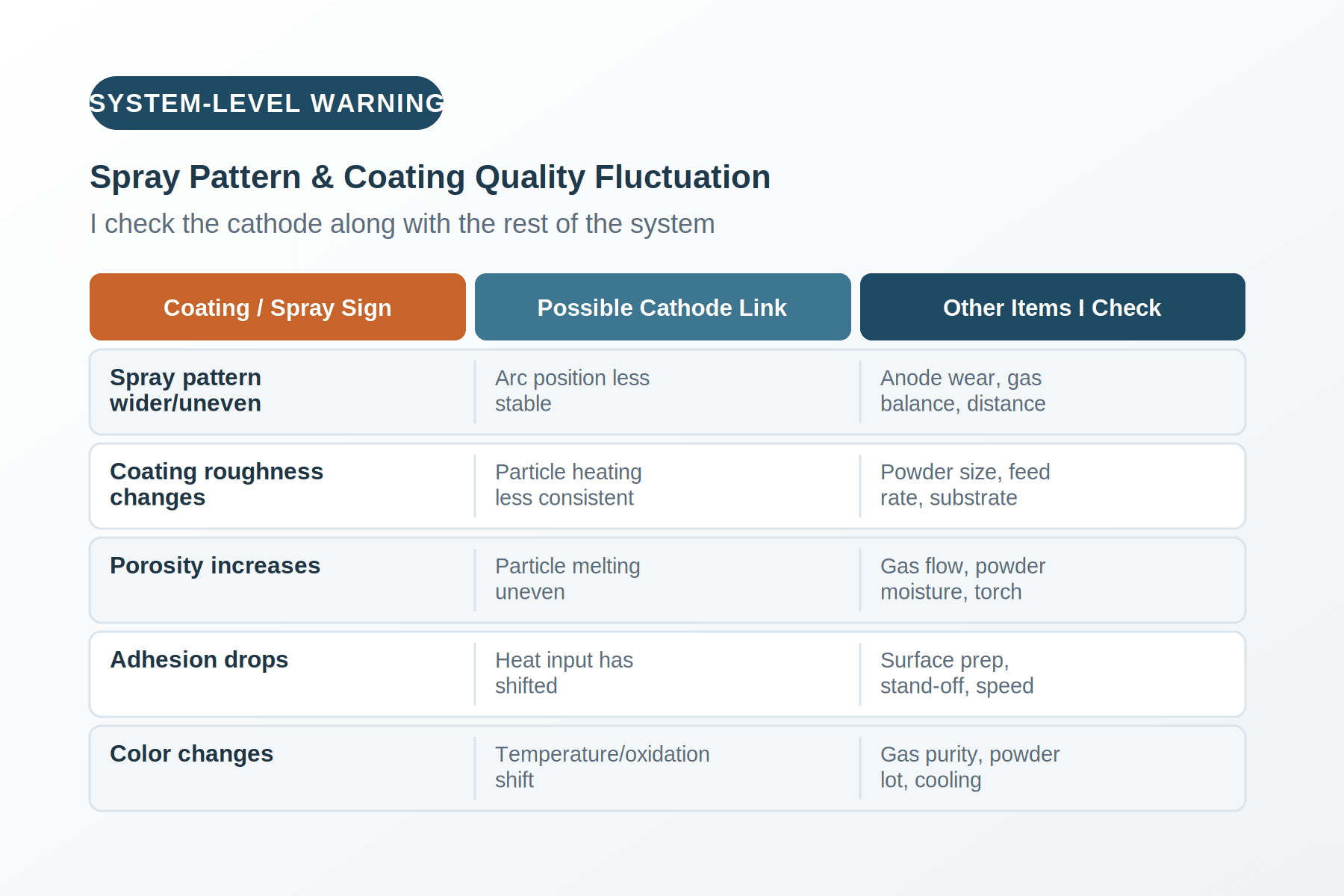
I treat spray pattern drift, roughness change, porosity increase, adhesion drop, and color change as system-level warnings. I inspect the cathode, but I also check the anode, gas flow, powder condition, carrier gas, spray distance, and parameter settings before I decide the cause.
I connect coating changes with arc stability, not just part wear
I have seen teams replace powder lots, adjust parameters, and clean fixtures before they inspect the cathode. I understand why this happens. Coating defects often look like process problems first. A worn F4 cathode can still be one part of the problem because the arc affects particle heating and acceleration7. If the arc is not stable, the spray plume can become less stable.8 Then the coating can show changes in surface finish, porosity, adhesion, or color.9
| Coating or spray sign | Possible cathode link | Other items I check |
|---|---|---|
| Spray pattern becomes wider or uneven | Arc position may be less stable | Nozzle/anode wear, gas balance, spray distance |
| Coating roughness changes | Particle heating may be less consistent | Powder size, powder feed rate, substrate condition |
| Porosity increases | Particle melting may be uneven | Gas flow, powder moisture, torch parameters |
| Adhesion drops | Heat input may have shifted | Surface preparation, stand-off distance, traverse speed |
| Color changes | Temperature or oxidation condition may change | Gas purity, powder lot, cooling, parameter drift |
I do not want to overstate the cathode role. A coating problem is rarely fair to one part without evidence. I use a simple sequence. I first compare today’s spray pattern with the known good pattern. I then check the recorded parameters. I inspect the powder feed and gas flow. I look at the anode and the cathode together. This approach keeps me from replacing good parts, and it also helps me catch cathode wear before it causes repeated rework.
What Physical Wear on the F4 Cathode Tip Should I Look for After Shutdown?
A cathode can look acceptable from a distance, but I have found the real clues at the tip after safe cooling and removal.
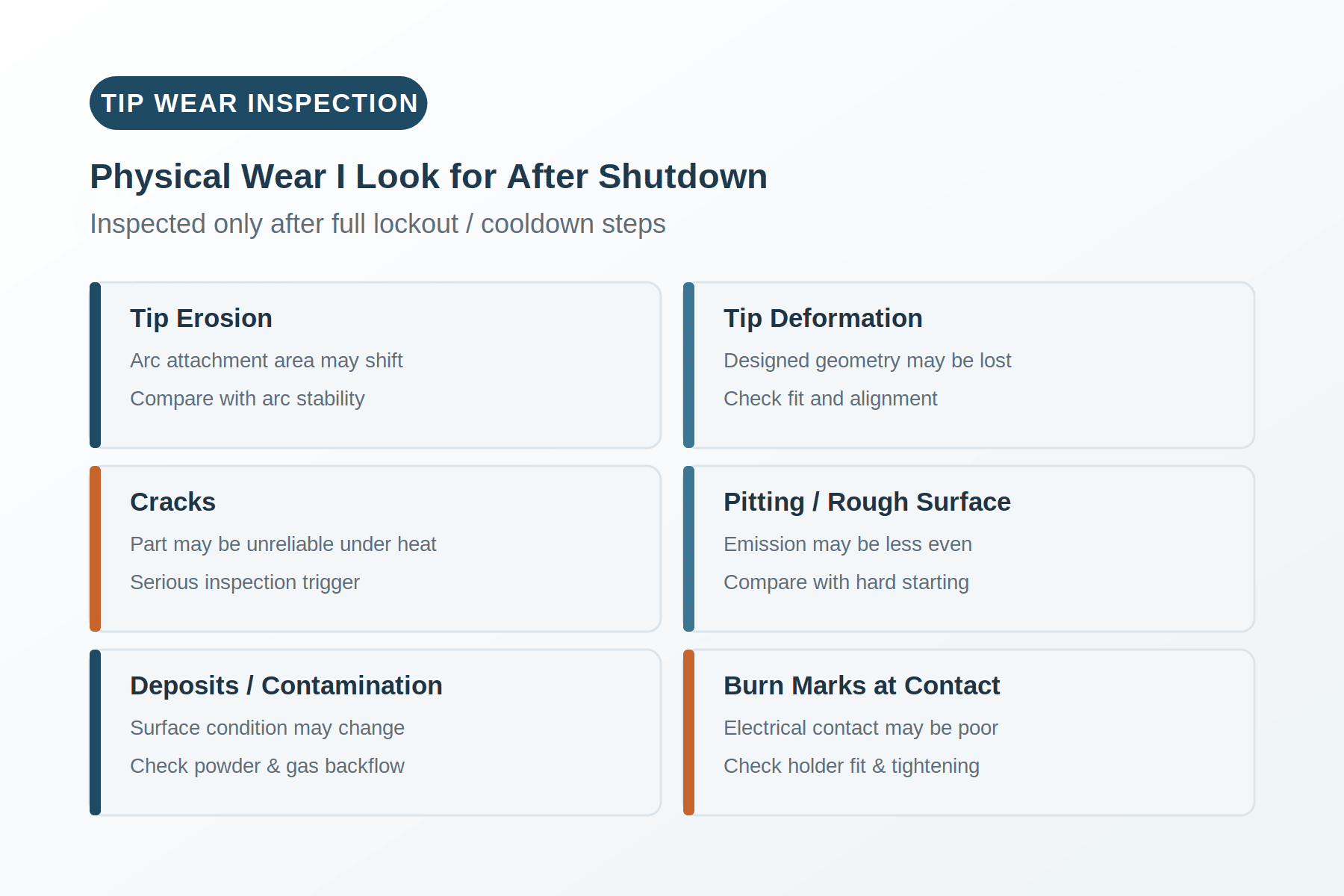
I look for tip erosion, shape change, deformation, cracking, pitting, contamination, and poor contact marks. These conditions can disturb arc attachment and stability10, but I still compare them with process symptoms and other gun parts before I confirm replacement.
I inspect the cathode only after the correct safety steps
I never suggest opening a spray gun without following the equipment safety procedure. I wait for shutdown, cooling, lockout steps, and the maintenance rule used in that shop.11 After that, I inspect the F4 cathode tip with clean handling. I do not judge only by color. I look at shape, surface, and contact areas.
| Wear mark I look for | Why I care | How I use the finding |
|---|---|---|
| Tip erosion | The arc attachment area may shift | I compare it with arc stability records |
| Tip deformation | The designed geometry may be lost | I check fit and alignment |
| Cracks | The part may become unreliable under heat | I treat it as a serious inspection trigger |
| Pitting or rough surface | Emission may become less even | I compare it with hard starting |
| Deposits or contamination | The surface condition may change | I check powder backflow and gas condition |
| Burn marks at contact area | Electrical contact may be poor | I inspect holder fit and tightening condition |
From a manufacturing view, I care about repeatable dimensions and stable material connection. A cathode is not only a piece of material. It is a working electrical and thermal part. The connection between tungsten-based material and copper-based body, the machining of the contact surfaces, and the tip shape all support stable operation. I have seen that poor fit can turn a good process into a difficult process. I have also seen that a damaged tip can make the team chase powder and gas problems for hours. I treat visible wear as a reason to inspect the full stack, not as a reason to skip thinking.
Why Are Cathode-Related Issues Often Misdiagnosed in the Whole Spray System?
A worn cathode is easy to blame when the job goes wrong, but I have made better decisions when I check the full system first.
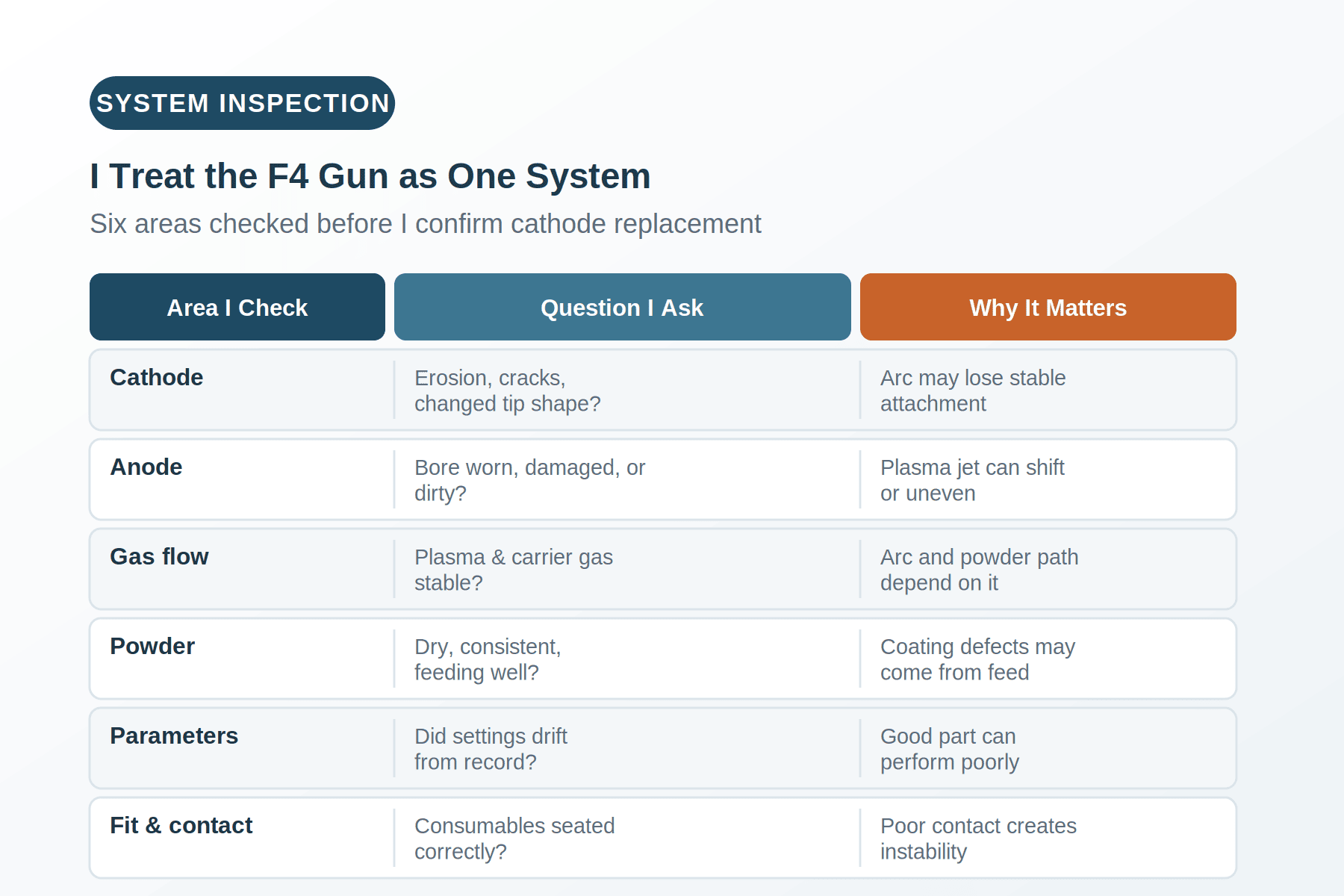
I avoid instant blame because cathode symptoms can look like anode wear, gas flow error, powder feed trouble, cooling problems, or parameter drift. I replace the cathode when the evidence from arc behavior, coating results, and physical inspection points in the same direction.
I use a simple inspection path before I decide
I treat the F4 gun as a system. The cathode, anode, gas, powder, cooling, power supply, and mechanical fit work together. If one part changes, the process can react in a way that looks like another part failed. This is why I do not like fixed-hour thinking. Service hours help me plan inventory and inspection, but they do not tell the full story. A cathode in one process can face different load, gas, powder, start-stop frequency, and operator practice than a cathode in another process.12
| Area I check | Question I ask | Why it matters |
|---|---|---|
| Cathode | Do I see erosion, cracks, or changed tip shape? | The arc may lose a stable attachment point |
| Anode | Is the bore worn, damaged, or dirty? | The plasma jet can shift or become uneven |
| Gas flow | Are plasma gas and carrier gas stable? | The arc and powder path depend on gas balance |
| Powder | Is the powder dry, consistent, and feeding well? | Coating defects may come from feed variation |
| Parameters | Did current, voltage, flow, distance, or speed drift? | A good part can perform poorly under wrong settings |
| Fit and contact | Are consumables seated and connected correctly? | Poor contact can create heat and instability |
I also think about replacement-part reliability. When I produce or inspect consumables, I focus on dimensions, surface finish, material condition, and connection quality because those details affect fit and repeatability. For F4-type cathodes, I want the part to install correctly and support stable arc behavior. I cannot promise a universal lifetime, and I do not think any serious supplier should. I can say that consistent manufacturing helps maintenance teams make clearer decisions. If the part is consistent, then the team can trust their process records more. If the part is not consistent, then troubleshooting becomes harder.
Conclusion
I replace an F4 cathode only after I connect arc behavior, coating results, physical wear, and full-system checks into one clear maintenance decision.
"A Perspective on Plasma Spray Technology", http://www.columbia.edu/cu/seas/earth/wtert/newwtert/Research/sofos/Plasma_%20spraying_Nov2014.pdf. Research on plasma-spray torch operation reports that electrode erosion can alter arc behavior and plasma-jet characteristics, providing contextual support for treating cathode wear as a contributor to coating instability and production interruption. Evidence role: general_support; source type: paper. Supports: Electrode erosion in plasma-spray torches can affect arc stability and plasma-jet behavior, which may contribute to coating-quality variation and maintenance interruptions.. Scope note: This would support the mechanism generally, not prove that every rough coating or downtime event is caused by an F4 cathode. ↩
"Condition Monitoring of a Three-Cathode Cascaded Plasma Spray ...", https://pmc.ncbi.nlm.nih.gov/articles/PMC9501464/. Thermal-spray diagnostic literature describes electrical signals, plasma-jet behavior, coating properties, and electrode condition as interrelated indicators of process stability, supporting the use of these observations as inspection triggers. Evidence role: expert_consensus; source type: research. Supports: Thermal-spray diagnostics commonly consider arc behavior, electrical signals, plume behavior, coating results, and electrode condition when assessing process stability.. Scope note: The source may not validate this exact seven-item list or the F4 model specifically. ↩
"Condition Monitoring of a Three-Cathode Cascaded Plasma Spray ...", https://pmc.ncbi.nlm.nih.gov/articles/PMC9501464/. Reviews of atmospheric plasma spraying identify torch condition, plasma gas flow, feedstock properties, and operating parameters as major factors controlling particle state and coating quality, supporting a system-level troubleshooting approach. Evidence role: expert_consensus; source type: paper. Supports: Multiple variables, including torch hardware, gas flow, powder feedstock, and process parameters, influence plasma-spray stability and coating outcomes.. Scope note: The evidence supports the general importance of these variables rather than ranking their importance for a particular fault. ↩
"Condition Monitoring of a Three-Cathode Cascaded Plasma ...", https://pmc.ncbi.nlm.nih.gov/articles/PMC9501464/. Maintenance and process-monitoring studies for plasma-spray systems support combining operating history with observed process signals and component inspection when assessing torch condition. Evidence role: general_support; source type: paper. Supports: Condition-based monitoring of plasma-spray systems can use process behavior and component inspection rather than only elapsed service time.. Scope note: This provides general maintenance support and may not give a universal replacement interval for F4 cathodes. ↩
"Section 3.0: Plasma Torch Design - VTechWorks", https://vtechworks.lib.vt.edu/bitstreams/d632b148-48f7-4dbc-a219-8eb5382f6957/download. Studies of direct-current plasma torches show that electrode geometry and surface condition influence arc attachment and arc stability, supporting the claim that small cathode differences can affect starting and steadiness. Evidence role: mechanism; source type: paper. Supports: Electrode geometry and cathode surface condition influence arc attachment and stability in direct-current plasma torches.. Scope note: The source may discuss plasma torches broadly rather than the F4 cathode design alone. ↩
"[PDF] Section 3.0: Plasma Torch Design - VTechWorks", https://vtechworks.lib.vt.edu/bitstreams/d632b148-48f7-4dbc-a219-8eb5382f6957/download. Plasma-torch research links electrode erosion and arc-root movement with changes in arc voltage and stability, supporting the mechanism by which a worn or poorly connected cathode can reduce arc repeatability. Evidence role: mechanism; source type: paper. Supports: Cathode erosion and contact condition can affect arc attachment, arc voltage behavior, and repeatability in plasma torches.. Scope note: The evidence supports a general physical mechanism, not a diagnostic rule that isolates the cathode from all other causes. ↩
"Thermal spraying - Wikipedia", https://en.wikipedia.org/wiki/Thermal_spraying. Standard descriptions of plasma spraying state that feedstock particles are injected into a high-temperature plasma jet, where they are heated and accelerated before impact on the substrate. Evidence role: definition; source type: encyclopedia. Supports: Plasma spraying relies on a plasma jet to heat and accelerate feedstock particles toward the substrate.. Scope note: An encyclopedia source supports the basic process description but not the specific effect size of arc variation in an F4 torch. ↩
"Capturing the Influence of Jet Fluctuations on Particles ... - PMC", https://pmc.ncbi.nlm.nih.gov/articles/PMC8765765/. Experimental and modeling studies of plasma-spray torches report that arc-root motion and arc-voltage fluctuations are associated with unsteady plasma-jet behavior, supporting the link between arc instability and plume instability. Evidence role: mechanism; source type: paper. Supports: Instability in the arc or arc root can produce fluctuations in plasma-jet or plume behavior.. Scope note: The support is mechanistic and may not specify the exact visual plume symptoms described by an operator. ↩
"Warm spraying—a novel coating process based on high ...", https://pmc.ncbi.nlm.nih.gov/articles/PMC5099653/. Thermal-spray coating studies show that particle temperature, velocity, and process parameters influence coating microstructure and properties such as roughness, porosity, and adhesion, providing contextual support for linking plume instability to coating variation. Evidence role: general_support; source type: paper. Supports: Particle temperature, velocity, and process stability influence coating roughness, porosity, adhesion, and related appearance characteristics.. Scope note: Color change may depend strongly on material chemistry and oxidation, so support for color is likely more contextual than direct. ↩
"[PDF] Section 6.0: Plasma Arc Stability - VTechWorks", https://vtechworks.lib.vt.edu/server/api/core/bitstreams/3bf440a4-cfd2-4fea-a33f-9df09aff98fa/content. Arc-physics and plasma-torch studies describe cathode surface condition, erosion, and arc-root attachment as linked factors in arc stability, supporting the claim that visible tip damage can disturb attachment behavior. Evidence role: mechanism; source type: paper. Supports: Cathode surface condition and wear can influence where and how the arc attaches, affecting stability.. Scope note: The source may not address every listed wear mark individually. ↩
"1910.147 - The control of hazardous energy (lockout/tagout). - OSHA", http://www.osha.gov/laws-regs/regulations/standardnumber/1910/1910.147. Occupational safety guidance on the control of hazardous energy requires lockout/tagout or equivalent energy-control procedures during equipment servicing and maintenance, supporting the need to follow shutdown and lockout steps before inspection. Evidence role: expert_consensus; source type: government. Supports: Maintenance work on equipment should follow hazardous-energy control procedures such as lockout/tagout, along with applicable site procedures.. Scope note: General lockout/tagout guidance does not provide F4 spray-gun-specific disassembly instructions. ↩
"Condition Monitoring of a Three-Cathode Cascaded Plasma Spray ...", https://pmc.ncbi.nlm.nih.gov/articles/PMC9501464/. Studies of plasma-torch electrode erosion report that wear behavior depends on operating conditions such as current, gas environment, and torch operation, supporting the view that cathode service life varies between processes. Evidence role: general_support; source type: paper. Supports: Plasma-torch electrode wear and stability depend on operating conditions such as current, gas composition or flow, and usage pattern.. Scope note: The source may not quantify the effect of operator practice or start-stop frequency for F4 cathodes specifically. ↩