A short cathode life hurts production, raises costs, and creates pressure. I often see teams replace the cathode first, but the same failure returns.
In my work with F4 plasma spray consumables, I usually treat premature cathode failure as a system stability problem. I check arc behavior, cooling, anode condition, gun condition, part fit, and cathode manufacturing consistency before I call it a bad cathode.
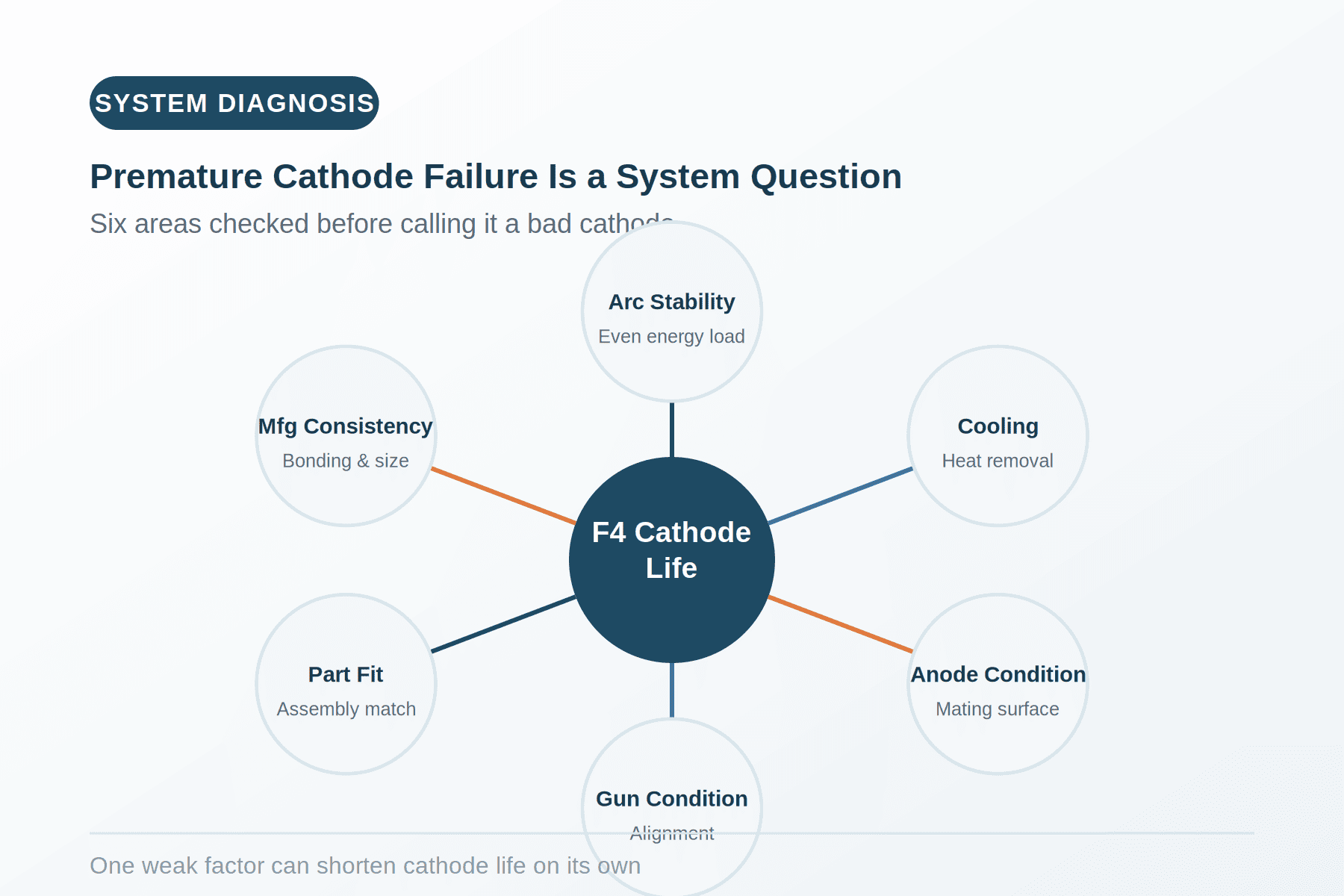
I have learned that the first question is often not the best question. Many buyers ask me, “How many hours should an F4 cathode last?” I understand that question. A workshop needs a clear replacement plan. A production manager needs a stable cost. A maintenance person needs fewer surprises during spraying. But I have also seen that one number can hide the real issue. Cathode life depends on arc stability, cooling, matching parts, gun condition, and the way the plasma system runs under load.1 If I look only at the cathode, I may miss the reason the cathode is being attacked so fast. The real clue is usually in the whole gun.
Rethinking “Cathode Life”: It’s Not Just About Hours?
When a cathode fails early, I know the workshop loses trust. The easy answer is to blame the cathode, but that answer can stop the real diagnosis.
I usually think of F4 cathode life as a result of stable operating conditions, not only a fixed hour value. I ask whether the gun allows the cathode tip to hold a stable arc, receive enough cooling, and work with healthy mating parts.

I Start With the Operating Window
I often tell customers that cathode life is not a single promise. It is a result. The cathode sits inside a plasma gun system. The system includes the cathode, anode or nozzle, gas flow, cooling water, power supply behavior, and gun body condition.2 Each part can push the arc into a better or worse state.
In many troubleshooting talks, I hear a question like, “Your cathode lasted fewer hours than expected. Why?” I do not reject the concern. I take it seriously. But I also ask what changed before the failure. I ask about arc sound, spray pattern, anode condition, cooling water flow, and any change in powder, gas, or parameters. These details often show a more useful picture.
| Question I Ask | Why I Ask It | What It May Suggest |
|---|---|---|
| Did the arc fluctuate? | I want to know if the arc was stable. | The cathode may be under unstable arc load. |
| Was the anode worn? | I want to check the mating part. | The arc path may be disturbed. |
| Was cooling steady? | I want to protect the tip zone. | Heat may be too high near the cathode. |
| Was the gun rebuilt recently? | I want to check assembly and fit. | Alignment or contact may have changed. |
I Avoid One-Number Thinking
I do not like to promise a fixed service life for F4 cathodes. I can inspect material, bonding, dimensions, and surface quality in manufacturing. I can reduce product-side risk. But I cannot see every on-site factor after the part leaves the factory.
A cathode may perform well in one gun and fail early in another gun. That does not always mean the second workshop made a mistake. It may mean the second system has a worn nozzle, weak cooling, unstable arc behavior, or a combination of small issues. I prefer to find the chain of causes. That approach helps the maintenance team make a better decision. It also helps me improve my own manufacturing control when the product side is truly involved.
Early Warning Signs: Arc Instability and Tip Erosion Patterns?
A cathode rarely fails without clues. I often see warning signs first, but busy production teams may ignore them until the gun stops.
In customer troubleshooting, I treat unstable arc behavior and abnormal cathode tip erosion as key warning signs.3 These signs do not prove material failure by themselves. They show that the plasma arc and the cathode surface are not working in a healthy way.
I Listen to the Arc Before I Judge the Part
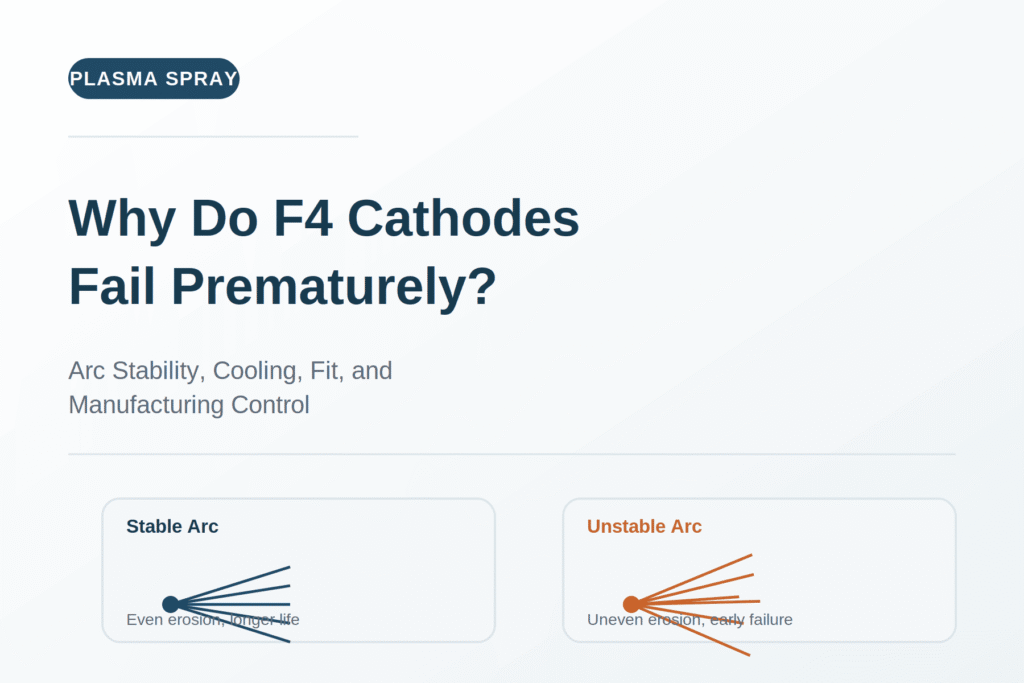
I always pay attention when a customer says the arc sound changed. A stable F4 gun usually gives the operator a known feeling. The sound, spray pattern, and current behavior have a normal rhythm. When the arc becomes noisy, jumpy, or unstable, the cathode tip may receive uneven energy.4 That uneven energy can create fast erosion, rough melting marks, or a damaged tip shape.
I do not treat arc fluctuation as automatic proof that the cathode is defective. I treat it as a signal. The arc may be affected by the cathode material. It may also be affected by anode wear, gas flow, cooling, gun alignment, or contamination.5 The important step is to connect the symptom with the system.
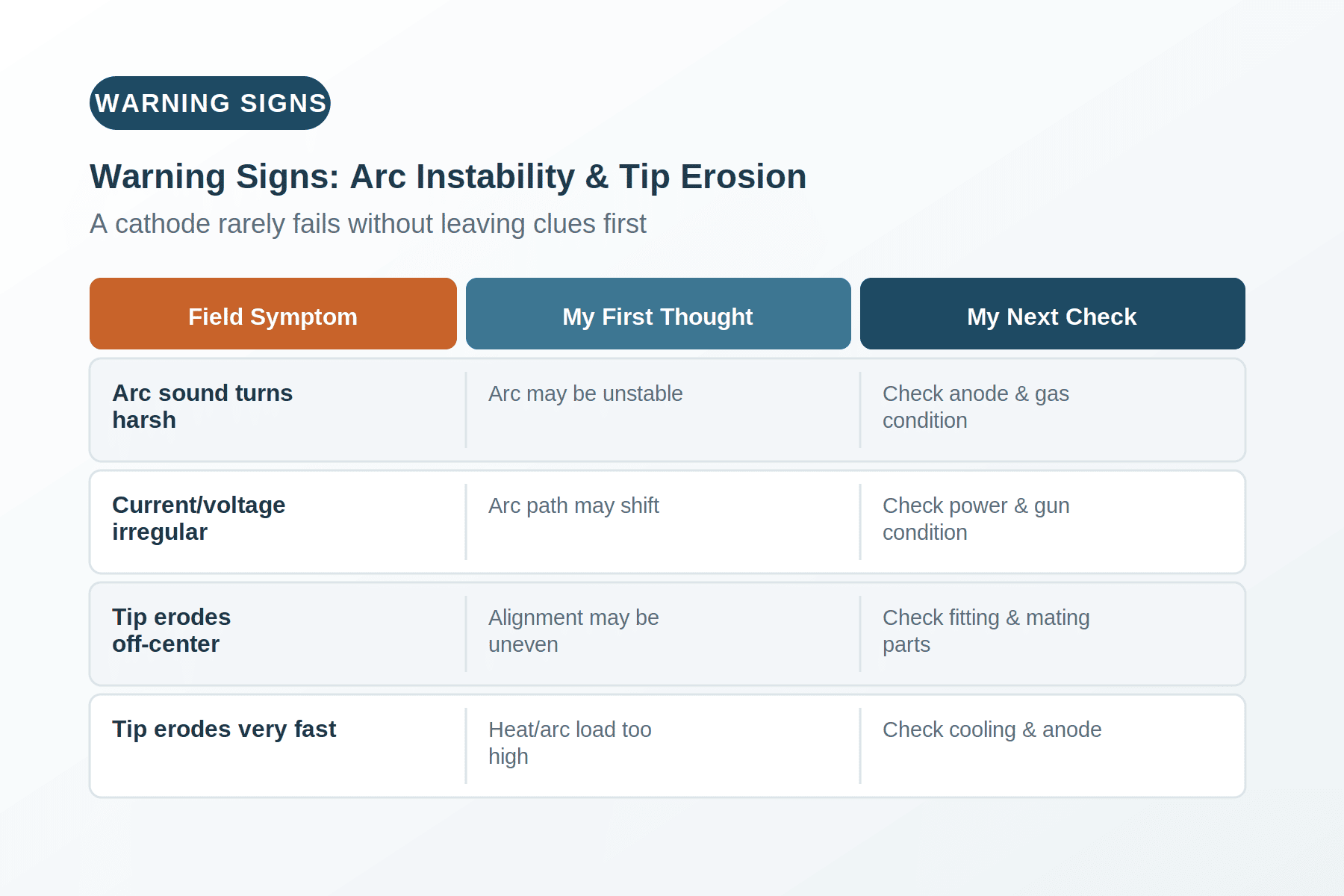
| Field Symptom I Hear About | My First Thought | My Next Check |
|---|---|---|
| Arc sound becomes harsh | The arc may be unstable. | I check anode wear and gas condition. |
| Current or voltage seems irregular | The arc path may shift. | I check power and gun condition. |
| Tip erodes off-center | Alignment or flow may be uneven. | I check fitting and mating parts. |
| Tip erodes very fast | Heat or arc load may be too high. | I check cooling and anode condition. |
I Read the Tip Like a Maintenance Record
The cathode tip can tell a story. A clean and expected erosion pattern often shows that the arc stayed in a more stable zone. A rough, off-center, deep, or unusually fast erosion pattern tells me that something changed around the arc.6 I do not need to make a laboratory claim to say this. I see this logic often in after-sales discussions.
When I look at tip erosion, I ask simple questions. I ask whether the erosion is centered. I ask whether the tip shape changed suddenly. I ask whether the wear looks smooth or broken. I ask whether the anode also shows abnormal marks. If the cathode and anode both show strange marks, I think about arc stability first. If only one part looks unusual, I still check the whole gun before I decide.
I Treat Warning Signs as a Chance
I believe early warning signs are useful because they give the workshop time. If a team replaces only the cathode and keeps running the same unstable condition, the next cathode may fail in the same way. If the team checks the arc, cooling, and matching parts early, the cause may be found before another failure.
This is why I prefer a practical diagnosis. I do not ask the maintenance team to stop production for every small mark. I ask them to watch the pattern. A repeated pattern is important. A sudden change is important. A combination of unstable arc sound and abnormal tip erosion is very important.
Hidden System Factors That Often Get Overlooked in Maintenance Checks?
A cathode can look like the failed part because it is the part that burns away. But I often find the cause around it.
In my troubleshooting conversations, I often check worn or contaminated anodes, nozzles, gun parts, cooling water flow, water quality, and blocked cooling paths. These factors can push a good cathode into fast erosion.7
I Check the Parts That Touch the Arc Environment
The F4 cathode does not work alone. The anode or nozzle shapes the arc environment.8 The gun body holds the alignment. Seals, threads, contact surfaces, and cooling channels all matter. If these parts are worn, dirty, loose, or out of shape, the cathode may receive stress that it was not designed to handle.
I often see maintenance teams focus on the newest part installed. If the cathode was changed last, the cathode gets blamed first. I understand why this happens. The timing looks clear. But old mating parts can damage a new cathode quickly. A worn anode can disturb the arc.9 A contaminated surface can affect contact. A damaged gun component can change alignment.
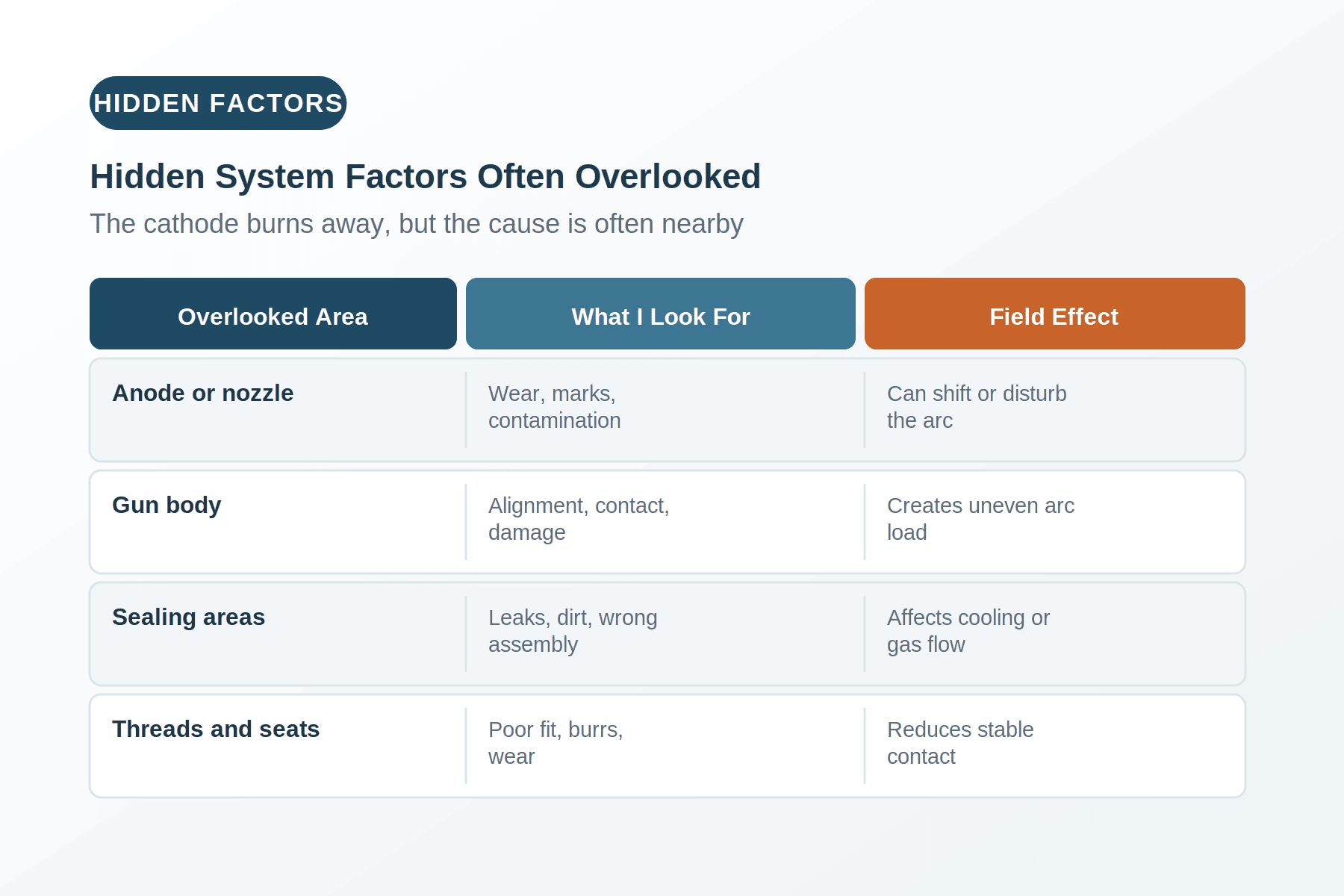
| Overlooked Area | What I Look For | How It Can Affect Cathode Life |
|---|---|---|
| Anode or nozzle | Wear, marks, contamination | It can shift or disturb the arc. |
| Gun body | Alignment, contact, damage | It can create uneven arc load. |
| Sealing areas | Leaks, dirt, wrong assembly | It can affect cooling or gas behavior. |
| Threads and seats | Poor fit, burrs, wear | It can reduce stable contact. |
I Take Cooling Very Seriously
Cooling is one of the first areas I ask about. A cathode tip works in a high energy zone. If cooling is weak, uneven, or blocked, the cathode may overheat.10 The failure may then look like poor material performance. But the true trigger may be water flow, water temperature, water quality, or deposits inside the path.
I do not like to assume that cooling is fine just because water is present. I want to know if the flow is stable. I want to know if the cooling circuit is clean. I want to know if water quality has changed. I want to know if there is scale, blockage, or partial restriction. A small cooling problem can become a large cathode problem.
I Ask About Maintenance History Without Blame
I never want to blame a customer by saying the failure is simply “improper use.” That kind of answer does not help. I prefer to ask about maintenance history in a practical way. I ask when the anode was changed. I ask whether the gun was cleaned. I ask whether the cooling channels were checked. I ask whether the same failure happened before.
This approach keeps the discussion useful. A workshop may have strong operators and still face hidden system problems. A maintenance checklist may look complete and still miss an internal cooling restriction. A gun may run, but it may not run in a stable state. I see premature cathode failure as a sign that the whole system deserves attention.
How Manufacturing Quality Influences Stability—but Is Rarely the Only Cause?
Manufacturing quality matters, and I care about it deeply. But I do not believe every early failure can be explained by the cathode alone.
I see cathode manufacturing quality as one important part of risk control. Tungsten-copper bonding, material stability, critical dimensions, geometric tolerance, and surface quality can affect fit, arc stability, and service life, but system conditions still matter.11
I Control What I Can Control in Production
As a thermal spray consumables manufacturer, I focus on the product factors that can affect stability. For F4 cathodes and related consumables, I care about material selection, tungsten-copper bonding consistency, machining accuracy, surface finish, and repeatable geometry. These are not small details. They influence how the cathode fits, how heat moves, and how the arc behaves near the working area.
In my factory work, I also care about the matching parts around the cathode. I know that tight and stable dimensions help the gun assemble correctly. I know that poor surface quality can create risk. I know that inconsistent bonding can affect heat transfer and mechanical strength. I know that critical dimensions must stay controlled because a small error can become a large problem inside a plasma gun.
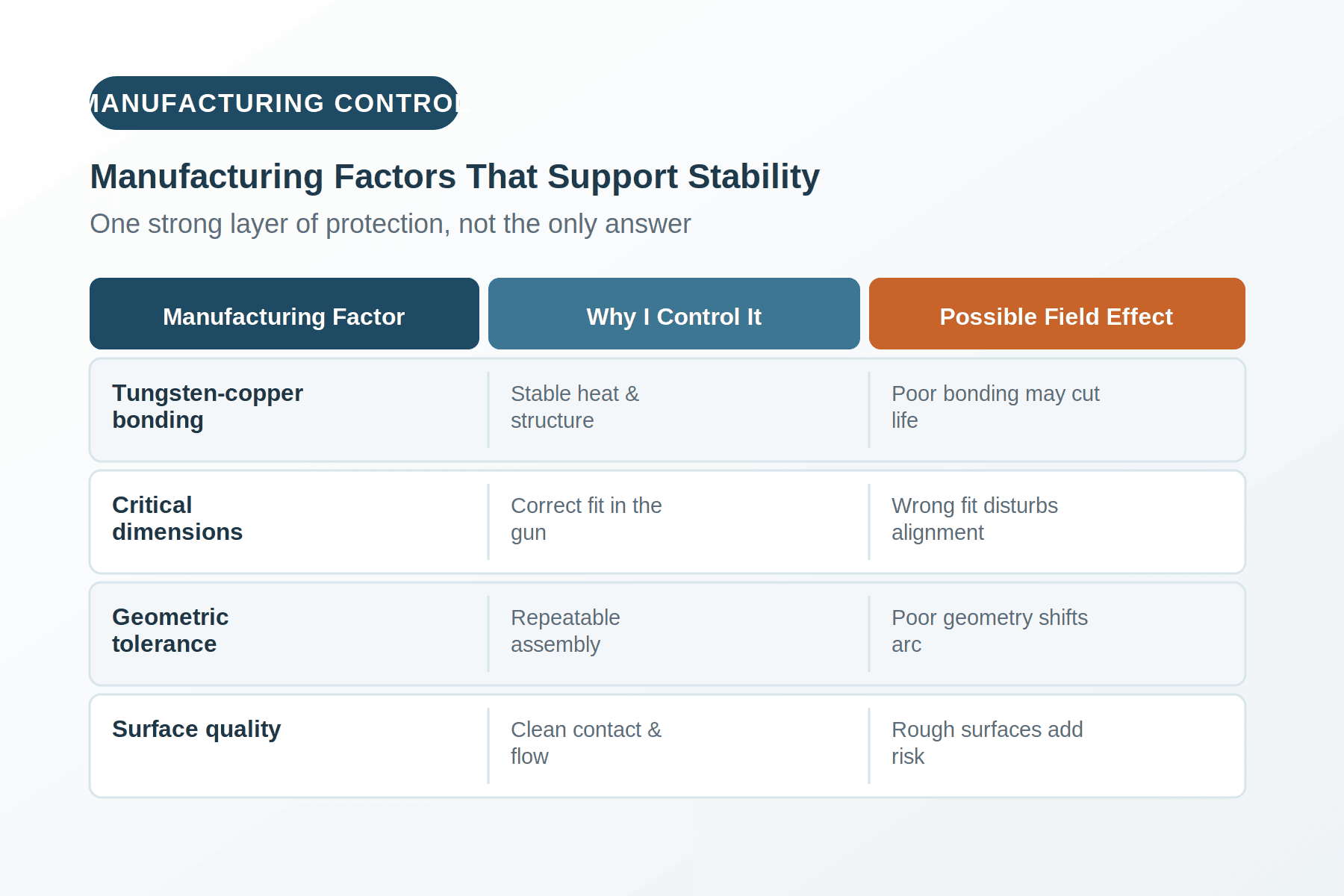
| Manufacturing Factor | Why I Control It | Possible Field Effect |
|---|---|---|
| Tungsten-copper bonding | I want stable heat and structure behavior. | Poor bonding may reduce life or stability. |
| Critical dimensions | I want correct fit in the gun. | Wrong fit may disturb alignment. |
| Geometric tolerance | I want repeatable assembly. | Poor geometry may affect arc position. |
| Surface quality | I want clean contact and flow areas. | Rough or damaged surfaces may create risk. |
I Use Inspection to Reduce Product-Side Risk
I believe factory inspection has real value. Inspection can catch wrong dimensions, poor finish, visible defects, and process drift. In our production logic, precision machining and strict checks are not decoration. They are part of cathode reliability. When I speak with customers, I can explain how part fit and manufacturing control relate to arc stability.
But inspection is not magic. A good inspection report cannot clean a blocked cooling path. A well-machined cathode cannot repair a worn anode. A stable tungsten-copper connection cannot fix a power or gas problem. This is why I do not sell manufacturing quality as the only answer. I see it as one strong layer of protection.
I Separate Product Risk From System Risk
When a customer reports premature failure, I try to separate two groups of risk. The first group is product-side risk. This includes material, bonding, size, shape, and surface condition. The second group is system-side risk. This includes arc behavior, cooling, anode condition, gun condition, assembly, and process settings.
This separation helps the discussion stay fair. If the product has a defect, I want to know. I want to correct it. I want to prevent it. But if the system is unstable, replacing the cathode with another cathode may not solve the problem. The maintenance team needs a diagnosis path.
I Suggest a Practical Check Sequence
I often suggest a simple order for troubleshooting. I start with the visible symptoms. I then check the mating parts. I then check cooling. I then check assembly and gun condition. I then review the cathode quality factors. This order does not prove one cause in every case. It helps the team avoid guessing.
| Step | What I Would Check | What I Want to Learn |
|---|---|---|
| 1 | Arc behavior during spraying | I want to know if the arc is stable. |
| 2 | Cathode tip and anode wear pattern | I want to see if erosion matches system stress. |
| 3 | Cooling flow and water condition | I want to know if heat removal is healthy. |
| 4 | Gun parts and assembly | I want to know if alignment and fit are stable. |
| 5 | Cathode dimensions and surface | I want to reduce product-side doubt. |
I believe this approach respects the maintenance team’s real problem. The team does not need a slogan. The team needs a way to decide whether the failure came from the cathode, the anode, the cooling path, the gun, the process, or several factors together.
Conclusion
I see premature F4 cathode failure as a system diagnosis. I check stability, cooling, mating parts, gun condition, and manufacturing quality together.
"[PDF] A Perspective on Plasma Spray Technology - Columbia University", http://www.columbia.edu/cu/seas/earth/wtert/newwtert/Research/sofos/Plasma_%20spraying_Nov2014.pdf. A review of plasma spray torch operation describes electrode wear as a system-dependent outcome influenced by arc attachment, thermal loading, cooling, gas flow, and the condition of adjacent torch components. Evidence role: general_support; source type: paper. Supports: A technical review or paper should support that plasma torch electrode life depends on arc behavior, cooling, component condition, and operating parameters rather than on the cathode material alone.. Scope note: The source may discuss plasma spray torches generally rather than the F4 cathode model specifically. ↩
"Thermal spraying", https://en.wikipedia.org/wiki/Thermal_spraying. General descriptions of plasma spraying identify the torch as an integrated device using electrodes, a plasma-forming gas, a power supply, and cooling arrangements to generate and sustain the plasma jet. Evidence role: definition; source type: encyclopedia. Supports: A neutral overview should identify the main components and operating inputs of a plasma spray torch or gun.. Scope note: An overview source may not address F4-specific gun construction or maintenance details. ↩
"Section 10.0: Electrode Erosion - VTechWorks", https://vtechworks.lib.vt.edu/bitstream/handle/10919/36917/Sec10.pdf. Research on thermal plasma torches links arc attachment dynamics and fluctuations with localized electrode heating and erosion, making abnormal erosion patterns a relevant diagnostic indicator. Evidence role: mechanism; source type: paper. Supports: A source should explain the relationship between arc instability, arc attachment behavior, and electrode erosion patterns in plasma torches.. Scope note: The source may support the mechanism generally rather than providing a field-maintenance checklist. ↩
"Predicted Anode Arc Attachment by LTE (Local Thermodynamic ...", https://pmc.ncbi.nlm.nih.gov/articles/PMC8428209/. Studies of thermal plasma arcs show that arc-root motion and fluctuations can alter local heat flux on electrodes, providing a mechanism for uneven cathode thermal loading. Evidence role: mechanism; source type: paper. Supports: A technical paper should support that arc root movement or instability changes heat flux distribution on torch electrodes.. Scope note: The source may not use operator terms such as 'noisy' or 'jumpy' even if it addresses the underlying arc instability. ↩
"Condition Monitoring of a Three-Cathode Cascaded Plasma Spray ...", https://pmc.ncbi.nlm.nih.gov/articles/PMC9501464/. Technical literature on plasma spray torches reports that arc stability is affected by electrode condition, plasma gas flow, cooling, and torch geometry, which contextualizes maintenance-related arc fluctuations. Evidence role: general_support; source type: research. Supports: A research or institutional source should support that plasma arc stability is sensitive to electrode condition, gas flow, cooling, and torch geometry.. Scope note: The source may not separately evaluate every listed factor in the same experiment. ↩
"Predicted Anode Arc Attachment by LTE (Local ... - PMC", https://pmc.ncbi.nlm.nih.gov/articles/PMC8428209/. Experimental and modeling studies of plasma torch electrodes associate erosion morphology with arc attachment location, local heat flux, and operating conditions, supporting the use of erosion patterns as contextual diagnostic evidence. Evidence role: mechanism; source type: paper. Supports: A paper should support that electrode erosion morphology reflects arc attachment behavior and local thermal or flow conditions.. Scope note: The source may not provide a one-to-one interpretation for each visual erosion pattern described in the article. ↩
"[PDF] Solving an Anode Burning Problem in Sandia's Low Pressure ... - OSTI", https://www.osti.gov/servlets/purl/1146616. The plasma torch literature describes electrode erosion as influenced by adjacent electrode condition, contamination, and cooling efficiency, supporting the claim that system defects can shorten cathode life. Evidence role: general_support; source type: paper. Supports: A technical source should support that torch component wear, contamination, and cooling deficiencies can increase electrode erosion.. Scope note: The source may discuss torch electrodes broadly rather than diagnosing a specific failed F4 cathode. ↩
"Predicted Anode Arc Attachment by LTE (Local Thermodynamic ...", https://pmc.ncbi.nlm.nih.gov/articles/PMC8428209/. Educational treatments of plasma spray torch design describe the anode/nozzle as a component that constrains the arc and contributes to the formation and direction of the plasma jet. Evidence role: mechanism; source type: education. Supports: An educational or technical source should explain that the nozzle or anode helps confine, shape, or influence the arc and plasma jet.. Scope note: The source may describe standard torch design rather than the specific geometry of an F4 gun. ↩
"Arc instabilities in a plasma spray torch - ADS", https://ui.adsabs.harvard.edu/abs/2002JTST...11...44D/abstract. Studies of plasma torch electrode erosion indicate that anode wear can alter arc attachment and plasma jet behavior, providing a mechanism by which a worn anode may disturb the arc. Evidence role: mechanism; source type: paper. Supports: A paper should support that anode erosion or wear changes arc attachment or plasma torch stability.. Scope note: The source may focus on anode erosion mechanisms rather than maintenance outcomes in production workshops. ↩
"Condition Monitoring of a Three-Cathode Cascaded Plasma ...", https://pmc.ncbi.nlm.nih.gov/articles/PMC9501464/. Research on thermal plasma torch heat transfer shows that electrodes are exposed to high localized heat loads and require effective cooling to limit overheating and erosion. Evidence role: mechanism; source type: paper. Supports: A source should support that plasma torch electrodes require effective cooling to manage heat load and prevent overheating or accelerated erosion.. Scope note: The source may discuss modeled or laboratory heat loads rather than a specific field blockage event. ↩
"A Perspective on Plasma Spray Technology", http://www.columbia.edu/cu/seas/earth/wtert/newwtert/Research/sofos/Plasma_%20spraying_Nov2014.pdf. Materials literature on tungsten-copper composites and plasma torch electrodes indicates that thermal conductivity, bonding integrity, geometry, and surface condition affect heat transfer and electrode performance. Evidence role: general_support; source type: paper. Supports: A materials or plasma torch paper should support that tungsten-copper properties, bonding quality, geometry, and surface condition influence electrode heat transfer, fit, and performance.. Scope note: The source may support the material and design principles without directly testing the exact F4 cathode design. ↩