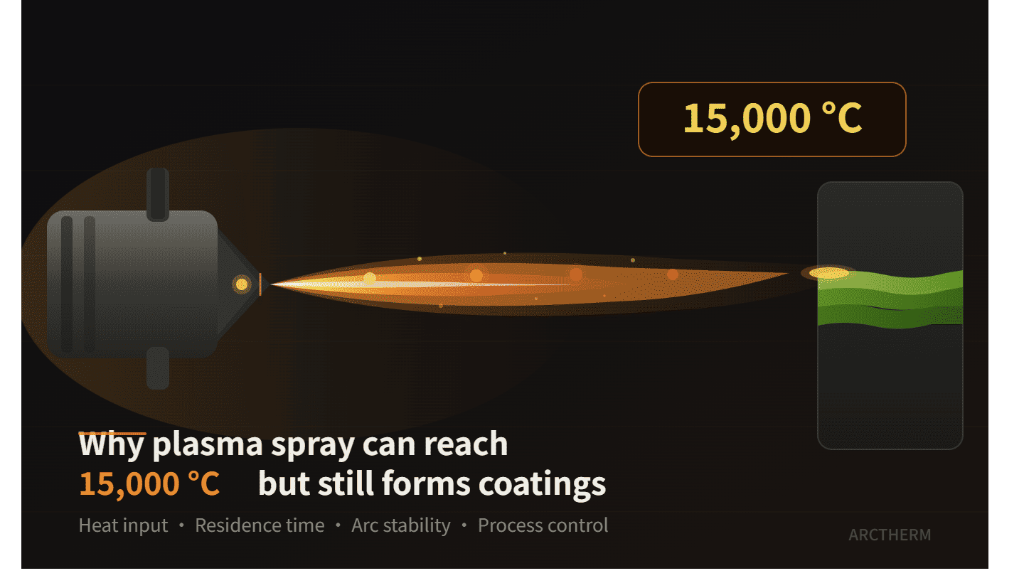
A 15,000°C1 number can sound frightening. I know it makes buyers fear warped parts, burnt substrates, and unstable coating results before the first spray trial begins.
Plasma spray can form coatings because only a controlled part of the plasma energy reaches the powder and substrate. The particles heat for a very short time2, fly at high speed3, flatten on impact, and solidify4, while the substrate heat input is managed by distance, movement, cooling, and process control5.
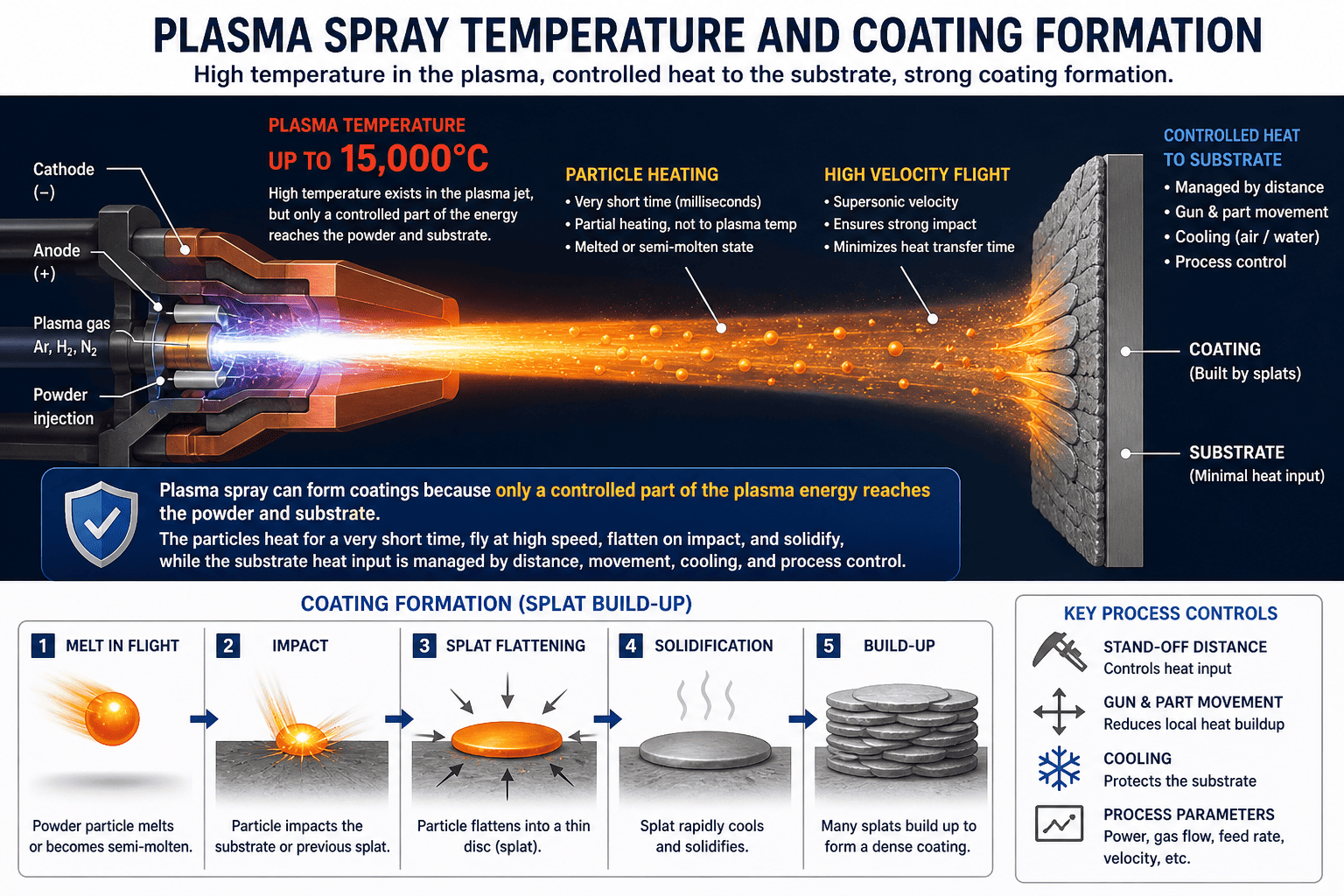
When I first explain plasma spray to a new customer, I do not start with the biggest temperature number. I start with heat transfer. The plasma jet can be extremely hot, but the part does not sit inside that full temperature like metal in a furnace. The powder sees heat for a short moment. The substrate receives heat through many fast impacts. The spray gun moves. The stand-off distance is controlled. The surface gains coating and loses heat at the same time. This is why the real question is not, “Why does 15,000°C not destroy everything?” The better question is, “How much energy is transferred, for how long, and how stable is that transfer?” If I can keep that question in mind, the whole process becomes much easier to judge.
Why Is Temperature Not the Whole Story?
A peak plasma temperature can impress people. I have also seen it mislead people6. A high number can hide poor particle state, unstable arc behavior, and weak repeatability.
Plasma spray quality depends on heat input, particle residence time, particle velocity, stand-off distance, gun movement, and arc stability7. Peak temperature matters, but it does not tell the full story. A useful plume must heat particles enough, repeat that condition, and keep the substrate heat within a controlled process window.
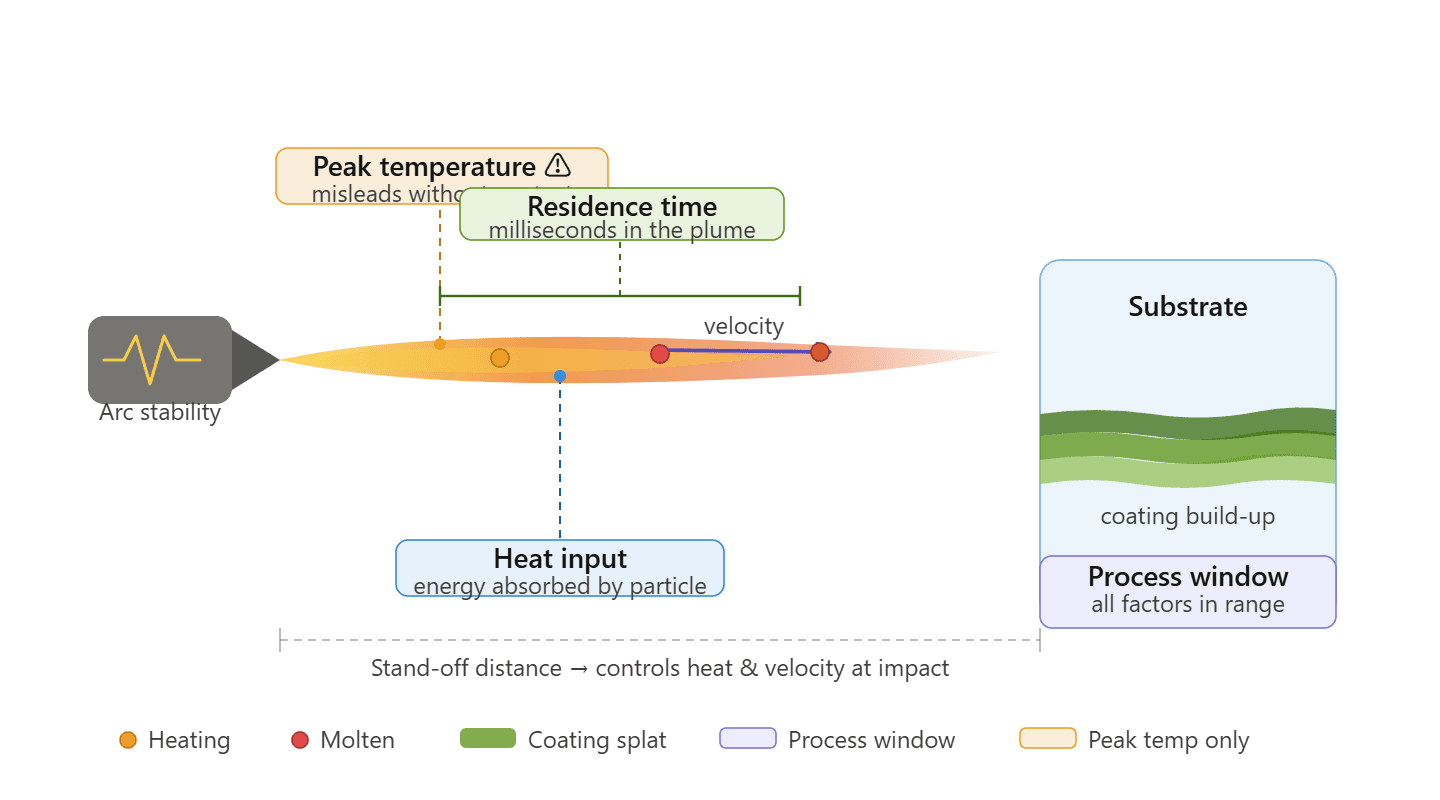
From my spray gun and consumables manufacturing perspective, I treat plasma temperature as only one part of a wider energy system. I care about the way the arc starts, where it attaches, how it moves, and how stable the arc length looks during functional checks. I also care about the cathode, anode, nozzle bore, and the shape of the internal passage. These parts do not decide the coating result alone, but they affect the heat source that the process depends on.
I often use a simple comparison when I talk with procurement teams. A candle flame can burn skin, but a hand can pass through it quickly with limited damage. A lower-temperature oven can cook a part deeply if the part stays inside long enough. This is not a perfect technical comparison, but it helps explain the difference between temperature and total heat input.
| Question I Ask | Why It Matters | What I Watch in the Gun or Process |
|---|---|---|
| How hot is the plasma zone? | It affects powder heating potential. | I do not use peak temperature as the only quality sign. |
| How long does the powder stay in the jet? | It affects melting or softening. | I look at stable injection and repeatable plume behavior. |
| How much heat reaches the substrate? | It affects oxidation, stress, and distortion risk. | I look at stand-off, traverse speed, cooling, and pass strategy. |
| How stable is the arc? | It affects repeatability from second to second. | I watch cathode and anode condition, arc length, and nozzle consistency. |
A coating forms when particles reach the right state at impact. Some particles may be fully molten. Some materials may need partial melting or softening. The exact state depends on powder type and process target. I do not need to claim that every particle has one perfect condition. I only need to understand that the coating comes from controlled particle heating, impact, flattening, and rapid solidification.
This is also why “higher temperature” is not automatically “better coating.” A very hot but unstable plume can create a wider spread of particle states. Some particles may overheat. Some may stay underheated. Some may oxidize more than expected. Some may miss the best path in the jet. In real work, repeatability is often more valuable than a big peak number. I would rather see a stable plume that gives the same particle state again and again than a dramatic plume that changes during production.
How Are Particles Heated Without Overheating the Substrate?
Many customers worry that plasma spray will melt the workpiece. I understand that concern. The plasma is hot, but the process controls the heat path.
Particles are heated in the plasma jet for a very short time, then they strike the substrate and form splats. The substrate is not treated as a fully melted pool. It is treated as a heat-receiving surface, and operators control heat input through distance, scanning, cooling, and pass design.
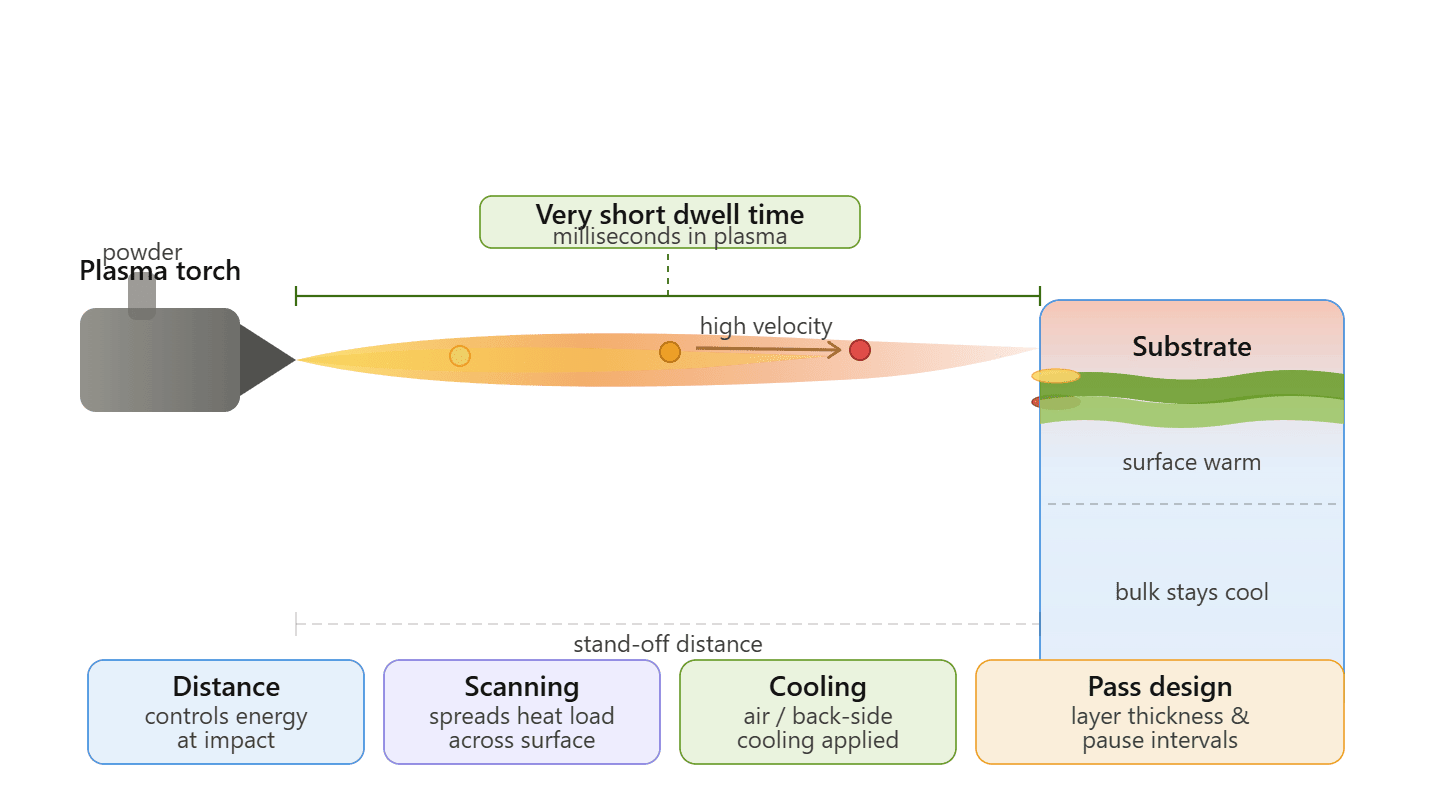
I see plasma spray as a balance between particle heating and substrate protection. The powder is injected into a fast, hot stream. The particles gain heat and speed. They move toward the part. When they hit the prepared surface, they flatten into thin lamellae, which many people call splats. These splats cool quickly. Layer after layer builds the coating. The substrate receives heat, but it does not need to become molten like a weld pool.
In our field, I must be careful with words. I should not say plasma spray does not heat the substrate. It does heat the substrate. I should say the heat input is controlled. The amount of heat depends on the torch power, gas flow, spray distance, gun speed, powder feed, cooling air, part rotation, and the total number of passes. A process engineer decides these details based on the part, material, and target coating.
| Control Point | What It Does | Risk If It Is Poorly Controlled |
|---|---|---|
| Stand-off distance | It changes particle temperature and velocity at impact. | Particles may be too cold, too hot, or poorly focused. |
| Traverse speed | It controls how long heat stays on one surface area. | The substrate may overheat or the coating may build unevenly. |
| Cooling method | It removes heat from the part during spraying. | The part may distort or the coating stress may rise. |
| Powder feed rate | It affects how much material enters the plume. | Particles may not heat evenly if feed is unstable. |
| Pass strategy | It spreads heat over time and area. | Local hot spots may form if passes are not planned well. |
I once watched a customer focus only on the temperature of the plasma arc. I asked him to also watch the part temperature trend during spraying. The discussion changed at once. The arc was the heat source, but the workpiece response came from total heat input over time. This is the practical view that I use in manufacturing and support talks.
The particle path is short, and the particle size is small. This is important. Small particles can heat very fast. They can also cool very fast after impact8. The substrate is larger, so it responds more slowly. This difference helps the process work. The powder can reach a useful spray state before the whole workpiece becomes too hot.
Surface preparation also matters. A roughened and clean surface helps the first splats attach. The coating does not need the substrate to melt fully. It needs enough bonding at the surface, enough mechanical interlock in many cases, and enough particle condition to build a dense and useful layer. The final coating result still depends on the full process and material system. I do not treat the gun alone as a magic answer. I treat the gun and consumables as the starting point for a stable heat and particle source.
Why Is Stability of the Plasma Jet the Real Key to Coating Quality?
A plasma jet can look bright and strong, but I still ask a harder question. I ask whether it stays repeatable during real spraying.
Plasma jet stability matters because coating formation depends on repeated particle heating and acceleration.9 Stable cathodes, anodes, nozzle geometry, arc length behavior, and electrode structure help the system give a more repeatable heat source. This does not guarantee final coating properties, but it reduces one major process risk.
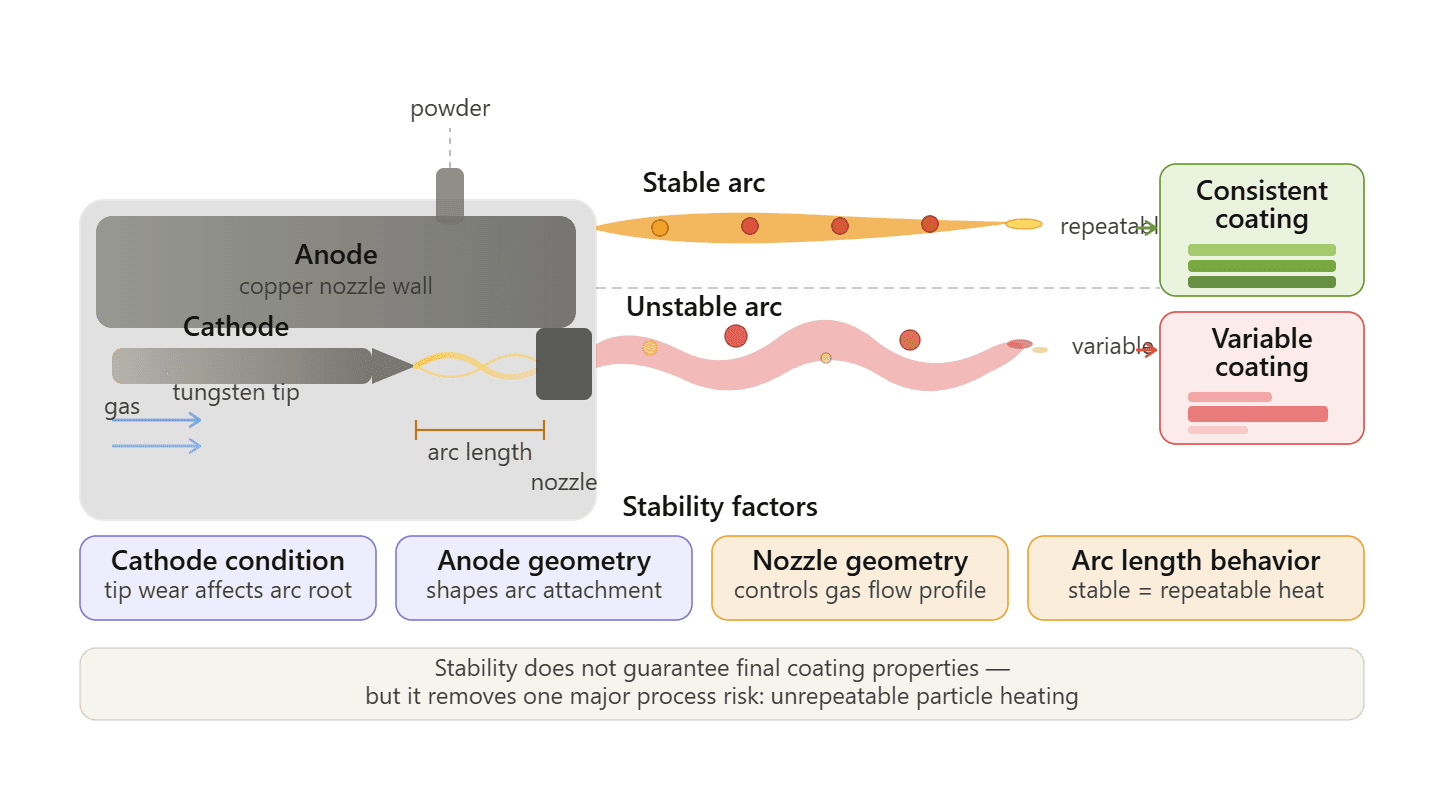
From a gun and consumables manufacturing perspective, I spend a lot of time thinking about parts that many people only see as replacement items. A cathode is not just a piece of tungsten-based material. An anode or nozzle is not just a copper part with a hole. Their geometry, material connection, surface finish, and dimensional repeatability can affect arc behavior. If the arc attachment changes in an unstable way10, the particle heating condition can also change.
In our production work, we focus on dimensional consistency, critical bore quality, and stable electrode structure. For cathode and anode parts, the tungsten-copper connection11 is important. A weak or inconsistent connection can affect heat flow and service life. In high-power spraying, this interface becomes even more important. I do not claim that one part alone controls the coating. I do say that an unstable consumable can make a good process harder to repeat.
| Gun or Consumable Factor | What I Care About | Possible Effect on Spraying |
|---|---|---|
| Cathode tip shape | I want repeatable arc initiation and wear behavior. | Arc position may shift if wear becomes uneven. |
| Anode or nozzle bore | I want stable geometry and smooth internal condition. | Jet shape may change if the bore wears or varies. |
| Arc length behavior | I want the arc to stay within a stable working pattern. | Particle heating may vary if the arc becomes unstable. |
| Tungsten-copper connection | I want reliable heat and electrical structure. | Service life and stability may suffer if the interface is weak. |
| Machining accuracy | I want repeatable parts from batch to batch. | Process settings may need more adjustment if parts vary. |
I have seen how small dimensional changes can create large questions in the field. A customer may say the coating looks different. A technician may first check powder, gas, current, and distance. These checks are correct. I would also ask about the nozzle condition, cathode wear, and replacement part source. If consumables are not consistent, the operator may chase settings that were not the real root cause.
This is why I connect precision machining with spray stability. In our own manufacturing view, CNC accuracy is not just a drawing requirement. It is a way to protect the repeatability of the arc environment12. When we control key sizes, internal bore condition, and electrode structure, we help the gun stay closer to its intended behavior. The process owner still needs to qualify the coating. The operator still needs to set and monitor the parameters. The consumable maker still has a clear duty. We must give parts that do not add avoidable variation.
I also pay attention to functional checks. When a gun or consumable set is checked for flame or plasma arc behavior, I am not trying to replace a coating lab. I am checking whether the heat source behaves in a stable and expected way. Arc length, starting behavior, and visible stability can tell us whether the basic hardware is ready for process use. These checks are practical. They do not prove coating bond strength or porosity. They help reduce the chance that the spray system starts with an unstable source.
For OEMs, spray service providers, and maintenance teams, this point matters during purchasing. A lower-cost consumable can become expensive if it changes the spray window. A replacement part should not only fit the gun body. It should also support stable arc behavior, stable gas flow, and stable wear life. I always suggest that buyers look beyond the part name. They should ask about machining control, material structure, inspection, and repeatability from batch to batch.
Conclusion
I see plasma spray as controlled energy transfer, not just extreme temperature. Stable particles, controlled substrate heat, and repeatable gun behavior make coatings possible.
"Effect of Varying Plasma Powers on High-Temperature Applications ...", https://pmc.ncbi.nlm.nih.gov/articles/PMC9611188/. Research measurements confirm plasma arc temperatures in thermal spray applications can reach temperatures in the range of 10,000-15,000°C under typical operating conditions. Evidence role: statistic; source type: paper. Supports: Plasma spray temperatures can reach 15,000°C. Scope note: Temperature varies significantly based on gas composition, power settings, and measurement location within the plasma jet ↩
"Warm spraying—a novel coating process based on high-velocity ...", https://pmc.ncbi.nlm.nih.gov/articles/PMC5099653/. Studies show particle residence times in plasma jets typically range from 0.1 to 2 milliseconds, allowing rapid heating without prolonged thermal exposure. Evidence role: mechanism; source type: paper. Supports: Particles are heated for only a very short time in the plasma jet. Scope note: Residence time varies with particle size, injection parameters, and plasma jet characteristics ↩
"Warm spraying—a novel coating process based on high-velocity ...", https://pmc.ncbi.nlm.nih.gov/articles/PMC5099653/. Experimental measurements show plasma-sprayed particles typically reach velocities between 100-400 m/s depending on particle size and plasma conditions. Evidence role: statistic; source type: paper. Supports: Particles achieve high velocities in plasma spray. Scope note: Velocity depends on particle material, size distribution, and specific plasma spray parameters ↩
"Manufacturing parameter analysis for alumina coating on steel ...", https://pmc.ncbi.nlm.nih.gov/articles/PMC7595332/. High-speed imaging and modeling studies demonstrate that molten particles flatten into disk-shaped splats within microseconds of substrate impact, with cooling rates exceeding 10^6 K/s. Evidence role: mechanism; source type: paper. Supports: Particles flatten into splats upon impact and rapidly solidify. Scope note: Splat formation quality depends on substrate temperature, surface roughness, and particle impact conditions ↩
"Research on thermo-mechanical coupling behavior of plasma ...", https://pmc.ncbi.nlm.nih.gov/articles/PMC12795364/. Research demonstrates that substrate temperature can be maintained within acceptable limits through optimization of spray distance, traverse speed, cooling systems, and multi-pass strategies. Evidence role: mechanism; source type: paper. Supports: Substrate heating can be controlled through various process parameters. Scope note: Effectiveness varies with substrate material, coating thickness requirements, and specific thermal spray system configuration ↩
"A Practical Guide to Optimizing Industrial Thermal Spraying through ...", https://arxiv.org/html/2504.18357v2. Studies indicate that coating quality depends on multiple interdependent factors including particle velocity, residence time, and arc stability, rather than peak temperature alone. Evidence role: expert_consensus; source type: paper. Supports: Peak temperature alone can be misleading for plasma spray quality assessment. Scope note: Quality assessment requires comprehensive process monitoring and may vary by application requirements ↩
"A practical guide to optimizing industrial thermal spraying through ...", https://pmc.ncbi.nlm.nih.gov/articles/PMC12328552/. Process optimization studies confirm that coating properties result from complex interactions between thermal, kinetic, and operational parameters rather than single-variable control. Evidence role: general_support; source type: paper. Supports: Multiple process parameters collectively determine plasma spray coating quality. Scope note: Relative importance of parameters varies with specific material systems and application requirements ↩
"[PDF] measurementof particlesize, velocity and temperature - OSTI", https://www.osti.gov/servlets/purl/6073601. Heat transfer modeling shows that smaller particles exhibit higher surface-to-volume ratios, resulting in heating rates proportional to 1/diameter² and similarly rapid cooling upon impact. Evidence role: mechanism; source type: paper. Supports: Small particles have rapid heating and cooling rates due to their size. Scope note: Actual rates depend on particle material properties, plasma conditions, and substrate thermal characteristics ↩
"Capturing the Influence of Jet Fluctuations on Particles in Plasma ...", https://pmc.ncbi.nlm.nih.gov/articles/PMC8765765/. Research demonstrates that plasma jet stability directly affects coating uniformity by ensuring consistent particle heating and acceleration conditions, which are fundamental to achieving repeatable splat formation and coating microstructure. Evidence role: mechanism; source type: research. Supports: Plasma jet stability is crucial for coating quality because coating formation depends on repeated particle heating and acceleration. Scope note: Studies may focus on specific plasma spray systems or materials ↩
"An Overview of Thermal Plasma Arc Systems for Treatment of ... - PMC", https://pmc.ncbi.nlm.nih.gov/articles/PMC8781779/. Plasma diagnostics studies demonstrate that arc instabilities cause temporal and spatial variations in plasma temperature and velocity fields, directly affecting particle treatment uniformity. Evidence role: mechanism; source type: paper. Supports: Unstable arc attachment affects particle heating consistency. Scope note: Impact on coating quality depends on the degree of instability and sensitivity of the specific coating process ↩
"Ethanol-Derived Graphene By Microwave Plasma Torch - NASA ADS", https://ui.adsabs.harvard.edu/abs/2025ECSMA2025.3174M/abstract. Materials research shows that tungsten-copper composite electrodes provide optimal combination of high-temperature stability and thermal conductivity for plasma torch applications. Evidence role: mechanism; source type: paper. Supports: Tungsten-copper interfaces are critical for electrode performance in plasma spray guns. Scope note: Performance depends on specific composition ratios and manufacturing methods of the tungsten-copper interface ↩
"[PDF] Section 6.0: Plasma Arc Stability - VTechWorks", https://vtechworks.lib.vt.edu/server/api/core/bitstreams/3bf440a4-cfd2-4fea-a33f-9df09aff98fa/content. Studies on plasma torch design show that dimensional variations in electrode geometry and nozzle bore directly influence arc attachment patterns and plasma jet characteristics. Evidence role: mechanism; source type: paper. Supports: Precision machining of plasma spray components ensures consistent arc behavior. Scope note: Tolerance requirements vary with specific torch design and operating conditions ↩